
Plato’s Academy is the green archaeological park where the philosopher Plato founded his famous school around 387 BC, regarded as the first university of the Western world. Explore this profound, peaceful site alongside skip-the-line Acropolis tickets and tours from My Greece Tours, the cradle of Western learning.
This birthplace of the university is a thoughtful stop in the Athens travel guide. The sections below cover what Plato’s Academy is, Plato and his school, its long history, what survives to see, the digital museum, and how to visit the park.
What is Plato’s Academy?
Plato’s Academy is the archaeological site and park where the great philosopher Plato founded his famous school of philosophy around 387 BC, in a sacred grove northwest of ancient Athens. Regarded as the first university of the Western world, it was where the foundations of Western philosophy and science were laid. Today the open green park, in the Akadimia Platonos neighbourhood, preserves ancient ruins amid olive trees, a serene and historic place for reflection.
Among the most significant yet least visited of all Athens’ ancient sites is Plato’s Academy, the very ground where the philosopher Plato established his celebrated school around 387 BC and, in doing so, helped create the model of higher learning that the Western world still follows. The Academy is widely regarded as the first university of the Western world, the place where, two and a half thousand years ago, the foundations of Western philosophy, science, mathematics and systematic education were laid, and where Plato taught a generation of thinkers, including the young Aristotle. The school was located in a sacred grove of olive trees just to the northwest of the walls of ancient Athens, an area that to this day bears the name Akadimia Platonos, the Academy of Plato, now a working-class residential neighbourhood of the modern city.
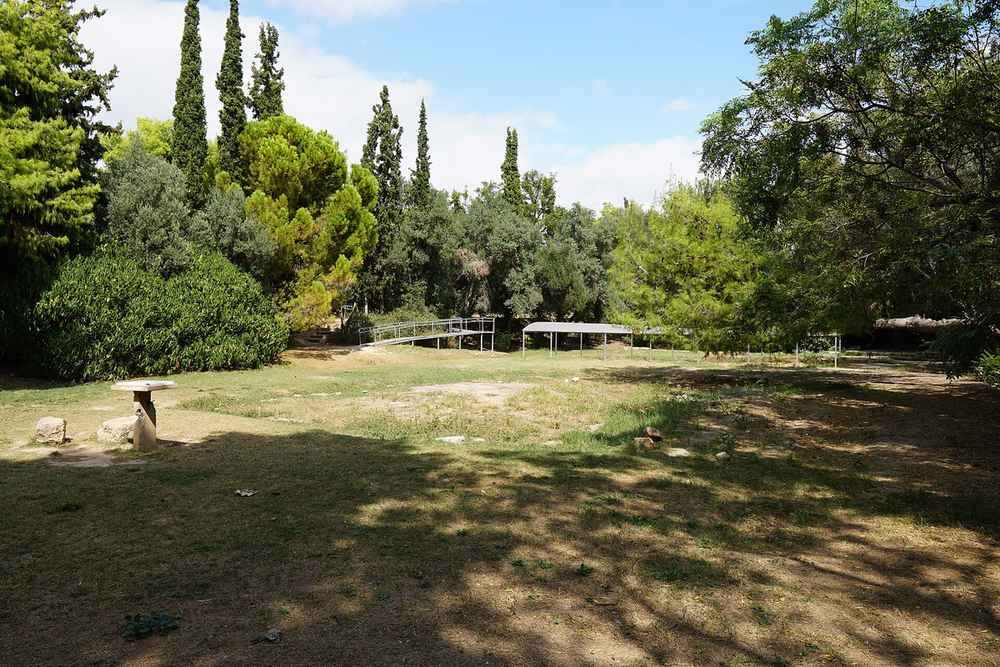
Today the site survives as an open, green archaeological park, freely accessible, where ancient ruins lie scattered among olive trees, grass and modern recreation areas, creating a tranquil and contemplative atmosphere far from the tourist crowds. For lovers of philosophy and history, it is a place of deep significance. It is the cradle of the academy itself. The man who founded it changed the world.
Who was Plato and what was his Academy?
Plato (around 428 to 348 BC) was one of the most important philosophers in history, a pupil of Socrates and teacher of Aristotle, whose dialogues shaped Western thought on ethics, politics, knowledge and reality. At his Academy he gathered students to study philosophy, mathematics and science through discussion and inquiry. The school endured for centuries, becoming the prototype of all later academies and universities, until it was finally closed in 529 AD by the Emperor Justinian.
The significance of the Academy flows from the extraordinary man who founded it, Plato, one of the most influential philosophers who ever lived and a pivotal figure in the history of Western thought. Living from around 428 to 348 BC, Plato was a devoted pupil of Socrates, whose trial and execution profoundly shaped him, and he in turn became the teacher of Aristotle, forming a remarkable chain of three of history’s greatest minds. Through his famous philosophical dialogues, many featuring Socrates, Plato explored enduring questions of ethics, justice, politics, knowledge, beauty and the nature of reality, including his celebrated theory of Forms, leaving a legacy that has shaped philosophy, religion and science ever since.
At his Academy, Plato gathered students around him to pursue learning not by rote but through dialogue, discussion, questioning and inquiry, studying philosophy alongside mathematics, geometry and the sciences, an approach that became the template for higher education. Remarkably, the school he founded endured in various forms for centuries after his death, becoming the prototype of every later academy and university, until it was finally closed in 529 AD by the decree of the Byzantine Emperor Justinian, who shut the pagan schools of Athens. Its lifespan of nearly nine centuries is astonishing. The site itself spans even more history. Its layers reach back to prehistory.
What is the long history of the site?
The Academy site has an exceptionally long history, predating Plato by centuries. It was a sacred grove dedicated to the hero Akademos, from whom the name derives, and home to one of ancient Athens’ three great gymnasia from the 6th century BC. Archaeology has revealed remains spanning from prehistoric times, including a Bronze Age house and a Geometric-era sacred house, through the classical school to the Roman period, making the park a palimpsest of thousands of years of history.
The ground on which Plato founded his school was already ancient and hallowed long before his time, and the archaeological park preserves an extraordinary depth of history spanning thousands of years. The area took its name, Akademia, from the legendary Attic hero Akademos or Hekademos, to whom the grove was sacred, and it was a revered green space of olive trees and shrines on the outskirts of the ancient city. From the sixth century BC it was home to one of the three great public gymnasia of ancient Athens, places of athletic training and gathering, alongside the Lyceum and the Kynosarges, so that Plato established his philosophical school within an already important public and sacred precinct.
The excavations carried out at the site over the decades have uncovered a remarkable range of remains testifying to this long occupation, reaching far back beyond the classical era: among the most notable are the foundations of a Bronze Age, Early Helladic house of curious apsidal, arched shape dating to around 2500 BC, and a so-called Sacred House of the Geometric period from around 700 BC, built of unbaked brick, as well as later structures including parts of the gymnasium, a palaestra and Roman-era buildings such as baths. The site is thus a palimpsest of many epochs. Layer upon layer of the past lies here. The visible ruins reward a curious eye.
What can you see at the Academy park?
The Academy park preserves several visible ancient remains scattered among the olive trees and lawns, including the foundations of the prehistoric Bronze Age house, the Geometric-era Sacred House, the gymnasium and palaestra ruins, and remains of Roman baths. The ruins are low and modest, identified by panels. The real appeal is the peaceful, green setting and the profound sense of place, where you walk the actual ground of Plato’s school amid ancient olive groves and quiet lawns.
Exploring the archaeological park of Plato’s Academy, you will find a scattering of visible ancient remains set among the olive trees, grass and pathways of the open green space, each marked and explained for visitors. The principal excavated features include the foundations of the prehistoric house from the Bronze Age, with its unusual rounded apsidal form, the remains of the Sacred House of the Geometric period built of mud brick, the foundations and outlines of the gymnasium and its palaestra, or wrestling court, where athletes once trained, and the remnants of Roman baths and other later structures, together representing the many phases of the site’s long life.
It should be understood that, as with so many ancient sites reduced by time, these remains are generally low and modest, consisting of foundations and partial walls rather than standing buildings, so visitors come not for spectacular monuments but for the atmosphere and the profound significance of the place. And the atmosphere is the real reward: a tranquil, leafy park of olive groves and lawns, a green oasis in an ordinary neighbourhood, where you can walk the very ground that Plato and his students trod, reflect amid the ancient stones, and feel the weight of history. It is contemplation made tangible. A nearby museum deepens the understanding.
What is the digital museum, and how do you visit?
Near the park stands the Digital Museum of Plato’s Academy, an interactive, multimedia museum that uses digital and educational exhibits to explain the site’s history and archaeology and to explore the world of Plato’s philosophy, bringing the ruins to life. The park itself is an open, free green space in the Akadimia Platonos neighbourhood, a few kilometres northwest of the centre, reached by bus or a short taxi ride. Wear comfortable shoes, bring water, and allow around an hour.
To deepen your understanding of this profound but ruin-light site, it is well worth knowing about the Digital Museum of Plato’s Academy, located near the archaeological park, which provides exactly the context and interpretation that the modest physical remains alone cannot. This is a modern, digital and interactive museum that uses multimedia, educational and immersive exhibits to illuminate the historical and archaeological story of the Akadimia Platonos and, crucially, to introduce visitors to the world of Plato’s thought and teachings, making it an ideal complement to a walk in the park and especially rewarding for families and the curious. As for visiting the park itself, it is an open, freely accessible green archaeological space located in the Akadimia Platonos neighbourhood, a few kilometres northwest of the historic centre of Athens, in an authentic residential district off the main tourist trail; it is best reached by city bus or a short taxi ride from the centre, as it lies a little beyond the metro network.
A few practical tips help: wear comfortable shoes for the uneven ground, bring water and sun protection as the open park has limited shade, and allow around an hour to wander the ruins and soak up the atmosphere, more if you also visit the digital museum. It is a serene and meaningful excursion. The other great school is covered in the Aristotle’s Lyceum guide. The questions below cover the points visitors ask most.
Frequently Asked Questions
What is Plato’s Academy?
Plato’s Academy is the archaeological site and park where the philosopher Plato founded his famous school of philosophy around 387 BC, northwest of ancient Athens. Regarded as the first university of the Western world, it was where the foundations of Western philosophy and science were laid. Today the open green park in the Akadimia Platonos neighbourhood preserves ancient ruins among olive trees.
Can you visit Plato’s Academy in Athens?
Yes, you can visit Plato’s Academy, which survives as an open, freely accessible green archaeological park in the Akadimia Platonos neighbourhood, a few kilometres northwest of central Athens. It preserves ancient remains, including a prehistoric house and gymnasium ruins, among olive trees and lawns. A nearby digital museum explains the site and Plato’s philosophy. It is reached by bus or taxi.
Is Plato’s Academy worth visiting?
Plato’s Academy is worth visiting for those interested in philosophy and history, who will be moved to walk the actual ground of the first university of the Western world. The physical ruins are modest, low foundations among olive trees, so the appeal lies in the profound significance and the peaceful, green atmosphere rather than dramatic monuments. The nearby digital museum adds valuable context.