
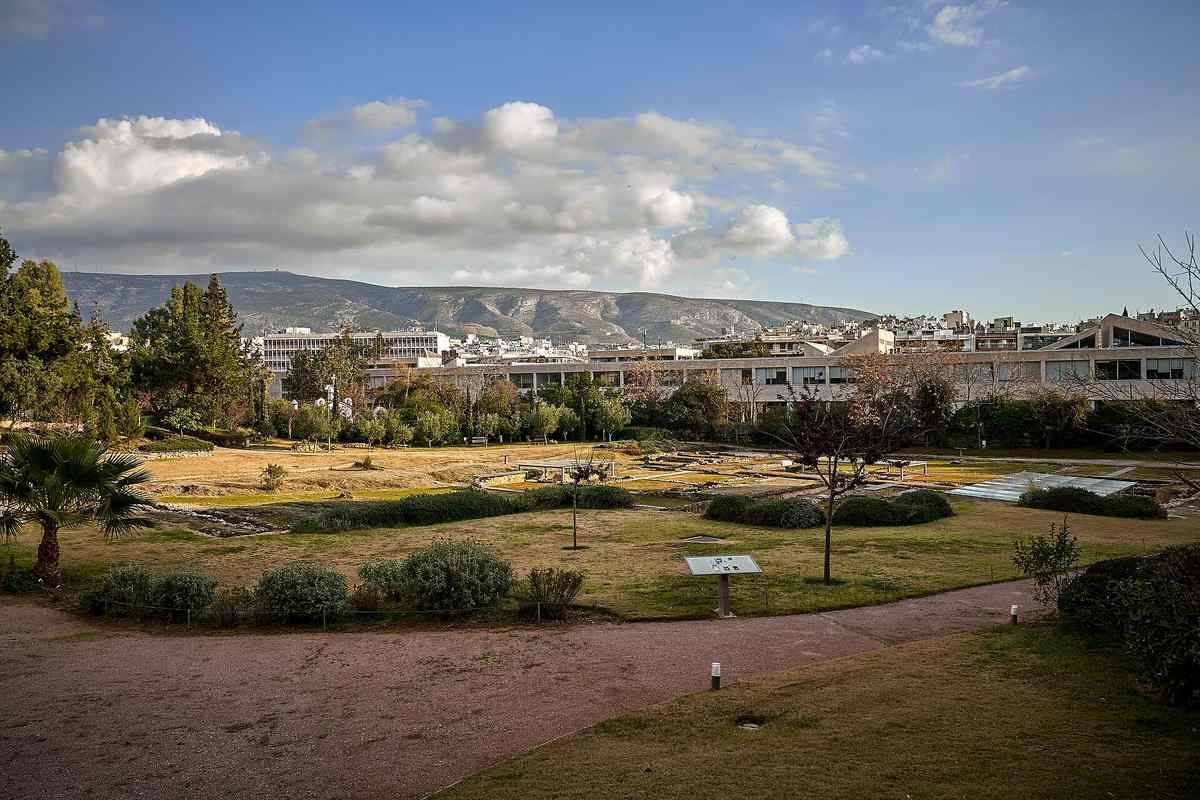
Aristotle’s Lyceum is the archaeological site of the school the great philosopher founded in 335 BC, the home of the Peripatetic school where he taught while walking and talking among the gardens. Discover this quiet, profound ruin alongside skip-the-line Acropolis tickets and tours from My Greece Tours.
This birthplace of philosophy is a thoughtful stop in the Athens travel guide. The sections below cover what the Lyceum is, Aristotle and the Peripatetic school, its older history as a gymnasium, its rediscovery, what survives to see, the practical visit, and how to get there.
What is Aristotle’s Lyceum?
Aristotle’s Lyceum is the archaeological site of the famous school of philosophy founded by the great philosopher Aristotle in 335 BC in Athens, where he taught for around 12 years. Home to his Peripatetic school, it was one of the three great gymnasia of ancient Athens. Rediscovered only, the quiet, green site near the Byzantine Museum on the slopes of Lycabettus preserves the building outlines of this birthplace of Western science and learning.
For lovers of philosophy, history and ideas, Aristotle’s Lyceum is a quietly profound and moving site, the very ground where one of the greatest thinkers in human history taught and shaped the course of Western thought. The Lyceum is the archaeological site of the renowned school of philosophy that the great Aristotle, the philosopher and scientist who had himself studied under Plato and tutored Alexander the Great, founded here in Athens in 335 BC, and where he then taught for around twelve years. It became the home of his famous school, known as the Peripatetic school, and was one of the three celebrated gymnasia of ancient Athens, alongside Plato’s Academy and the Kynosarges.
Remarkably, the precise location of the Lyceum was lost for centuries and only rediscovered by archaeologists, during construction work, with excavations following in the years after. Today the site is a peaceful, green archaeological park set among the museums on the southern slopes of Lycabettus hill, where the excavated foundations and outlines of the ancient buildings can be seen amid gardens, a serene memorial to the birthplace of so much of Western science, logic and philosophy. It is hallowed ground for the life of the mind. Its founder gave the world a method of thinking. The Peripatetic school is his legacy.
Who was Aristotle and what was the Peripatetic school?
Aristotle (384 to 322 BC) was one of the greatest philosophers and scientists in history, a pupil of Plato and tutor of Alexander the Great, whose work spanned logic, science, ethics, politics and more. At the Lyceum he founded the Peripatetic school, so named because he is said to have taught while walking, peripatetic meaning walking about, with his students around the covered walkways and gardens. The school advanced systematic research, observation and learning across countless fields.
To appreciate the significance of the Lyceum, it helps to know the towering figure who made it famous and the distinctive school he founded there. Aristotle, who lived from 384 to 322 BC, was one of the most influential philosophers and scientists who ever lived, a polymath whose vast body of work laid foundations for logic, biology, physics, astronomy, ethics, politics, rhetoric, poetics and metaphysics, and whose ideas dominated Western and Islamic thought for nearly two thousand years. Born in northern Greece, he came to Athens as a young man to study at Plato’s Academy, later served as tutor to the young Alexander the Great in Macedon, and then returned to Athens to establish his own school at the Lyceum in 335 BC.
His school became known as the Peripatetic school, a name traditionally explained by his habit of teaching while strolling, the Greek word peripatetikos meaning given to walking about, as he is said to have walked with his students through the covered colonnades and gardens of the Lyceum while discussing and debating ideas. The school placed great emphasis on systematic observation, the collection of evidence and research across an enormous range of subjects, pioneering an empirical, scientific approach to knowledge. Its influence on the history of learning is incalculable. The walking philosopher’s ground is sacred to scholarship. The site itself is far older than Aristotle.
What was the Lyceum before Aristotle?
The Lyceum existed long before Aristotle, as a sacred grove and public gymnasium, a place for athletic training, military exercise and gatherings, dedicated to Apollo Lyceus, the wolf-god, from whom it took its name. One of the three great gymnasia of ancient Athens, it was a green public space outside the ancient city walls where philosophers, including Socrates and others, had taught before Aristotle chose it for his school, layering deep history beneath the site.
While the Lyceum is forever associated with Aristotle, the site itself was already ancient and significant when he chose it for his school, with a history reaching back centuries before him. Long before becoming a centre of philosophy, the area was a sacred grove and a public gymnasium, that is, a place for the athletic training, physical exercise and military drill of Athenian citizens and youths, set in green parkland just outside the walls of the ancient city. It took its name, Lyceum, or Lykeion, from a nearby shrine to the god Apollo in his aspect as Apollo Lyceus, associated with the wolf, lykos in Greek.
As one of the three principal gymnasia of ancient Athens, together with Plato’s Academy and the Kynosarges, the Lyceum was an important public space that hosted not only sport but also gatherings, lectures and intellectual discussion, and it is recorded that philosophers including Socrates frequented it to converse and teach in the generations before Aristotle established his formal school there. This deep layering of athletic, religious and intellectual history beneath the philosophical fame gives the site added richness and resonance. It was a hub of Athenian civic life. Its modern rediscovery was a remarkable event.
How was the Lyceum rediscovered, and what survives?
The exact site of Aristotle’s Lyceum was lost for centuries and only rediscovered by chance, during excavations for a planned museum building, with archaeological work following. Today the site, covering around 11,000 square metres, preserves the excavated foundations and outlines of the ancient gymnasium buildings, including a palaestra, or wrestling ground, set in a landscaped garden with informational panels. The remains are modest, mainly low walls, but the historic significance is immense.
One of the most fascinating aspects of the Lyceum is the story of its rediscovery, for the precise location of this most famous of ancient schools had been lost and forgotten for many centuries, its memory preserved only in ancient texts. The site was found again quite by accident, when excavations being carried out on a plot of land in central Athens, intended for the construction of a new museum, unexpectedly uncovered the remains of the ancient gymnasium, which scholars identified as the long-lost Lyceum, a discovery of great excitement; further archaeological investigation followed in the years afterward to reveal and study the site. What the visitor sees today, spread across an area of around eleven thousand square metres, are the excavated foundations and ground-level outlines of the buildings of the ancient gymnasium complex, most notably a palaestra, the courtyard wrestling and exercise ground surrounded by rooms, all set within a pleasant landscaped garden dotted with informational panels that explain the history and the structures.
It must be said that the physical remains are modest, consisting largely of low walls and foundations rather than standing monuments, so visitors come more for the profound historical and philosophical significance than for dramatic ruins. The imagination supplies the rest, and the informational panels and the very ground underfoot help conjure the scholars who once gathered here. For many visitors, the quiet act of standing on this spot, knowing what was born here, is more powerful than any grand ruin could be. Standing here, you walk where Aristotle walked. Visiting the tranquil site is easy.
How do you visit Aristotle’s Lyceum?
Aristotle’s Lyceum is an enclosed archaeological site with a modest entry fee, open daily with longer summer hours, set in a green space between the Byzantine and Christian Museum, the city’s War Museum and the Conservatory, about a kilometre east of Syntagma. The nearest metro is Evangelismos on line 3, a short walk away. Quiet and uncrowded, it takes around 30 to 45 minutes, and combines well with the nearby museums and Kolonaki.
Visiting Aristotle’s Lyceum is straightforward and rewarding, especially for those drawn to philosophy and history, and its central yet peaceful location makes it easy to fit into an itinerary. The site is an enclosed, ticketed archaeological park with a modest admission fee, generally open daily, with longer hours in the summer season and shorter ones in winter, so it is worth checking the current times. It occupies a green and tranquil space in the elegant district on the southern slopes of Lycabettus, conveniently sandwiched between several cultural institutions, namely the excellent Byzantine and Christian Museum, the War Museum and the city’s Conservatory, about a kilometre east of Syntagma Square toward Kolonaki.
The most convenient way to reach it by public transport is the metro, with the Evangelismos station on line 3, the blue line, only a short walk away. Because the Lyceum remains relatively little-known and uncrowded, it offers a calm, contemplative experience, and a visit typically takes around thirty to forty-five minutes to walk the site and read the panels. It combines naturally with the surrounding museums, especially the superb Byzantine and Christian Museum next door, and with a stroll into the chic Kolonaki neighbourhood. It is a serene cultural detour. The metro network is explained in the Athens metro guide. The questions below cover the points visitors ask most.
Frequently Asked Questions
What is Aristotle’s Lyceum?
Aristotle’s Lyceum is the archaeological site of the school of philosophy that the great philosopher Aristotle founded in Athens in 335 BC, where he taught for around 12 years. It was home to his Peripatetic school and was one of the three great gymnasia of ancient Athens. Rediscovered only, the quiet green site preserves the foundations of this birthplace of Western learning.
Is Aristotle’s Lyceum worth visiting?
Aristotle’s Lyceum is worth visiting for those interested in philosophy and history, who will find it a moving and profound site, the very ground where Aristotle taught. The physical remains are modest, mainly low walls and foundations in a landscaped garden, so it appeals more for its immense significance than dramatic ruins. It is quiet, uncrowded and easily combined with the nearby museums.
Where is Aristotle’s Lyceum located?
Aristotle’s Lyceum is in central Athens, in a green space on the southern slopes of Lycabettus between the Byzantine and Christian Museum, the city’s War Museum and the Conservatory, about a kilometre east of Syntagma toward Kolonaki. The nearest metro is Evangelismos on line 3, the blue line, a short walk away. It is an enclosed archaeological site with a modest entry fee.