
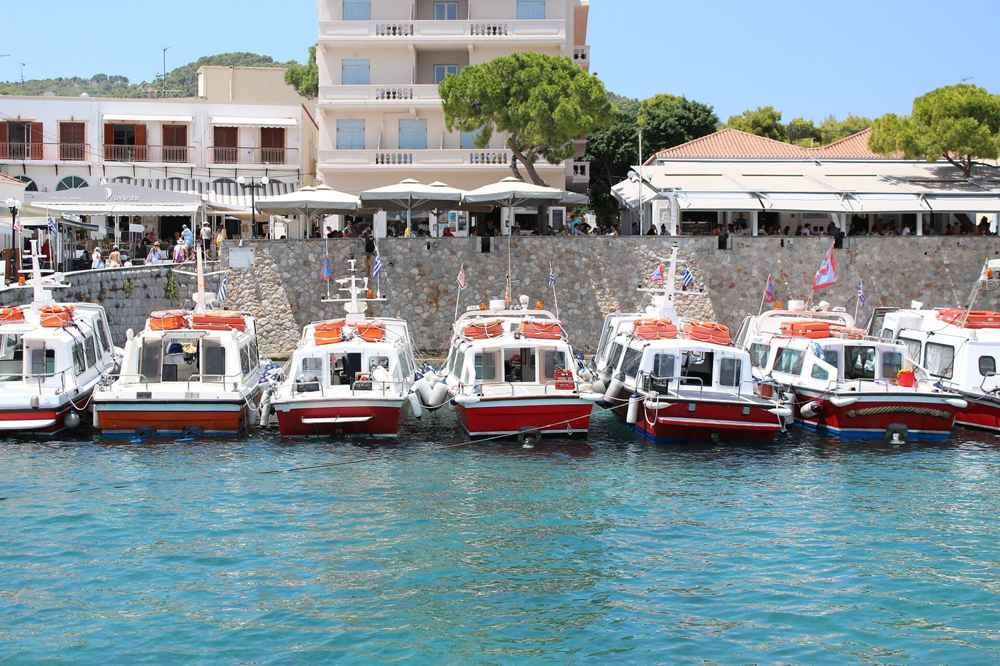
Spetses ranks among the easiest Greek islands for day trips, sitting only a narrow channel from the mainland and a short hydrofoil hop from its Saronic neighbours. Because the island is car-free, almost every excursion starts by boat at the Dapia, the main quay. At My Greece Tours we plan trips from Spetses to Hydra, Poros, Porto Heli and the Argolid, so you can match each outing to your own pace and interests.
Your options fall into three groups. Sea crossings reach the neighbouring islands of Hydra and Poros and the swimming islet of Dokos. Short water-taxi hops land you at Kosta and Porto Heli, where a hire car opens the Argolic coast. Inland drives lead to Ancient Epidaurus, Nafplio and Mycenae, while caique cruises simply circle the island’s own coves. The right choice depends on whether you want ruins, quiet beaches or a relaxed sail.
What are the best day trips from Spetses?
The best day trips from Spetses are Hydra and Poros by hydrofoil, Porto Heli and the Argolic coast by water taxi and hire car, the theatre of Ancient Epidaurus, historic Nafplio, Mycenae, and swimming stops at the islet of Dokos.
Ranking the day trips depends on what you want from the sea. For classic island atmosphere, Hydra is the standout: its car-free stone harbour lies about 40 minutes away by hydrofoil. Poros adds a greener, quieter contrast a little further north. Couples often pair a morning in Hydra with a sunset sail, while families tend to prefer the short water-taxi hop to the mainland, where beaches and tavernas sit minutes from the dock. If you are still deciding between the two most obvious island choices, our Spetses vs Hydra comparison sets out the practical differences in harbour, beaches and mood before you commit a whole day to either.
Sea crossings form the backbone of most plans. Regular Flying Dolphin hydrofoils link the island with Hydra, Poros, Ermioni and Piraeus, so reaching another Poros or Hydra harbour needs no private charter. Beyond the scheduled boats, local caiques and water taxis run on demand from the Old Harbour and the Dapia. These smaller craft reach places the hydrofoil skips, including the uninhabited islet of Dokos and the quiet swimming coves along the Argolic shoreline. Booking a seat on a scheduled hydrofoil suits independent travellers, while a private water taxi gives families the flexibility to leave and return on their own timetable.
The mainland opens up the Argolid’s archaeology. From Kosta and Porto Heli, both directly opposite the island, a hire car reaches Ancient Epidaurus and its celebrated theatre in about an hour. Nafplio in roughly an hour to an hour and a quarter. Mycenae a little beyond. These inland drives suit visitors who want ruins and history rather than beaches. Because Spetses is car-free, you collect the car on the mainland side after the crossing. Read how to get to Spetses to understand the ferry and hydrofoil connections that make these mainland links so quick and reliable.
Arranging each trip is straightforward once you know the pattern. Scheduled hydrofoils are booked online or at the Dapia ticket kiosks, water taxis are hired at the quay, and organised boat tours are reserved through local agencies. Sailing charters and caique cruises around the island’s coves usually leave in the morning and return by late afternoon. For a full menu of on-the-water options, our guide to Spetses boat tours lists the day cruises, while Spetses travel tips covers timing, tickets and what to pack for a long day away from your island base.
How do you get from Spetses to Kosta and Porto Heli on the mainland?
Water taxis cross from Spetses to Kosta in about 10 minutes, running on demand from the Dapia and the Old Harbour. Kosta sits directly opposite the island, and Porto Heli lies kilometres further around the sheltered bay.
The channel between Spetses and Kosta is narrow, roughly a nautical mile of sheltered water, which is why the hop takes only about ten minutes. Water taxis operate around the clock, gathering at the Dapia and the Old Harbour, so you rarely wait long for a boat. Fares depend on the number of passengers rather than a fixed ticket, and the drivers run to Kosta, Porto Heli and the beaches on request. This constant, on-demand service is the reason the mainland feels like an extension of the island rather than a separate journey. It is the key that unlocks every Argolid day trip described in this guide.
Kosta is the small mainland port directly facing Spetses, and it works as the island’s road-head. Here you find open-air car parks, a cluster of car-hire desks and the slow car ferry that shuttles vehicles across the strait. Most day-trippers leave Spetses on a water taxi, collect a hire car at Kosta, and drive inland from there. The village itself is modest, with a couple of tavernas and a beach, so it is a transit point more than a destination. If you are weighing transport before you arrive, getting around Spetses explains how the car-free rules shape every journey on and off the island.
Porto Heli sits kilometres around the bay from Kosta, about ten to fifteen minutes by road. It is a sheltered natural harbour ringed by resorts, a yacht marina and waterfront tavernas, and it serves as the launch point for sailing charters into the Argolic Gulf. Families often make Porto Heli the day’s base: children can swim from the calm bay while adults arrange a boat or a car onward. The town also has supermarkets and pharmacies that Spetses, with its village shops, lacks. For couples, the marina restaurants make an easy lunch stop before continuing to Epidaurus or Nafplio in the afternoon.
Practicalities are simple but worth planning. Bring cash for the water taxi, agree the fare before departing, and confirm a pickup time for the return so you are not stranded after the last light. Car-hire desks at Kosta open early, though booking ahead in high summer is wise. Because Spetses bans private cars, there is no point hiring on the island itself; the vehicle waits for you on the mainland. Travellers with young children should note that the crossing is short and calm, making it far gentler than a long ferry. Our Spetses with kids guide covers family logistics for these mainland outings in more detail.
Is Hydra a good day trip from Spetses?
Hydra makes an excellent day trip from Spetses, reachable in about 40 minutes by Flying Dolphin hydrofoil. The car-free island shares Spetses’ seafaring history, and its stone amphitheatre of a harbour rewards a half-day of unhurried wandering.
The hydrofoil crossing to Hydra is short and scenic, taking around 40 minutes on the scheduled Flying Dolphin service that threads the Argo-Saronic islands. Several sailings run each day in summer, letting you leave mid-morning and return in the early evening with a comfortable margin. Because both islands lie on the same Piraeus route, you rarely need to change boats. Book the outbound and return legs together, since popular departures fill in July and August. The approach itself is memorable: Hydra’s harbour reveals itself slowly as grey-stone mansions climb the bare hillside. A first impression that sets the tone for the day and echoes the maritime wealth that also built Spetses.
Hydra and Spetses are sister islands in ways, both car-free and both grown rich from eighteenth and nineteenth-century shipping. On Hydra the ban goes further: even bicycles are restricted, and goods move by donkey and mule through the lanes. The horseshoe harbour is lined with the archontika, the fortified captains’ mansions, and old cannons still point out to sea. An artistic crowd has summered here for decades, leaving galleries and cafes among the chandleries. Spend the first hour simply circling the port, then climb a few of the stepped alleys for the view back down over the masts. It is a compact, walkable town that rewards slow exploration on foot.
Beyond the harbour, Hydra offers swimming and coastal walks rather than sandy beaches. A flat seafront path leads west in about twenty minutes to Kamini, a tiny fishing port, and on to Vlychos with its pebble beach and old stone bridge. Swimmers also use the rocky platforms and ladders right below the town at Spilia and Hydronetta, where the water is deep and clear. Donkey rides and small water taxis reach quieter coves such as Bisti and Agios Nikolaos. Lunch in Kamini, a swim and a slow walk back fills an afternoon comfortably before the return hydrofoil. Couples in particular find Hydra’s car-free lanes and sunset bars an ideal romantic contrast to a Spetses base.
Deciding when to go matters as much as where. Hydra is busiest at midday when the cruise and hydrofoil crowds overlap in the harbour, so an early boat buys you quieter lanes. Shoulder-season visits in late spring and early autumn are calmest and coolest for the hillside climbs. If you are torn between making Hydra a day trip or your main base, check the best time to visit Spetses to line up the calmest seas for the crossing, and remember that the whole neighbouring island is close enough that you sleep back on Spetses the same night. That proximity is what makes Hydra the single most popular day trip of all.
Can you visit Poros as a day trip from Spetses?
Poros is a feasible day trip from Spetses, about an hour and a half north by hydrofoil.
Reaching Poros takes longer than Hydra, roughly an hour and a half by hydrofoil, because it lies further up the Saronic chain toward Piraeus. Fewer direct sailings link Spetses with Poros each day, so timing is tighter and a same-day return needs checking against the timetable before you commit. The reward for the extra travel is a very different island: lush, pine-clad and set in a channel so narrow it feels like a river. If the schedule is awkward, visitors fold Poros into a wider Saronic sailing loop rather than relying on the scheduled hydrofoil alone, swimming en route instead of watching the clock.
Poros town wraps around a hill on the smaller of the island’s two parts, Sfairia, and its whitewashed houses rise to the white clock tower that crowns the skyline. Across a strait only a few hundred metres wide sits Galatas on the Peloponnese, linked by a constant shuttle of small boats. The waterfront is busier and more workaday than Hydra’s, lined with cafes, ticket agents and yachts moored stern-to. Climbing to the clock tower takes about fifteen minutes and delivers a panorama over the strait, the town roofs and the mainland mountains beyond. The Poros harbour makes an easy, flat first stroll straight off the boat.
The island’s set-piece sights lie a short hop across the water and around its shores. Behind Galatas spreads the Lemon Forest, an old grove of thousands of citrus trees with a taverna and a small waterfall, reached by boat and a short walk. On Poros itself, the scant ruins of the Temple of Poseidon crown the pine-covered interior, a gentle drive or scooter ride from town. Swimmers head for Love Bay and Russian Bay, sheltered coves fringed with pines where the water is calm and shallow. A day here mixes a little archaeology, a forest walk and an easy swim, making it a well-rounded, family-friendly outing rather than a museum marathon.
Poros suits travellers who value greenery and calm water over Hydra’s stone drama, and its shallow bays make it comfortable for children. The longer crossing, though, means less time on the ground, so it rewards an early start and a relaxed plan rather than a packed checklist. Compare the two options with our Spetses vs Poros guide before choosing, and note that the fuller island story sits on the Poros hub page. For a slower pace, a caique cruise that includes a Poros stop lets you swim along the way and avoid the tighter hydrofoil connections back to the island.
What is there to see on the islet of Dokos near Spetses?
Dokos is a small uninhabited islet between Hydra and the mainland, prized for clear-water swimming and a sheltered anchorage at Skindos Bay.
Dokos lies just west of Hydra, a rugged, largely uninhabited islet guarding the entrance to the Gulf of Hydra between the island and the Ermioni peninsula. It has no village, no road and only a handful of seasonal shepherds and a small monastery, which is exactly its appeal. Boats reach it in well under an hour from Spetses, making it a natural stop on a sailing day or a dedicated swimming excursion. The islet’s deeply indented coast shelters bays from the summer meltemi wind, and the water over its pale seabed turns a striking turquoise. For anyone chasing solitude away from the busy harbours, Dokos is the quietest destination within easy reach.
Beneath that calm water lies a genuine archaeological landmark. In the bay of Skindos, divers identified the Dokos shipwreck, generally regarded as the oldest known underwater shipwreck yet found. Its cargo of pottery dated to the Early Helladic period around the late third millennium BC. The wreck is a protected site and off-limits to casual snorkelling, but its presence underlines how long these waters have carried trade. The islet also shows traces of an ancient and Byzantine settlement on the hillsides above the bay. Knowing this history adds depth to a swim stop that might otherwise feel like an empty cove, and it links Dokos to the same seafaring past that shaped the history of Spetses.
Practically, Dokos is a swimming and anchoring destination rather than a place to explore on foot. Skindos Bay on the northern side is the main anchorage, a wide, protected inlet where charter yachts and caiques pause for a long lunch swim. There are no tavernas, no shops and no reliable shade beyond what the boat provides, so every excursion must carry its own water, food and sun cover. The seabed shelves gently in places, giving easy entry, while deeper drop-offs suit stronger swimmers and snorkellers exploring the rocks. Because nothing on the islet is developed, the experience is pure sea and stone, a marked contrast to a day among Hydra’s cafes or Nafplio’s museums.
Getting to Dokos means chartering, since no scheduled boat calls there. Most visitors add it to a private sailing day or a group caique cruise leaving the Old Harbour. Often paired with swim stops along the Argolic coast or a run past Hydra. Half-day and full-day trips are arranged through local operators, and our Spetses boat tours guide lists the cruises that include a Dokos anchorage. The quiet, facility-free setting makes it a favourite for couples seeking a private swim. A chartered caique for a a Spetses honeymoon can drop anchor here well away from the crowds of the main harbours.
How do you reach Ancient Epidaurus and its theatre from Spetses?
Ancient Epidaurus is reached by crossing to Kosta, hiring a car at Porto Heli and driving inland for about an hour. The great fourth-century-BC theatre, famed for its acoustics, seats roughly 14,000 and remains the Argolid’s finest ruin.
Ancient Epidaurus is the easiest of the Argolid’s great sites to fold into a Spetses day. After the ten-minute water taxi to Kosta and a hire car from Porto Heli, the drive north and west takes roughly an hour on good roads through olive country. The route skirts the Argolic Gulf before climbing gently inland toward Ligourio, the village beside the archaeological site. Because the crossing and the drive together run under two hours each way, an early start leaves ample time at the ruins and a lunch stop before returning for the last water taxi. No tour bus is needed: the self-drive from the coast is straightforward and lets you add Nafplio on the same loop.
The Theatre of Epidaurus is the reason most visitors come, and it lives up to its billing. Carved into the hillside in the fourth century BC and later enlarged, it seats around 14,000 spectators across its near-perfect semicircle of tiers. Its acoustics are famous: a coin dropped or a whisper on the central stone of the orchestra carries clearly to the highest row, a feat guides demonstrate throughout the day. The theatre is remarkably well preserved and still hosts ancient dramas during the summer arts festival, so you may find a stage being set. Climb to the top row for the full sweep of the seating against the pine-covered hills, then test the acoustics yourself from the centre.
The theatre is only one part of the wider Sanctuary of Asklepios, the most important healing centre of the ancient Greek world and a UNESCO World Heritage Site. Spread across the valley below are the remains of temples, the athletes’ stadium, guest halls and the circular Tholos, whose foundations still puzzle archaeologists. Pilgrims came here to be cured through rest, dreams and the god’s intervention, and the on-site museum displays surgical instruments, inscriptions and reconstructed columns. Allow an hour or more for the sanctuary in addition to the theatre.
The combination of medicine, ritual and performance makes Epidaurus a richer stop than a single monument, and the shaded paths keep it comfortable even around the middle of the day.
There are two Epidauruses, and it helps to know the difference. The famous theatre and sanctuary sit inland near Ligourio. The separate coastal town of Ancient Epidaurus, or Palaia Epidavros. Lies on the gulf and has its own small theatre and a submerged Roman villa you can snorkel over in the shallows. Families short on time usually prioritise the great theatre, then swim at the coastal town on the way back. For a full day, pair Epidaurus with Nafplio, half an hour further on, as described in the next section. Slotting the site into a wider plan is easy with a Spetses itinerary that blocks out one inland day for the Argolid.
Is Nafplio worth a day trip from Spetses?
Nafplio is well worth a day trip from Spetses, about an hour to an hour and a quarter by car from Porto Heli.
Nafplio rewards the extra driving beyond Epidaurus, sitting about an hour to an hour and a quarter from Porto Heli by car. Most day-trippers combine the two, seeing the theatre in the morning and reaching Nafplio for a late lunch, since only about thirty kilometres separate them. The town curls around a headland on the Argolic Gulf, its old quarter pinned between the sea and the towering Palamidi fortress. Parking sits along the waterfront and at the edge of the pedestrian old town. Because Nafplio is compact and walkable, a single afternoon covers its main sights comfortably, leaving time for a harbour-side coffee before the drive back to Kosta and the last water taxi to the island.
Nafplio wears its history openly. It served as the first capital of the newly independent Greek state in the 1820s and early 1830s. The country’s first governor. Ioannis Kapodistrias, was assassinated on its streets in 1831. Three fortifications guard the town: the hilltop Palamidi, a masterpiece of early-eighteenth-century Venetian engineering reached by a stone stair traditionally counted at 999 steps. The older Acronauplia on the ridge above the houses. And the photogenic Bourtzi. A small island fortress built in the harbour to defend the port. Climbing Palamidi at opening time, before the heat, is the classic first move. The view over the red roofs. The sea and the surrounding mountains is the finest in the Argolid.
Down at sea level, Nafplio’s old town is made for wandering. Marble-paved lanes thread between neoclassical and Venetian facades, wrought-iron balconies drip with bougainvillea. The wide Syntagma Square opens at its heart. Flanked by a Venetian arsenal that now houses the archaeological museum. Independent shops sell worry beads, olive-oil soap and regional wine, while cafes and ouzeries fill the shaded corners. It is one of the most refined towns in Greece, a place to slow down rather than tick off monuments. The waterfront promenade curves beneath Acronauplia toward Arvanitia beach, a pebbly cove where you can swim within a short walk of the square. This blend of culture and ease makes Nafplio a couples’ favourite.
For families, Nafplio balances the fortress climb with gentler pleasures: the little road train around the old town. Ice cream on the square and a swim at Arvanitia or Karathona beach. Practical points are few but useful. Wear proper shoes for Palamidi’s stair, carry water in summer, and time the drive so you are not descending the fortress in the midday sun. Some visitors are so taken with the town that they extend the outing overnight rather than rush back. If that tempts you, weigh it against the comfort of your island base described in where to stay in Spetses. As a same-day trip, though, Nafplio remains firmly within reach.
Can you see Mycenae on a day trip from Spetses?
Mycenae can be seen on a day trip from Spetses, though it is the furthest option, about an hour and a half by car from Porto Heli.
Mycenae is the most ambitious Argolid day trip from Spetses, lying about an hour and a half inland from Porto Heli. Because it sits only around twenty-five kilometres north of Nafplio, the sensible plan is to pair the two, or to string Epidaurus, Nafplio and Mycenae into one long archaeological loop for those willing to start at dawn. The site occupies a bare, dramatic hill between two peaks, commanding the Argive plain, and there is little shade, so morning visits are far more comfortable than afternoon ones. Given the driving involved, Mycenae works best for travellers with a genuine appetite for ancient history rather than those wanting a relaxed beach-and-lunch day.
Mycenae gave its name to an entire civilisation. The Bronze Age culture that dominated mainland Greece in the second millennium BC and whose kings Homer later cast as the leaders against Troy. You enter the citadel through the Lion Gate, a monumental portal crowned by two carved lionesses that has stood since about the thirteenth century BC. The fortress walls are built of stones so massive that later Greeks believed only the giant Cyclopes could have raised them. Just inside lies Grave Circle A, the royal burial ground where the archaeologist Heinrich Schliemann unearthed the gold death mask he famously, if wrongly, attributed to Agamemnon.
Walking the ramparts to the summit reveals the palace foundations and a sweeping view across the plain to the sea.
Below the citadel stand the finest of Mycenae’s beehive tombs, the tholos structures cut into the hillside. Grandest is the so-called Treasury of Atreus. A vast corbelled dome entered through a towering doorway whose lintel is a single stone weighing tonnes. Its interior swallows sound and light in a way no photograph conveys. The whole complex, together with nearby Tiryns, is a UNESCO World Heritage Site and one of the cornerstones of European archaeology. The site museum gathers pottery, frescoes and replicas of the grave-circle gold, giving context to the ruins outside.
Between the citadel, the tombs and the museum, Mycenae needs a good couple of hours, which is why the drive demands an early, committed start from the coast.
A Mycenae day is long, so plan it carefully. Leave Spetses on one of the first water taxis, collect the car promptly at Kosta, and carry water, a hat and sturdy shoes for the uneven, sun-baked paths. Families with older children who enjoy castles and legends usually get the most from it, while very young children may find the heat and the driving tiring. For them, Nafplio alone is the gentler choice. Fold the citadel into a broader Argolid plan with a Spetses itinerary, and choose spring or autumn, since the shoulder seasons make these inland archaeological drives far more pleasant than high summer’s heat on the exposed hill.
What sailing and caique cruises circle Spetses itself?
Caique and sailing cruises circle Spetses in about half a day, calling at the island’s own coves such as Zogeria, Agioi Anargyroi and Bekiris Cave.
The simplest day out of all never leaves Spetses’ own waters. The island’s coast runs for roughly twenty-four kilometres, indented with pine-backed coves that the interior road cannot reach. Small caiques circle it daily from the Old Harbour and the Dapia. A full loop takes about half a day, drifting past the wooded western shore, pausing to swim in sheltered bays, and often rounding the whole island. Because these cruises stay close to home, they need no mainland car or hydrofoil timetable, making them the most relaxed option in this guide. They also reveal a side of the island invisible from land, where cliffs, sea caves and empty beaches replace the busy town waterfront.
The coves themselves are the highlight. On the sheltered south-western side the boats call at Zogeria beach, a double bay ringed by pines, and at Agioi Anargyroi beach, the island’s largest sandy stretch and the site of Bekiris Cave, a sea cave that once hid islanders and now draws snorkellers. Nearby Agia Paraskevi beach adds a chapel above the sand. Many of these bays are far quieter reached by sea than by the crowded shore road. A caique lets you swim off the back of the boat in deep, clear water between stops. Bring a mask, since the rocky headlands shelter plenty of fish.
Cruises come in two forms, and the choice shapes the day. Group caiques run to a set route at a fixed per-person fare, sociable and inexpensive, ideal for families who want a swim-filled afternoon without commitment. Private sailing yachts and motorboats, hired for the day, let couples set their own course, linger at a favourite cove and time the return for sunset over the western capes. Some operators run glass-bottom or semi-submarine trips that suit young children, while others fold in a beach barbecue or a taverna lunch ashore. Evening sunset cruises are short, romantic and popular; full-day charters can extend beyond the island to Dokos or across to Hydra for a change of scene.
Booking is done at the quay or through local agencies, usually a day ahead in peak season. Confirm what is included, whether snorkelling gear, drinks or lunch, and agree the departure and return times before you pay. Our guide to Spetses boat tours details the round-island cruises, sunset sails and private charters, along with the coves each one favours. Whether you spend the day on Hydra’s stone quay, among the ruins of the Argolid, or simply swimming your way around your own island. The sea remains the thread that ties every Spetses day trip together. The calm home harbour is always waiting at the end of it.
Frequently Asked Questions
Do you need a car for day trips from Spetses?
You do not need a car for the island-based day trips, but you do for the mainland archaeology. Reaching Hydra, Poros or Dokos relies entirely on boats, and the round-island caique cruises need nothing more than a ticket at the quay. Spetses itself is car-free, so no vehicle is involved on the island at all. For Ancient Epidaurus, Nafplio and Mycenae, however, a hire car is effectively essential: public transport from Kosta and Porto Heli into the Argolid is sparse and slow. The usual pattern is a ten-minute water taxi to Kosta, then a car collected from a Porto Heli rental desk booked in advance.
Local agencies arrange private transfers or guided excursions to the ancient sites, though at higher cost. In short, the sea trips are car-free and flexible, while the inland ruins reward the freedom and speed of a self-drive from the coast.
What is the cheapest day trip from Spetses?
The cheapest day trip from Spetses is the short water-taxi hop to Kosta and Porto Heli on the mainland, especially if you share the fare among passengers. The crossing takes about ten minutes, and once ashore you can swim, eat at a taverna and stroll the harbour for the price of the boat alone. A close second is a group caique cruise around the island’s own coves, which charges a modest fixed fare per person and includes several swim stops. The scheduled hydrofoil to Hydra costs more. Hiring a car for the Argolid adds fuel. Rental and site-entry fees on top of the crossing, making the archaeological days the most expensive.
To keep costs down, travel in a group to split water-taxi and charter fares. Bring your own picnic rather than relying on beach tavernas. Book hydrofoil tickets early while the cheaper seats are still available.
Which day trip from Spetses is best for families?
The best family day trip from Spetses is usually the short crossing to Porto Heli or a group caique cruise around the coves. Both of which keep travel time low and swimming central. Porto Heli’s calm, shallow bay lets children paddle safely while parents organise lunch or an onward boat, and the ten-minute water taxi is far gentler than a long ferry. Round-island caiques, especially glass-bottom or semi-submarine trips, turn the journey itself into entertainment and stop at sandy beaches such as Agioi Anargyroi. Among the islands, Poros suits families well thanks to its sheltered bays and the Lemon Forest walk.
The inland ruins are more demanding: Nafplio balances its fortress with beaches and ice cream, but Mycenae’s heat, exposed paths and long drive can tire young children. As a rule, choose sea and beach days for little ones and save the archaeology for families with older, castle-loving children.
Can you do a day trip from Spetses without booking in advance?
Many day trips from Spetses can be arranged on the day, though a few reward booking ahead. Water taxis to Kosta and Porto Heli run on demand with no reservation, and you simply agree a fare at the quay. Group caique cruises can often be joined the same morning outside peak weeks, and hydrofoil tickets to Hydra are sometimes available at the Dapia kiosk shortly before departure. In July and August, however, popular hydrofoil sailings and private charters fill quickly, so booking a day or two ahead is wise. Car hire at Porto Heli is the main thing to reserve in advance, since desks can sell out in high summer and a guaranteed vehicle underpins any Argolid plan.
The safest approach is to lock in the hydrofoil and the hire car early for the ruins, while leaving the flexible water-taxi and caique options for spontaneous, weather-dependent days.
What should you take on a day trip from Spetses?
Pack for a long day away from your base, since most excursions leave chances to restock. Carry water, sun cream, a hat and sunglasses on every trip, as the boats, beaches and open archaeological sites offer little shade. Bring cash in small notes for water taxis, quay-side tickets and village tavernas, which do not always take cards. For sea days add a mask and snorkel, a towel and swim shoes for the pebbly coves and rocky entries at Hydra and Dokos. For the inland ruins wear sturdy, closed shoes for the uneven paths and the stone stairway up Palamidi, and start early to beat the midday heat.
A light picnic saves both money and time on the islet of Dokos, which has no facilities at all. Finally, confirm your return-boat time before you set out so a late lunch never leaves you stranded on the mainland.
When is the best season for day trips from Spetses?
Late spring and early autumn are the finest seasons for day trips from Spetses, combining warm seas, reliable boats and comfortable temperatures for walking ruins. May, June, September and early October bring calm crossings and thinner crowds at Hydra. Nafplio and the archaeological sites, while the water stays warm enough for swimming at Dokos and the island’s coves. High summer works too, but midday heat makes the exposed sites of Epidaurus and Mycenae hard going, and the meltemi wind can occasionally disrupt smaller caiques and water taxis. Winter sees hydrofoil schedules thin out and many boat tours pause, so island-hopping becomes less dependable.
For the archaeological days in particular, aim for the shoulder seasons, when an inland drive is a pleasure rather than an endurance test. Whenever you travel, check the forecast the evening before, since wind rather than rain usually decides whether the boats run.
Can you combine two islands or sites in one day from Spetses?
You can combine sites in one day from Spetses, and the Argolid mainland makes it easy. A single hire car from Porto Heli links Ancient Epidaurus. Nafplio and even Mycenae. Pairing the theatre with Nafplio is the most popular full-day loop, since only half an hour separates them. Adding Mycenae stretches the day but stays feasible with an early start. At sea, combining islands is harder because the hydrofoil timetable, not distance. Sets the limit. Hydra alone fills a comfortable day, while squeezing in Poros as well rarely leaves enough time ashore. A better sea combination is a private charter that mixes a swim at Dokos with a stop on Hydra.
The key is to respect the return-boat time to Spetses: build the day around the last water taxi or hydrofoil. Never plan so tightly that a delayed sailing leaves you stranded on the mainland after dark.