
To get from Chania to Xerokambos, drive east on the E75/A90 national road through Rethymno, Heraklion and Agios Nikolaos to Sitia, then over the mountains through Ziros or Zakros down to the coast, about 240 kilometres in 4 to 4.5 hours, reaching the remote beach settlement on the south-east tip of Crete in the Lasithi region. Plan the whole trip with Greece Tours.
This guide covers the trip from Chania to Xerokambos in full: where it is, how to drive it, why there is no practical bus, the scattered off-grid settlement behind its wild beaches, the turquoise coves, the Alatsolimni salt lake and the therapeutic clay of Argilos, the Minoan palace of Kato Zakros and the Valley of the Dead nearby, and whether this far south-east trip is worth it.
Where is Xerokambos and how far is it from Chania?
Xerokambos sits on the south-east tip of Crete in the Lasithi regional unit, on the coast below the mountains south of Zakros. It lies 240 kilometres east of Chania, one of the farthest points from the city on the whole island.
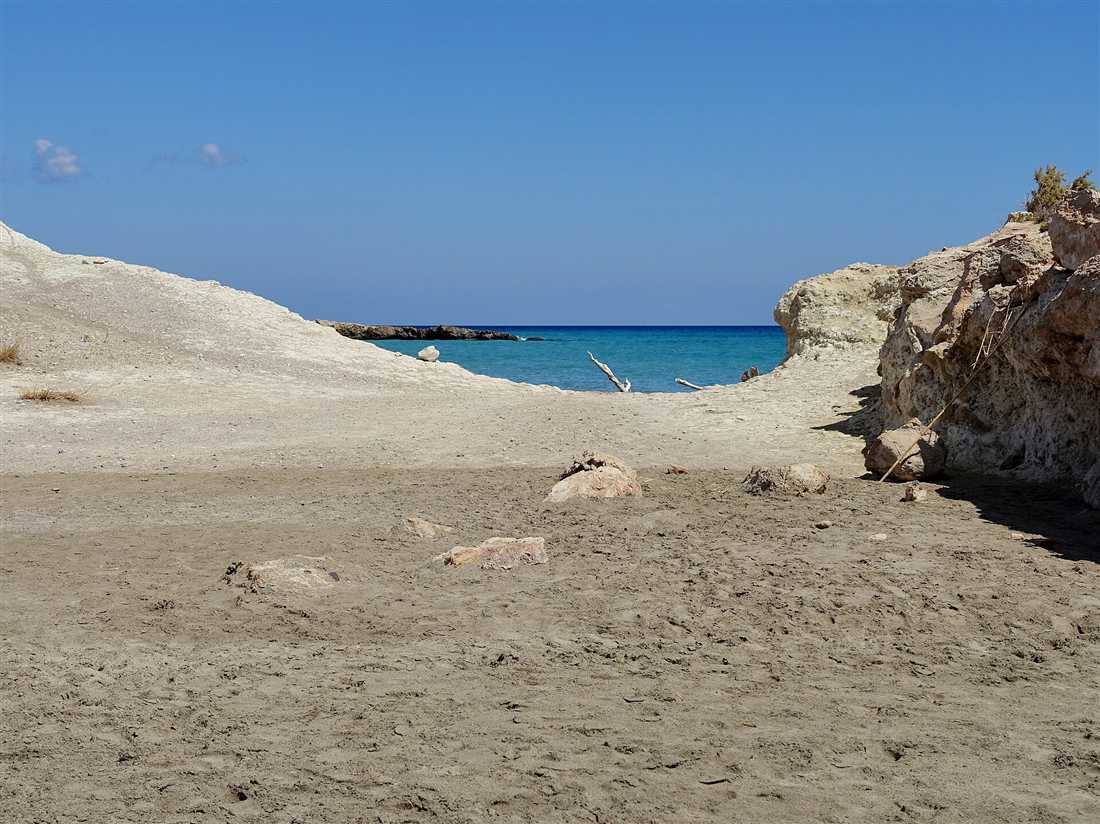
Xerokambos, spelled Xerokampos on part of the road signs, is a scattered beach settlement pinned between a mountain wall and a run of wild sandy coves. It faces the Libyan Sea on the eastern end of the south coast, tucked below Ziros and the Zakros range, with the Kavalloi islet standing offshore. The nearest town of any size is Sitia, and the closest famous landmark is the Minoan palace of Kato Zakros to the north.
The distance separates two opposite corners of Crete. Chania anchors the west, a harbour city with a Venetian port and a busy old town; Xerokambos anchors the deep south-east, an off-grid strip of farms and rooms. Between them stand three regional units \u2014 Chania, Rethymno and Heraklion \u2014 before the road even enters Lasithi. The straight-line gap flatters the trip, because the ground route bends inland through Heraklion and climbs over two mountain sections that add distance and time.
That remoteness is the point of the place. Xerokambos draws travellers who want empty beaches, clear shallow water and silence, and the 240-kilometre reach from Chania filters out day-trippers and keeps the coast quiet. Anyone measuring the journey needs to read it as a full cross-island transfer, not a short hop, and plan an overnight stay at the far end rather than a same-day return.
How do you drive from Chania to Xerokambos?
Drive east on the E75/A90 national road through Rethymno and Heraklion to Agios Nikolaos, take the road to Sitia, then cross the mountains through Ziros or Zakros down to Xerokambos. The route runs 240 kilometres in 4 to 4.5 hours, with slow two-lane mountain roads on the last legs.
The first half is fast and simple. From Chania the E75/A90 hugs the north coast, a wide dual and single carriageway that carries the main traffic of Crete past Georgioupoli, Rethymno and the Heraklion approaches. This stretch flows at national-road speed, and the kilometres fall away quickly as far as the eastern edge of Heraklion. Past there the road narrows toward Agios Nikolaos, where the character of the drive changes.
The second half is the mountain half. From Agios Nikolaos the route bends inland and climbs toward Sitia through Pachia Ammos and along the Gulf of Mirabello, a twisting single carriageway with tight bends and long uphill grades. Beyond Sitia the final descent to Xerokambos leaves the coast entirely, threading over the interior through Ziros or dropping down the Zakros side. These last legs are slow two-lane mountain roads, narrow and steep, with switchbacks that cut the average speed to a crawl. The 240-kilometre total therefore takes 4 to 4.5 hours of steady driving, not the 3 hours a distance-only estimate suggests.
Practical planning keeps the drive clean. Fuel up in Sitia, because filling stations thin out past the town and the settlement itself carries no reliable pump. Carry water, drive the mountain sections in daylight, and treat the descent with respect after dark, when the unlit bends and the absence of barriers demand full attention. A hire car is the natural tool for the trip, and travellers stitching Xerokambos into a wider east-Crete loop set it alongside other day trips from Chania that reach the island’s quieter corners.
Break the drive to make it enjoyable rather than a grind. Rethymno, at the halfway mark of the north-coast run, offers a Venetian old town, a fortress and a long sandy beach for a coffee and a leg-stretch. Agios Nikolaos, where the fast road ends, gives a harbour lake and waterfront tavernas before the mountain climb begins. Sitia marks the last chance for fuel, cash and supplies, so travellers stock up there for the final descent. Splitting the 240 kilometres into these three natural stages turns a long transfer into a strung-together tour of the north coast and the east.
Is there a bus to Xerokambos?
No practical direct bus line runs from Chania to Xerokambos. The KTEL network reaches Sitia through Heraklion, and the final stretch from Sitia to Xerokambos needs a car or a taxi. Xerokambos is a place reached by car, not by public transport.
The KTEL intercity network covers the north-coast spine of Crete well. Buses run Chania to Heraklion at high frequency along the national road, and a second service links Heraklion to Sitia across the east of the island. A traveller without a car rides those two legs and lands in Sitia, the last town on the route served by scheduled coaches. That much of the journey works on public transport, and the Sitia bus station is the practical end of the line for anyone heading to the south-east tip.
The problem is the final stretch. Xerokambos sits over the mountains beyond Sitia in scattered farmland with no resort, no station and no timetabled service that ties the settlement into the network. The gap between Sitia and the beaches falls to a taxi hired from the Sitia rank or to a hire car collected on arrival. The bus deposits a traveller close, then stops well short of the sand.
The honest verdict is that Xerokambos rewards drivers. The two-leg coach ride to Sitia demands changes, eats the better part of a day, and still leaves the last mountain descent unsolved. Renting a car from the start turns a fractured public-transport chain into one continuous drive and unlocks the wider region \u2014 Zakros, Vai and the coves north of the settlement \u2014 that no bus reaches at all.
What is Xerokambos like as a place?
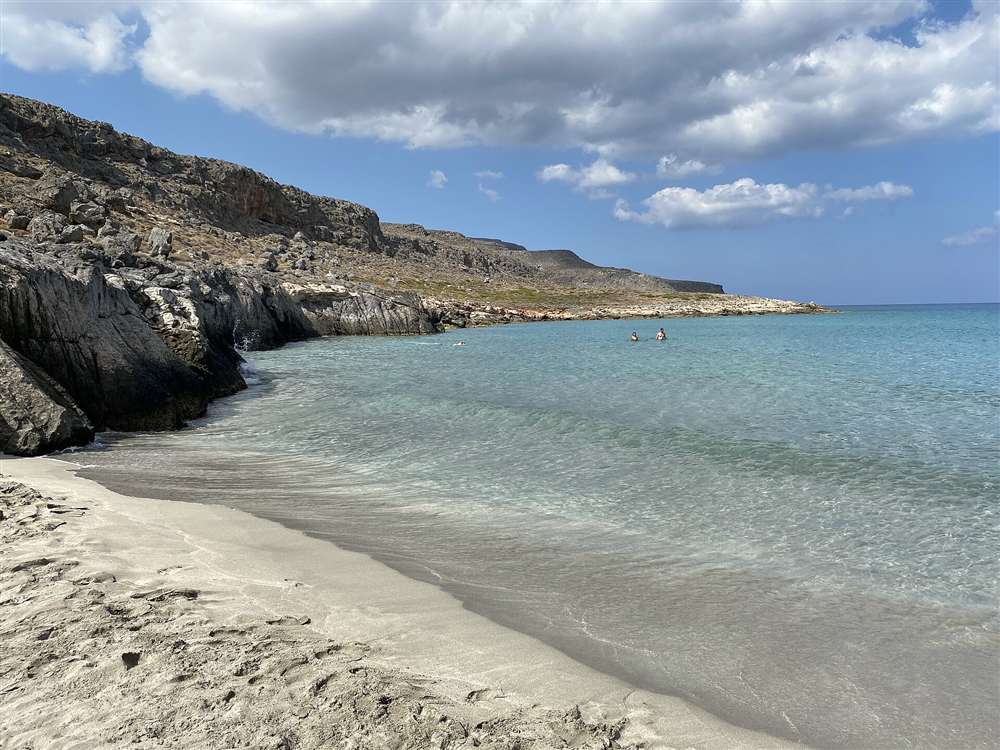
Xerokambos is a scattered, undeveloped settlement of rooms, a handful of tavernas and a few working farms, with no resort development. Simple lodgings and eating places string behind a run of wild sandy beaches, the water is shallow and turquoise, and the pace is slow and off-grid.
Nothing about Xerokambos reads as a resort. The buildings spread thin across the coastal flat and the low slopes behind, low-rise rooms-to-let, tavernas and greenhouses set among olive trees and grazing land. There is no promenade, no strip of hotels, no line of sunbeds marching down the shore. Goats cross the lanes, farmers tend their plots, and the built footprint stays small enough that the landscape swallows it. The settlement feels like a farming hamlet that happens to sit beside beautiful water.
Daily life runs at a farm-and-fishing rhythm. The tavernas serve what the land and boats bring \u2014 grilled fish, local greens, cheese, honey and oil from the surrounding plots \u2014 and the rooms are plain, family-run and close to the sand. Mobile signal drops in and out, night falls dark with no light pollution, and the soundtrack is wind, waves and cicadas rather than music from a bar. This off-grid quality draws people who want to unplug and disappoints anyone expecting nightlife or shopping.
The place suits a particular traveller. Families with young children take to the shallow, calm water; walkers and naturalists take to the dunes, the salt lake and the coastal paths; and couples take to the emptiness of beaches that stay uncrowded even at the height of summer. Xerokambos trades convenience for peace, and that trade is the whole appeal of standing at the wild south-east corner of Crete.
What are the beaches and nature of Xerokambos like?
Xerokambos strings a chain of white-sand coves and a long main beach along a protected Natura coast. Behind the shore lies the Alatsolimni salt lake, the Argilos cove holds therapeutic clay, cedar and juniper grow on the dunes, and the Kavalloi islet stands offshore in clear turquoise shallows.
The shoreline is the reason to make the drive. A run of white-sand coves gives way to a long central beach, all fronted by shallow, glass-clear water that shifts from pale green to deep turquoise over a sandy floor. The gentle gradient keeps the sea calm and warm close in, ideal for children and slow swimming, while the reefs and rocks at the edges of the coves draw snorkellers to bright fish and clean stone. Wind-sheltered pockets and open sweeps sit within short walking distance of each other, so a change of breeze means a change of beach rather than a lost day.
The nature behind the sand matches the sea. The Alatsolimni salt lake, a shallow lagoon that forms behind the shore, dries to a white salt crust in high summer and pulls in wading birds across the year. At the Argilos cove, grey mineral clay gathers along the water \u2014 bathers coat their skin with it for its therapeutic pull before rinsing in the sea. Cedar and juniper anchor the dunes, rare coastal trees that hold the sand and scent the air, and the whole strip falls inside a protected Natura landscape valued for its rarity and quiet.
Offshore the low islet of Kavalloi closes the view and shelters the bay, a bare rock that strong swimmers strike out toward on flat days. The combination is unusual for Crete \u2014 salt lake, healing clay, cedar dunes, an islet and a chain of empty turquoise coves inside one small protected pocket \u2014 and it explains why the long approach ends at scenery out of proportion to the size of the settlement.
The protected status shapes what a visitor finds and what a visitor leaves behind. As Natura land, the coast carries no bar strips, no beach clubs and no rows of loungers, and the dunes stay closed to vehicles that crush the cedar roots. Walkers reach the outer coves on foot along sandy tracks, carry their own shade, and pack out what they bring in. That discipline keeps the water clear and the sand clean, and it hands each cove the empty, wind-scoured feel that packed north-coast beaches lost long ago.
What sights lie near Xerokambos \u2014 Kato Zakros and the Valley of the Dead?
North of Xerokambos stand the Minoan palace of Kato Zakros and the Valley of the Dead gorge that leads down to it. The town of Sitia, the Toplou monastery and the Vai palm forest lie further north, turning the south-east corner into a dense cluster of sights.
Kato Zakros is the headline. The fourth of the great Minoan palaces, it sits at the mouth of a gorge on the east coast, excavated ruins of courtyards, storerooms and workshops set right beside the sea. The palace controlled trade with Egypt and the Levant, and finds from the site fill the display at the Heraklion Archaeological Museum. A short drive north from Xerokambos over the mountains reaches Zakros, and the descent to the coast delivers the ruins and a quiet pebble beach in one stop.
The Valley of the Dead links the two Zakros settlements on foot. This gorge, named for the Minoan burial caves cut into its walls, runs from upper Zakros down to the palace and the shore, a walking route of a few hours through wild rock, oleander and birds of prey overhead. Walkers descend the gorge to Kato Zakros, tour the palace, and arrange a lift or taxi back rather than climbing the whole way out. It ranks among the finest gorge walks in eastern Crete.
Further north the sights keep coming. Sitia offers a harbour front, a Venetian fortress and the services a small town provides. The Toplou monastery, a fortified religious house standing alone on the arid plateau, holds famous icons and produces its own wine and oil. Beyond it the Vai palm forest fills a valley with thousands of native Cretan date palms behind a broad beach, the largest natural palm grove in Europe. A base at Xerokambos puts this whole cluster \u2014 palace, gorge, monastery, palm forest and town \u2014 within a day’s reach by car.
Is the long trip to Xerokambos worth it, and when to go?
The trip rewards travellers who want empty, protected beaches and slow days at the wild edge of Crete. Go in late spring or early autumn for warm calm seas, quiet coves and comfortable mountain driving, and treat Xerokambos as an overnight base rather than a same-day return from Chania.
The 240-kilometre distance and the 4 to 4.5-hour drive rule out a there-and-back visit from Chania in a single day. The value comes from staying. Book a room for two nights or more, and the long approach converts into a proper east-Crete escape \u2014 turquoise water, the salt lake and clay coves, the Zakros palace and gorge, the Vai palms and the Toplou monastery, all within reach of one quiet base. Read against that, the drive is a fair price for a corner of the island that resort development never touched.
Season shapes the experience sharply. Late spring brings wildflowers on the dunes, a full salt lake, warm air and a sea already swimmable, with the mountain roads clear and dry. Early autumn holds the summer sea temperature into the shoulder months while the crowds thin and the light softens. High summer delivers the hottest, calmest water and the strongest guarantee of clear skies, at the cost of fiercer heat on the exposed coast and busier coves at the peak weeks. Winter shrinks the settlement to a handful of open doors, and the mountain descent turns cold and wet.
Timing the drive matters as much as timing the year. Set out from Chania in the morning, clear the national road before the midday heat, and reach the mountain legs and the final descent to Xerokambos in daylight. Fuel in Sitia, carry water, and book lodging ahead, because the settlement runs small and fills at the height of summer. Planned this way, the farthest beach from Chania becomes the reward at the end of the road rather than an ordeal to endure.
The long haul filters out the crowds, which is the point. A base at Xerokambos, Zakros or Sitia turns the 240-kilometre drive from Chania into a single one-way transfer and opens the Minoan palace of Kato Zakros, the Valley of the Dead gorge and the wild eastern beaches without a daily grind. Carry water, cash and a full tank, since services thin out past Sitia, and let the salt lake, the clay coves and the quiet set the pace over a clock.
Frequently Asked Questions
How do you get from Chania to Xerokambos?
From Chania to Xerokambos, drive east on the E75/A90 national road through Rethymno, Heraklion and Agios Nikolaos to Sitia, then over the mountains through Ziros or Zakros down to the coast, 240 kilometres in 4 to 4.5 hours. There is no practical direct bus; the network reaches Sitia, and the final stretch needs a car or taxi.
How far is Xerokambos from Chania?
Xerokambos lies 240 kilometres east of Chania on the south-east tip of Crete in the Lasithi regional unit, on the coast south of Zakros. It is one of the farthest points from Chania on the island, a drive of 4 to 4.5 hours.
Is the trip from Chania to Xerokambos worth it?
The trip from Chania to Xerokambos rewards visitors with wild turquoise beaches, a salt lake, therapeutic clay and total off-grid quiet, with the Minoan palace of Kato Zakros nearby. The 240-kilometre distance makes Xerokambos a far-eastern base rather than a day trip from Chania.