
To get from Chania to Neapoli, drive east on the E75/A90 national road through Rethymno and Heraklion, then on toward Agios Nikolaos and exit for Neapoli, about 120 kilometres in 1.75 to 2 hours, reaching the inland market town of the Lasithi region in its upland basin. Plan the whole trip with Greece Tours.
This guide covers the trip from Chania to Neapoli in full: where it is, how to get there by car and by KTEL bus, the quiet town around its plane-shaded square, the domed church of Megali Panagia and the birthplace of Pope Alexander V, the ancient city of Lato, the Milatos cave and the Lasithi plateau nearby, and whether this inland Lasithi trip is worth it or better as a base.
Where is Neapoli and how far is it from Chania?
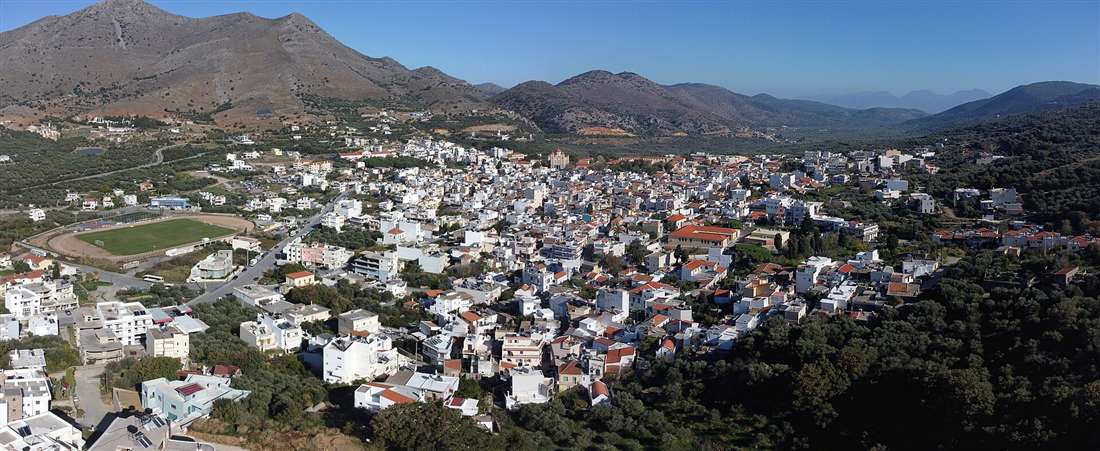
Neapoli is an inland market town in the Lasithi regional unit of eastern Crete, 14 kilometres north-west of Agios Nikolaos on the old national road and 120 kilometres east of Chania. It sits at 270 metres altitude in a fertile upland basin.
The distance places Neapoli at the far eastern edge of a day’s reach from the west of the island. Chania holds the north-west corner of Crete, its harbour and White Mountains facing the Cretan Sea. Neapoli sits deep in the east, past Rethymno and Heraklion, in the hills that rise before the coast folds into the Gulf of Mirabello. The 120 kilometres between the two run almost entirely along the northern spine of the island, the corridor that carries the bulk of Crete’s traffic between its four regional capitals.
Neapoli’s setting is upland, not coastal. The town rests in a green basin ringed by low mountains, watered by springs that feed almond groves and olive terraces. At 270 metres, the air stays cooler than the shore, and the light in the basin softens in the late afternoon. This is agricultural Crete, a landscape of working fields rather than beach resorts, and the town’s position on the old national road made it a natural halt between the coast and the interior long before the modern highway bypassed it.
Travellers confuse this Neapoli with two others in Greece. The Neapoli of the Peloponnese lies at the southern tip of Laconia, a seaside town facing Elafonisos. A district of Thessaloniki carries the same name in the far north. The Neapoli reached from Chania is neither of these: it is the Cretan town of the Lasithi uplands, 14 kilometres short of Agios Nikolaos, and the whole route described here ends in that eastern basin, not on any southern or northern shore.
How do you drive from Chania to Neapoli?
Drive east from Chania on the E75/A90 national road through Rethymno and Heraklion, continue toward Agios Nikolaos, and take the Neapoli exit. The 120 kilometres take 1.75 to 2 hours of steady coastal-highway driving with a clear final climb inland.
The route is a single sweep along the north coast. Leaving Chania, the E75 runs east past the Souda bay and lifts over the headlands toward Rethymno, 60 kilometres on, where the Venetian fortress marks the halfway mark. Past Rethymno the road hugs the shore, crossing the Panormos and Bali stretch, then climbs the passes before the wide plain of Heraklion. Heraklion is the pinch point: the highway threads the city’s northern flank, and the interchange traffic slows the pace at peak hours. East of Heraklion the road narrows from full motorway to the older national-road profile, with junctions at grade and villages set close to the tarmac.
The final leg turns inland. After the port of Gournes and the beach strip east of Heraklion, the highway bends toward Agios Nikolaos, and a signed exit peels off north-west for Neapoli. The exit road lifts from sea level into the basin at 270 metres, a short, well-graded climb through olive groves that delivers the driver into the town square. Fuel stations line the stretch between Heraklion and Agios Nikolaos, so the tank needs no forward planning, and a single stop at Rethymno breaks the drive cleanly in two.
Timing rewards an early start. Departing Chania before 09:00 clears the Heraklion belt before the city fills and puts the car in Neapoli’s square by late morning, with the full afternoon free for the town and the sights in its hills. The drive works as one of the longer day trips from Chania, and pairing it with a stop in Chania‘s old harbour on the return closes the loop across the width of the island.
How do you get from Chania to Neapoli by KTEL bus?
No direct KTEL line connects Chania to Neapoli. Ride the coastal KTEL from Chania to Heraklion, a 2.75 to 3 hour trip, then change to the Heraklion\u2013Agios Nikolaos or Heraklion\u2013Sitia service, which stops at Neapoli en route.
The journey splits into two legs at Heraklion, the hub of eastern Crete’s bus network. The first leg is the busy coastal corridor: Chania’s central KTEL station runs frequent departures to Heraklion through the day, the coaches following the same E75 the cars use, with a set stop at Rethymno. The ride covers the western half of the north coast in 2.75 to 3 hours, and the modern fleet holds air-conditioning, reclining seats and luggage bays underneath. Buy the first-leg ticket at the counter or online, and reserve a window on the sea side for the Rethymno-to-Bali cliffs.
At Heraklion the traveller crosses to the eastern network. The Heraklion KTEL runs services toward Agios Nikolaos and onward to Sitia, and these coaches call at Neapoli’s stop on the old national road below the town. The connection is the tighter part of the plan: the two networks keep separate timetables, so a wait of 30 to 60 minutes between legs is the norm, and the Heraklion terminal’s cafe and ticket hall fill that gap. The second leg from Heraklion to Neapoli runs 75 to 90 minutes.
Total door-to-door time by bus reaches 5 to 6 hours with the change factored in, against 2 hours by car. The trade is time for freedom from the wheel: the coaches let a traveller watch the coast unspool rather than manage the Heraklion interchange. For a single day the bus is tight, and an overnight in Neapoli or nearby Agios Nikolaos turns the two-leg ride into an unhurried crossing of the island east to west.
Fares stay low across both legs. The Chania to Heraklion ticket and the Heraklion to Neapoli ticket together cost a fraction of a rental car and its fuel, so the bus wins on price for a solo traveller or a pair. The drawback is the fixed rhythm of the timetable: the last eastbound service from Heraklion departs in the evening, and the last coach back from Neapoli toward Heraklion runs in the afternoon, so a same-day return demands an early first departure from Chania and a firm eye on the return times posted at the Neapoli stop.
What is Neapoli like as a town?
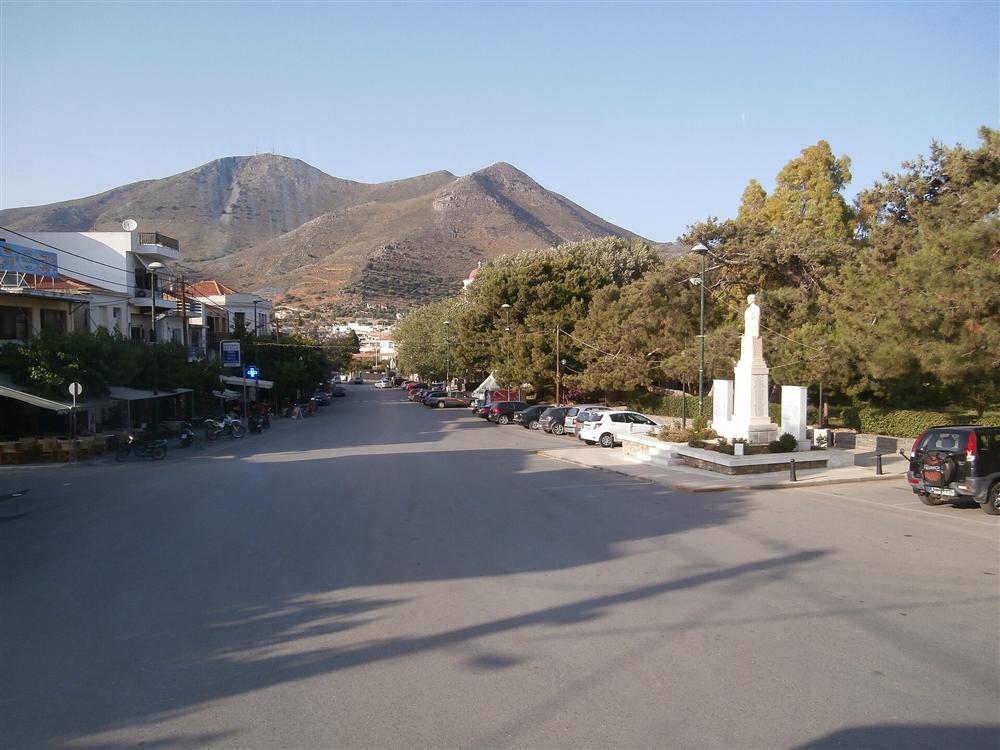
Neapoli is a quiet, un-touristy market town built around a large central square shaded by plane trees. The great domed church of Megali Panagia rises over it, and an archaeological and folklore museum, working cafes and a produce market fill the surrounding streets.
The square is the heart of the place. Plane trees throw deep shade across the paving, and beneath them the cafes set out tables where farmers, shopkeepers and pensioners hold the town’s slow daily rhythm. Coffee stretches into conversation, and the pace stays unhurried through the heat of the afternoon. This is a working Cretan town that lives from its fields and its market rather than from visitors, and the absence of souvenir shops and tour crowds is precisely its character.
Megali Panagia dominates the skyline. The great domed church, one of the largest in Crete, stands over the square with its twin bell towers and broad interior, a monument to the town’s standing as the former capital of the Lasithi prefecture. Nearby, the archaeological museum holds finds from the surrounding sites, and the folklore collection records the tools, textiles and household life of the upland villages. The market days bring almonds, olive oil, honey and vegetables from the basin’s farms into the streets around the square.
Neapoli’s food and drink carry its identity. The town is famous across Crete for soumada, a milky almond cordial pressed from the bitter almonds of its groves and served chilled, sweet and cloudy over ice. Bakeries sell almond sweets and the local breads, and the tavernas plate mountain lamb, wild greens and the cheeses of the surrounding pastures. The town wears its history plainly, without polish, and a traveller sits inside ordinary Cretan life rather than a staged version of it.
What is the history and character of Neapoli?
Neapoli was the capital of the Lasithi prefecture and the birthplace of Petros Filargos, who rose to become Pope Alexander V. Its shaded square, great church and famous soumada almond drink hold a civic dignity out of step with its quiet size.
The town’s proudest son left it for the wider world. Petros Filargos, born in the Neapoli district in the fourteenth century, entered the Franciscan order, taught theology at Paris and rose through the Latin church to be crowned Pope Alexander V during the schism that split the papacy between rival claimants. That a market town in the Cretan uplands produced a pope is a fact the townsfolk hold close, and it grounds Neapoli’s sense of itself as a place of standing rather than a mere farming village.
Its rank as prefectural capital shaped the town’s fabric. As the seat of Lasithi’s administration before that role passed to Agios Nikolaos on the coast, Neapoli built the civic weight its size no longer explains: the vast Megali Panagia, the museums, the broad square laid out for gatherings and markets. The administrative move to the harbour town drew commerce and officialdom to the sea, and Neapoli settled into the calm of a market centre serving its basin, its former importance still legible in the scale of its central buildings.
Soumada carries the town’s name across the island. Pressed from the almonds that thrive in the fertile basin, the cloudy cordial is Neapoli’s signature, poured at weddings and feast days and sold from the town to households across Crete. The almond groves, the plane-shaded square and the papal story together give Neapoli a character that rewards the traveller who reads a place slowly: a town of quiet substance, sure of its history, indifferent to fashion.
What sights lie near Neapoli?
The ancient city of Lato sits in the hills toward Agios Nikolaos, the Kremaston monastery and the Milatos cave lie to the north, the Lasithi plateau and the Dikteon Cave rise to the south, and the resort of Agios Nikolaos on the Gulf of Mirabello is 14 kilometres away.
Lato is the nearest ancient site of the first rank. The Dorian city climbs a saddle between two peaks in the hills between Neapoli and Agios Nikolaos, its stepped agora, defensive walls and hillside houses looking out over the Mirabello coast. The ruins hold their commanding position in near solitude, one of Crete’s more complete non-Minoan cities and a short drive from the Neapoli basin. The Kremaston monastery, set against the slopes to the north, adds a stop of quiet devotion on the same upland roads.
The coast to the north opens the Milatos cave. The great cavern, its chambers reaching deep into the cliff, carries a heavy history: villagers sheltering here were besieged during the island’s revolts, and a small chapel inside marks the memory. The village of Milatos below runs down to a shingle shore of small tavernas, a coastal counterpoint to the inland town. From Neapoli the drive north to the cave and the sea takes 20 to 30 minutes.
South of Neapoli the land climbs to the Lasithi plateau, the high mountain plain ringed by the Dikti range and dotted with the villages and old windmill frames of its farms. At the plateau’s southern rim, the Dikteon Cave descends into the rock where myth places the birth of Zeus, its stalactite chambers lit for the climb down. East of the town, Agios Nikolaos and the Gulf of Mirabello bring the harbour, the bottomless lake and the resort strip within 14 kilometres, so a base at Neapoli reaches mountain, coast and antiquity in every direction.
Is the trip from Chania to Neapoli worth it, and when to go?
The trip rewards travellers drawn to authentic inland Crete over resort coastline. At 120 kilometres and 2 hours by car each way, it works as a long day or a first-night base for eastern Crete. Late spring and early autumn bring the finest weather and the fullest fields.
The value of the journey rests on what a traveller wants from Crete. For beaches and nightlife, the west holds Chania’s own shore and the pink sands of the south. Neapoli offers the opposite: a genuine market town where daily life runs unstaged, a papal birthplace, a famous almond drink and a hub within striking distance of Lato, the Lasithi plateau, the Milatos cave and the Mirabello coast. A visitor who values history, upland scenery and the texture of working Crete finds the 240-kilometre round trip well spent; a visitor set only on sunbeds finds better use of the day closer to Chania.
The structure of the trip matters as much as the destination. As a single day the drive is long but clean, and an early departure returns the traveller to the west by evening with the town, its square and one hillside site behind them. The stronger plan treats Neapoli or neighbouring Agios Nikolaos as the first stop of an eastward loop, unpacking the coach or car for a night and giving Lato, the plateau and the Dikteon Cave the time they deserve before the return west.
Season shapes the reward. Late April to mid-June brings warm days, green basins and the almond and olive terraces in full leaf, with the plateau’s fields worked and the coastal heat still gentle. September and October hold the same balance as the summer crowds thin and the light turns golden across the uplands. High summer bakes the interior at midday, so a summer visit starts early and shelters in the shade of the plane-tree square through the afternoon. Winter turns the basin cool and green, quiet and unvisited, the town returned wholly to itself.
The distance rewrites the plan around a base. Neapoli sits on the doorstep of the Lasithi east, so a stay here or at Agios Nikolaos turns the 120-kilometre run from Chania into a one-way transfer and puts the ancient city of Lato, the Milatos cave, the Lasithi plateau and the Gulf of Mirabello within a short drive. Break the outbound leg with fuel and a coffee at Heraklion, and treat the western sights of Chania as a separate half of the same holiday rather than a daily return.
Frequently Asked Questions
How do you get from Chania to Neapoli?
From Chania to Neapoli, drive east on the E75/A90 national road through Rethymno and Heraklion, then on toward Agios Nikolaos and exit for Neapoli, 120 kilometres in 1.75 to 2 hours. By bus, take the KTEL Chania to Heraklion, then the Heraklion to Agios Nikolaos or Sitia bus, which stops at Neapoli.
How far is Neapoli from Chania?
Neapoli lies 120 kilometres east of Chania, 14 kilometres north-west of Agios Nikolaos in the Lasithi regional unit, at 270 metres in an upland basin. The drive on the national road takes 1.75 to 2 hours.
Is the trip from Chania to Neapoli worth it?
The trip from Chania to Neapoli rewards visitors with an authentic, un-touristy Cretan market town, a grand plane-shaded square, the great church of Megali Panagia, and the ancient city of Lato nearby. The 120-kilometre distance makes Neapoli an eastern base or a stop toward Agios Nikolaos.