
To get from Chania to Platanias, drive west on the old coastal national road or the E75/A90, about 11 kilometres in 15 to 20 minutes, to the largest beach resort west of the city, split between a long sandy beachfront strip and the old village of Ano Platanias on the hill above. Plan the whole trip with Greece Tours.
This guide covers the trip from Chania to Platanias in full: where it is, how to get there by car and by bus, the resort strip and the old hill village, the long sandy beach and the Thodorou islet reserve offshore, the neighbouring resorts of Agia Marina and Stalos and the west-coast road on to Maleme, and whether this short west-of-Chania trip is worth it or a base in itself.
Where is Platanias and how far is it from Chania?
Platanias is a beach resort on the north-west coast of Crete, 11 kilometres west of Chania town, inside the Chania regional unit. It is the largest resort strip west of the city, spread along the coastal road that runs from Chania toward Kissamos.
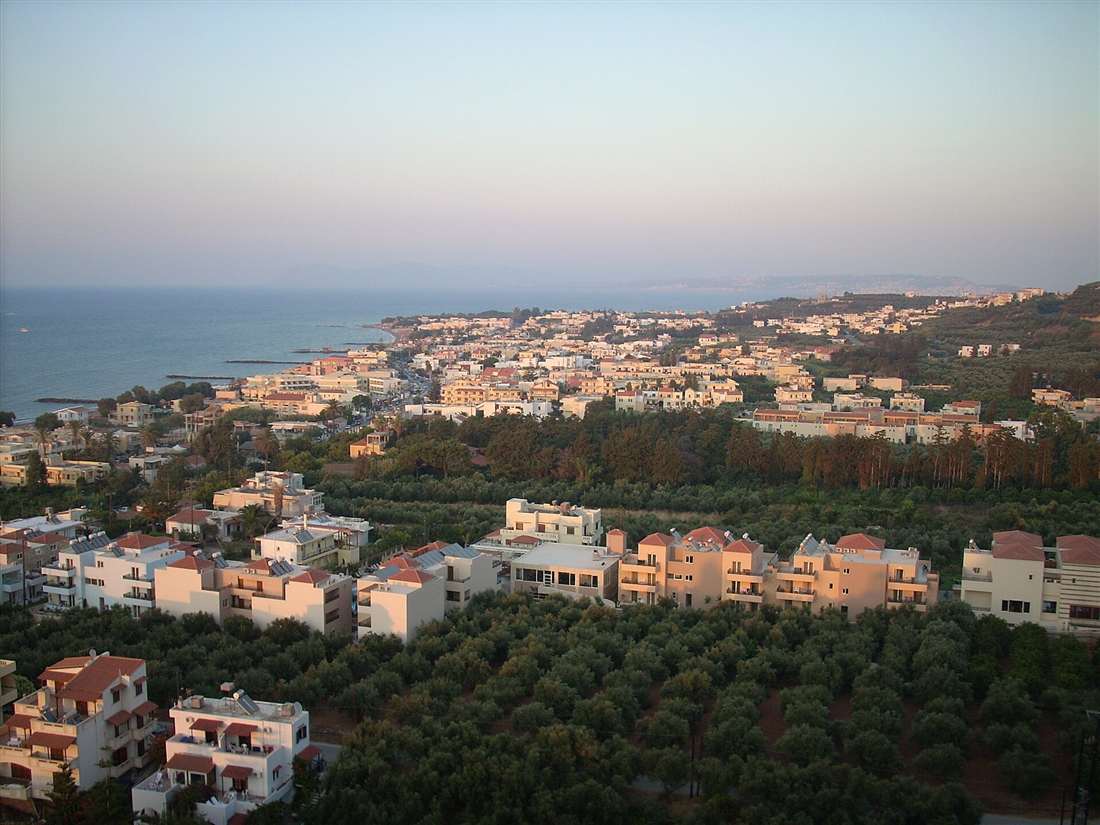
Platanias sits on the flat coastal plain where the mountains of western Crete step back from the sea and leave a wide band of beach, farmland and orange groves. The resort faces north across the Cretan Sea, with the low green islet of Agioi Theodoroi a short distance offshore. The name comes from the plane trees (platania) that shade the old village on the hill, and those same trees line the square and the lanes above the beachfront.
The 11 kilometres between the two places run almost entirely along the coast, so the drive stays close to the water the whole way. Chania is the administrative centre, the harbour town and the transport hub; Platanias is its western beach front, the place where the hotels, the sand and the nightlife concentrate. Travellers base themselves in Chania for the Venetian harbour and the old town, then move west to Platanias for the long sandy beach and the strip of tavernas and bars.
Because the two points are so close, Platanias works as a day destination from Chania and Chania works as a day destination from Platanias. The short distance means the transfer takes 15 to 30 minutes by every method, and the coastal road passes the smaller resorts of Stalos and Agia Marina on the way, so the trip doubles as a tour of the near-west coast rather than a bare point-to-point hop.
How do you drive from Chania to Platanias?
Drive west from Chania on the old coastal national road, or take the E75/A90 national road, to cover the 11 kilometres to Platanias in 15 to 20 minutes. Both routes are signposted for Kissamos and Kastelli and both end at the Platanias beachfront.
The old coastal road is the scenic choice. It leaves the west edge of Chania, passes the beach suburbs of Nea Chora and Kalamaki, then threads through Stalos and Agia Marina before reaching Platanias. This road runs a stone’s throw from the sea for long stretches, past beach bars, car-hire lots, supermarkets and roadside tavernas, so it doubles as a slow tour of the resort coast. Traffic thickens through the built-up sections in high summer, and that pushes the drive toward the 20-minute mark.
The E75/A90 national road runs a little inland and moves faster. It carries the through-traffic to Kissamos and the far west, bypasses the resort centres, and delivers a steadier 15-minute run when the coastal road is congested. Signs for Platanias direct you off the national road and down to the beachfront. Drivers heading beyond Platanias to Kolymbari, Maleme or the Rodopou peninsula stay on the E75/A90 for the longer legs.
Parking in Platanias sits along the beachfront road and in the side streets behind the tavernas, with hotel car parks for guests. A hire car turns the resort into a base for the whole west of the island, from the pink sand of Elafonissi to the lagoon of Balos and the ruins at Aptera. For a wider set of ideas built around a car and this stretch of coast, the guide to day trips from Chania lays out the routes that start on this same road west.
How do you reach Platanias by bus?
The Chania urban buses and the KTEL coastal buses both run west to Platanias on frequent departures, a ride of 25 to 30 minutes. Services leave from central Chania and the KTEL station, and the coastal line continues past Platanias to Kolymbari and Kissamos.
The urban line is the workhorse for this trip. Blue Chania city buses run the coastal corridor from the town centre out through Nea Chora, Stalos and Agia Marina to Platanias and back, with departures spaced through the day and into the evening in the summer season. The fare is low, tickets are bought from the driver or a kiosk, and the bus stops sit along the beachfront road, so passengers step off within walking distance of the sand, the hotels and the tavernas.
The KTEL coastal buses add the longer-distance option. These larger coaches run from the Chania KTEL station toward Kissamos and Kastelli, and they halt at Platanias on the way west. Passengers heading on to Gerani, Maleme, Kolymbari or the far-west beaches use the same line, and the stop at Platanias links the resort to that whole coast without a car.
The bus takes longer than the car because it pulls in at the intermediate stops and threads the resort traffic, so 25 to 30 minutes is the honest figure door to door. For travellers without a hire car, the frequency and the low fare make the bus the practical way to shuttle between the old town of Chania and the beach at Platanias, morning to late night through the high season, when departures run at short intervals.
What is Platanias like as a resort?
Platanias splits into two parts: the long beachfront strip of sandy beach, hotels, tavernas, bars and nightclubs at sea level, and the old village of Ano Platanias on the hill above, with plane trees, narrow lanes and a view over the coast. The resort is the nightlife centre of the Chania coast.
The beachfront strip is where the resort earns its name. A wide road runs parallel to the sand, and along it stand the mid-range and larger hotels, the souvenir shops, the car-hire and scooter-rental fronts, the mini-markets and a dense run of tavernas and caf\u00e9s. After dark the strip switches character: the bars fill, the music clubs open, and Platanias becomes the loudest, latest place on the whole Chania coast. Groups and younger travellers come here for that reason, and the nightlife runs from the beach bars at sunset through to the clubs in the small hours.
Ano Platanias, the old village on the hill, is the counterweight. A short climb up from the strip leads into narrow stone lanes shaded by the plane trees that gave the place its name. The village keeps its Cretan tavernas, its small square and its church, and from the top the view opens across the whole beach, the resort roofs and the sea out to the Thodorou islet. Diners climb up in the evening for a table with that view and a quieter meal away from the strip below.
The two sides make Platanias flexible. A family takes a beach hotel and a shaded taverna terrace; a group of friends takes a strip apartment and the club run; a couple takes a table in the old village at sunset. The resort holds the sand, the food and the nightlife of the west coast in one place, 11 kilometres from the Venetian harbour, and that combination is why it draws the largest summer crowd west of Chania.
What are the beaches of Platanias and the Thodorou islet?
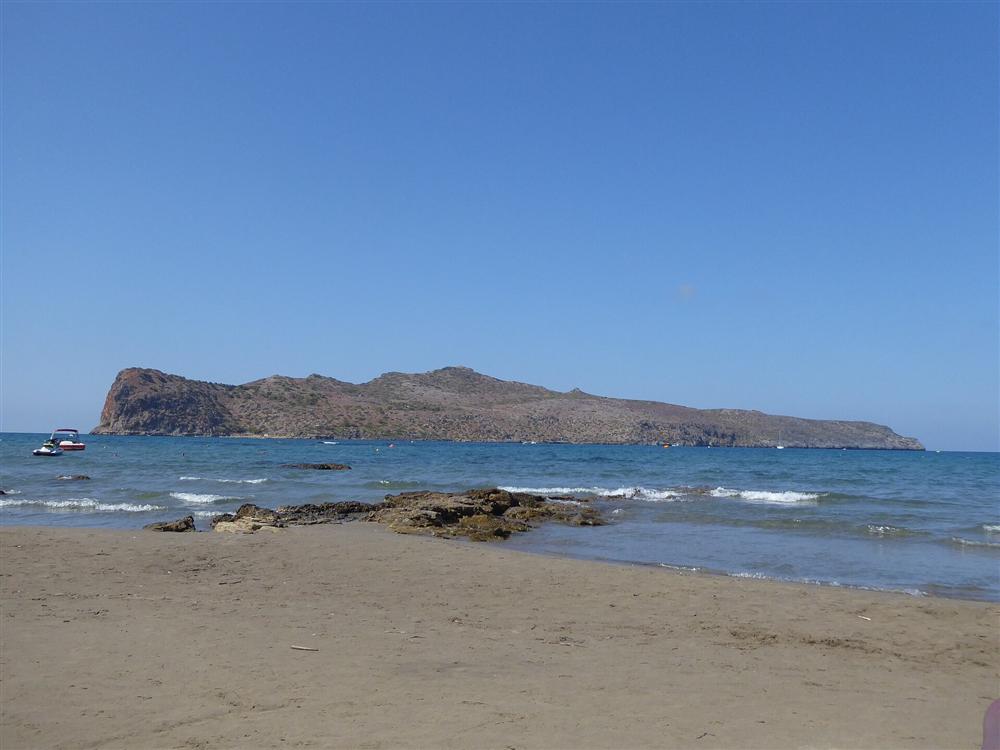
Platanias fronts a long sandy beach with watersports and sunbeds, joined by the neighbouring beaches of Agii Apostoli and Gerani to the east. Offshore lies the islet of Agioi Theodoroi, called Thodorou, a protected reserve for the Cretan wild goat, the kri-kri, with a cave on its seaward side.
The main Platanias beach is a broad band of pale sand that runs for a long stretch along the resort front. The water shelves gently, which suits families and swimmers, and the developed sections carry sunbed-and-umbrella rows, beach bars and watersports operators offering jet-skis, pedalos, banana rides and paragliding. Blue Flag standards apply along the organised parts, with lifeguards and facilities in the peak season, while quieter sand opens up toward the edges of the resort.
Toward the east, the coast strings together more beaches within a short drive. Agii Apostoli sits in a set of small sheltered coves backed by pine, calmer and greener than the open Platanias front, and Gerani spreads its own long sandy shore near the mouth of the gorge that carries its name. These give bathers a choice of moods along one short coastline, from the busy resort sand to the tucked coves next door.
Thodorou, the islet on the horizon, is the natural landmark of the view. It is an uninhabited protected reserve, home to a colony of the kri-kri, the Cretan wild goat, and closed to casual landing to guard that population. A sea cave breaks its seaward cliff, and boat trips run out from the coast to circle the island and take in the reserve from the water. The islet fixes the outlook from every taverna terrace and hotel balcony on the Platanias front, a green rock set in blue that marks this stretch of coast apart.
What lies nearby along the west coast: Agia Marina, Stalos, Maleme?
Toward Chania stand the resorts of Agia Marina and Stalos, both on the same coastal road; the village of Gerani sits just east of Platanias; and west the road runs on to Maleme and Kolymbari. The whole strip forms one continuous resort coast from the edge of Chania out to the Rodopou peninsula.
Agia Marina, between Platanias and Chania, is the near neighbour and the direct twin of Platanias in feel: a long sandy beach, a run of hotels and tavernas, watersports on the sand and a view across to the same Thodorou islet, which sits closest to shore here. Stalos, one step nearer Chania, is the quieter, more family-oriented resort of the three, with a sandy main beach and a smaller cluster of accommodation on the slope behind. The three run into one another along the coast, so a walk or a short drive links them.
Gerani, just east of Platanias, keeps a village core inland from its beach and marks the point where the Gerani gorge meets the sea. West of Platanias the coast road pushes on to Maleme, a name written into the history of the island as the site of the airfield fought over in the wartime battle for Crete, with its German war cemetery on the hill above the beach. Beyond Maleme the road reaches Kolymbari at the neck of the Rodopou peninsula, gateway to the Gonia monastery and the drive out toward Afrata and the wild capes.
This chain of places turns a stay in Platanias into a base for the whole near-west. A single road strings the resorts, the beaches, the gorge mouths and the historic sites together, and the same buses that serve Platanias run along it. From one hotel a traveller reaches the calm coves of Agii Apostoli, the family sand of Stalos, the war history of Maleme and the peninsula road at Kolymbari, all inside the western arm of the Chania coast.
Is the trip from Chania to Platanias worth it, and when to go?
The trip is worth it for the long sandy beach, the watersports, the two-sided resort of strip and old village, and the west-coast nightlife, all 11 kilometres and 15 to 30 minutes from Chania. Go from late spring through early autumn for warm sea and full services, with July and August the peak.
Platanias rewards the short journey because it packs the west coast’s best beach front, its liveliest evenings and its fullest run of tavernas into one place beside Chania. A day-tripper from the old town gets a full beach day with sunbeds, watersports and a shaded lunch, then a sunset table in Ano Platanias above the coast. A resort guest gets the reverse: the beach and the nightlife on the doorstep, with Chania’s Venetian harbour a 15-minute drive east for a change of scene.
Timing shapes the experience. Late spring brings warm days, a calm sea warming through and the resort opening up before the crowds arrive, which suits couples and families after a quieter beach. High summer, from the start of July to the end of August, delivers the hottest weather, the warmest water, the fullest beach services and the loudest nightlife, along with the densest crowds on the sand and the strip. Early autumn holds the warm sea and the summer facilities while the numbers thin, a strong window for a relaxed beach stay.
For the trip itself, drive the coastal road when you want the resort views and the national road when you want speed, and take the frequent urban or KTEL bus when you travel without a car. Whichever way you go, the 11 kilometres pass in under half an hour, the beach and the islet of Thodorou wait at the end, and Platanias sends you back to Chania at night with the strongest nightlife on the western coast of Crete behind you.
Frequently Asked Questions
How do you get from Chania to Platanias?
From Chania to Platanias, drive west on the old coastal national road or the E75/A90, 11 kilometres in 15 to 20 minutes. The Chania urban and KTEL coastal buses run west to Platanias on frequent departures, a ride of 25 to 30 minutes, continuing to Kolymbari and Kissamos.
How far is Platanias from Chania?
Platanias lies 11 kilometres west of Chania town on the north-west coast of Crete, in the Chania regional unit. It is the largest resort strip west of the city, and the drive on the coastal road takes 15 to 20 minutes.
Is the trip from Chania to Platanias worth it?
The trip from Chania to Platanias rewards visitors with a long sandy beach, the liveliest nightlife on the Chania coast, and an old hill village with a view over the sea, 15 minutes from the city. The short distance makes Platanias an easy day out and a resort base.