
To get from Chania to Sitia, drive east on the E75/A90 national road through Rethymno, Heraklion and past Agios Nikolaos, then the coast road on to the far-east harbour town, about 265 kilometres in 3.5 to 4 hours. Sitia also has its own airport and a ferry port on the Dodecanese line. Plan the whole trip with Greece Tours.
This guide covers the trip from Chania to Sitia in full: where it is, how to drive it, the long KTEL bus corridor, the flight and ferry alternatives, the quiet tiered harbour town under its Venetian fort, the Vai palm forest, the Toplou monastery, the Minoan palace at Kato Zakros, and whether this far-east trip is worth it or better as a base.
Where is Sitia and how far is it from Chania?
Sitia sits on the north-east coast of Crete in the Lasithi regional unit, about 265 kilometres east of Chania. It marks the far eastern end of the island, past Heraklion and Agios Nikolaos, a harbour town rising in tiers above a wide bay.
Chania anchors the west of Crete; Sitia anchors the east. Between the two lies the full length of the island, crossing four regional units in sequence: Chania, Rethymno, Heraklion and Lasithi. The 265-kilometre gap is the longest single point-to-point journey a traveller makes on Crete, longer than the run from Chania to Heraklion and longer than any island-crossing on the south coast. Sitia stands beyond the tourist belt of the north-central coast, which keeps its streets calm and its prices honest.
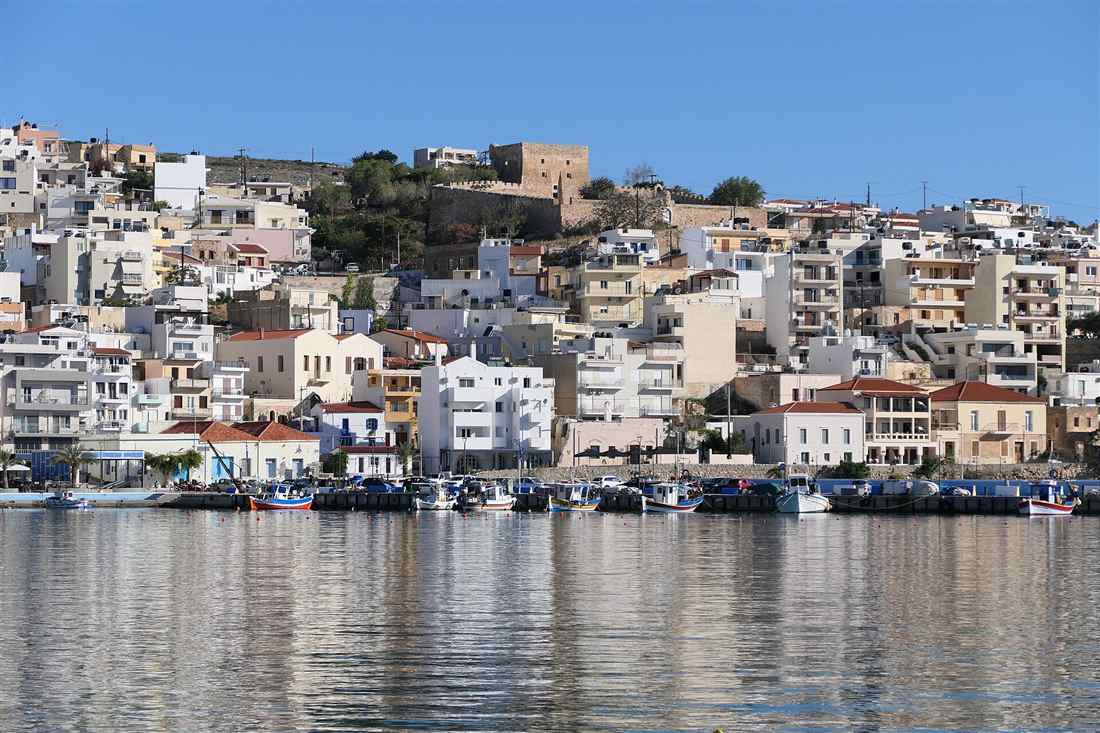
The town spreads across a natural amphitheatre of low hills that fold down to the water. A long sandy town beach runs east from the port, the Venetian fort called the Kazarma crowns the ridge above the harbour, and a palm-lined waterfront of tavernas fronts the bay. Sitia is the birthplace region of Vitsentzos Kornaros, the Cretan Renaissance poet who wrote the verse romance Erotokritos, and the town carries his name on its cultural centre and its streets.
Distance is the defining fact of this trip. A visitor based in the west treats Sitia as a destination in its own right, not a half-day outing. The three routes east \u2014 the car, the KTEL bus and the plane or ferry \u2014 each answer the 265 kilometres in a different way, and the choice between them shapes the whole day.
Set Sitia against the island’s other landmarks to fix its position. Heraklion, the island capital, sits at the 200-kilometre mark from Chania, two-thirds of the way. Agios Nikolaos, the last town before the road narrows, stands at 200 kilometres by the fast route. Sitia lies 65 kilometres beyond that, in the corner of Crete that points toward the Dodecanese. This is the last inhabited stretch of the island’s north coast before the land runs out at Cape Sidero and the Vai palms.
How do you drive from Chania to Sitia?
Drive east on the E75/A90 national road through Rethymno, Heraklion and past Agios Nikolaos, then take the coastal road on to Sitia. The full run is 3.5 to 4 hours across 265 kilometres. The fast national road ends near Agios Nikolaos and the final stretch is a slower two-lane coast road.
The drive splits into two halves with distinct characters. The first half, Chania to Agios Nikolaos, runs on the E75/A90 national road, a fast dual-and-single carriageway that hugs the north coast through Rethymno and skirts Heraklion. This part moves at highway pace, with fuel stations, service stops and clear signage. The gradient is gentle, the surface is good, and the kilometres fall away quickly. A driver clears the first 200 kilometres to Agios Nikolaos in about 2.5 hours of steady motoring.
The second half changes tone. Past Agios Nikolaos the fast road ends and the route becomes a two-lane coastal road that climbs and winds above the Gulf of Mirabello before dropping through Pahia Ammos and cutting east across the Isthmus of Ierapetra country to the coast at Sitia. This stretch is slower, with bends, elevation changes and stretches where speed drops to 50 kilometres per hour. The scenery earns the pace \u2014 sea views, olive terraces and the bare eastern hills \u2014 but a driver plans for 60 to 75 minutes across this final 65 kilometres.
Break the drive rather than pushing straight through. Rethymno’s old town, at the one-hour mark, makes a natural coffee stop, and Agios Nikolaos, at the point where the fast road ends, is the logical spot for lunch and fuel before the winding final leg. Fill the tank in Agios Nikolaos; stations thin out on the road east. Drivers exploring the wider region first will find more options among the day trips from Chania before committing to the long eastern haul, and the base town itself, Chania, rewards a full day of its own.
How do you reach Sitia by KTEL bus?
Yes, but with one change and no direct line \u2014 this is the longest bus corridor on Crete. Ride the frequent coastal KTEL from Chania to Heraklion in 2.75 to 3 hours, change stations, then take Heraklion to Sitia in about 3 hours via Agios Nikolaos and the Gulf of Mirabello. Count on a full travel day.
No single coach links the two towns. The public network splits Crete’s east-west spine into two operators and two legs. The first leg, Chania to Heraklion, is the busiest intercity route on the island, with departures through the morning and afternoon on modern air-conditioned coaches. It runs along the national road through Rethymno and reaches the Heraklion bus terminal by the port in 2.75 to 3 hours.
The second leg, Heraklion to Sitia, departs from a different terminal in Heraklion \u2014 Bus Station A near the harbour serves the eastern routes. This coach threads Neapoli, climbs past Agios Nikolaos, follows the Gulf of Mirabello and crosses to the east coast, reaching Sitia in about 3 hours. The two legs plus the terminal change and the wait between connections build a door-to-door total of 6.5 to 7.5 hours, a genuine full day on the road.
Book the two legs as a deliberate connection. Take an early Chania departure to give a comfortable buffer at the Heraklion change, buy the onward Sitia ticket at the terminal counter on arrival, and confirm the eastern schedule the day before, because departures to Sitia are fewer than the dense Chania\u2013Heraklion frequency. A traveller without a car uses the bus as a one-way transfer to a multi-night stay in Sitia rather than a same-day return, since a round trip consumes two full days.
Is there a flight or ferry to Sitia instead?
Yes. Sitia has its own airport, Sitia Public Airport, code JSH, with domestic flights to Athens and seasonal links, and a ferry port on the Dodecanese line serving Kasos, Karpathos, Rhodes, Milos and Piraeus. Neither connects directly to Chania, so both are alternatives to the overland crossing rather than shortcuts from the west.
The airport sits on the plateau just north-east of the town, a short taxi ride from the harbour. Its scheduled service links Sitia with Athens, putting the far east of Crete within a short flight of the mainland and, by connection, the wider Greek network. For a traveller arriving from outside the island, flying into Sitia removes the entire 265-kilometre overland leg in a single step. From a base in Chania, though, reaching Sitia by air means backtracking through Chania or Heraklion airport, so the plane serves arrivals from Athens, not west-to-east hops within Crete.
The ferry port opens a different map. Sitia is the western terminus of the Dodecanese coastal line, the sea route that stitches Crete to the small islands of the eastern Aegean. Boats run to Kasos and Karpathos, on to Rhodes, and westward to Milos and Piraeus. This makes Sitia a working gateway for island-hopping east rather than a stop on the main Cretan tourist circuit, and it gives the harbour its unhurried, functional character.
Match the mode to the trip. A visitor combining Crete with the Dodecanese uses the Sitia ferry as the link. A visitor flying in from Athens uses JSH to land in the east directly. A visitor already in Chania with a car crosses by road, because the airport and the port both point outward from Sitia rather than back toward the west of the island.
What is Sitia town like?
Sitia is a quiet, un-touristy harbour town rising in tiers above a bay, with a long sandy town beach, the Venetian Kazarma fort above the port, and a palm-lined waterfront of tavernas. It keeps the working rhythm of a Cretan port rather than the polished surface of a resort, and its calm is the point.
The layout reads clearly from the water. Whitewashed and pastel houses stack up the hillside in tiers, laced with stepped lanes and small squares. At the top of the ridge stands the Kazarma, the Venetian fortress that guarded the port for centuries and now frames the town’s skyline and hosts open-air events. Below it the harbour front runs as a long promenade shaded by palms, lined with fish tavernas, kafeneia and ouzeri where the catch of the day is the menu.
The town beach is one of Sitia’s plain pleasures \u2014 a long, sandy strand that begins at the eastern edge of the harbour and stretches for kilometres, backed by a quiet road and shallow, gentle water. It draws local families more than tour groups, and even in high summer it holds space. The pace on the waterfront is slow: long lunches, evening strolls, coffee that stretches for an hour.
Sitia carries its heritage lightly. The archaeological museum holds finds from the Minoan sites of the east, including material from the palace at Kato Zakros. The Kornaros connection ties the town to the summit of Cretan literature. A visitor who reaches Sitia trades the crowds and set-piece sights of the north-central coast for a town that still belongs to the people who live in it, and that authenticity is the reward for the distance.
What is there to do near Sitia \u2014 Vai, Toplou and Kato Zakros?
The far east packs headline sights near Sitia: the Vai palm forest beach, the largest natural palm grove in Europe, to the north-east; the fortified Toplou monastery; the Minoan palace at Kato Zakros with the Valley of the Dead gorge above it; and the remote beaches of Xerokambos. Each sits within a 30-to-70-minute drive of the town.
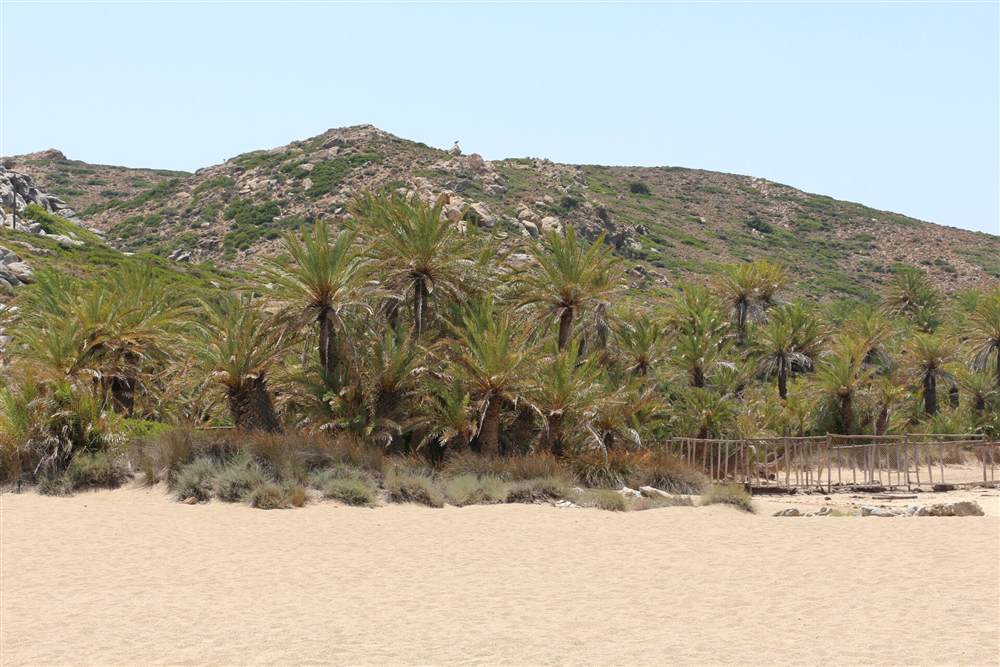
Vai is the signature. A dense grove of Cretan date palms \u2014 the largest natural palm forest on the continent \u2014 backs a curve of pale sand and turquoise water, a scene that looks transplanted from North Africa. It lies to the north-east of Sitia, past the cape, and draws the day-trippers who make the effort to reach the east. Arrive early to have the palms and the sand before the tour buses fill the car park.
Toplou monastery stands on the bare plateau on the way to Vai, a fortified religious house built like a small castle against pirates, with a tall bell tower, thick walls and a renowned collection of icons. Beyond it, at the eastern shore, the Minoan palace of Kato Zakros sits where the mountains meet the sea \u2014 one of the four great palaces of Minoan Crete, reached through the Valley of the Dead, a gorge named for the Minoan burial caves cut into its cliffs, walked as a 6.5-kilometre trail down to the coast.
Xerokambos closes the list to the south \u2014 a scatter of remote, undeveloped beaches with clear shallow water and almost no building, the reward for a driver willing to follow the last of the roads east. Together these four sights make Sitia a base rather than a single stop: two or three days turn the long drive into a proper exploration of the wildest, least-crowded corner of Crete.
Is the long trip worth it, and when to go?
Yes, when treated as a multi-night stay rather than a day trip. The 265-kilometre distance rules out a same-day return from Chania, so the payoff comes from basing in Sitia for two or three nights and using it as the gateway to Vai, Kato Zakros and the empty eastern coast. Go in late spring or early autumn for warm sea and thin crowds.
The trip fails as a day trip and succeeds as a destination. Driving 3.5 to 4 hours each way in one day leaves no time for the town or its sights, and the bus makes a same-day round impossible outright. A traveller who commits two or three nights, though, unlocks the whole east: a day for Sitia town and its beach, a day for Vai and Toplou, a day for Kato Zakros, the Valley of the Dead and Xerokambos. The distance that defeats a day trip guarantees the quiet that defines the reward.
Season shapes the experience as much as time. Late spring brings green hills, wildflowers on the plateau and a sea already warm enough to swim, with the sights near-empty. Early autumn holds the summer sea temperature into the shoulder season while the crowds thin and the light softens. High summer delivers reliable heat and full ferry and flight schedules, at the cost of busier beaches at Vai and hotter midday driving on the winding final leg. Winter closes the seasonal tavernas and services but rewards a visitor with the town stripped to its local rhythm.
Plan the logistics for the distance. Fuel and lunch in Agios Nikolaos on the way east, book the Sitia accommodation before setting out, and carry the return either by the same road, by the Sitia ferry east to the Dodecanese, or by a flight from JSH. Sitia repays the journey precisely because so few make it \u2014 the far east of Crete stays wild, uncrowded and unhurried, and reaching it is the price of that reward.
The distance rewrites the itinerary. A base at Sitia, Agios Nikolaos or Elounda puts the far-east sights within a short drive and turns the 265-kilometre run from Chania into a single one-way transfer rather than a daily grind. Fuel and lunch in Agios Nikolaos break the outbound leg, and the coast road past the Gulf of Mirabello carries its own reward of sea views. Travellers who fly into Sitia or arrive by ferry skip the road entirely and start the eastern half of the trip fresh.
Frequently Asked Questions
How do you get from Chania to Sitia?
From Chania to Sitia, drive east on the E75/A90 national road through Rethymno, Heraklion and past Agios Nikolaos, then the coast road on to Sitia, 265 kilometres in 3.5 to 4 hours. By bus, take the KTEL Chania to Heraklion, then the Heraklion to Sitia line via Agios Nikolaos, a full travel day.
How far is Sitia from Chania?
Sitia lies 265 kilometres east of Chania, at the far eastern end of Crete in the Lasithi regional unit. The fast national road runs as far as Agios Nikolaos, and the final stretch is a slower two-lane coast road, so the drive takes 3.5 to 4 hours.
Is the trip from Chania to Sitia worth it?
The trip from Chania to Sitia rewards visitors with the Vai palm forest, the Toplou monastery, the Minoan palace at Kato Zakros and a quiet, un-touristy harbour town. The 265-kilometre distance makes Sitia an eastern base rather than a day trip from Chania.