
To get from Chania to Ierapetra, drive east on the E75/A90 national road through Rethymno and Heraklion to the Agios Nikolaos area, then south across the Isthmus of Ierapetra to the coast, about 250 kilometres in 3.25 to 3.75 hours, reaching the largest town on the south coast and the southernmost town of Europe. Plan the whole trip with Greece Tours.
This guide covers the trip from Chania to Ierapetra in full: where it is, how to drive it, the long KTEL bus corridor, the tiered seafront town under its Venetian Kales fortress, the Chrissi island day boat with its cedar forest and Golden Beach, the villages of Myrtos and the south-east coast, and whether this far trip is worth it or better as a base.
Where is Ierapetra and how far is it from Chania?
Ierapetra sits on the south-east coast of Crete in the Lasithi regional unit, 250 kilometres east of Chania. It is the largest town on the south coast of Crete and the southernmost town of Europe, facing the Libyan Sea across open water toward Africa.
Chania anchors the far west of Crete; Ierapetra anchors the far south-east. Between them stretch the two other regional units, Rethymno and Heraklion, and the mountain spines of the White Mountains, Psiloritis and Dikti. The straight-line distance understates the drive, because the coastal route bends with the north shore before cutting south across the island. The trip crosses the full length of Crete from one corner to the diagonally opposite corner, which makes it one of the longest single town-to-town journeys the island offers.
Ierapetra stands on the Isthmus of Ierapetra, the narrowest neck of Crete. Here the island pinches to 12 kilometres of land from the north coast at Pachia Ammos down to Ierapetra on the Libyan Sea. That geography defines the final approach from any northern starting point: the road descends across a low, wind-swept corridor between two seas. The town’s position on the sun-baked southern shore gives it the record as the sunniest town in Greece, with a climate warmer and drier than the north coast where Chania sits.
The distance matters for planning. A visitor based in the west treats Ierapetra as a long expedition rather than a casual outing, and the town rewards an overnight stay rather than a same-day return. Travellers weighing this against shorter options review the full list of day trips from Chania before committing a whole day to the east.
How do you drive from Chania to Ierapetra?
Drive east on the E75/A90 national road through Rethymno and Heraklion to the Agios Nikolaos area, then turn south across the Isthmus of Ierapetra to the coast. The route runs 250 kilometres and takes 3.25 to 3.75 hours, with the final legs on two-lane roads.
The first two-thirds of the drive follow the E75, the Cretan north-coast national road that links the island’s four main cities. From Chania the road threads past Georgioupoli and the Almyros wetlands into Rethymno, then climbs and dips along the coast toward Heraklion, the island capital. This stretch is the fastest of the journey: engineered dual sections, sea views to the left, and mountain flanks to the right. Fuel stations, tavernas and rest stops line the corridor, so the long haul breaks naturally into stages.
East of Heraklion the national road continues past Hersonissos and Malia toward the Gulf of Mirabello. Near Agios Nikolaos the E75 winds down to a two-lane standard, and the character of the drive changes. At Pachia Ammos the route leaves the north coast and turns due south onto the isthmus. The crossing is short and stark: 12 kilometres of open, gusty land between the Aegean-facing north and the Libyan-facing south, with the Ha gorge slicing the Thripti massif to the east. Wind is the constant here, funnelled between the two seas.
The road delivers you straight into Ierapetra’s greenhouse plain, a sea of white plastic that feeds much of Greece with off-season vegetables. Drivers hold to exact figures: 250 kilometres door to door, 3.25 hours with light traffic, 3.75 hours in the summer crush at Heraklion and the resort strip. A car is the only way to reach Ierapetra’s outlying beaches and the villages of the south-east coast, so the western visitors who make the trip do it behind the wheel. Those starting from the old town of Chania add fifteen minutes clearing the city before the national road opens up.
How do you get from Chania to Ierapetra by KTEL bus?
No direct KTEL line connects Chania and Ierapetra. Ride the frequent coastal KTEL from Chania to Heraklion in 2.75 to 3 hours, then change to the Heraklion\u2013Ierapetra service, which takes 2 to 2.5 hours via the Agios Nikolaos and Gournia corridor. The full journey fills a travel day.
The Cretan public bus network splits at Heraklion. Western Crete, including Chania and Rethymno, runs under KTEL Chania-Rethymno; eastern Crete, including Lasithi and Ierapetra, runs under KTEL Heraklion-Lasithi. The two meet at the Heraklion terminals, where every long east\u2013west trip forces a change. The first leg is the busy coastal line that shuttles between Chania and Heraklion at high frequency through the day, hugging the same national road the drivers use.
At Heraklion the connection swings to the eastbound service. Buses to Ierapetra leave from the terminal near the port, run out past Agios Nikolaos and the Gournia archaeological site, cross the isthmus, and finish at the Ierapetra KTEL stop three streets back from the seafront. The two segments together consume 4.75 to 5.5 hours of riding, before the wait between connections is counted. Add the transfer and a margin for the schedule, and the door-to-door figure stretches across a full day.
The bus suits a traveller without a car who wants to reach the town itself and explore on foot, since central Ierapetra, the beach, the fortress and the boat quay all sit within a walkable grid. It does not suit anyone aiming for Chrissi island departures, the outlying beaches, or the villages of the coast, all of which sit beyond the bus network. Timing is tight: an early first bus out of Chania is the difference between arriving with the afternoon free and arriving at dusk.
What is Ierapetra town like?
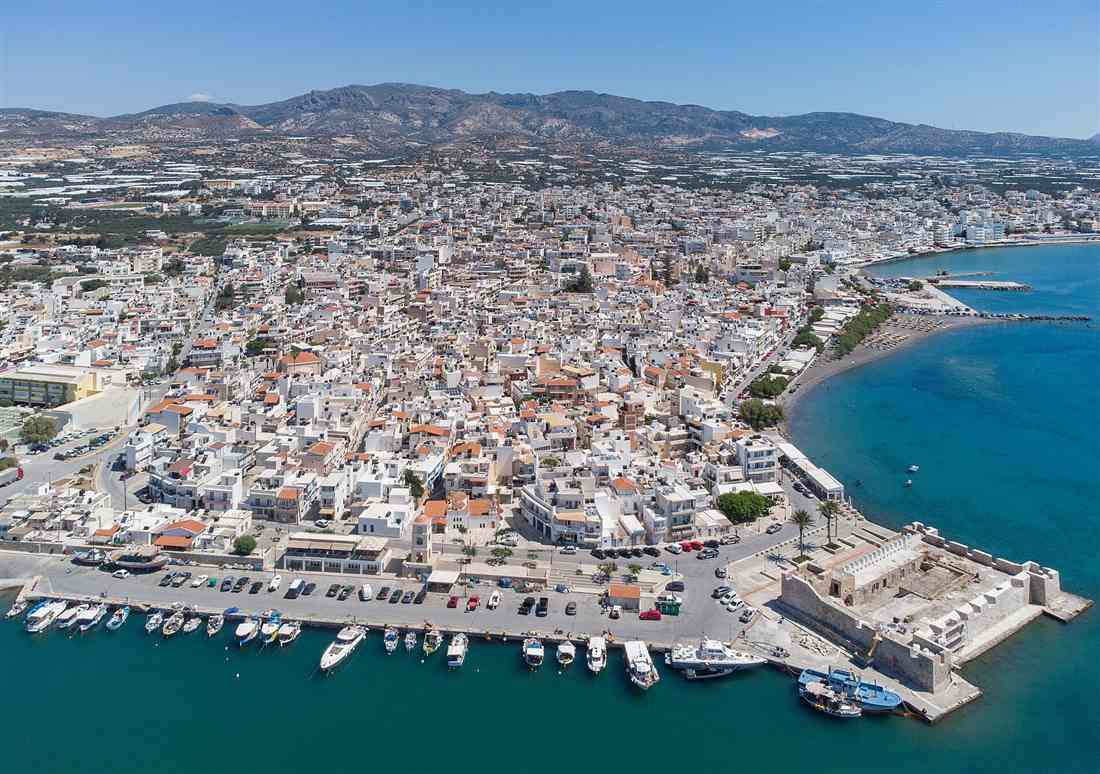
Ierapetra is a working southern port town with a long dark-sand beach, the Venetian Kales fortress guarding the old harbour, a palm-lined seafront, and a maze-like old quarter called Kato Mera. Its farming economy runs on plastic greenhouses that make the plain the vegetable garden of Crete.
The waterfront is the town’s spine. A broad promenade edged with palms runs the length of the shore, lined with tavernas, kafeneia and fish restaurants that fill at dusk when the heat breaks. The town beach is dark volcanic sand, long and open, sloping into warm Libyan-Sea water that stays swimmable deep into autumn. At the harbour’s edge stands the Kales, a squat Venetian sea fortress that once watched for pirates and now frames every photograph of the old port.
Behind the seafront the old quarter of Kato Mera tightens into narrow lanes, whitewashed houses, bougainvillea and small squares. This is the historic core, where a restored Ottoman mosque and old merchant houses record the town’s layered past as a port that traded across the Libyan Sea. Ierapetra carries a long history: a Dorian city-state, a Roman harbour, a Venetian and Ottoman stronghold, each leaving its mark in the street plan and the stones.
Beyond the town the plain spreads out under a blanket of greenhouses. Ierapetra grows tomatoes, cucumbers, peppers and bananas year-round in the polythene tunnels, and the produce ships north across Greece through the winter. This is the engine of the local economy, and it explains the town’s unglamorous, lived-in feel: Ierapetra is a place that works, not a resort dressed for visitors. That authenticity, plus the sunniest-town-in-Greece climate and the low prices of a farming hub, is the draw for travellers who make the long trip east.
How do you visit Chrissi island from Ierapetra?
Chrissi island, also called Gaidouronisi, is a flat uninhabited islet 15 kilometres south of Ierapetra in the Libyan Sea. Day-boats reach it in 50 minutes to an hour from the town harbour. The protected island holds a Lebanon-cedar forest, the shell-sand Golden Beach, and turquoise shallows.
Chrissi is the headline reason travellers push all the way to Ierapetra. Boats depart the town quay in the morning, cross the open Libyan Sea, and land on a low, treeless-looking island that reveals a rare Lebanon-cedar forest inland, one of the last natural cedar stands in Europe. The island is a protected Natura reserve: no building, no residents, no roads, only marked paths across sand and juniper to the beaches on the far shore.
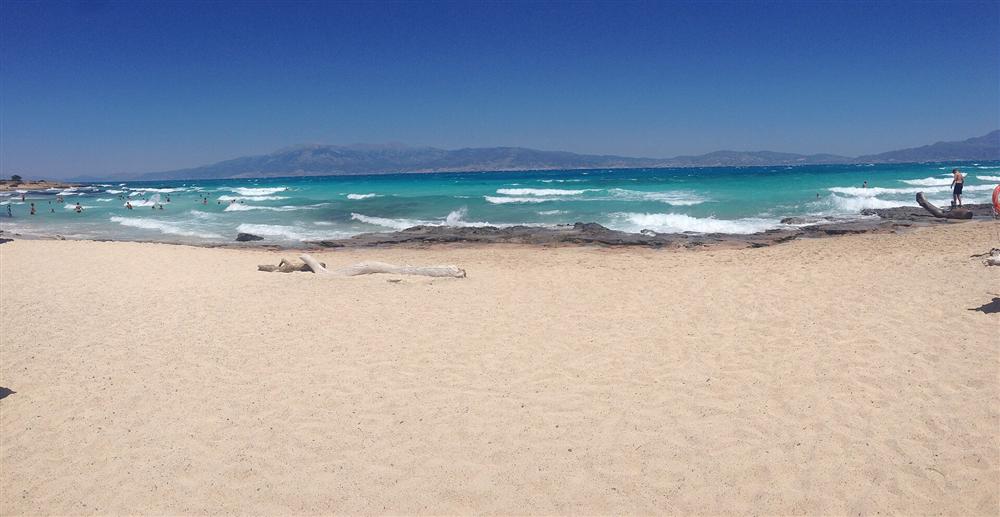
Golden Beach, or Chrysi Ammos, is the destination within the destination. Its sand is made of crushed seashells, pink-white underfoot, sloping into water that shades from clear to deep turquoise over a pale seabed. The shallows are warm, calm and shallow enough to wade far out. Fossilised dunes, banded rock and thousands of scattered shells give the island a landscape found nowhere else on the Cretan coast.
The trip is a full-day commitment: an hour out, hours on the sand, an hour back, with no shop, no shade beyond the cedars and no facilities beyond a single seasonal canteen. Visitors carry water, food and sun cover, keep to the paths that protect the fragile dunes, and take everything back off the island. Boats run in the warm season only, and departures depend on the sea state on the exposed southern crossing. For anyone reaching Ierapetra from the far west, Chrissi is the payoff that justifies the distance.
What beaches and sights lie near Ierapetra?
West of Ierapetra sits the seaside village of Myrtos and the Minoan villa at Fournou Korifi; north on the isthmus opens the Ha gorge; and east the coast runs through a string of beaches toward Makrigialos. Each is a short drive from the town and extends the trip beyond the beach and the boat.
Myrtos lies 15 kilometres west along the coast, a whitewashed fishing village with a grey-sand beach, a cluster of tavernas and a slow, unhurried pace. Above it on the hill of Fournou Korifi stands one of the earliest Minoan settlements excavated on Crete, a Bronze Age village whose foundations still trace rooms, lanes and workshops across the ridge. The pairing of a quiet swimming beach and a 4,500-year-old settlement makes Myrtos the natural half-day out from Ierapetra to the west.
North of town the Ha gorge cuts a dramatic vertical slash into the Thripti massif above the isthmus. It is a highly technical canyon on Crete, a narrow rock cleft reserved for equipped canyoners, but its cliff-framed mouth is a striking sight from the isthmus road and a landmark of the crossing. The Gournia Minoan town, a full excavated Bronze Age settlement, sits at the north end of the same isthmus where the road meets the sea.
East of Ierapetra the south-east coast unrolls a sequence of beaches, coves and small resorts. The road runs through Ferma and Koutsounari to Makrigialos, a broad sheltered bay with shallow warm water, a fishing harbour and a long sandy strand backed by tavernas. This eastern stretch catches the full southern sun and stays warm late in the year, and it links inland to the Minoan Villa of Makrigialos and the hill villages of the Sitia foothills. Together these sights turn Ierapetra from a single stop into a base for the whole south-east corner of Crete.
Is the long trip from Chania to Ierapetra worth it, and when to go?
The 250-kilometre trip rewards travellers who stay overnight and treat Ierapetra as a base for Chrissi island, the south-east beaches and an authentic working town. Go in late spring or early autumn, when the boats to Chrissi run, the heat eases, and the crowds thin across the south coast.
The distance is the honest obstacle. 3.5 hours of driving each way, or a full day on two buses, is a heavy price for a same-day return, and a day-tripper from Chania sees the road more than the destination. The trip earns its keep as an overnight or a multi-night stay, and better still as one leg of a wider eastern loop that takes in Agios Nikolaos, the Lasithi plateau, the palm beach at Vai and Sitia. Ierapetra as a single out-and-back from the far west is a long day for a short reward; Ierapetra as a two-night base opens the whole south-east.
The season sets the terms. Chrissi island boats run in the warm months, and the island is the strongest single reason to come, so a trip outside boat season loses its centrepiece. The Libyan-Sea coast holds its warmth from late spring through mid-autumn, longer than the north coast, and the sunniest-town climate keeps the beaches usable when Chania has turned cool. Late spring and early autumn hit the balance: the sea is warm, the boats sail, the greenhouse-plain heat of high summer has broken, and the seafront tavernas serve without the peak-season press.
For the western-based traveller, the verdict is a matter of appetite. Ierapetra offers a different Crete from the polished west: a farming town on the edge of Africa, a shell-sand island in protected water, cedar forest, a Venetian fort, low prices and long sun. Weighed against a short hop from Chania, it is a commitment. Weighed as a two-day journey to the opposite corner of the island, with Chrissi at its heart, it repays every kilometre of the drive east.
Frequently Asked Questions
How do you get from Chania to Ierapetra?
From Chania to Ierapetra, drive east on the E75/A90 national road through Rethymno and Heraklion to the Agios Nikolaos area, then south across the 12-kilometre Isthmus of Ierapetra to the south coast, 250 kilometres in 3.25 to 3.75 hours. By bus, take the KTEL Chania to Heraklion, then Heraklion to Ierapetra.
How far is Ierapetra from Chania?
Ierapetra lies 250 kilometres east of Chania, on the south-east coast of Crete in the Lasithi regional unit. The national road runs as far as the Agios Nikolaos area, and the final leg crosses the 12-kilometre Isthmus of Ierapetra, so the drive takes 3.25 to 3.75 hours.
Is the trip from Chania to Ierapetra worth it?
The trip from Chania to Ierapetra rewards visitors with the Kales fortress, the Chrissi island day boat and the sunniest town in Greece. The 250-kilometre distance makes Ierapetra a south-east base rather than a day trip from Chania.