
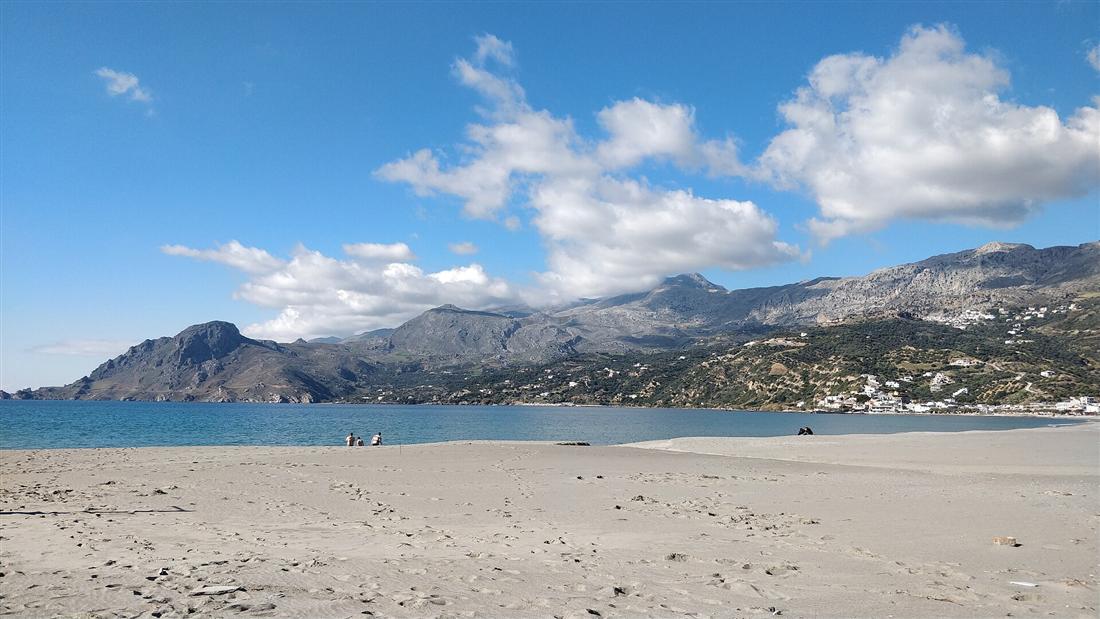
To get from Chania to Plakias, drive east on the E75/A90 national road to Rethymno, then south on the inland road through the Kourtaliotiko gorge to the coast, about 100 kilometres in 1.75 to 2 hours, to the laid-back grey-sand resort on the south coast of the Rethymno region. Plan the whole trip with Greece Tours.
This guide covers the trip from Chania to Plakias in full: where it is, how to get there by car and by KTEL bus, the drive through the gorge, the resort and its windswept bay, the beaches from Damnoni to Preveli Palm Beach, the Kourtaliotiko gorge, Myrthios and the Preveli monastery, and whether this south-coast trip is worth it or better as a base.
Where is Plakias and how far is it from Chania?
Plakias sits on the south coast of Crete in the Rethymno regional unit, 100 kilometres east-then-south of Chania. The road route bends east along the north coast to Rethymno, then cuts inland and south through the mountains to the sea, a drive of 1.75 to 2 hours.
Plakias faces the Libyan Sea, the stretch of Mediterranean that separates Crete from North Africa. This places it on the opposite coast from Chania, which sits on the island’s north shore facing the Cretan Sea. The two towns share the same island but different waters, and the mountain spine of Crete stands between them. That spine forces every route to run east first along the developed north coast and only then turn south across the interior.
The 100-kilometre figure is road distance, not the straight line across the map. As the crow flies, Chania and Plakias sit closer, but no coastal road crosses the roadless southwest, so traffic funnels through Rethymno. Plakias belongs administratively to the Rethymno regional unit, while Chania is the capital of its own regional unit to the west. Crossing from one to the other is a genuine transfer between two of Crete’s four prefectures.
Plakias serves as the anchor for a cluster of south-coast beaches and gorge scenery, which makes it a target for travellers based in the northwest. For the wider set of excursions out of the city, the guide to day trips from Chania maps the routes and driving times across the region, and Plakias ranks among the longer south-coast runs on that list.
How do you drive from Chania to Plakias?
Drive east from Chania on the E75/A90 national road to Rethymno, 60 kilometres in 50 minutes. At Rethymno, turn south onto the inland road through the Kourtaliotiko gorge and down to Plakias, 40 kilometres in 45 minutes. Total driving time runs 1.75 to 2 hours.
The first leg is fast and simple. The E75/A90 is Crete’s north-coast trunk road, a wide two-lane highway with long straights and gentle curves that hugs the sea between the two cities. Leaving Chania, the road passes Georgioupoli and the Kournas lake turnoff before reaching the outskirts of Rethymno. Traffic moves at national-road speed the whole way, and the 60 kilometres pass in 50 minutes without a single mountain climb.
The second leg changes character entirely. South of Rethymno the road narrows, climbs into the foothills, and then threads the Kourtaliotiko gorge, a deep limestone canyon carved by the river of the same name. The tarmac twists through the village of Koxare, drops between sheer rock walls, and opens onto the coastal plain above Plakias bay. This 40-kilometre stretch takes 45 minutes because the bends demand a slower pace, and the descent to the sea unfolds in tight switchbacks.
Fuel stations line the north-coast leg near Rethymno, so top up before the inland turn, where stations thin out. The gorge road is paved and in good order end to end, and standard hire cars handle it without difficulty. Drivers who start in the city itself find the run a clean out-and-back; the town profile for Chania sets out where the main car-hire depots sit and how to reach the eastbound national road from the old harbour district.
Parking in Plakias is straightforward. A free lot sits behind the seafront near the marina, and roadside spaces line the approach into town. The bay’s beaches, the gorge trailhead, and the Preveli clifftop each have their own parking, so a car turns the whole coast into a self-guided loop. Break the return by pausing at a gorge viewpoint or a Myrthios taverna on the climb back to the national road.
How do you get from Chania to Plakias by KTEL bus?
No direct bus links Chania and Plakias. Ride the frequent coastal KTEL from Chania to Rethymno, 1 hour, then change to the Rethymno-to-Plakias bus, 1 hour, routed through the Kourtaliotiko gorge and Koxare. The Plakias line runs a handful of departures a day in summer and thins off-season.
The first bus is the easy half. KTEL runs the Chania-Rethymno coastal service at high frequency through the day, with departures spaced close together from the Chania central station. The ride tracks the same national road a car takes and reaches the Rethymno bus station in 1 hour. Buy the ticket at the counter or from the driver, and confirm the Rethymno platform on arrival.
The second bus is the constraint. The Rethymno-to-Plakias service is a rural line with a handful of departures a day in the summer season, and fewer once the season ends. It leaves from the Rethymno station, climbs the same inland road through the Kourtaliotiko gorge, stops at Koxare, and reaches Plakias in 1 hour. Because the two legs run on separate timetables, the connection hinges on matching your Rethymno arrival to a Plakias departure, so check both schedules before setting out.
The full bus journey runs 2 to 2.5 hours end to end once the wait at Rethymno is counted, longer than the drive. Travellers without a car use it to reach Plakias for a multi-day stay rather than a single day out, since the sparse return timetable makes a same-day round trip tight. Carry the current KTEL timetable and plan the last Plakias-to-Rethymno departure into your day.
What is Plakias like as a resort town?
Plakias is a laid-back south-coast resort built along a long grey-sand bay with a small marina and a seafront of tavernas. It keeps a non-package, independent character, draws walkers and windsurfers rather than mass tour groups, and earns a reputation for strong afternoon winds off the Libyan Sea.
The town curves along the western end of a wide bay, its buildings low and its waterfront given over to a single strip of tavernas, cafes, and rooms-to-let. A small marina anchors the seafront where fishing boats and pleasure craft tie up. The grey sand runs in a long unbroken arc from the marina eastward, backed by tamarisk trees that throw shade over the beach through the hot hours. The scale stays human: no high-rise hotels, no manufactured resort core, just a working village that grew a tourist face.
Plakias built its name on independent travel rather than block bookings. The accommodation skews toward small family-run studios, apartments, and a long-standing youth hostel, which pulls in walkers, climbers, and returning regulars over charter crowds. That mix gives the town a slower, self-organised feel, where the day runs on beach time and the evening on taverna time. English, German, and Scandinavian voices mingle along the front, and the atmosphere stays unhurried into the shoulder months.
The wind is part of the identity. Through the afternoon the Libyan Sea sends a firm onshore breeze across the bay, cooling the beach and kicking up a chop that windsurfers ride hard. The same wind that suits board sports turns the water lively, so swimmers favour the calmer morning hours or the sheltered coves a short drive east. The tavernas serve the day’s catch, Cretan staples, and local wine, and the seafront lights up after dark with a relaxed dinner crowd.
What are the beaches of Plakias and Preveli Palm Beach like?
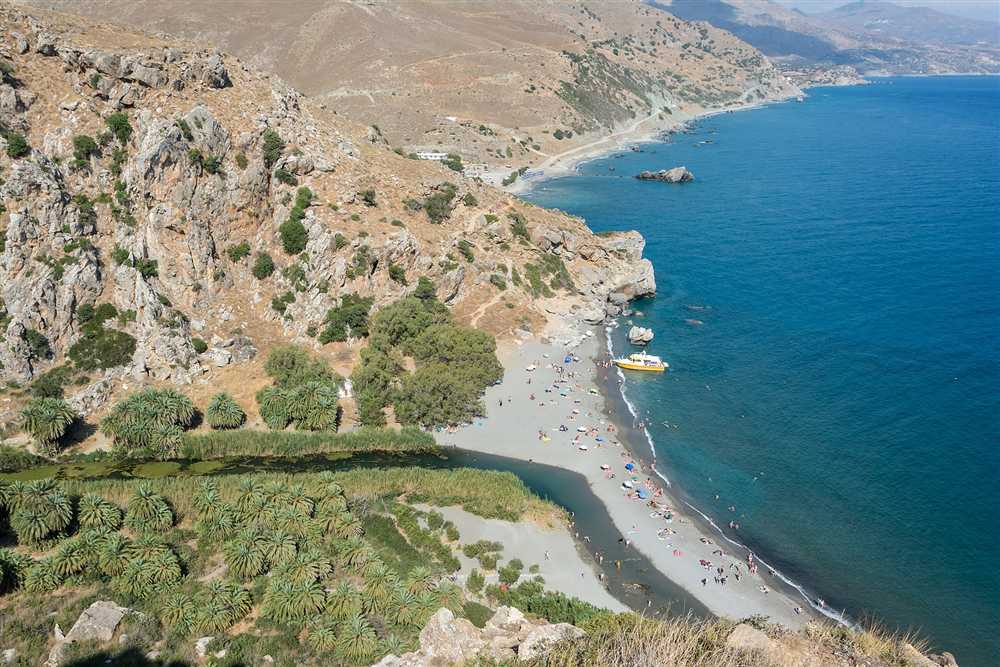
Plakias fronts a long grey-sand bay, and a string of coves lies a short drive east: Damnoni, Ammoudi, and Schinaria. Further east at the mouth of the Kourtaliotiko river gorge is Preveli beach, also named Palm Beach, a sheltered strand backed by a palm-lined freshwater lagoon beneath the Preveli monastery.
The town beach is the headline stretch: a long, wide arc of coarse grey sand with tamarisk shade, sunbeds toward the marina end, and open sand further along. It shelves gently into the sea and takes the afternoon wind full on, which suits board sports and keeps the water fresh. For calmer swimming, the coves east of town deliver. Damnoni is the closest, a compact sandy bay with clear water and a beach bar. Ammoudi sits just beyond it, smaller and quieter. Schinaria lies a little further east, a broad pebble-and-sand cove popular with divers for its clear, deep water.
Preveli beach is the star of the coast. It sits at the point where the Kourtaliotiko river reaches the Libyan Sea, and the river forms a freshwater lagoon fringed by a natural stand of Cretan date palms before it meets the salt water. The combination of golden sand, blue sea, palm grove, and a river you wade up into the gorge behind gives Preveli a scene found nowhere else on this stretch of Crete. The palm canyon runs inland from the beach and rewards a barefoot walk up the streambed.
Reaching Preveli takes effort, which keeps it from overcrowding. The road ends at a clifftop car park, and a stepped footpath descends to the sand, a steep climb back up in the heat. An alternative is the small seasonal boat that runs from Plakias marina to Preveli across the bay, which trades the cliff steps for a short sail. Above the beach stands the Preveli monastery, its terrace opening onto a wide view of the sea and the river mouth below.
What is there to do near Plakias beyond the beach?
The headline sights ring the town: the Kourtaliotiko gorge on the inland road, the hillside village of Myrthios overlooking the bay, the Preveli monastery above Palm Beach, and the Frangokastello Venetian fortress west along the coast. Walking trails, river hikes, and taverna terraces fill the days between beaches.
The Kourtaliotiko gorge is the gateway to the whole area and a destination in itself. The road threads its floor, but a footpath and a set of stone steps drop from a chapel viewpoint to the riverbed and the waterfalls that feed the pools below. Griffon vultures wheel over the limestone walls, and the river runs clear year-round, ending at Preveli beach downstream. Walkers combine the gorge descent with the palm-lined river hike inland from the beach for a full day on foot.
Myrthios hangs on the hillside directly above Plakias bay, a cluster of stone houses reached by a short climb from the coast road. Its tavernas command a wide view down over the town, the marina, and the Libyan Sea, which makes the village the prime spot for a sunset dinner. A footpath links Myrthios to Plakias on foot for walkers who prefer the trail to the road. The village keeps an old-Crete calm that the busier waterfront trades away.
Frangokastello lies west along the coast, a squat rectangular Venetian fortress standing alone on a flat shore with corner towers and a crenellated wall. The Venetians raised it to hold the unruly Sfakia district, and it fronts a shallow sandy beach that warms early and stays calm. The drive west from Plakias traces the empty south coast, one of the least developed shores on Crete. Between the fortress, the gorge, the monastery, and the mountain villages, the area rewards a stay of days of exploring beyond the sand.
Is the trip from Chania to Plakias worth it, and when to go?
The trip rewards travellers who want the wild, uncrowded south coast rather than another north-shore resort. Go from late spring to early autumn for warm seas and running buses. High summer brings the strongest afternoon winds and the busiest beaches; the shoulder months deliver quiet sand and gentle heat.
Plakias justifies the 2-hour transfer because it delivers a different Crete from the north coast. The Libyan Sea is warmer, the shore is emptier, the palm gorge at Preveli has no equal nearby, and the whole area keeps an independent, unpolished feel that the packaged north-coast strips have lost. For a driver, the run doubles as scenery: the Kourtaliotiko gorge alone earns the inland turn. Travellers weighing it against a closer beach trade 40 extra minutes of driving for a coastline that stays wild.
Timing shapes the experience. Late spring brings warm days, wildflowers in the gorge, and a full lagoon at Preveli fed by the winter river. High summer delivers the hottest sea and the liveliest town, along with the firmest afternoon winds off the Libyan Sea, which favour windsurfers and push swimmers to the morning water or the eastern coves. Early autumn holds the sea warmth while the crowds thin, and the light turns gold over Myrthios at dinner.
Plan the day by the wind and the bus. Reach the beaches by late morning for calm water, save the exposed town beach for board sports in the afternoon, and climb to Myrthios for the sunset. Bus travellers pin their return to the last Rethymno departure and treat Plakias as an overnight base rather than a same-day dash, while drivers move freely between the gorge, the fortress, and the string of coves on their own clock.
Fuel and timing shape the day. Fill the tank in Rethymno before the turn inland, since the gorge road runs without a petrol station to the coast, and pack water for the beach. The return climb from Plakias back over the gorge to the national road adds 45 minutes, so a day visitor leaves the south coast by late afternoon to reach Chania before dark, while a base at Plakias or Myrthios turns the drive into a one-time transfer and opens the whole south coast of the Rethymno region.
Frequently Asked Questions
How do you get from Chania to Plakias?
From Chania to Plakias, drive east on the E75/A90 national road to Rethymno, 60 kilometres in 50 minutes, then turn south on the inland road through the Kourtaliotiko gorge for 40 kilometres to the coast. The total run is 100 kilometres in 1.75 to 2 hours. The KTEL bus links Chania to Rethymno, then Rethymno to Plakias.
How far is Plakias from Chania?
Plakias lies 100 kilometres from Chania on the south coast of the Rethymno regional unit. The route splits into a 60-kilometre national-road leg to Rethymno and a 40-kilometre mountain leg through the Kourtaliotiko gorge, a drive of 1.75 to 2 hours in total.
Is the trip from Chania to Plakias worth it?
The trip from Chania to Plakias rewards visitors with a long grey-sand bay, the palm-lined Preveli beach and the Kourtaliotiko gorge, without the crowds of the north coast. The 100-kilometre drive is short enough for a day out and rewarding enough for a multi-day south-coast base.