
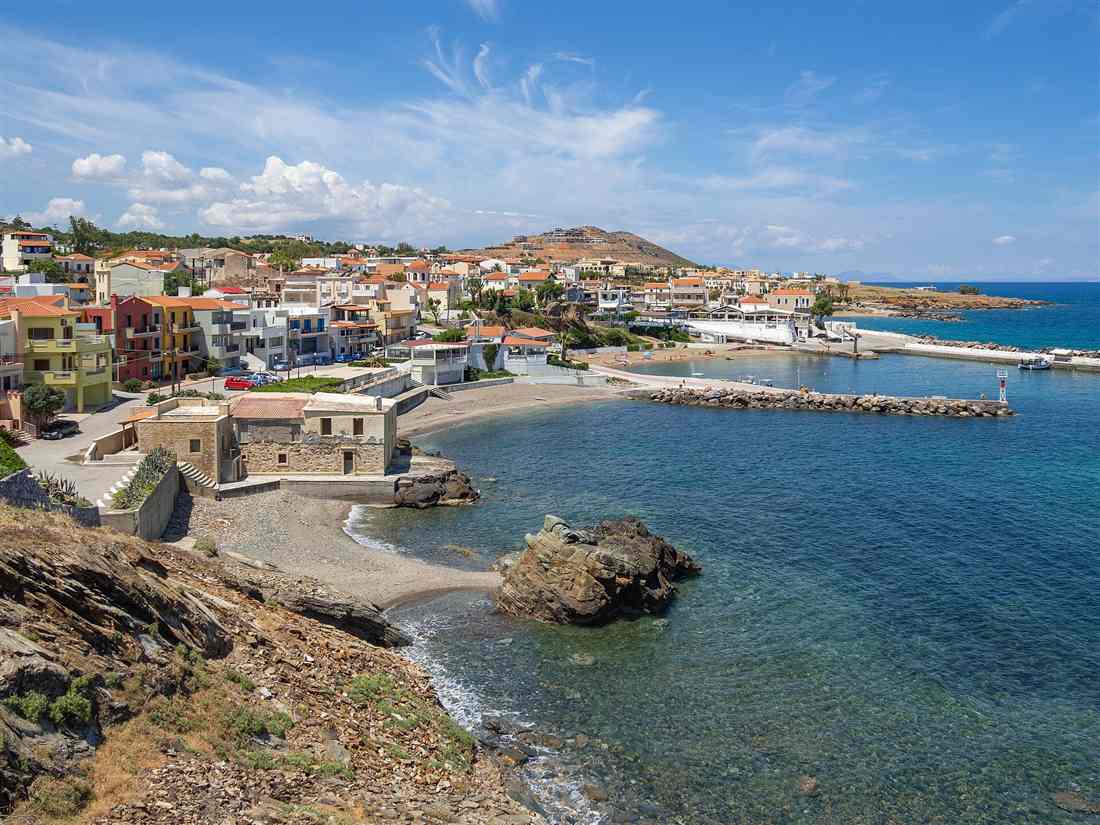
To get from Chania to Panormos, drive east on the E75/A90 national road past Rethymno to the Panormos exit, then the short side road to the village, about 85 kilometres in 1.25 to 1.5 hours, reaching the stone fishing village and its small Venetian harbour on the north coast of the Rethymno region. Plan the whole trip with Greece Tours.
This guide covers the trip from Chania to Panormos in full: where it is, how to get there by car and by KTEL bus, the compact village around its harbour, the beaches from Limanaki to Geropotamos, the ruined Milopotamos fortress and the Agia Sofia basilica, the resort of Bali and the pottery village of Margarites nearby, and whether this north-coast trip is worth it or a base of its own.
Where is Panormos and how far is it from Chania?
Panormos is a seaside fishing village on the north coast of Crete, inside the Rethymno regional unit, 22 kilometres east of Rethymno town and 85 kilometres east of Chania. The drive covers that 85 kilometres in 1.25 to 1.5 hours along the E75/A90 national road.
Panormos, also spelled Panormo, sits on the open coastline between Rethymno and the resort of Bali. This is the Cretan Panormos, not the small harbours that carry the same name on Mykonos and Tinos in the Cyclades. The village faces the Cretan Sea to the north, backs onto the foothills of the Talea range, and marks the eastern edge of the Milopotamos district within the Rethymno regional unit. Its position on the main north-coast corridor puts it within easy reach of both Rethymno and Heraklion, and it stands at a clean, measured distance from Chania in the far west.
From Chania, the route runs straight east along the spine of northern Crete. The national road links Chania, Rethymno and Heraklion in one continuous line, and Panormos lies on that line, past Rethymno, three-quarters of the way toward Heraklion. Drivers reach the village through a signed exit off the national road, followed by a short descent to the harbour. The 85-kilometre journey is one of the more direct point-to-point runs on the island, with the sea on the left and the mountains on the right for much of the way.
The trip suits travellers based in Chania who want a north-coast village that keeps its fishing character. Panormos rewards the distance with a Venetian harbour, a cluster of sandy beaches, and a compact stone core that never turned into a package resort. Its 85-kilometre gap from Chania is short enough for a full day out and long enough to feel like a genuine change of scene.
How do you drive from Chania to Panormos?
Drive east out of Chania on the E75/A90 national road, pass Rethymno, and stay on the coastal highway to the signed Panormos exit. Leave the national road there and take the short side road down to the village. The full run is 85 kilometres in 1.25 to 1.5 hours.
The route is one straight artery. Join the national road on the eastern side of Chania and follow the signs for Rethymno and Heraklion. The road hugs the north coast, cutting past Georgioupoli and Episkopi before it reaches Rethymno at the 60-kilometre mark. Keep on the highway as it bypasses Rethymno town \u2014 the signs continue to read Heraklion \u2014 and press east past Platanias and the coastal plain toward the Milopotamos district. The Panormos exit is signed by name; the village name appears on the blue national-road boards well before the turn.
Leaving the highway, the side road drops through a short stretch of olive groves and delivers you into the village within two minutes. Parking sits on the edge of the stone core, since the inner lanes are narrow and built for foot traffic. The surface of the national road is smooth two-lane blacktop with wide margins for much of the distance, and the gradient stays gentle throughout, so the 85-kilometre drive holds a steady pace rather than a mountain crawl.
Timing lands between 1.25 and 1.5 hours depending on traffic through the Rethymno stretch. The single fuel stop worth planning is on the approach to Rethymno, where service stations cluster along the highway. Panormos works as one stop on a wider coastal loop \u2014 pairing it with Bali to the east or Rethymno old town to the west turns the drive into a full itinerary. Travellers who want the village as part of a broader set of day trips from Chania find it slots neatly between the western beaches and the Rethymno coast.
A rental car gives full control over the journey, since the village rewards an unhurried arrival and a flexible departure. The road is well maintained end to end, the signage is consistent, and the only sharp navigation comes in the final descent to the harbour, where the lanes tighten and speed drops to walking pace.
How do you reach Panormos by bus?
No direct bus links Chania and Panormos. Take the KTEL coastal service that runs Chania\u2013Rethymno\u2013Heraklion, and ride it to the Panormos junction on the national road. From that junction it is a short walk or a taxi down to the village. Change at Rethymno if the through service does not stop.
The KTEL network is the backbone of public transport on Crete, and the north-coast line is its busiest route. Buses depart the Chania KTEL station and run east along the same national road that cars use, calling at Rethymno before continuing toward Heraklion. Panormos is served at the junction where the village exit meets the highway, not inside the village core, so the drop-off point is on the main road above the settlement.
The cleanest approach is to ride the Chania\u2013Rethymno leg first, then board a Rethymno\u2013Heraklion coastal bus that halts at the Panormos junction. Staff at the Rethymno KTEL station confirm which departures stop there, since the express services skip minor junctions while the all-stops services call at them. Buying the second leg at Rethymno keeps the connection flexible and lets you check the exact stop before boarding.
From the junction, the village lies a short distance downhill. The walk takes ten to fifteen minutes on foot, dropping through olive groves to the harbour, and a taxi covers it in two minutes for travellers with luggage or limited time. Return timing needs the same planning in reverse: note the last coastal service back toward Rethymno and Chania before setting out, since evening frequencies thin out on the all-stops line. For a car-free day, the bus reaches Panormos reliably, provided the junction stop and the change at Rethymno are built into the plan from the start.
What is Panormos like as a village?
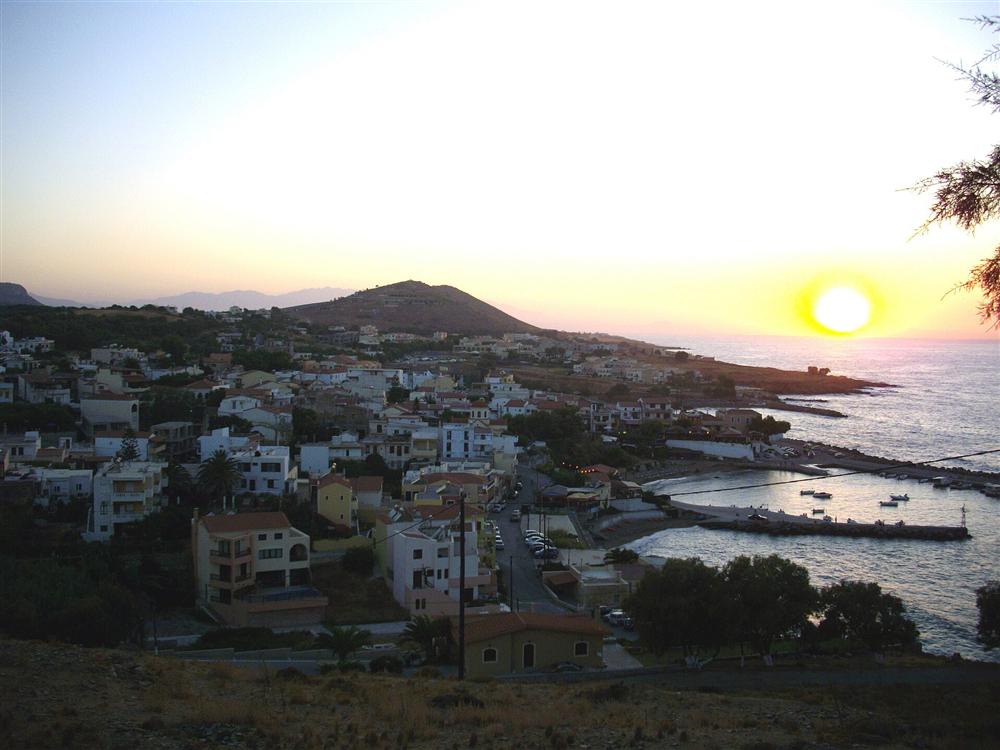
Panormos is a compact stone village wrapped around a small Venetian harbour, threaded with narrow lanes, lined with family tavernas, and edged by sandy beaches. It keeps a quiet, un-package, family character that sets it apart from the built-up resorts along the same coast.
The heart of the village is the old harbour, a snug Venetian basin where fishing boats still tie up beside the quay. Stone houses climb the slope behind it, and the lanes between them are too tight for through traffic, so the core stays given over to walkers. Bougainvillea spills over doorways, tavernas set their tables on the waterfront, and the pace holds at the unhurried rhythm of a working fishing settlement rather than a tourist strip.
Food is the village’s daily theme. Family-run tavernas ring the harbour and fill the back lanes, serving grilled fish landed by the local boats, Cretan meze, and slow-cooked village dishes. The kitchens are household operations passed down through generations, and the menus lean on what the sea and the surrounding farmland provide. Evenings gather along the waterfront, where the harbour lights reflect on the water and the tables run late.
What defines Panormos is what it never became. The coast east and west carries large resort complexes, but Panormos held onto its stone core, its fishing fleet, and its family scale. The result is a village that reads as authentic Crete \u2014 small enough to cross on foot in fifteen minutes, anchored by a Venetian harbour, and populated by families who live there year-round. That un-package character is the single strongest reason travellers make the 85-kilometre trip from Chania.
What are the beaches of Panormos?
Panormos fronts a run of sandy beaches. Limanaki is the small, sheltered village beach beside the harbour; Kato Gialos is the longer strand stretching east; and Geropotamos is the wide open beach at the river mouth to the west. The three cover calm family swimming, longer sandy walks, and open sea in one short stretch of coast.
Limanaki is the beach closest to the heart of the village, tucked beside the Venetian harbour. It is small, sandy, and sheltered by the harbour arm, so the water stays calm and shallow at the edge \u2014 the beach families choose for young children. Steps from the tavernas and the lanes, it functions as the village’s own front-door swimming spot, busy in high summer and quiet in the shoulder months.
Kato Gialos runs east from the harbour as the longer of the village beaches. Its sandy stretch gives room to spread out beyond the compact core, with sunbeds and tavernas backing part of the shore and open sand beyond. This is the beach for a longer swim and a shoreline walk, and its length absorbs summer crowds better than the pocket-sized Limanaki.
Geropotamos lies to the west, at the mouth of the Geropotamos river, where fresh water meets the sea. It is the widest of the three, a broad open sweep of sand exposed to the Cretan Sea, with a wilder feel than the sheltered village beaches. The river mouth and the open aspect draw walkers and swimmers who want space and a natural setting rather than serviced sand. Together, the three beaches give Panormos a range that runs from a calm child-friendly cove to an open windswept strand inside a two-kilometre span, and that variety is a core part of the village’s appeal.
What are the Milopotamos fortress, Agia Sofia basilica and nearby sights?
Above the harbour stand the ruins of the Venetian fortress of Milopotamos, Castello Milopotamo, guarding the coast. Nearby lie the ruins of the large early-Christian basilica of Agia Sofia. Within a short drive sit the resort of Bali to the east, the Melidoni Cave, the pottery village of Margarites inland, and Rethymno old town to the west.
The Venetian fortress of Milopotamos, known as Castello Milopotamo, crowns the rise above the harbour. Built to watch and defend this stretch of the north coast, it now stands as a ruin, its walls broken but its command of the sea intact. The climb to the site rewards visitors with a sweep across the harbour, the beaches, and the open Cretan Sea, and the stones themselves date the village’s strategic role back to the Venetian centuries on Crete.
The early-Christian basilica of Agia Sofia is the village’s second major monument. Its ruins mark a large three-aisled church from the early-Christian era, evidence that Panormos held real importance long before the Venetians arrived. The scale of the surviving foundations shows a substantial place of worship, and the site sits within reach of the harbour, tying the village’s Byzantine past to its stone-built present.
The country around Panormos is dense with sights. East along the coast is the resort of Bali, set in a cluster of small coves. Inland rise the attractions of the Milopotamos district: the Melidoni Cave, a cavern of stalactites carrying an ancient and a tragic history, and Margarites, a hillside village famous across Crete for its potters and their workshops. West along the coast waits Rethymno old town, with its Venetian harbour, Fortezza citadel, and maze of lanes. This concentration of monuments, caves, craft villages and old towns means Panormos anchors a full touring region, not a single stop.
Is the trip from Chania to Panormos worth it, and when to go?
The trip is worth it for travellers who want an authentic north-coast fishing village over a package resort. The 85-kilometre drive takes 1.25 to 1.5 hours each way, so it fills a full day. Late spring and early autumn bring warm sea, open tavernas, and thinner crowds than the peak summer weeks.
Panormos earns the distance on character. The Venetian harbour, the three-beach spread from sheltered Limanaki to open Geropotamos, the fortress of Milopotamos, the Agia Sofia basilica, and the family tavernas add up to a destination that holds a full day rather than a quick photo stop. Pairing the village with Bali to the east or Rethymno old town to the west turns the 85-kilometre run into a complete coastal itinerary, and the direct national road keeps the driving simple from end to end.
Season shapes the visit. Late spring warms the sea and fills the harbour tavernas while the crowds stay light, and early autumn holds the warm water and the open kitchens deep into the shoulder season with even smaller numbers. High summer brings the fullest life to the waterfront and the busiest beaches, along with the strongest heat and the tightest parking. The winter months quiet the village to its year-round core, when the seasonal tavernas close and the fishing rhythm takes over.
For a day out of Chania, Panormos delivers a genuine fishing village at a measured distance, reached by a clean 1.25-to-1.5-hour drive or by the coastal KTEL line with a change at Rethymno. Travellers who value stone lanes, a working harbour, and un-package Crete over a serviced resort find the journey pays off, and the surrounding district of caves, potters and Venetian towns gives every reason to linger past a single afternoon.
The short distance makes the timing easy. Panormos sits close enough to Chania for a half-day visit, and close enough to Rethymno old town for a combined outing that pairs the harbour village with the Venetian city 22 kilometres west. Fill the tank in Rethymno if the plan runs on to Bali or the Melidoni Cave, and read the day trips from Chania guide to string the north-coast stops into one route. A base at Panormos itself opens the beaches, the fortress and the inland villages without the drive.
Frequently Asked Questions
How do you get from Chania to Panormos?
From Chania to Panormos, drive east on the E75/A90 national road past Rethymno to the Panormos exit, then the short side road to the village, 85 kilometres in 1.25 to 1.5 hours. By bus, take the Chania-Rethymno-Heraklion coastal KTEL to the Panormos junction, then walk or taxi to the village.
How far is Panormos from Chania?
Panormos lies 85 kilometres east of Chania on the north coast of Crete in the Rethymno regional unit, 22 kilometres east of Rethymno town, between Rethymno and Bali. The drive on the fast national road takes 1.25 to 1.5 hours.
Is the trip from Chania to Panormos worth it?
The trip from Chania to Panormos rewards visitors with a quiet stone village around a Venetian harbour, a run of sandy beaches and a ruined fortress above the sea, 1.25 hours from the city. The short distance suits a day out and a relaxed north-coast base.