
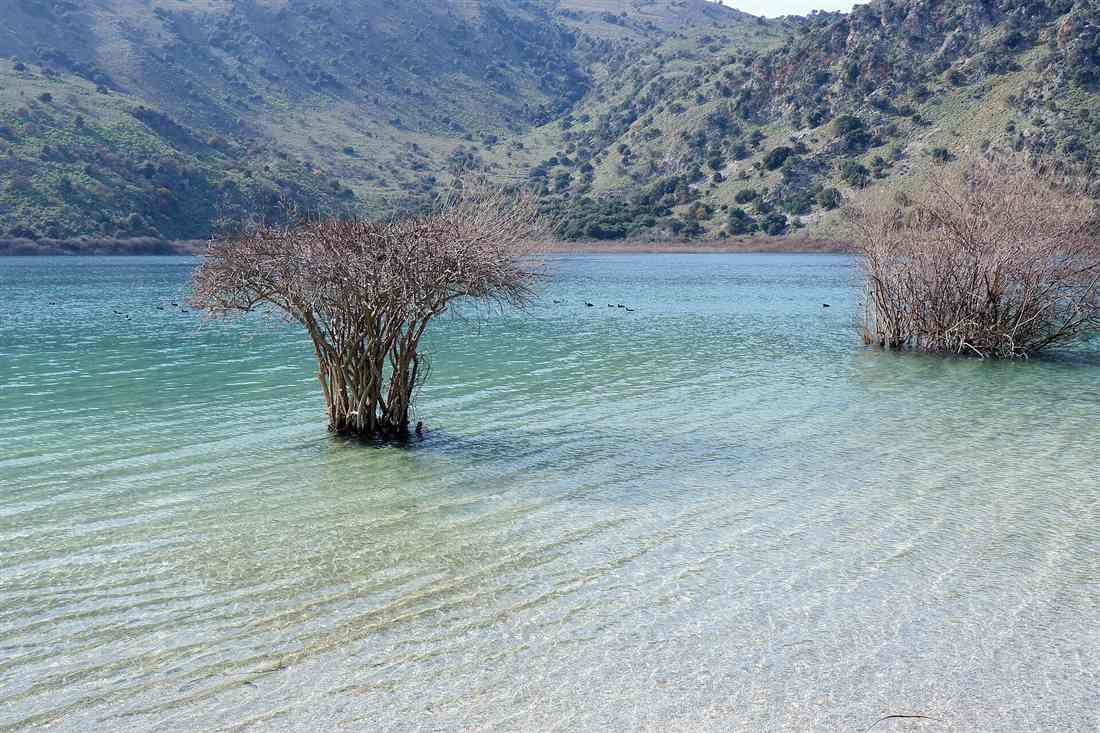
To get from Chania to Lake Kournas, drive east on the E75/A90 national road to the Georgioupoli exit, then the local road 4 kilometres inland to the lake, about 43 kilometres in 40 to 45 minutes, reaching the only natural freshwater lake in Crete in its bowl below the Apokoronas hills. Plan the whole trip with Greece Tours.
This guide covers the trip from Chania to Kournas in full: where it is, how to get there by car and by bus, the lake and its shifting colours, the pedal boats, kayaks and swimming, the wildlife and why the water turns from blue to green, the village of Kournas and the coastal resort of Georgioupoli nearby, and whether this short trip is worth it.
Where is Lake Kournas and how far is it from Chania?
Lake Kournas sits in the Apokoronas area of the Chania regional unit, 4 kilometres inland from the coastal resort of Georgioupoli and 43 kilometres east of Chania. It is the only natural freshwater lake in Crete, set in a mountain bowl below the Dramia hills.
The lake fills a natural depression on the eastern edge of the Chania regional unit, where the flat coastal strip of Georgioupoli gives way to the first slopes of the Apokoronas uplands. From the harbour front of Chania town, the distance to the lakeshore is 43 kilometres by the national road, a run of 40 to 45 minutes when traffic on the coast road is light. The lake sits at an altitude of 20 metres above sea level, so the road from the coast climbs a short, gentle grade inland from the Georgioupoli junction before the water opens up in the valley below the village.
Kournas belongs to the Apokoronas municipality, a district of stone villages, olive groves and cypress hills that stretches from the Georgioupoli coast up toward the foothills of the White Mountains. The lake is the district’s single defining landmark and its best-known feature. Georgioupoli, the palm-lined resort on the shore, is the nearest settlement of any size, 4 kilometres north on the coast, and it acts as the gateway for every visitor who arrives without a car. Rethymno town lies 20 kilometres east along the same national road, which places the lake almost exactly halfway between the two western Cretan capitals.
The setting is compact and self-contained. A ring of tavernas and boat-rental jetties lines the near shore where the road meets the water, while the far shore stays wild, backed by tall reed beds and the bare rock of the Dramia ridge. The whole basin is a protected Natura landscape, which keeps building off the water’s edge and preserves the amphitheatre of hills that enclose it. For a traveller measuring the trip, the headline figures are simple: 43 kilometres from Chania, 4 kilometres from the sea at Georgioupoli, and a single freshwater lake that exists nowhere else on the island. The lake reads as a natural extension of the western Cretan coast, close enough for a morning visit yet far enough inland to feel like a change of country, from open sea to a walled valley of fresh water in under an hour.
How do you drive from Chania to Kournas?
Drive east from Chania on the E75/A90 national road for 39 kilometres to the Georgioupoli exit, then turn inland on the signed local road for the final 4 kilometres to the lake. The full trip is 43 kilometres and takes 40 to 45 minutes.
The route is direct and needs no navigation skill beyond following the coast road east. Leave Chania on the E75, the northern coastal artery that carries the A90 designation, and hold it eastbound past Souda Bay, the Kalyves and Almyrida turnoffs, and the long straight stretch above Georgioupoli beach. The Georgioupoli exit is clearly marked with brown tourist signs for the lake, and the slip road drops down toward the resort before the inland road for Kournas branches off to the right. From that junction the local road climbs a gentle valley through olive terraces, past the village of Mathes, and delivers you to the tavernas at the water’s edge, where the road ends at the shore.
The driving surface is good the whole way. The national road is a two-lane highway with wide shoulders and a 90-kilometre-per-hour limit on the open sections, dropping through the junction zones. The final 4-kilometre inland stretch is a narrower asphalt road with tight bends as it winds down into the basin, so the last few minutes run slower than the highway pace. Free parking sits along the near shore and in a gravel lot beside the boat jetties; in high summer the shoreline spaces fill by late morning, and the overflow lot up the slope takes the rest.
A car is the fastest and freest way to reach the lake, and it opens up the wider Apokoronas district on the same outing. Kournas pairs naturally with a string of other stops on this eastern flank of the Chania unit, which is why it features on countless self-drive itineraries and organised day trips from Chania. Fuel stations sit at Vryses and along the national road, and the drive back to Chania town at the end of the day mirrors the outbound run, 43 kilometres west on the same highway. For a half-day excursion the timing is generous: a 45-minute drive out, three or four hours at the water, and a 45-minute drive home.
How do you reach Kournas by bus?
No direct bus line runs to the lake. The KTEL coastal bus from Chania serves Georgioupoli on the main road, and from Georgioupoli the final 4 kilometres to the lakeshore is a short taxi ride or a walk inland. Plan the connection before you set out.
Public transport reaches the coast, not the water itself. The KTEL bus network runs frequent services along the Chania-to-Rethymno corridor, and the Georgioupoli stop sits on the national road above the resort, served by the intercity coaches that shuttle between the two towns through the day. The ride from the Chania KTEL station to the Georgioupoli junction takes 40 to 50 minutes depending on the stops the service makes. Buy the ticket at the Chania station counter or from the driver, and tell the driver you are getting off at Georgioupoli so the coach halts at the junction rather than running straight past it.
From the Georgioupoli stop the lake lies 4 kilometres inland, and there is no onward bus to bridge that gap. The practical options are two. A taxi from the Georgioupoli rank runs the 4 kilometres up to the tavernas in eight to ten minutes for a modest fixed fare; arrange the return pickup with the same driver, because the taxi rank at the lake itself thins out by late afternoon. The alternative is to walk, a 4-kilometre uphill route inland along the valley road that takes 50 minutes to an hour on foot, with the reward of the lake opening up below you as you crest the last rise.
For travellers without a car, the cleanest plan combines the two legs into a full day on the coast. Take the morning KTEL coach to Georgioupoli, spend time on the palm-backed beach and the little chapel on the breakwater, then taxi the 4 kilometres up to Kournas for lunch at a lakeside taverna and an afternoon on the water before the coach back to Chania. The bus keeps the trip cheap and simple as far as the coast; the last 4 kilometres are the piece to organise in advance, and a pre-booked taxi removes the one weak link in the chain.
Timing the coaches matters for a car-free day. The Chania-to-Rethymno service runs through the daylight hours, so an outbound seat is easy to catch, but the return coaches thin out toward evening, and the Georgioupoli junction is a request stop rather than a staffed station. Check the last departure back to Chania before leaving town, allow time for the 4-kilometre taxi hop down from the lake to the coast road, and stand at the junction stop in good time, because a coach passing a request stop with no waiting passenger drives straight on. Organised excursions sidestep the whole connection by running door to door from Chania, which is why a booked day trip is the simplest car-free route to the water.
What is Lake Kournas like?
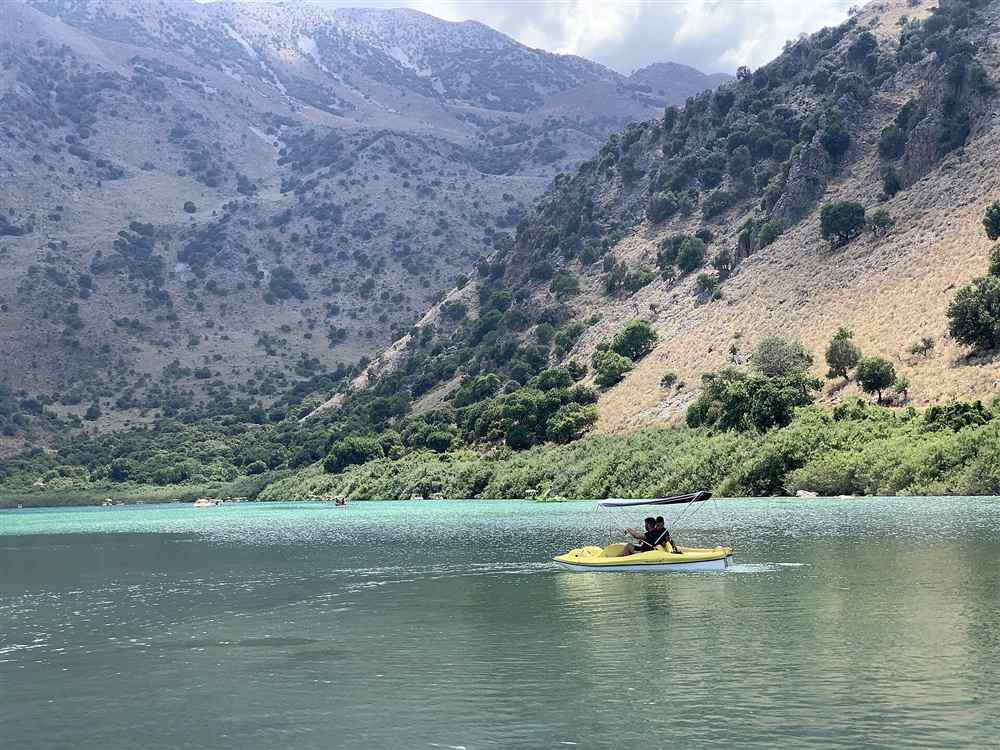
Lake Kournas is a broad, spring-fed freshwater lake in a natural bowl below the Dramia hills, its water shifting from deep blue to turquoise and green through the season. A ring of tavernas and boat jetties lines the near shore while the far shore stays wild with reeds and mountains.
The lake covers 579,000 square metres and reaches a depth of 22 metres at its centre, which makes it the largest body of standing fresh water on Crete as well as the only natural one. Springs on the bed and along the margins feed it, and the level rises through the wet months and drops through the dry ones, so the shoreline breathes in and out across the year. When the water is high the lake laps close to the taverna terraces; when it falls, a broad strip of firm sand and pale mud emerges on the southern side, forming the small seasonal beach where people spread out to swim and sunbathe.
The two shores tell opposite stories. The near shore, where the road arrives, is the lively front: a line of tavernas on stilted terraces over the water, racks of pedal boats and kayaks pulled up on the sand, and a paved edge where families gather. Cross to the far side, and the scene turns wild. Tall reed beds fringe the water, the bare grey rock of the Dramia ridge rises straight behind, and the only sound is birdsong and the wind through the canes. That contrast, a busy resort edge facing an untouched natural amphitheatre across a sheet of coloured water, is the character of the place.
Life fills the water and its margins. Terrapins bask on half-submerged logs and slip into the shallows as walkers pass, ducks paddle the open water, and eels move through the deeper channels. The whole basin carries Natura protection, which keeps development off the water’s edge and preserves the reed beds, the springs and the ring of hills as a single landscape. The effect on arrival is immediate: the road drops over a lip, the valley opens, and a bowl of blue-green water sits ringed by mountains, so still that the ridgeline reflects across its surface. Few Cretan sights land with that much impact in a single first glance.
What is there to do at Lake Kournas?
Rent a pedal boat or a kayak and paddle across to the wild far shore, swim off the seasonal beach on the south side, walk the shore path that rings the water, and eat at a lakeside taverna. The lake pairs with the beach and river of Georgioupoli on the coast for a full day.
The pedal boats and kayaks are the headline activity and the reason the near shore stays busy. Racks of two-seat and four-seat pedalos line the sand beside the tavernas, hired by the hour, and paddling them out to the middle of the lake is the classic Kournas experience. The pedalos let you cross to the untouched far shore, where terrapins bask on the reed banks and the mountain wall drops straight into the water. Kayaks suit anyone who wants a faster, more active loop of the whole shoreline, and both float on water clear enough to see the pale bed a metre or two down near the margins.
Pricing and hours are simple and seasonal. The pedalos and kayaks run from late morning through the afternoon in the warm half of the year, hired by the hour at the jetties on the near shore, with life jackets handed out for children. Sun loungers and umbrellas sit on the seasonal beach for a small daily charge, the tavernas keep their terraces open through lunch and into the evening, and the whole shore front operates without tickets or gates, since the lake is open ground under Natura protection. A visit needs no booking: arrive, park, hire a boat at the water, and the day builds itself from there.
Swimming is the second draw, and it works best when the level has dropped. As the summer heat pulls the water back, a firm sandy beach opens on the southern side, and the freshwater there is cool, clean and calm, a marked change from the salt and swell of the coast 4 kilometres away. The shallows warm through the day, the deeper water off the beach stays bracing, and there is no surf and no current, which makes it a gentle spot for children. A walking path traces much of the shoreline, and following it away from the tavernas brings quiet, birdsong and clear views back across the water to the village on its hill.
Eating at the water’s edge rounds out the visit. The tavernas on their stilted terraces serve Cretan cooking a metre above the surface, with the whole bowl of the lake spread out in front of the table, and lunch here stretches to fill the hot middle of the day. The natural way to build the outing is to twin the lake with the coast: the palm-lined beach and shallow warm sea of Georgioupoli, the mouth of the Almyros river, and the little white chapel that stands at the end of the breakwater are all 4 kilometres down the road. Lake in the morning, coast in the afternoon, or the reverse, and the day is full without a minute of dead time.
Why does the lake change colour, and what wildlife lives there?
The lake shifts from deep blue to turquoise and green as the season advances and the water level drops, exposing the pale bed and stirring the springs. Terrapins, ducks and eels live in the water, and the whole reed-fringed basin is a protected Natura landscape.
The colour is a product of depth, light and the lake bed. In the wet months the water stands deep over a dark bed and reads as a rich blue that mirrors the sky and the surrounding rock. As the dry season pulls the level down, the shallows spread wider over pale sand and mud, and sunlight bouncing off that light bed turns the near water a vivid turquoise, shading to green over the reed banks and the algae of the margins. Springs feeding in from below add their own clarity, and the same lake photographs blue at one edge and green at another on a single afternoon, the two colours meeting in a band across the middle where deep water gives way to shallow.
The wildlife is the reason the basin carries its protected status. Terrapins are the animal every visitor meets, dozens of them hauled out on logs and reed stems along the quiet shore, sliding into the water as a shadow passes. Ducks work the open surface, herons stalk the reed margins, and eels move unseen through the deeper channels, a freshwater community with no parallel elsewhere on an island otherwise ringed only by sea. The tall reed beds along the far shore are the nursery for this life, sheltering the young fish and amphibians and screening the birds that nest in the canes.
The Natura designation ties the whole scene together and guards its future. Building is held back from the water’s edge, the springs and reed beds are preserved, and the ring of Dramia hills that walls the basin stays bare and wild. That protection is why the far shore has never been developed and why the lake still reads as a piece of untouched nature rather than a landscaped resort feature. The changing colour, the basking terrapins and the reed-fringed stillness are all products of the same thing: a spring-fed natural lake left to behave as a natural lake, the single one of its kind on Crete.
What are the village of Kournas, Georgioupoli and the nearby sights?
The village of Kournas sits on the hillside above the lake, with the Byzantine church of Agios Georgios, stone houses and an old olive-oil culture in the uplands. On the coast, Georgioupoli offers a palm-lined beach, a breakwater chapel and the Almyros river, with Vamos, Vryses, Kavros, Dramia and Episkopi close by.
Kournas village stands on the slope above the water, a cluster of stone houses on stepped lanes that looks down over the whole basin. Its church of Agios Georgios carries Byzantine roots, and the surrounding uplands hold the old olive-oil culture of the district, terraces of ancient trees and the stone presses that worked their fruit. A cave in the hills above the village belongs to the same uplands, part of the karst landscape that feeds the springs below. Walking up into the village from the lake trades the busy shore for quiet lanes, shade and a high vantage back over the coloured water.
Georgioupoli, 4 kilometres down on the coast, is the lake’s twin destination and the reason countless visitors combine the two in one outing. The resort spreads behind a long sandy beach lined with palms and eucalyptus, the mouth of the Almyros river brings cool fresh water down to the sea, and the small white chapel of Agios Nikolaos stands alone at the end of a stone breakwater, reached by a walk out over the waves, one of the best-known spots on this coast. The village square sits under huge plane trees, and the shallow warm sea makes the beach a gentle counterpoint to the lake’s cool fresh water.
The wider Apokoronas district rewards a slower look beyond the two anchors. Kavros and Dramia are the coastal villages either side of Georgioupoli, Dramia lending its name to the hills that wall the lake. Episkopi, a short way east, has a long quiet beach and a historic church. Inland, the handsome hill village of Vamos is the old capital of Apokoronas, built in honey-coloured stone with restored houses and courtyards, and Vryses sits astride the national road where the mountain streams come down, a village of plane-shaded cafes on the water. Any of these turns a lake visit into a full circuit of western Crete’s richest district.
The uplands behind the lake carry the older layers of the story. Terraced olive groves climb the slopes above Kournas, worked for centuries and pressed in stone mills whose ruins still stand among the trees, and the karst limestone of the hills holds the caves and the underground water that surfaces as the lake’s springs. Byzantine chapels dot the ridges, dry-stone walls thread the terraces, and footpaths link the hamlets across the valley. This is the deeper Apokoronas, the farming country that ringed the lake long before the tavernas and pedal boats arrived, and a short walk up from the shore drops a visitor straight into it.
Is the trip to Kournas worth it, and when is the best time to go?
The trip is worth it: a 45-minute drive delivers the only natural freshwater lake on Crete, a bowl of blue-green water walled by mountains, with boats, swimming and lakeside tavernas. Go in late spring or early autumn for full colour and calm; arrive early on a summer day to beat the crowds and the parking, and pair the lake with the beach at Georgioupoli to fill the day.
For a landmark 43 kilometres from Chania, Kournas returns far more than the short drive costs. It is a genuine natural rarity, the single freshwater lake on an island otherwise defined by its coastline, and it delivers on first sight in a way few inland stops match. The mix of activity and stillness is its strength: pedal boats and busy tavernas on one shore, untouched reed beds and basking terrapins on the other, cool fresh swimming, and the coast of Georgioupoli 4 kilometres away for the second half of the day. A traveller building a half-day out of Chania finds few better returns on 45 minutes of driving.
Timing shapes the visit more than anything else. Late spring brings the lake at its fullest and greenest, the surrounding hills still carpeted in wildflowers, the water high against the taverna terraces and the air comfortable for walking the shore path. Early autumn is the other sweet spot: the water has dropped to expose the seasonal beach, the colour has turned its brightest turquoise, the crowds of high summer have thinned, and the swimming is at its warmest. Both seasons hand you the lake in good light and light company.
High summer works with a plan. The lake fills through July and August, the pedalos run flat out, and the shoreline parking is gone by late morning, so an early arrival is the key that unlocks a calm morning on the water before the coaches and self-drivers pour in. Midday heat is fierce in the exposed basin, which is exactly when a long lunch on a shaded taverna terrace over the water earns its place, before an afternoon swim off the south beach. Come at dawn light or in the shoulder seasons and Kournas rewards the effort every time, a natural landmark that carries its reputation on merit and pairs a mountain lake with a Cretan beach in a single unhurried day.
The lake rewards a slow visit over a quick photo stop. Arrive early to take a pedal boat out on the still turquoise water before the day-trip coaches fill the near shore, then walk the shaded path along the wild north bank where the reeds hide terrapins and waterbirds. Swim off the seasonal beach on the south side as the level drops through the summer, eat grilled fish at a taverna set on stilts over the water, and climb to the village of Kournas above for the view down over the whole bowl. Pair the lake with an afternoon on the palm-lined beach and river of Georgioupoli on the coast, and the short run from Chania fills a rewarding day rather than a rushed hour.
Timing and season shape the visit as much as the drive. In late spring the lake brims deep blue to the reed line, the surrounding hills stay green, and the water runs cool for a swim. Through high summer the level drops to expose the pale south-side beach and the colour warms to turquoise and jade, while the tavernas and boat rentals run at full tilt. Autumn holds warm water with thinner crowds, and winter fills the bowl again under the rain. Bring water shoes for the pebbly entry, a hat for the open shore, and cash for the boats and tavernas, and the short run from Chania turns a single natural landmark into a full, unhurried day out.
Frequently Asked Questions
How do you get from Chania to Lake Kournas?
From Chania to Lake Kournas, drive east on the E75/A90 national road to the Georgioupoli exit, then the local road 4 kilometres inland to the lake, 43 kilometres in 40 to 45 minutes. By bus, take the KTEL coastal line to Georgioupoli, then a 4-kilometre taxi ride to the lakeshore.
How far is Lake Kournas from Chania?
Lake Kournas lies 43 kilometres east of Chania in the Apokoronas area of the Chania regional unit, 4 kilometres inland from Georgioupoli. It is the only natural freshwater lake in Crete, and the drive takes 40 to 45 minutes.
Is the trip from Chania to Kournas worth it?
The trip from Chania to Lake Kournas rewards visitors with the only freshwater lake in Crete, pedal boats on turquoise water ringed by mountains, lakeside tavernas and the beach of Georgioupoli next door, 40 minutes from the city. The short distance makes it an easy half-day or day out.