
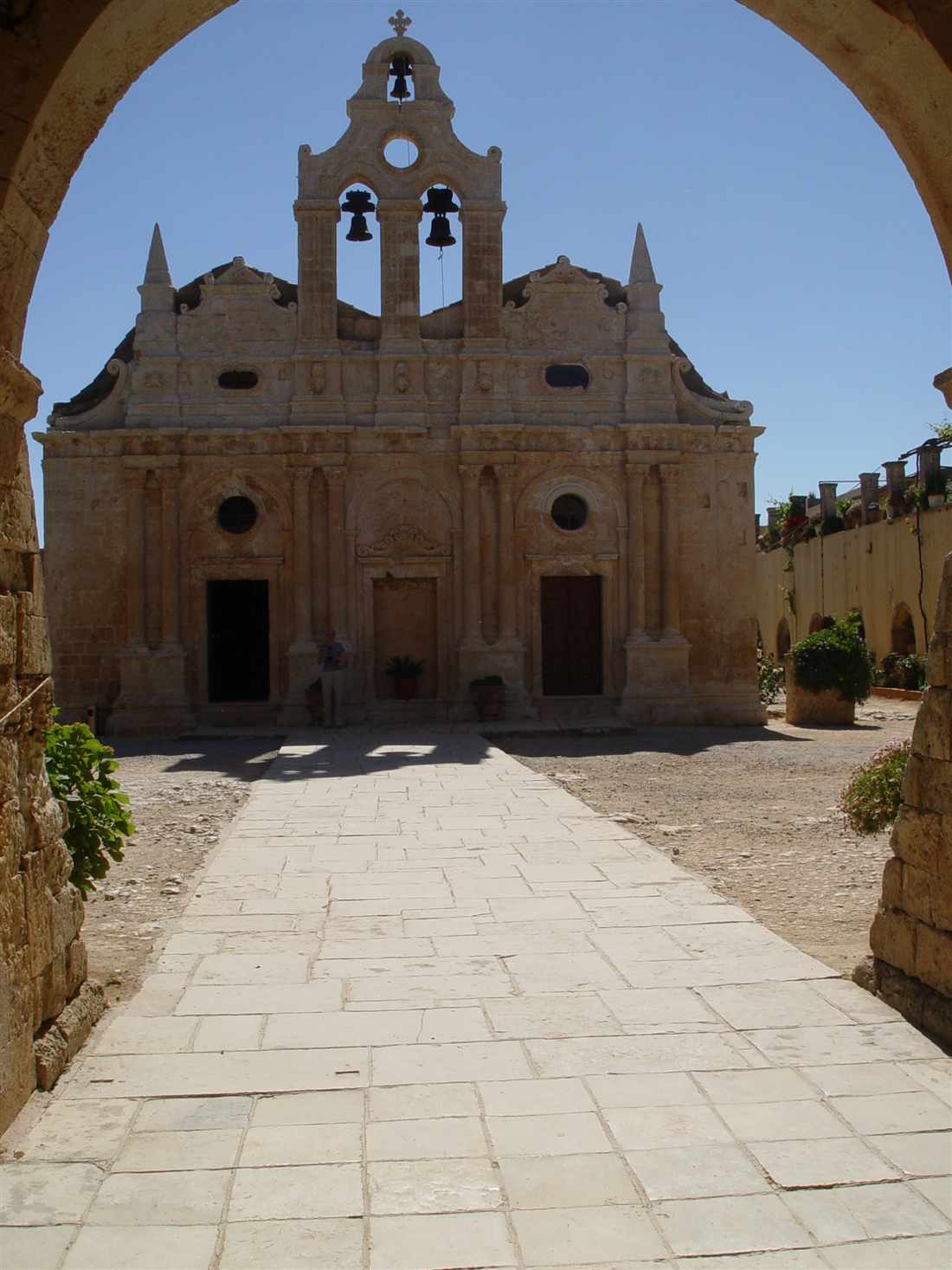
To get from Chania to the Arkadi Monastery, drive east on the E75/A90 national road to Rethymno, then the inland road south-east up into the hills, about 85 kilometres in 1.25 to 1.5 hours, reaching the fortified monastery that is the national sanctuary of Cretan freedom. Plan the whole trip with Greece Tours.
This guide covers the trip from Chania to Arkadi in full: where it is, how to get there by car and by KTEL bus, the monastery and its Venetian-baroque church front, the history of the holocaust of Arkadi during the Ottoman siege, what to see inside the walls, the tickets, dress and time it takes, the ancient city of Eleftherna and Rethymno nearby, and whether this trip is worth it.
Where is Arkadi Monastery and how far is it from Chania?
Arkadi Monastery stands in the hills 23 kilometres south-east of Rethymno town, in the Rethymno regional unit of Crete, at an altitude of 500 metres. It sits about 85 kilometres east of Chania, a drive of 1.25 to 1.5 hours across the north of the island.
The monastery, known in Greek as Moni Arkadiou, occupies a fertile plateau on the western flank of the Psiloritis massif, the highest mountain range in Crete. The setting is deliberate and defensible: fields of vine and olive spread across the tableland, cypress trees rise inside the walls, and the ground falls away into the Amari valley to the south and the coastal plain to the north. The elevation of 500 metres keeps the air cooler than the shoreline, and the position gives the complex a commanding view over the approaches, a trait that shaped its role in the history of Cretan resistance.
Measured from the harbour of Chania, the journey runs the full width of two regional units. Chania regional unit gives way to Rethymno regional unit near Georgioupoli, and from there the national road tracks the coast to Rethymno town before the route turns inland and climbs. The distance of about 85 kilometres divides into two clear legs: the fast national road along the coast to Rethymno, then 23 kilometres of slower inland road that gains height through farming country. The change of pace between the two legs defines the trip and explains the 1.25 to 1.5 hour drive time.
Arkadi is one of the flagship excursions from the west of the island, and it ranks among the finest of the day trips from Chania for travellers who want history rather than beach. The monastery pairs a striking building with a story that carries national weight, and it lies within reach of Rethymno old town, the ancient site of Eleftherna and the pottery village of Margarites. A base in Chania puts all of these within a single day’s driving, which is why the route east to Arkadi is a fixture of Cretan itineraries.
The regional geography matters for planning. Rethymno town is the midpoint and the gateway: every road to Arkadi from the west passes through or beside it. The town holds the last large fuel stations, supermarkets and cafes before the climb, and the inland villages of Adele and Amnatos mark the ascent to the plateau. Knowing that Arkadi sits 23 kilometres beyond Rethymno, and 500 metres above the sea, sets a realistic expectation for the final stretch, where the road narrows and winds through olive groves toward the fortified gate.
Distance from Chania also frames the choice of transport and timing. At about 85 kilometres and 1.25 to 1.5 hours each way, Arkadi is a comfortable half-day drive that leaves the afternoon free, yet it lies far enough east that a bus itinerary demands two separate services and careful timetable reading. Travellers staying in the far west of Chania regional unit, near Kissamos or the Rodopos peninsula, add 30 to 45 minutes to the outbound leg and start earlier as a result. Those based in Rethymno itself reach the monastery in 30 to 40 minutes, which explains why Arkadi appears on Rethymno itineraries as a short morning outing and on Chania itineraries as a full-day excursion. The plateau altitude of 500 metres brings cooler, clearer air than the coast, a welcome contrast on a hot summer day and a reason the drive up feels like a change of climate as much as a change of scene.
How do you drive from Chania to Arkadi?
Drive east from Chania on the E75/A90 national road to Rethymno, then take the inland road south-east through Adele and Amnatos and up to the monastery. The full route covers about 85 kilometres and takes 1.25 to 1.5 hours, split between fast coastal highway and a slower climbing final stretch.
The first leg leaves Chania on the New National Road, signed as the E75 European route and the A90 in the Greek network. This is the spine of northern Crete, a well-surfaced two-lane highway that hugs the coast with the White Mountains rising to the south and the Cretan Sea to the north. From Chania the road passes Souda, the Akrotiri turn-offs and the resort strip near Georgioupoli, then crosses into Rethymno regional unit. The 72-kilometre run to the Rethymno junctions moves quickly, and traffic thins once past the summer resort clusters. Fuel, rest stops and tavernas line the route at regular intervals.
At Rethymno the character of the drive changes. The exit for Arkadi leaves the national road and heads inland, and signposts for “Moni Arkadiou” point the way from the edge of town. The inland road threads through Adele and climbs past Pigi and Loutra toward Amnatos, gaining altitude with each kilometre. Olive terraces line the tarmac, the bends tighten, and the last 23 kilometres demand a steadier pace than the highway. The surface is sound, the lanes are narrow in the villages, and the gradient is constant. Budget 30 to 40 minutes for this final leg alone.
Parking sits directly outside the monastery walls in a free gravel area shaded by trees. The lot handles cars and tour coaches, and a short level walk leads from the parking to the ticket booth and the great western gate. The approach itself is part of the experience: the fortified outer wall reveals itself across the fields, and the cypress-lined frontage comes into view as the road makes its final turn onto the plateau.
Two practical points shape the drive. First, a hire car is the efficient choice for this excursion, because it collapses a multi-leg bus journey into one continuous trip and frees the afternoon for Eleftherna, Margarites or a Rethymno stop on the way back. Second, the mountain light and the switchback bends reward an unhurried departure: an early start clears the coastal traffic, reaches Arkadi before the coach groups arrive, and leaves the plateau quiet for the first hour of the visit. Fill the tank in Rethymno rather than gambling on the inland villages, where fuel is sparse and hours are short.
The return retraces the same route in reverse, dropping from 500 metres back to sea level and rejoining the A90 at Rethymno for the westbound run to Chania. Drivers who want a longer loop link the descent to the coastal beaches east of Rethymno or to the old Venetian harbour before turning for home. The road is the same either way, and the drive time back matches the outbound 1.25 to 1.5 hours.
Practical driving details make the inland leg smoother. The signposting for “Moni Arkadiou” is consistent from the Rethymno exit onward, painted in white on brown heritage signs at each junction, so a printed map is unnecessary once the town is behind you. The village lanes through Adele and Amnatos narrow to a single comfortable width in places, where oncoming vehicles pull aside at wider bends, and the gradient stays steady rather than steep. Livestock, tractors and slow local traffic set the pace on the final kilometres, and a patient approach beats the clock by little. Mobile signal holds across the route, and the free monastery car park removes the parking hunt that plagues the coastal towns. Drivers pairing Arkadi with Eleftherna or Margarites take the marked lanes north and east from the monastery rather than descending first, saving a backtrack to the coast.
How do you reach Arkadi by KTEL bus?
No direct KTEL bus links Chania with Arkadi. The route runs in two stages: the coastal KTEL from Chania to Rethymno, a journey of 1 hour, then the Rethymno-to-Arkadi local bus, which runs a handful of departures a day and takes 40 minutes to climb to the monastery.
KTEL is the intercity bus operator of Crete, and its coastal service between the western cities is frequent and reliable. Buses leave the Chania KTEL terminal for Rethymno through the day at short intervals, following the same A90 national road that private cars use. The ride takes about 1 hour and drops passengers at the central Rethymno bus station near the seafront. This first stage is the easy part, with departures spaced closely enough that a missed bus costs little time.
The second stage is the constraint. From the Rethymno station a separate local KTEL line climbs inland to Arkadi. This service runs a limited timetable, with a handful of departures spread across the day rather than an hourly cadence, and the 23-kilometre ascent through Adele and Amnatos takes 40 minutes. The scarcity of departures makes the return timing the critical planning point: check the posted schedule at the Rethymno station on arrival, note the last bus back down from the monastery, and set the visit to fit inside it. A visit of 1 to 1.5 hours at the site fits neatly between two of the inland departures for travellers who read the timetable first.
Total transit by bus, counting both legs and the connection wait at Rethymno, runs to 2.5 to 3.5 hours in each direction depending on how the two timetables align. That makes a bus day longer and less flexible than a drive, and it ties the schedule to the sparse inland service. Travellers without a car still reach Arkadi comfortably, provided they treat the Rethymno-to-monastery timetable as fixed and plan the day to fit it rather than improvising on arrival.
Three tactics smooth the bus journey. Take an early coastal bus from Chania to land in Rethymno with the morning inland departure in reach. Buy the onward ticket at the Rethymno KTEL counter and confirm the exact stop and platform for the Arkadi line. Photograph the return timetable posted at the monastery stop before walking to the gate, so the last descent is never in doubt. Taxis wait at the Rethymno station as a fallback for the final leg, and a shared taxi from town covers the 23 kilometres when the bus times refuse to cooperate.
For a group of two or more, an organised excursion or a hire car outperforms the bus on both cost and freedom, folding Arkadi together with Margarites and Eleftherna in one afternoon that the fixed inland timetable will not allow. The bus remains the honest budget route for the solo traveller, and it delivers the visitor to the same fortified gate, on the same plateau, that the cars and coaches reach.
What is Arkadi Monastery?
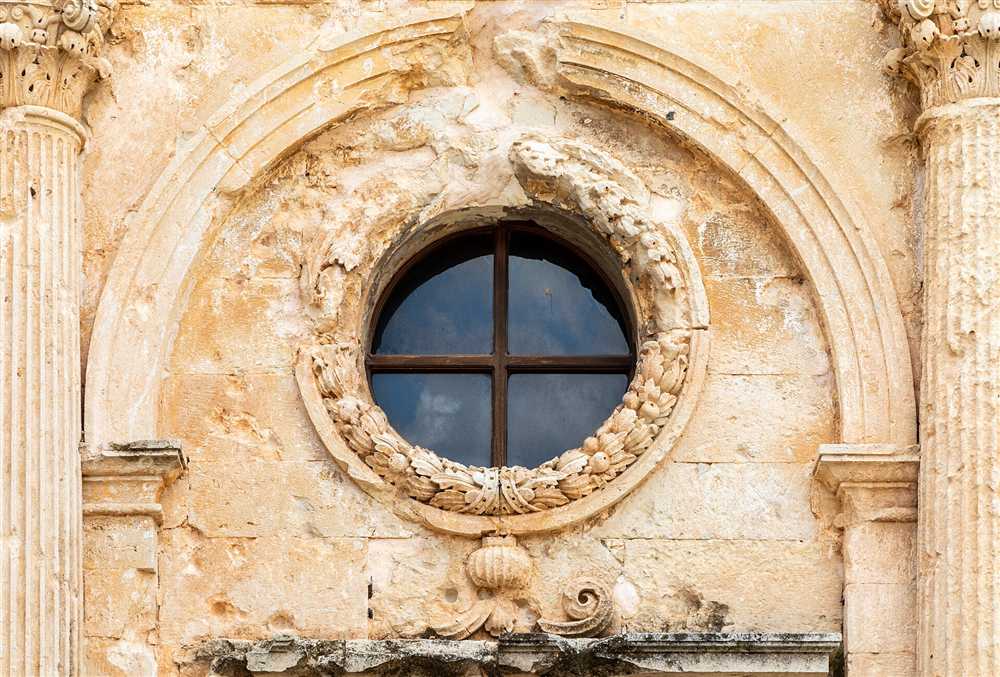
Arkadi Monastery is a fortified Orthodox complex on a mountain plateau at 500 metres, built about a twin-aisled basilica church at its heart. Its jewel is the Venetian-Renaissance-Baroque west front of the church, an ornate carved fa\u00e7ade that is the emblem of the monastery and appeared on the old Greek 100-drachma note.
The layout is that of a walled citadel rather than an open sanctuary. A rectangle of high outer walls, punctuated by a great arched gate, encloses a broad courtyard, and within that ring stand the church, the monks’ cells, a refectory, storerooms and a small museum. Cypress trees rise inside the walls and frame the katholikon, the main church, which sits free-standing at the heart of the courtyard. The defensive character is no accident: monasteries of Crete under Venetian and Ottoman rule doubled as strongholds, centres of learning and refuges for the surrounding population, and Arkadi filled all three roles.
The katholikon is the architectural prize. It is a twin-aisled basilica, one aisle dedicated to the Transfiguration of the Saviour and the other to Saints Constantine and Helen, and its western fa\u00e7ade is a masterwork of the Cretan Renaissance. The stone front blends Venetian Renaissance proportion with Baroque flourish: paired columns in two tiers, a curved and broken pediment, a rose window, an arched doorway and a slender bell-tower crowning the composition. The carved detail, the symmetry and the honey-coloured stone make this frontage the single best-known image of Cretan monastic architecture, familiar from the banknote that once carried it into every Greek pocket.
The stone of the fa\u00e7ade earns close attention. Cut from warm local limestone, the frontage rises in two column tiers that frame the central doorway, with a rose window set above and a triple-arched bell-tower crowning the whole. The paired columns carry Corinthian capitals, the pediment breaks and curves in the Baroque manner, and the carved mouldings run crisp after centuries of mountain weather. This fusion of Venetian Renaissance discipline with Baroque movement marks the high point of Cretan architecture under Venetian rule, and it is the reason the frontage was chosen to represent Cretan heritage on the old national currency. Seen in morning light, the honey tone of the stone deepens and the carved detail throws sharp shadow, which is why photographers time their arrival for the early hours.
Beyond its beauty, Arkadi held a working religious and cultural life. Monks copied manuscripts, taught, and farmed the surrounding plateau, and the monastery accumulated icons, vestments, liturgical silver and books that the small museum now displays. The refectory, with its long stone table, speaks to the communal rhythm of monastic days, and the cells ring the courtyard where the brothers lived. This everyday texture sits alongside the drama of the monastery’s history and gives the visit two registers: the quiet of a living Orthodox house and the weight of a national memorial.
The plateau setting binds the whole complex together. The walls command the approaches, the cypress trees soften the stone, and the mountains close the horizon on every side. Visitors arriving through the great gate step from the open glare of the courtyard into the cool of the church, then out to the scarred rooms that carry the monastery’s tragic story. Arkadi is at once a work of art, a fortress, a museum and a shrine, and its standing in Crete rests on all four identities at once.
What is the history of Arkadi and the holocaust?
Arkadi is the national sanctuary of Cretan freedom. During the great Cretan revolt against Ottoman rule, hundreds of fighters, women and children took refuge inside the walls. When the Ottoman army breached the gate, the defenders set fire to the gunpowder store rather than surrender, and the explosion killed attackers and defenders alike.
The monastery had long been a centre of Cretan learning and quiet resistance, and in the years of the great uprising against Ottoman rule it became a command point and a rallying place for the insurgents of the Rethymno highlands. As the revolt spread, the population of the surrounding villages gathered behind its walls for protection, so that the garrison of armed fighters was joined by a far larger crowd of women, children and the old. The fortified plateau, chosen centuries earlier for defence, now held a besieged community numbering in the hundreds.
The Ottoman army marched on the monastery in overwhelming force, with artillery to batter the walls. The defenders held the gate through a day and night of assault against impossible odds. When the great door was blown open and the attackers poured into the courtyard, the outcome of the fighting was already sealed. The defenders retreated to the powder magazine, the store of gunpowder, and rather than yield the refugees to slaughter and slavery they set the powder alight. The blast tore through the packed rooms and killed the Ottoman soldiers crowding the space together with the Cretans inside. This act of collective sacrifice is remembered as the holocaust of Arkadi.
The news of the explosion travelled across Europe and turned Arkadi into a symbol of the struggle for Cretan independence. Writers, artists and statesmen of the age seized on the story of a besieged people who chose death over surrender, and the monastery became a byword for the wider fight to free Crete from Ottoman rule. Within Greece the holocaust of Arkadi entered the national memory as one of the defining acts of the long road to Cretan union, spoken of alongside the great sacrifices of the war of independence on the mainland.
The abbot who led the defence and the monk credited with firing the powder are named among the heroes of the island, and their portraits and relics hold pride of place in the monastery museum. The banner of the revolt, torn weapons, and the personal effects of the fallen sit behind glass as evidence of the siege, and the guides who accompany school groups and pilgrims tell the story in the courtyard where it unfolded. The explosion transformed a rural monastery into a monument of the whole Greek nation, and it drew the sympathy of foreign governments toward the Cretan cause at a decisive moment in the island’s long march away from Ottoman rule toward union with Greece.
That memory is why the monastery is treated as sacred ground rather than as an ordinary tourist site. The plateau is a place of pilgrimage for Cretans, the anniversary of the explosion is a day of national commemoration, and the abbot and monks who led the defence are honoured as heroes of the island. Visitors walk the same courtyard where the refugees waited, pass the same gate the army broke, and stand in the ruined magazine where the powder was fired. The history is not a caption on a wall at Arkadi; it is the reason the walls still stand and the reason the nation keeps them.
What is there to see at the Arkadi Monastery?
The highlights are the carved west fa\u00e7ade of the church, the small museum of icons and relics, the ossuary holding the skulls of the dead, the scarred powder magazine where the explosion took place, and the old windmill. The courtyard, cypress trees, cells and refectory fill out the fortified enclosure.
The carved west front of the katholikon is the first thing to draw the eye and the last to leave the memory. Standing free in the courtyard, the twin-aisled basilica presents its Venetian-Renaissance-Baroque frontage of paired columns, curved pediment, rose window and crowning bell-tower in warm cut stone. This is the emblem that appeared on the old 100-drachma note, and it rewards slow looking: the tiers of columns, the broken curves of the pediment and the fine masonry of the doorway reveal the hand of Cretan Renaissance craftsmen at the height of their art. The interior holds the two dedicated aisles, carved wooden screens and icons.
The scarred powder magazine is the emotional centre of the visit. This is the room where the defenders fired the gunpowder store, and its broken walls and blackened stone are preserved as they were left after the explosion. A plaque and a lamp mark the spot where the powder was lit, and the ruined space speaks with a directness that no museum case matches. Standing inside it connects the beauty of the church to the tragedy that made the monastery a national shrine.
The ossuary sits a short walk from the gate, outside the main walls in a former windmill, and it holds the skulls and bones of those who died in the siege and the explosion. The rows of skulls behind glass are a stark memorial to the hundreds who fell, and the sight fixes the human scale of the holocaust in a way that the courtyard alone does not. Nearby stands the old windmill itself, a squat stone tower that survived the assault and now serves as a landmark of the site and a viewpoint over the plateau.
The small museum gathers the movable heritage of the monastery: icons, sacred vestments, liturgical silver, manuscripts, and relics tied to the siege, including weapons, a torn banner and personal objects of the defenders. The display is compact and repays 20 to 30 minutes. Ringing the courtyard the visitor finds the refectory with its long stone table, the ring of monastic cells, and the storerooms and wine cellars of a working religious house. The cypress trees, the wells and the shaded corners of the enclosure complete a walk that moves between architecture, faith and the memory of sacrifice within a single set of walls.
How do you visit Arkadi, and what is nearby?
Entry costs two to three euros, the site opens through the day, and modest dress with shoulders and knees covered is required. The visit takes 1 to 1.5 hours, and a cafe and shop sit by the entrance. Nearby are ancient Eleftherna, the pottery village of Margarites, and Rethymno old town.
The ticket is inexpensive, a matter of two or three euros bought at the booth beside the great gate, and the proceeds support the upkeep of the monastery and its museum. The complex opens across the daylight hours, with the widest window in the warm months and a shorter afternoon in winter, so an arrival in the morning or early afternoon guarantees full access to the church, the museum, the magazine and the ossuary. As a living Orthodox house and a place of national mourning, Arkadi enforces a modest dress code: shoulders and knees stay covered for both men and women, and a light scarf or shawl carried in a bag solves the problem for anyone in beachwear.
Plan 1 to 1.5 hours on the plateau. That span covers the carved fa\u00e7ade and the church interior, the scarred powder magazine, the museum, the ossuary and windmill, and a slow circuit of the courtyard under the cypress trees. The cafe and shop by the entrance sell cold drinks, coffee, snacks and local products, including honey, oil, herbs and monastery-made items, and the shaded terrace gives a place to rest before the drive back down. Water, sun protection and comfortable shoes make the visit easier, since the courtyard is open and the summer sun on the plateau is strong.
The surrounding country turns the outing into a full day. Eleftherna, an ancient Cretan city with a modern archaeological museum, lies a short drive to the north-east and pairs a hilltop excavation with one of the finest small museums on the island. Margarites, a hillside village famed for its potters, sits nearby and fills its lanes with workshops turning out the ceramics that carry the Cretan tradition. Both fold naturally into the descent from Arkadi and reward an hour each.
On the coastal leg, Rethymno old town is the obvious companion stop. Its Venetian harbour, the great Fortezza fortress on the headland, the Ottoman minaret and the tangle of arcaded lanes make a walkable counterpoint to the mountain quiet of the monastery, and the town’s tavernas serve the meal that a morning at Arkadi earns. The beaches of the north coast east and west of Rethymno lie minutes from the national road for anyone wanting to end the day at the sea. A single loop from Chania links Arkadi, one inland village and a Rethymno stop without strain, which is the strength of driving the route.
A workable full-day plan runs the loop in one direction to avoid backtracking. Leave Chania early and drive straight to Arkadi for the quiet first hour, then descend north to Eleftherna for the archaeological site and its museum, then cross to Margarites for the potters’ workshops and a village lunch, and finish with the afternoon in Rethymno old town before the westbound run home. This sequence covers the monastery, an ancient city, a craft village and a Venetian port in one day of driving, and it keeps the total road time within reason because each leg is short once the plateau is reached. Families with children lean the day toward the beach finish, history travellers weight it toward Eleftherna and the museum, and food-focused visitors build it on the Margarites and Rethymno tavernas. The flexibility to shape the day this way is the reward of a car, and it turns a single monument into a rounded portrait of inland Rethymno.
Is the trip from Chania to Arkadi worth it, and when to go?
Yes. Arkadi rewards the 95-kilometre drive with the finest monastic fa\u00e7ade in Crete and the island’s foremost memorial of the struggle for independence. Go in spring or autumn for cool air and green hills, start early to beat the coach groups, and set aside a full day to fold in Rethymno and the inland villages.
The trip earns its place on any western-Crete itinerary because it delivers two things at once that few excursions combine. The carved Venetian-Renaissance-Baroque west front is a genuine work of art, the building that a nation put on its banknote, and the scarred magazine and the ossuary carry a story of sacrifice that reshaped European opinion of the Cretan cause. A traveller who wants more than sun and sand finds at Arkadi the deepest single dose of Cretan history and architecture within reach of Chania, and the 1.25 to 1.5 hour drive is a fair price for it.
Season shapes the experience sharply. Spring brings wildflowers to the plateau, a green tint to the terraces and mild air at 500 metres, and the anniversary period of the holocaust fills the monastery with a solemn national significance. Autumn holds the warmth of the sea while the crowds of high summer recede, and the light on the honey-coloured stone is at its best. High summer works too, with long opening hours and reliable sun, but the plateau bakes at midday and the coach parties are thickest, so an early arrival matters in the hot months.
Time of day is the other lever. An early start from Chania clears the coastal traffic, reaches the plateau before the organised groups, and gives the first quiet hour in the courtyard and church. The soft morning light suits the fa\u00e7ade, the museum and the magazine are uncrowded, and the return leaves the afternoon free for Rethymno, Margarites or the beach. Midweek beats the weekend for calm, and the shoulder months beat the peak for both weather and space.
Set expectations to match the site. Arkadi is a place of quiet reflection and national memory, not an adrenaline stop, and its power grows on the visitor who reads the story before arriving and walks the courtyard slowly. Pair it with the coast and the inland villages, respect the dress code, carry water for the open plateau, and give the plateau the 1 to 1.5 hours it deserves. Treated this way, the run east from Chania to Arkadi stands among the finest days the west of the island offers, a single drive that joins the finest monastic architecture in Crete to the sacred ground of Cretan freedom.
The drive rewards the effort as much as the destination. From Rethymno the road climbs south-east through Adele and Amnatos into a country of olive terraces, stone villages and low hills, and the monastery appears on its plateau at the end. Fuel the tank in Rethymno, since the hill roads run without a station to the site, and set out early to reach the walls before the tour coaches. Pair Arkadi with the Venetian old town and fortress of Rethymno on the coast below, the pottery village of Margarites, and the ancient city and museum of Eleftherna, and the 95-kilometre run from Chania fills a full, rewarding day rather than a single stop. Modest dress, sturdy shoes and a bottle of water complete the plan for the exposed, sun-struck plateau.
Timing shapes the visit through the year. Late spring brings wild flowers to the plateau, warm light on the honey-coloured stone and thin crowds; high summer runs hot and busy, and an early start beats both the heat and the coaches; autumn holds warm, clear days as the season winds down. The monastery keeps the anniversary of the holocaust as a solemn commemoration each year, when the site fills with visitors and dignitaries. On an ordinary day the courtyard stays quiet by late afternoon once the tours leave, and the low sun throws the carving of the church front into sharp relief, the finest hour to stand before the emblem of Cretan freedom.
Frequently Asked Questions
How do you get from Chania to Arkadi Monastery?
From Chania to Arkadi, drive east on the E75/A90 national road to Rethymno, then the inland road south-east through Adele and Amnatos up to the monastery, about 85 kilometres in 1.25 to 1.5 hours. By bus, take the KTEL Chania to Rethymno, then the Rethymno-to-Arkadi bus, a 40-minute ride on a handful of daily departures.
How far is Arkadi from Chania?
Arkadi Monastery lies about 85 kilometres east of Chania, in the hills 23 kilometres south-east of Rethymno town in the Rethymno regional unit, at 500 metres altitude. The drive takes 1.25 to 1.5 hours on the national road and the inland climb.
Is the trip from Chania to Arkadi worth it?
The trip from Chania to Arkadi rewards visitors with the most revered monument of Cretan independence, a Venetian-baroque church front that is the emblem of the island, and the memorial of the holocaust of Arkadi. The 95-kilometre distance suits a day trip paired with Rethymno.