
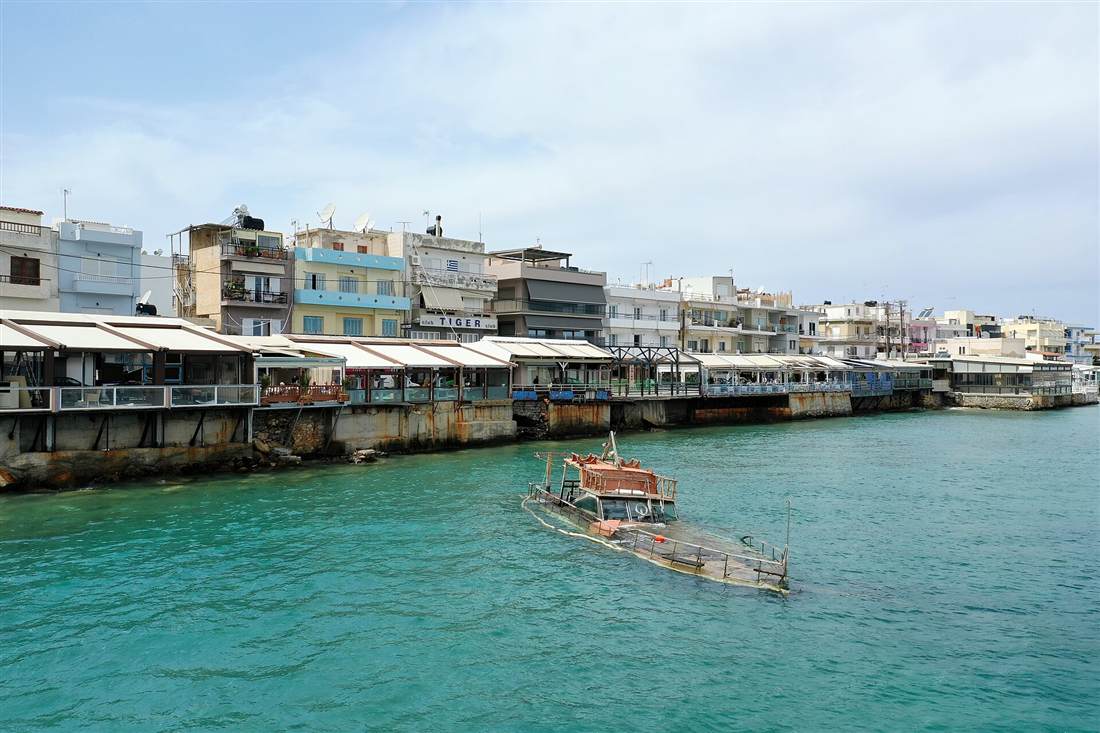
To get from Chania to Hersonissos, drive east on the E75/A90 national road about 165 kilometres through Rethymno and Heraklion, in about 2.5 to 3 hours, to the lively east-coast resort town near Heraklion with its beaches, waterparks and nightlife. Plan the whole trip with Greece Tours.
This guide covers the trip from Chania to Hersonissos in full: where it is, how to get there by car and bus, the drive time, the resort, families and waterparks, the beaches, the nightlife, where to stay, the harbour and old town, what is near it, and whether this long east-Crete trip is worth it or better as a base.
Where is Hersonissos from Chania?
Hersonissos, written Chersonissos or Limenas Chersonisou, is a resort town on the north coast of Crete in the Heraklion region, 25 km east of Heraklion city and 165 km east of Chania. It fronts a long beach strip and a working harbour and ranks among the busiest resorts on the island.
Chania sits at the western end of Crete, wrapped around its Venetian harbour in Chania regional unit. Hersonissos sits far to the east, past the regional boundary and past Heraklion, on the open north coast that faces the Cretan Sea. The two towns bracket most of the island’s northern shoreline between them, which fixes the distance at 165 km by the coastal road.
The resort splits into two parts. The coastal town, Limenas Chersonisou, holds the harbour, the beaches, the bars and the tourist strip. Above it, the old inland village of Piskopiano and the neighbouring hillside settlements of Koutouloufari and Ano Chersonisos keep the tavernas and the quieter accommodation. The beach strip runs for 5 km east towards Stalis and Malia.
Hersonissos anchors Crete’s east-coast resort belt. Waterparks, a diving centre, the harbour promenade and a dense nightlife strip draw the crowds, and the town links straight into Stalis and Malia along the same coast road. From Chania the trip crosses three regional units, Chania, Rethymno and Heraklion, to reach it.
How do you get from Chania to Hersonissos?
Drive east on the E75/A90 national road the length of the north coast through Rethymno and Heraklion, a 2.5 to 3 hour trip. The bus route runs KTEL from Chania to Heraklion, then the frequent Heraklion-Hersonissos service. Airport transfers depart from Chania or Heraklion. A car is the most direct option.
The car route is one road for almost the entire distance. The E75/A90 national road, the island’s main north-coast artery, carries traffic east from Chania past Georgioupoli, Rethymno and the Heraklion approach. East of Heraklion the road continues along the coast through Gouves to the Hersonissos exit, a total of 165 km.
The bus route splits into two legs. KTEL operates the intercity coach from Chania bus station to Heraklion in about 3 hours, and Heraklion’s east-coast line then runs the frequent Hersonissos-Malia service along the shore. The change happens at Heraklion’s main bus terminal near the port.
Airport transfers cover the door-to-door route without a change. A pre-booked transfer from Chania airport drives the full 165 km east, and a transfer from Heraklion airport covers the shorter final 30 km. A hired car collected at either airport gives full control over the timing and the stops along the coast.
How long does it take to drive from Chania to Hersonissos?
The drive takes 2.5 to 3 hours over 165 km. The route runs east on the A90 national road past Rethymno and Heraklion, then continues on the coastal road east through Gouves to Hersonissos. The dual-carriageway keeps the pace high, and Heraklion traffic is the main delay.
The first 135 km, from Chania to the eastern edge of Heraklion, run on the A90 dual-carriageway at national-road speed. This stretch passes the Souda bay, the Rethymno bypass and the long central section, and it carries the bulk of the driving time at a steady cruise.
The Heraklion approach adds the delay. The national road narrows and slows as it threads the city’s northern edge past the port and the airport turn-off, and rush-hour traffic around Heraklion stretches the timing towards the 3-hour end. Timing the crossing outside the morning and evening peaks holds the trip near 2.5 hours.
The final 30 km east of Heraklion run through Gournes and Gouves on the coastal road to the Hersonissos exit. This closing stretch stays fast and flat beside the sea, and the town sits directly off the national road with a short descent to the harbour front.
Can you reach Hersonissos by bus from Chania?
Yes. The KTEL bus runs Chania to Heraklion in about 3 hours, then the frequent Heraklion-Hersonissos-Malia coastal service covers the last leg in 45 minutes to 1 hour. The journey changes once at Heraklion. The east-coast resort line runs at a high frequency. Check the timetable before travelling.
The first leg is the intercity KTEL coach. It departs Chania’s central bus station on Kydonias street and runs east on the national road to Heraklion’s main terminal by the port, a 3-hour trip with stops at Rethymno and Georgioupoli along the way. Departures run through the day at a steady interval.
The second leg is the east-coast resort line. From the Heraklion terminal the Hersonissos-Malia service departs at a high frequency through the day, following the coast road east through Gouves and reaching Hersonissos in 45 minutes to 1 hour. This line serves the busiest resort corridor on the island, which keeps the departures close together.
The change at Heraklion sets the total. Both KTEL legs use the same terminal, so the transfer is a short walk between platforms, and the two-leg journey adds up to about 4 hours end to end. Aligning the arrival from Chania with a Hersonissos departure trims the wait, and the printed timetable at the terminal confirms the next service.
What is Hersonissos like as a resort?
Hersonissos is a large east-coast resort built along a 5 km beach strip, with a harbour ringed by tavernas and bars, sandy and pebble beaches, watersports centres, and a nightlife of clubs and cocktail bars, while three old villages sit on the hill above.
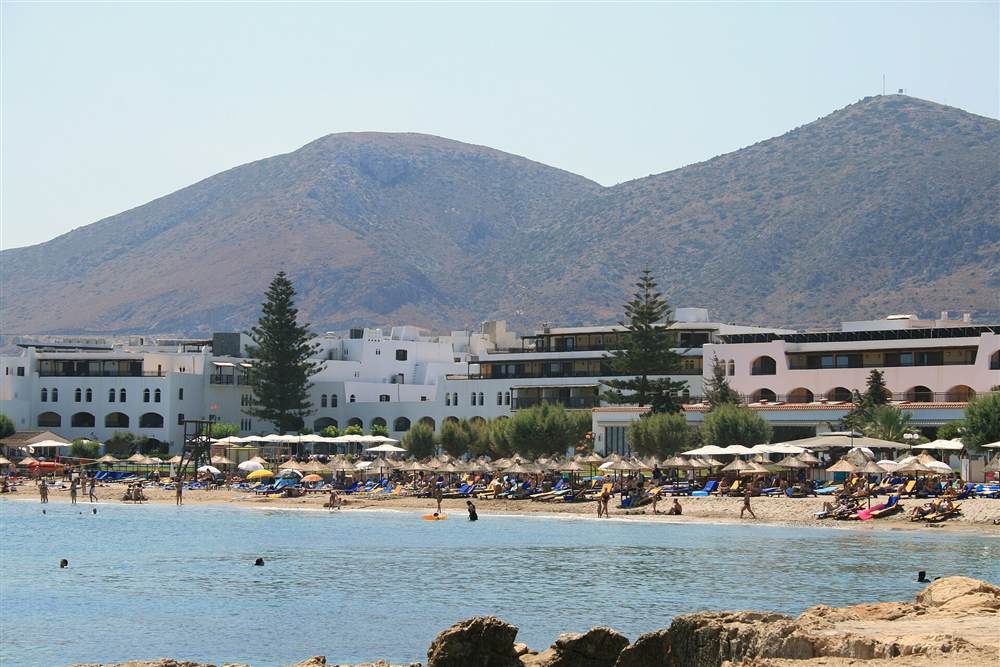
The waterfront runs from the harbour eastward past a chain of beaches. The main town beach mixes fine sand and pebble, backed by sunbeds, showers and beach bars. Watersports operators along the front run jet skis, banana boats, parasailing and pedalos, and diving schools take groups to reefs off the coast. The harbour itself holds fishing boats, day-cruise vessels and a promenade of fish tavernas that serve grilled octopus, sea bream and Cretan meze.
After dark the strip near the harbour turns into the resort’s nightlife core. Cocktail bars, music bars and clubs line a 400-metre run of the coast road, and the crowd stays out past 03:00 in high summer. This concentrated party zone keeps the noise to one part of town, so the beaches and the hill villages stay calm.
Above the resort, three old settlements hold the traditional side of Hersonissos. Koutouloufari, Piskopiano and Old Hersonissos climb the hillside 2 km inland, with stone houses, vine-shaded courtyards, family tavernas and a folklore museum in Piskopiano. These villages sit 100 metres above the sea, catch the evening breeze, and give a quieter base within a short drive of the beach and the bars.
Is Hersonissos good for families?
Hersonissos is one of Crete’s most family-oriented resorts, with two large waterparks, an aquarium, shallow sandy beaches, watersports and family hotels; the town runs as a beach-and-splash destination by day and a nightlife strip by night, keeping the two apart.
Acqua Plus, set 5 km inland in the hills, holds more than 25 slides, wave features, a lazy river and children’s pools across a landscaped park. Star Beach, at the eastern end of the resort, combines a free-entry beach with waterslides, a bungee, a climbing wall and a beach-bar zone, so families mix pool time and sea time on one site. Both parks run daily through the summer season and lay on shaded seating and snack points for younger children.
Aquaworld Aquarium, near the town centre, keeps Cretan and Mediterranean sea life alongside a reptile rescue collection, and its compact indoor layout suits a hot afternoon. The main beaches shelve gently into shallow water, which lets small children paddle close to shore, and lifeguard-watched sections and roped swimming zones add a margin of safety at the busier stretches.
Family hotels cluster along the beach road and up towards the hill villages, from large all-inclusive complexes with kids’ clubs to small apartment blocks with pools. Parents who want an early night book rooms in Koutouloufari or Piskopiano, 2 km from the bars, where family tavernas serve dinner in quiet squares. The split between the beach strip and the hillside villages is the reason the resort works for both a stag group and a family of four.
What is near Hersonissos?
Hersonissos sits at the centre of eastern-central Crete, with the Minoan palace of Malia and the beaches of Stalis and Malia a short drive east, the Lasithi plateau and the Dikteon Cave inland, and Heraklion, Knossos and the Cretaquarium at Gournes to the west.
The Minoan palace of Malia lies 8 km east along the coast road, a large excavated site with a central court, storage magazines and the carved stone kernos disc. Beyond it the wide sandy beach of Malia and the calmer bay of Stalis fill the coast between the two towns, each backed by tavernas and sunbeds and reachable in under 15 minutes.
Inland the road climbs to the Lasithi plateau, a ring of farmland at 840 metres framed by the Dikti mountains, where the Dikteon Cave marks the mythological birthplace of Zeus. The drive up from Hersonissos covers 40 km through mountain villages, and the plateau’s apple orchards and old stone windmills sit an hour from the coast.
West of the resort, Heraklion lies 25 km along the national road, with the palace of Knossos on its southern edge and the Heraklion Archaeological Museum holding the finds from it. The Cretaquarium at Gournes, 10 km west of Hersonissos, keeps more than 2,000 marine animals in 60 tanks. This spread of Minoan sites, mountain scenery and coastal towns makes Hersonissos a working base for the eastern half of the island.
What are the beaches at Hersonissos?
Hersonissos has a central town beach of soft sand and fine pebble backed by sunbeds, bars and tavernas, then a long shore strip running east towards Stalis and Star Beach at the eastern end, with shallow, calm water, blue-flag sections and full watersports.
The main town beach sits in front of the resort, a 300-metre band of sand and small pebble edged by a paved promenade. Sunbed-and-parasol sets rent from 8 to 12 euros a pair for the day, and the shoreline shelves to about waist depth 20 metres out, so the water suits young children and slow swimmers. Snack bars and tavernas line the back of the beach the whole way along.
East of the harbour the coast opens into a longer strip that continues towards Stalis, broken by small rocky coves that give quieter spots between the busier sand. Star Beach anchors the eastern end: a free-entry beach club with pools, waterslides, bungee and a bar programme that runs through the afternoon. Jet-skis, banana boats, pedalos and parasailing operate from marked bases along this eastern shore.
Blue-flag status covers the central and eastern sections, marking tested water quality, lifeguard cover and marked swimming lanes kept clear of watersport craft. The harbour itself holds two pocket beaches of coarse sand tucked beside the breakwaters, sheltered from swell and popular with families who want flat water. For a wider Cretan picture beyond this coast, plan wider trips through day trips from Chania.
What is the nightlife in Hersonissos?
Hersonissos nightlife concentrates on the coast road by the harbour, a 400-metre strip of cocktail bars, music bars and clubs that stay open past 03:00 through summer, ranking beside Malia as one of the two biggest party scenes in Crete.
The strip packs dozens of venues into that short stretch: pavement cocktail bars at the quiet end, louder music bars in the middle, and full clubs with DJs and dance floors at the harbour end. Drinks run from 6 to 10 euros for a cocktail, and doors on the clubs stay open until dawn in July and August. Promoters work the pavement handing out shot vouchers to pull the passing crowd inside.
Because the whole scene sits inside that tight 400-metre zone, the noise stays penned in one corner of the resort. The town beach, the residential blocks and the hill villages behind stay quiet after midnight, so the party crowd and the sleeping families occupy different parts of the same town without clashing.
The mix leans towards a young international crowd through peak season, with British, Scandinavian and German groups dominating the club end. Spring and autumn strip that back to a handful of cocktail bars and tavernas with music, giving a calmer evening for couples and older visitors who want a drink by the water without the club volume.
Where do you stay in Hersonissos?
Hersonissos splits into two zones: large all-inclusive beach hotels and apartment blocks along the coastal strip, and quieter traditional rooms and boutique stays 2 kilometres up the hill in Koutouloufari, Piskopiano and Old Hersonissos. Party groups pick the strip; families and couples pick the hill.
The strip carries the big resort hotels: 4-star and 5-star all-inclusive complexes with pools, kids’ clubs and private beach frontage, priced from 120 euros a night in shoulder season upward. Between them sit apartment blocks and studios renting from 45 euros a night, walkable to the beach, the bars and the harbour in under 10 minutes.
The three hill villages sit on the slope behind the resort, reached by a 5-minute drive or a 25-minute walk uphill. Koutouloufari and Piskopiano keep stone-built houses converted into boutique hotels and studios, with pool terraces looking down over the bay. Old Hersonissos, the original settlement, holds family-run rooms among the churches and squares, away from the coastal traffic.
Couples and families weigh the trade directly: the strip puts the beach and nightlife at the door but carries the noise, while the hill trades a short transfer for cool evenings, village tavernas and quiet nights. Groups chasing the clubs book the harbour end of the strip to walk home. Visitors combining Crete with the west of the island commonly base part of a trip near Chania.
What is the old town and harbour of Hersonissos?
The harbour forms the old heart of Hersonissos: a curved quay lined with fish tavernas, day-cruise and fishing boats, a paved promenade, the church of Agia Paraskevi, and small Roman remains \u2014 rock-cut fish tanks and a pyramid fountain mosaic beside the working and tourist waterfront.
Fish tavernas run the length of the quay, their tables set at the water’s edge, serving the morning’s catch weighed by the kilo. Day-cruise boats tie up alongside working fishing caiques, selling trips to nearby coves and to Dia island off Heraklion. The promenade curls around the whole harbour, a flat 600-metre walk lit through the evening.
The Roman remains sit at the western tip of the harbour: rectangular fish tanks cut straight into the coastal rock, once used to keep the catch alive, and the base of a pyramid fountain that carried a mosaic of fishing scenes. A short marble path and a plaque mark the ancient port of Chersonisos, the harbour that served the inland city of Lyttos.
The church of Agia Paraskevi stands back from the quay behind the tavernas, its blue dome a landmark above the roofs. The waterfront works in two halves: fishermen land and mend nets at the north mole through the morning, while the tourist front fills with diners and strollers from late afternoon into the night.
Is the trip from Chania to Hersonissos worth it, and when to go?
The trip rewards travellers who want a lively beach resort with waterparks and nightlife, but Chania to Hersonissos is a 165 km cross-island drive, so Hersonissos suits a stay or a centre-east base rather than a day trip; late spring to early autumn is the window, and high summer is the busiest.
The distance is the deciding factor. The E75 national road links the two in about 2.5 hours each way, which turns a day return into 5 hours behind the wheel for a few hours at the resort. Booking two or three nights in Hersonissos, or treating it as the eastern leg of a wider Crete trip, returns far more than a single long dash from the west. Travellers based in the west who want a shorter outing pick the day trips from Chania that stay within the region instead.
Timing follows the resort’s season. Beaches, waterparks and the harbour bars open from late April, hit full swing across July and August, and wind down through October. Sea temperatures climb to 25\u00b0C in the height of summer, the waterparks run at capacity, and the nightlife strip reaches its peak. Late May, June and September trade the crowds for warm water and shorter queues at Acqua Plus and Star Beach.
For a west-Crete base, pair Hersonissos with the harbour town of Chania and the beaches, gorges and hilltop villages that ring it, then run east when the itinerary turns towards Heraklion and the Minoan sites. Travellers arriving on the island plan the first leg with the guide on how to get to Chania, then decide whether Hersonissos earns a place as a second base further east.
Frequently Asked Questions
How do you get from Chania to Hersonissos?
From Chania to Hersonissos, drive east on the E75/A90 national road about 165 kilometres through Rethymno and Heraklion, then the coast road through Gouves, in about 2.5 to 3 hours. The KTEL bus runs Chania to Heraklion then the frequent Heraklion-Hersonissos-Malia coastal bus.
How far is Hersonissos from Chania?
Hersonissos lies about 165 kilometres east of Chania on the north coast, 25 kilometres east of Heraklion in the Heraklion region. The drive takes 2.5 to 3 hours on the fast A90 national road; traffic around Heraklion is the main delay.
Is the trip from Chania to Hersonissos worth it?
The trip from Chania to Hersonissos rewards visitors with a lively beach resort of waterparks, a harbour and nightlife, plus the hill villages above. The 165-kilometre cross-island drive is the trade-off, so Hersonissos suits a stay or a centre-east base over a day trip.