
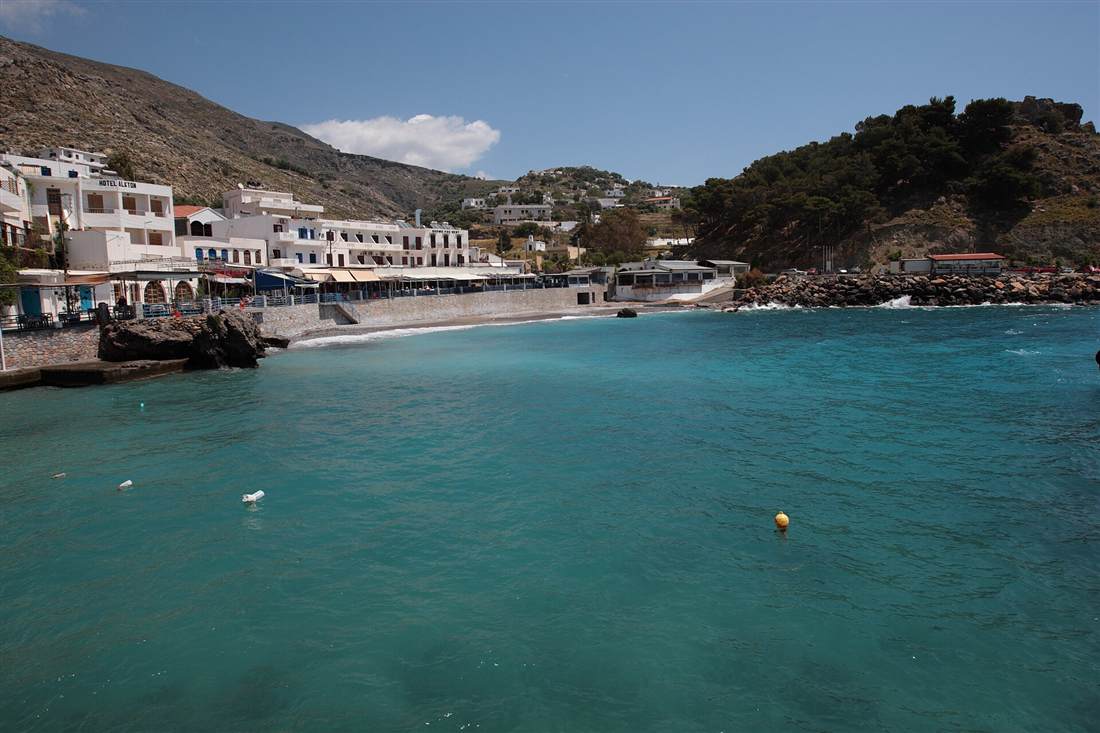
To get from Chania to Chora Sfakion, drive about 72 kilometres south over the White Mountains through Vryses, the Askifou plateau and the Imbros gorge in about 1.5 to 2 hours, or take the direct KTEL bus, to the south-coast harbour town and ferry hub of Sfakia. Plan the whole trip with Greece Tours.
This guide covers the trip from Chania to Chora Sfakion in full: where it is, how to get there by car and bus, the drive time, the harbour town, the ANENDYK ferries to Loutro, Agia Roumeli, Sougia and Gavdos, the Samaria Gorge return, what to do around it, the Sfakia region and its history, where to stay, the best time, and whether this south-coast trip is worth it.
Where is Chora Sfakion from Chania?
Chora Sfakion, also written Hora Sfakion or simply Sfakia, sits on the south coast of Crete about 72 km south of Chania. It is a small harbour town on the Libyan Sea in the Sfakia region of the Chania regional unit, the main port below the White Mountains.
Chania is the largest town of western Crete and faces the Cretan Sea on the north coast. Chora Sfakion faces the opposite way, out across the Libyan Sea towards Africa. The White Mountains, the Lefka Ori, rise between the two, so the 72 km separating them crosses the full width of the western island from the north shore to the south shore.
The town is the administrative and maritime centre of the Sfakia region, a rugged stretch of coast where the mountains drop straight into the sea. Sfakia holds a string of villages that stand off the road network, and Chora Sfakion is the port that ties them together. Its harbour is the departure point for the ferries that reach the roadless coast to the west.
From Chora Sfakion the coastal ferry runs west to Loutro and Agia Roumeli, the two villages with no road access, and on to the Samaria Gorge exit. A separate line links the harbour to Gavdos, the small island to the south that marks the southernmost point of Greece and Europe. This ferry role makes the town the transit hub of the whole southern Chania coast.
How do you get from Chania to Chora Sfakion?
Drive south from Chania over the White Mountains through Vryses and the Askifou plateau, past the Imbros gorge, and down to the coast in about 1.5 to 2 hours. The direct KTEL bus covers the same route in about 2 hours and meets the ferries at the harbour.
The road leaves Chania and heads south towards Vryses, a village on the National Road that marks the turn inland into the mountains. From Vryses the route climbs onto the Askifou plateau, a high enclosed basin ringed by peaks, then rises again to the head of the Imbros gorge before the long descent to the sea at Chora Sfakion.
A hire car is the most direct way and gives control over timing, which matters when a ferry connection is the goal. The drive is one continuous mountain road with a clear run to the harbour car park at the end. Drivers who continue to Loutro or Agia Roumeli leave the car at Chora Sfakion, because those villages have no road.
The KTEL bus is the alternative for travellers without a car. It runs the same mountain route as a direct service and finishes at the Chora Sfakion waterfront next to the ferry berths. The bus is the standard link for walkers finishing the Samaria Gorge, who ride the boat to Chora Sfakion and then board the coach back to Chania.
How long does it take to drive from Chania to Chora Sfakion?
The drive takes about 1.5 to 2 hours over roughly 72 km. The route runs south from Chania through Vryses, climbs onto the Askifou plateau, then descends the mountain road above the Imbros gorge to the south coast, a winding drive with long sea views on the final descent.
The distance is short in kilometres but the terrain sets the pace. The first stretch south to Vryses is fast on open road. Past Vryses the road narrows and starts to climb, with tight bends through the villages and up to the rim of the Askifou plateau at around 700 metres above sea level.
From the plateau the road rises once more to the top of the pass near Imbros, the village at the head of the Imbros gorge. Here the route turns to face the sea and begins the descent to Chora Sfakion. The Libyan Sea comes into view far below, and the road drops through a series of hairpins down the mountainside to the coast.
The 1.5 to 2 hour range reflects that mountain profile rather than traffic. A steady drive with stops at the Askifou viewpoint and the top of the descent runs nearer two hours; a direct run holds closer to ninety minutes. The final section demands attention, as the road is single carriageway with sharp bends and a steep gradient down to the harbour.
Can you take the bus from Chania to Chora Sfakion?
Yes. The KTEL bus runs a direct service from Chania to Chora Sfakion in about 2 hours, a few times a day in the summer season. The buses are timed to connect with the coastal ferries to Loutro and Agia Roumeli and with the Samaria Gorge return, dropping passengers at the harbour.
The service departs from the Chania KTEL bus station and runs the mountain road through Vryses and Askifou to the south coast. The number of daily departures is highest in the summer months, when demand from Samaria Gorge walkers and south-coast travellers peaks, and drops to a reduced timetable outside the main season.
The timetable is built around the ferries. Morning departures from Chania reach Chora Sfakion in time for the boats west to Loutro and Agia Roumeli, and afternoon buses out of Chania meet the returning ferries that bring gorge walkers back from Agia Roumeli. This coordination lets a walker cross the Samaria Gorge one way and return to Chania by boat and bus.
The bus stops at the Chora Sfakion waterfront, a short walk from the ferry berths and the tavernas along the seafront. Confirm the departure times against the current KTEL timetable before travelling, because the schedule shifts between the summer and winter seasons and the ferry links depend on the same times holding.
What is Chora Sfakion town like?
Chora Sfakion is a small, quiet harbour town rather than a resort. It is a working port with a seafront of fish tavernas and rooms to let, fishing and ferry boats in the harbour, and a proud independent Sfakian character. A war memorial marks the wartime evacuation of Allied troops from this beach.
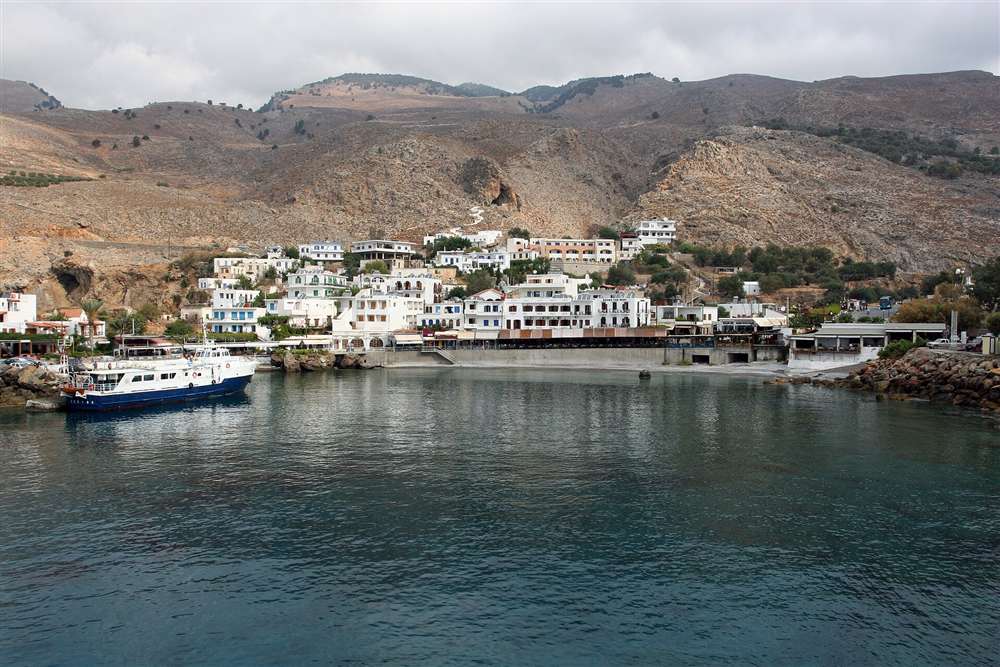
The town wraps around a compact harbour where the ferries berth alongside local fishing boats. The waterfront is a single line of tavernas serving grilled fish and Sfakian dishes, backed by rooms and small guesthouses. There is no strip of large hotels and no beach-resort infrastructure; the scale stays that of a working port with a modest visitor trade.
Sfakia holds a strong regional identity within Crete. The Sfakians are known across the island for a fierce independent streak rooted in centuries of mountain isolation and resistance, and that character marks the town and its people. Local food follows suit, with the Sfakian pie, a thin cheese-filled pancake served with honey, the dish the region is named for.
Above the harbour stands the memorial to the Second World War evacuation, when thousands of Allied soldiers withdrew across the White Mountains after the Battle of Crete and were taken off by ship from this shore. For most travellers the town works as a base and transit point: a night in a harbour room, a meal on the seafront, and a ferry out to the roadless coast the next morning.
What ferries run from Chora Sfakion?
Chora Sfakion is the eastern terminus of the ANENDYK coastal ferry line, the only transport link along Crete’s roadless south-west shore. Boats sail west to Loutro and Agia Roumeli, connect onward to Sougia and Paleochora, and run south to Gavdos, the southernmost island of Europe.
No road reaches the villages west of Chora Sfakion. The ANENDYK ferry is the road, and every settlement on this coast lives by its timetable. From the harbour the primary route runs 20 minutes west to Loutro, a car-free bay reached only by boat or on foot, then a further 45 minutes to Agia Roumeli at the mouth of the Samaria Gorge. A second link continues from Agia Roumeli to Sougia and Paleochora, stitching the whole southern shoreline into one waterborne line. Explore the harbour village itself on the Loutro guide before you sail.
The Gavdos ferry departs Chora Sfakion for the island 26 nautical miles south across the Libyan Sea, a crossing of about 2 hours 30 minutes. Gavdos marks the last land before Africa and draws walkers to its cedar-backed beaches at Sarakiniko and Agios Ioannis. Sailings thin outside the summer months, so the harbour board and the ANENDYK schedule are the two references that govern the day.
The busiest traffic through the port is the Samaria return. Walkers finish the gorge at Agia Roumeli, board the ferry east, and step ashore at Chora Sfakion to meet the waiting bus. The last eastbound boat of the day is timed to clear the gorge crowd, which makes the afternoon harbour the single liveliest moment on the Sfakia coast.
How does Chora Sfakion connect to the Samaria Gorge?
Chora Sfakion is the return point of the Samaria Gorge walk. Hikers descend the 16-kilometre gorge to Agia Roumeli on the coast, take the eastbound ANENDYK ferry to Chora Sfakion, then ride the KTEL bus back over the White Mountains to Chania. Boat and bus are timed to link.
The Samaria route runs one direction only, north to south. Walkers start at the Xyloskalo trailhead on the Omalos plateau at 1,230 metres, drop through the gorge past the abandoned village of Samaria and the narrow Iron Gates, and reach the sea at Agia Roumeli after 16 kilometres. Agia Roumeli has no road out. The ferry east is the sole exit, and it terminates at Chora Sfakion. Plan the descent itself with the Samaria Gorge guide.
From Agia Roumeli the crossing to Chora Sfakion takes about 1 hour 15 minutes, calling at Loutro on the way. The last boat leaves in the late afternoon to gather the day’s walkers, and the harbour fills as three or four busloads assemble on the quay. Chora Sfakion functions here as a transfer hub: pier to bus stop is a two-minute walk across the seafront.
The KTEL bus climbs from the port back through the Imbros Gorge road and over the mountains to Chania in about 1 hour 45 minutes. The full circuit \u2014 Chania to Omalos by early bus, the gorge on foot, the ferry, the return bus \u2014 is the standard Samaria day loop, and Chora Sfakion is the pivot that closes it. This trip anchors the wider set of day trips from Chania.
What is there to do in and around Chora Sfakion?
Chora Sfakion holds a pebble town beach beside a working harbour, and serves as the launch point for Sweetwater beach, the coastal path to Loutro, the Venetian fortress at Frangokastello, and the Imbros and Aradena gorges above. Sfakian cheese pie and mountain lamb are the local table.
The town beach sits right below the tavernas, a strip of grey pebbles with clear deep water. West of the port lies Glyka Nera, Sweetwater beach, named for the freshwater springs that bubble up through the shingle at the shoreline. Reach it by a 10-minute boat taxi or a 40-minute cliff path from the harbour. The springs keep the sand cool where they surface, and the beach has no road, which keeps it quiet.
The coastal footpath west links Chora Sfakion to Loutro in about 2 hours, tracing the old kalderimi above the sea past Sweetwater. East of town, 14 kilometres along the shore, stands Frangokastello, a square Venetian fort built above a long flat sand beach, its four corner towers still intact. Above the coast the Imbros Gorge cuts an 8-kilometre walking route down toward the sea, and the Aradena Gorge crosses beneath a 138-metre iron bridge, the highest in Crete.
The Sfakian kitchen is distinct. Sfakiani pita is a thin pan-fried cheese pie folded round soft myzithra and drizzled with local thyme honey. Mountain lamb, snails, and mizithropitakia fill the tavernas along the front. Chora Sfakion works as a base for the whole Sfakia coast, close to the sea trips and the gorges alike, and reached from the harbour town of Chania by a single mountain road.
What is the Sfakia region and its history?
Sfakia is the wild, mountainous south-west corner of Crete, a region famed for fiercely independent people who resisted Venetian, Ottoman and every outside rule. Its history holds rebellions, blood vendettas, distinctive dress, and the wartime sea evacuation of Allied troops from Chora Sfakion after the Battle of Crete.
Sfakia spreads across the southern flank of the White Mountains, where peaks reach 2,453 metres at Pachnes and drop straight into the Libyan Sea. The terrain bred a people the lowland rulers never fully governed. Under Venetian control the Sfakians launched repeated revolts, and under Ottoman rule the region kept its arms and its autonomy long after the plains had submitted. The great uprisings of the south repeatedly ignited in these gorges and passes.
The culture is marked and worn openly. Sfakian men wear the black shirt, the breeches and the high boots, and carry the ornate silver-hilted knife inscribed with mantinada verse. The tradition of the vendetta, the blood feud between families, ran through the mountain villages for generations and left its own code of honour and hospitality. The Cretan lyra and the sung rhyming couplet remain the region’s living music.
Chora Sfakion holds a specific place in the wider war. After the Battle of Crete, thousands of Allied troops of the retreating force crossed the White Mountains on foot to reach this harbour, and the Royal Navy lifted them from its beach by night over four evenings before the port fell. A memorial on the seafront marks the evacuation. That proud, distinct identity \u2014 mountain, sea and stubborn independence \u2014 is what the name Sfakia carries.
How do you get to Gavdos from Chora Sfakion?
The ANENDYK ferry sails from Chora Sfakion south to Gavdos, the southernmost island of Greece and Europe, a crossing of about 2.5 hours over 26 nautical miles of the Libyan Sea. Sailings run a few times a week in summer and thin outside the season, so the timetable governs the trip.
Gavdos lies out in the open Libyan Sea beyond the Sfakia coast, the last land before the African shore. The ferry is the only public way there, and it leaves from the Chora Sfakion harbour alongside the coastal boats, so the town is the mainland gateway to the island. The crossing runs about 2.5 hours in calm conditions and longer when the sea rises.
The island draws walkers and campers to its cedar-backed beaches at Sarakiniko, Agios Ioannis and Potamos, and to the wooden chair marker at Tripiti that stands at the southernmost point. There is a handful of tavernas and rooms, no resort, and the pace matches the remoteness. Travellers pack for a self-sufficient stay rather than a day trip.
The sailing schedule is the one fixed constraint. Boats run a few days a week through the summer, cut back sharply in spring and autumn, and hold to the weather, since the open crossing closes in a strong south wind. Confirm the ANENDYK Gavdos timetable at the Chora Sfakion quay and build the return around it, because a missed boat means days on the island.
Where do you stay and eat in Chora Sfakion?
Chora Sfakion offers rooms, studios and small family guesthouses along the harbour and the streets above it, with no large hotels. The seafront tavernas serve grilled fish, Sfakian cheese pie with honey, and mountain lamb. The town is a quiet, cheap base for the Sfakia coast rather than a resort.
Accommodation is small in scale and local in character. Rooms to let and self-catering studios line the harbour front and climb the lanes behind it, most family-run with a handful of units and a balcony over the port. Prices sit below the north-coast resorts, and the quiet after the day boats leave is the draw for travellers who want the working coast.
The tavernas run along the seafront, tables set at the water beside the moored boats. Fish comes off the local boats, and the Sfakian kitchen fills the rest of the menu: the thin cheese pie folded round myzithra and drizzled with thyme honey, spit-roast and stewed mountain lamb, snails, and the hard cheeses of the high villages.
Staying overnight suits the ferry rhythm. A night in a harbour room lets a traveller take the morning boat west to Loutro or south to Gavdos without racing the mountain road, and the evening empties the port to the few dozen guests once the Samaria crowd has bussed back to Chania. The town works as a base for the gorges, the beaches and the boats alike.
When is the best time to visit Chora Sfakion?
Late spring to early autumn is the season, when the coastal ferries, the Gavdos boat and the Samaria Gorge all run their full timetable. May, June and September bring warm sea and thinner crowds; July and August are the busiest and hottest, and the winter service drops to a minimum.
The ferries set the calendar. The ANENDYK coastal line to Loutro and Agia Roumeli and the Gavdos crossing run their fullest schedule from May to October, the same window the Samaria Gorge stays open, so a visit inside that season reaches every route the port serves. Outside it the boats and the gorge scale back or stop.
The shoulder months reward the walker. May, June and September hold warm sea and settled weather with fewer people on the boats and the trails, and the gorge walks to Imbros and Aradena stay comfortable before the summer heat. July and August fill the harbour with Samaria crowds each afternoon and push the temperature up on the exposed coast.
Winter turns the town inward. The service drops to a skeleton timetable, the Gavdos boat runs rarely, and the storms off the Libyan Sea close the crossings for days at a time. For the full range of ferries, gorges and beaches, plan the trip between late spring and early autumn.
Is the trip from Chania to Chora Sfakion worth it?
Yes. Chora Sfakion is the gateway to the roadless Sfakia coast, the Samaria Gorge return, Loutro, Gavdos, the mountain gorges and the Sfakian table. The trade-off is a 72-kilometre winding drive to a small working port, and for south-coast travel that hub earns the journey.
The drive from Chania runs 72 kilometres south, about 1 hour 30 minutes, climbing over the Askifou plateau and down through the Imbros valley before the sea opens below. It is a mountain road with tight switchbacks and a final steep descent to the harbour. What waits at the bottom is not a resort but a working ferry port of a few hundred residents, and that is the point of it.
Everything the south-west coast offers threads through this harbour. The Samaria walkers return here, the Loutro and Agia Roumeli boats leave from here, the Gavdos crossing starts here, and Sweetwater, Frangokastello and the gorges ring the town. No other single point on the southern shore opens the same spread of routes, which places Chora Sfakion among the essential south-coast trips out of west Crete.
Pair it with the surrounding cluster to build the day: reach it through the day trips from Chania, close the Samaria loop, or use it as the eastern door to Loutro and the ferry line. The winding road is the toll; the roadless coast beyond the harbour is the reward.
Frequently Asked Questions
How do you get from Chania to Chora Sfakion?
From Chania to Chora Sfakion, drive about 72 kilometres south over the White Mountains through Vryses, the Askifou plateau and the Imbros gorge in about 1.5 to 2 hours, or take the direct KTEL bus in about 2 hours. The bus is timed to meet the coastal ferries at the harbour.
How far is Chora Sfakion from Chania?
Chora Sfakion lies about 72 kilometres south of Chania on the south coast in the Sfakia region. The drive takes 1.5 to 2 hours over a winding mountain road across the Askifou plateau and down above the Imbros gorge to the Libyan Sea.
Is the trip from Chania to Chora Sfakion worth it?
The trip from Chania to Chora Sfakion rewards visitors with the gateway to the roadless Sfakia coast, the Samaria Gorge return, the ferries to Loutro, Agia Roumeli and Gavdos, the gorges and the Sfakian food. The winding mountain drive to a small working port is the trade-off.