
To get from Chania to Bali, drive east on the E75/A90 national road past Rethymno to the Bali exit, then the 2-kilometre side road down to the coast, about 78 kilometres in 1 to 1.25 hours, reaching the small cove resort on the north coast of the Rethymno region between Rethymno and Heraklion. Plan the whole trip with Greece Tours.
This guide covers the trip from Chania to Bali in full: where it is, how to get there by car and by KTEL bus, the resort built over four sheltered coves, the beaches from Livadi to Karavostasi, the Melidoni Cave and the pottery village of Margarites inland, and whether this north-coast trip is worth it or better as a base. This is Bali in Crete, not Bali in Indonesia.
Where is Bali in Crete, and how far is it from Chania?
Bali is a small coastal resort on the north coast of Crete, in the Rethymno regional unit, 45 kilometres east of Rethymno town and 78 kilometres east of Chania. It sits between Rethymno and Heraklion, built around four sheltered coves.
This is Bali in Crete, a Greek fishing hamlet turned holiday village, and not the Indonesian island that carries the same name. The two share nothing but the spelling. The Cretan Bali occupies a rocky stretch of the island’s northern shore, tucked into a series of bays where the land drops toward the Cretan Sea. From Chania, the drive tracks the full width of two regional units, west Crete’s Chania unit and then Rethymno, before the exit that peels off the national road toward the water.
The resort’s position is precise: 78 kilometres east of Chania, 45 kilometres east of Rethymno town, and inside the Rethymno regional unit that separates the island’s two largest cities. The coast here faces north, so the beaches look out over open water toward the mainland horizon, and the four coves that form the settlement each cut into the rock at a slightly different angle. The village name attaches to the whole cluster of bays rather than a single square, which is why arrivals from Chania find the place spread along and above the shoreline instead of gathered around one central point.
The distance matters for planning. At 78 kilometres, Bali sits far enough from Chania to rule out a casual afternoon errand, yet close enough for a full day out with the drive folded into the schedule. It falls almost exactly halfway between Rethymno and Heraklion on the coastal route, which makes it a natural stop for travellers crossing the island from west to east. The gap between the national road above and the coves below is 2 kilometres of side road, a descent that separates the through-traffic corridor from the quiet water at the bottom.
How do you drive from Chania to Bali?
Drive east from Chania on the E75/A90 national road, pass Rethymno, and take the signed Bali exit. From the exit, a 2-kilometre side road drops down to the coves. The full trip covers 78 kilometres and takes 1 to 1.25 hours.
The route is direct and hard to lose. Leaving Chania, the E75/A90 national road runs east as the island’s main north-coast artery, a fast dual and single carriageway that hugs the coast and threads the hills between the two cities. The road carries every long-distance vehicle crossing Crete, so it stays well surfaced and clearly signed in Greek and Latin script. Rethymno arrives at the halfway mark; the town’s exits pass on the right, and the national road continues east beyond it without any need to enter the centre.
Past Rethymno, the carriageway climbs and dips through a rockier, emptier stretch of coast. The Bali exit is signed by name from the national road. Leaving the fast road, the 2-kilometre side road twists downhill toward the sea, tightening as it nears the coves and passing between low-rise hotels and tavernas that climb the headlands. The final descent is steep in places, and the lanes inside the resort narrow further, so the last kilometre runs slower than the highway that fed it.
Total driving time lands between 1 and 1.25 hours for the 78 kilometres, with the national road covering the bulk of the distance at speed and the side road eating the final minutes. A car is the cleanest way to reach Bali from Chania because it carries you the whole way down to the water, past the junction where public transport stops short. Parking sits at the edges of each cove and along the steep lanes, and the resort’s compact footprint means a short walk from any space to the beach. For travellers weighing this against other outings, Bali ranks among the longer day trips from Chania, rewarded by the calm bays at the far end of the drive.
How do you reach Bali by bus?
No direct KTEL line runs to Bali. The Chania-Rethymno-Heraklion coastal bus stops at the Bali junction on the national road. From the junction it is a 2-kilometre downhill walk or a short taxi to the resort. Change at Rethymno if the through service does not serve the stop.
The public route asks for a little effort at the end. KTEL, the regional bus network, runs frequent coaches along the north coast linking Chania, Rethymno and Heraklion, and this coastal service passes directly above Bali. The catch is that the bus does not descend the 2-kilometre side road; it sets passengers down at the Bali junction on the national road, at the top of the hill. From that stop, the resort lies 2 kilometres downhill, reached on foot or by a short taxi from the junction.
Travellers without a car board the coastal KTEL at the Chania bus terminal and ride east. A through service to Heraklion that halts at the Bali junction covers the whole leg in one seat. When the timetable does not offer a direct halt, the fix is a change at Rethymno: ride the Chania-Rethymno leg, then join the Rethymno-Heraklion coach that stops at the junction. Either way, the coastal buses run through the day, so connections at Rethymno line up without long waits.
The final 2 kilometres down to the coves is the part to plan for. The walk is entirely downhill on the way in, a 25 to 30 minute descent past the tavernas and hotels toward the harbour cove. The return climb back to the junction is the harder direction, uphill the full 2 kilometres in the sun. A taxi from the junction shortens both legs, and local drivers work the stop when buses arrive. For a car-free visitor, the sequence is fixed: coastal KTEL to the junction, then walk or taxi the 2 kilometres to the water.
What is Bali like as a resort?
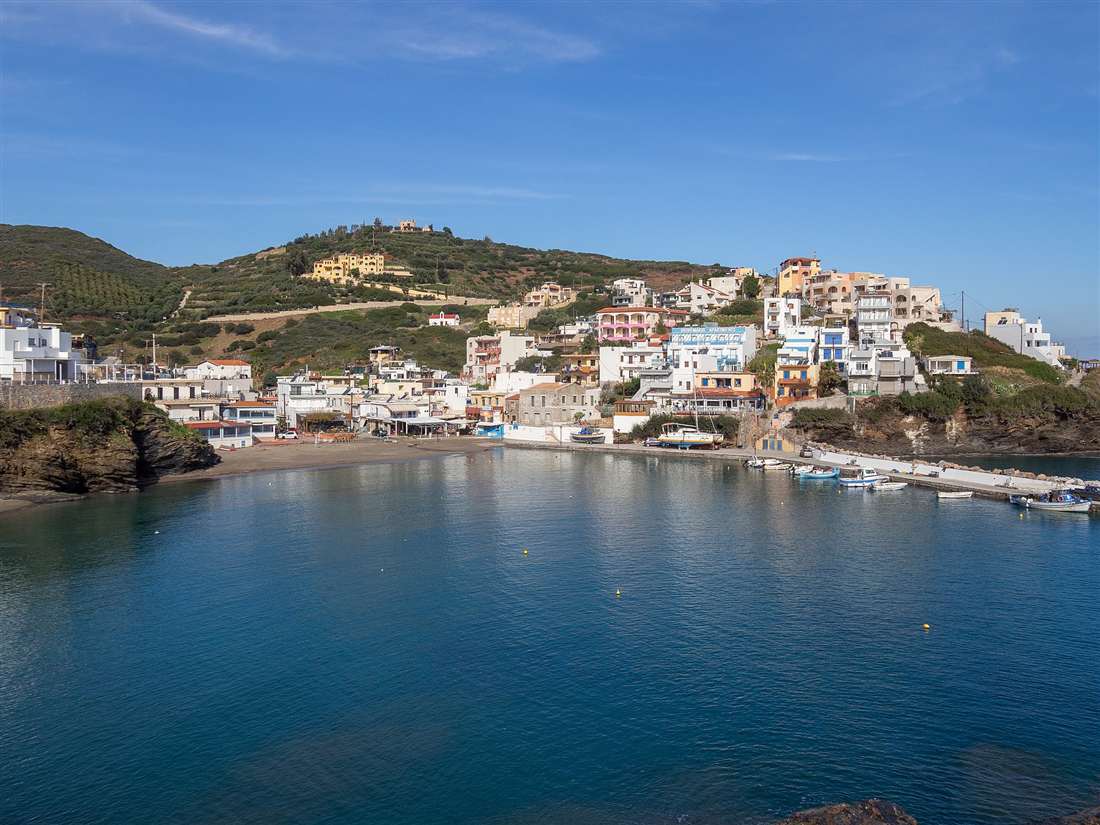
Bali is a former fishing hamlet spread over four consecutive coves. Steep lanes, a small fishing harbour, tavernas and low-rise hotels climb the headlands between the bays. The water shelves gently and stays sheltered, which suits snorkelling and families.
The resort grew out of a working fishing hamlet, and the old bones still show. A small fishing harbour anchors one of the coves, with boats tied along the quay and tavernas set close to the water’s edge. Behind and above the shoreline, the village climbs the rock in tiers, its lanes steep and winding as they connect one cove to the next. The buildings stay low-rise, hotels and rooms stacked into the headlands rather than towering over the beaches, so the settlement keeps the scale of the hamlet it once was.
The defining trait is shelter. Each of the four coves cuts into a rocky bay, and the enclosing headlands break the open sea into calm, clear pools of water. The seabed shelves gently from the sand and shingle, deepening slowly rather than dropping away, and the enclosing rock keeps the surface flat on days when the open coast churns. That combination of clear water, gentle shelving and shelter is what draws families and snorkellers: children wade out over a slow gradient, and the transparent water over the rocky fringes of each bay reveals fish close to shore.
Life in Bali concentrates on the four bays and the lanes between them. Tavernas cluster by the harbour and along the coves, serving fish landed at the quay and the standard Cretan table. The steep streets link small beaches, rooms and hotels into a compact grid that rewards walking over driving once you arrive. The resort trades on quiet water and a slow pace rather than nightlife or scale, which fixes its character as a family and swimming destination on a coast otherwise built for through-traffic.
What are the four coves and beaches of Bali?
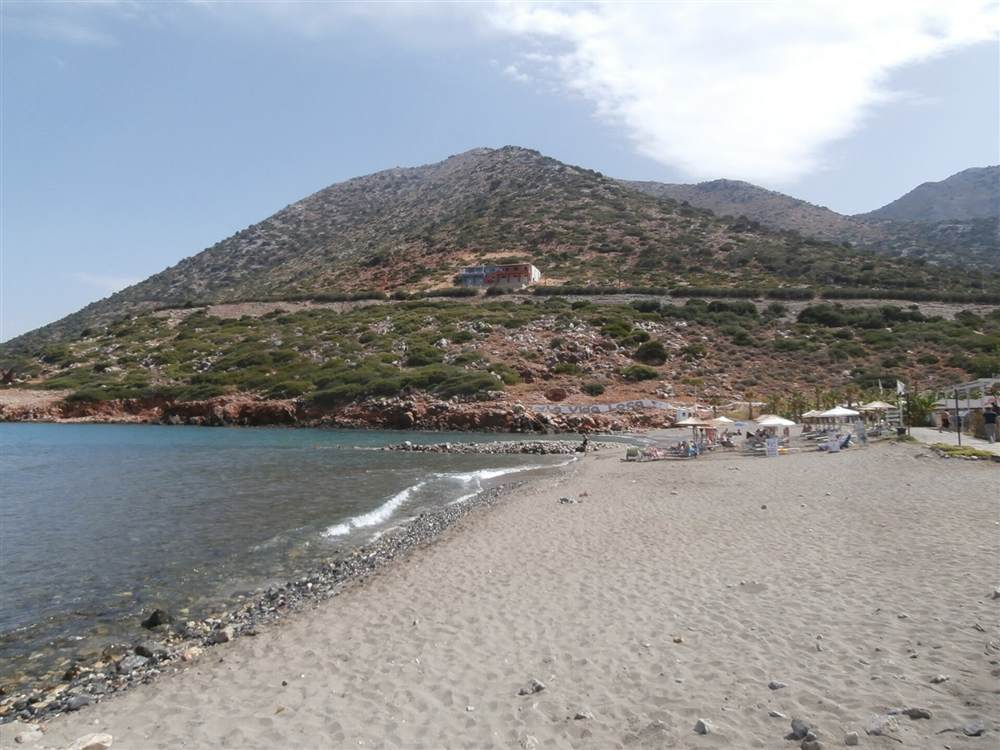
Bali is built around four consecutive coves: Livadi, Varkotopos, Limani (the harbour cove) and Karavostasi, also called Paradise. Each is a small sand-and-shingle beach in a rocky bay with clear, calm, sheltered water that shelves gently from the shore.
The four coves run one after another along the resort’s shore, and each carries its own name and character. Livadi is the first, a small sand-and-shingle beach set into its rocky bay. Varkotopos follows, another sheltered pocket of beach beneath the climbing lanes. Limani is the harbour cove, built around the small fishing harbour where boats tie up and tavernas line the quay, so it mixes working waterfront with swimming. Karavostasi, widely known as Paradise beach, closes the sequence and draws the crowds with its name and its calm water.
All four share the same makeup: a strip of sand and shingle, a rocky bay enclosing it, and clear water that stays calm and sheltered behind the headlands. The seabed shelves gently in every cove, deepening by degrees rather than plunging, which is the trait that makes the whole resort a swimming destination for families. The rock that separates each bay from the next also breaks the sea, so the water inside stays flat and transparent even when the wind picks up along the open coast.
The coves link by the steep lanes that climb the headlands between them, so a visitor walks from Livadi to Karavostasi across the tops rather than along a single beachfront. That layout spreads sunbathers across four separate beaches instead of one, which keeps each cove smaller and quieter than a single long strand. The clear, calm water over the rocky fringes suits snorkelling in all four, and the harbour cove adds boats and quayside tavernas to the swimming. Between them, the four bays give Bali its shape: a resort of small sheltered beaches strung along a rocky coast.
What sights are near Bali \u2014 Melidoni Cave, Margarites and Panormos?
Inland from Bali sit the Melidoni Cave, an ancient cult cave with a grim Ottoman-era history, and the pottery village of Margarites. West lie the Arkadi Monastery and the beaches of Panormos and Rethymno, and the north-coast road runs on east to Heraklion.
The Melidoni Cave lies inland from Bali, a short drive up from the coast. It served as a cult cave in antiquity, a place of worship deep in the rock, and it carries a grim Ottoman-era history layered over that ancient use. The cave is the closest major sight to the resort and pairs a swim on the coves with a cool descent underground. Further into the hills sits Margarites, a pottery village where workshops shape and fire clay, a craft that has held the place for generations and fills its lanes with kilns and displays.
West of Bali, back toward Rethymno, the Arkadi Monastery stands as one of Crete’s charged historical sites, set in the hills above the coast. The beaches of Panormos lie along the same western stretch, a nearer resort on the road between Bali and Rethymno town, and Rethymno itself adds its old Venetian harbour, fortress and long town beach 45 kilometres back toward Chania. These sights cluster within a short radius, so a base at Bali reaches cave, pottery village, monastery and neighbouring beaches without long transfers.
East, the north-coast road continues to Heraklion, opening the eastern half of the island from the same junction that feeds the resort. That position between Rethymno and Heraklion, with Melidoni and Margarites inland and Panormos and Arkadi to the west, makes Bali a hub for touring the central north coast as much as a beach in its own right. A day here folds a swim in the sheltered coves into a run inland to the cave and pottery village, or west to the monastery and Panormos, before the drive back to Chania.
Is the trip from Chania to Bali worth it, and when to go?
The trip rewards travellers who want calm, sheltered swimming and a slow-paced resort rather than a quick beach. At 78 kilometres and 1 to 1.25 hours each way from Chania, it earns a full day. Late spring through early autumn brings warm, settled sea.
Bali suits a specific traveller. The four sheltered coves, the gentle shelving seabed and the clear, calm water make it a strong choice for families with young children and for snorkellers who want transparent water close to shore. The former fishing hamlet, its harbour and its steep lanes give the resort a character that a purpose-built beach strip lacks. Against that, the 78-kilometre distance from Chania and the 1 to 1.25 hours of driving each way turn Bali into a full-day commitment rather than a morning’s outing, so the visit repays travellers who plan the whole day around it.
The season shapes the experience. Late spring through early autumn delivers warm air and a settled Cretan Sea, and the sheltered coves hold their calm even when the open coast turns choppy, which extends good swimming days at both ends of the season. High summer fills the beaches, above all Karavostasi, the Paradise cove, so early arrivals claim space before the day-trippers descend the 2-kilometre side road. The shoulder months trade crowd for cooler water and quieter lanes, and the sheltered water still swims well when the exposed beaches further west lose their warmth.
Weighed against a Chania base, Bali is worth the drive for a traveller after sheltered swimming, a working harbour and a run of inland sights within reach. Those set on the shortest possible beach day stay closer to Chania; those willing to trade 78 kilometres for calm coves, clear water and a slower resort find the trip pays back. Pairing the swim with the Melidoni Cave, Margarites or Panormos turns the distance into a rounded day out, and the sheltered water at the bottom of the coves is the reward that fixes Bali on the itinerary.
Frequently Asked Questions
How do you get from Chania to Bali?
From Chania to Bali, drive east on the E75/A90 national road past Rethymno to the Bali exit, then the 2-kilometre side road down to the coves, 78 kilometres in 1 to 1.25 hours. By bus, take the Chania-Rethymno-Heraklion KTEL to the Bali junction, then walk or taxi the last 2 kilometres.
How far is Bali from Chania?
Bali lies 78 kilometres east of Chania on the north coast of Crete in the Rethymno regional unit, 45 kilometres east of Rethymno town, between Rethymno and Heraklion. The drive on the fast national road takes 1 to 1.25 hours.
Is the trip from Chania to Bali worth it?
The trip from Chania to Bali rewards visitors with four sheltered coves of clear, calm water, snorkelling and a small fishing harbour, an hour from the city. The short distance makes Bali an easy day out and a relaxed north-coast base.