
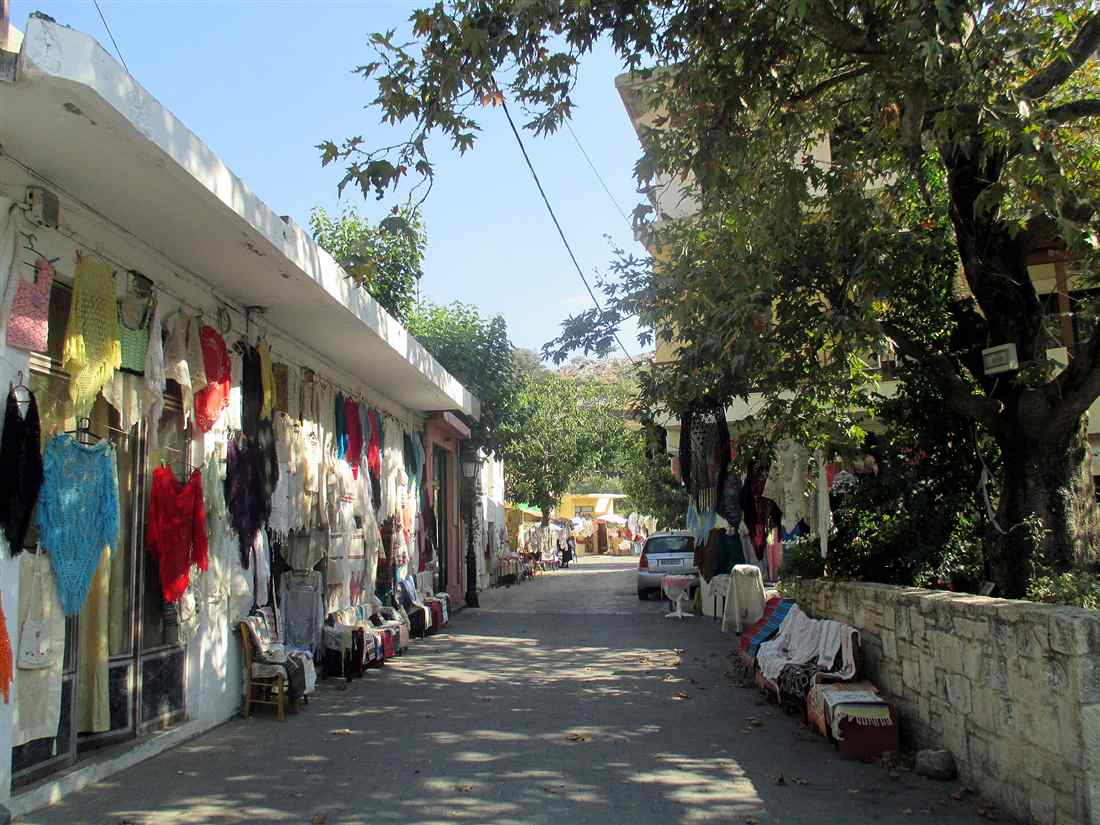
To get from Chania to Anogia, drive east on the E75/A90 national road past Rethymno, then inland and uphill through Perama and Garazo onto Mount Psiloritis, about 135 kilometres in 2 to 2.5 hours, reaching the mountain village at 740 metres on the northern slopes of the massif. Plan the whole trip with Greece Tours.
This guide covers the trip from Chania to Anogia in full: where it is, how to drive it, the awkward KTEL bus corridor, the proud weaving-and-lyra village and its resistance history, the Ideon Cave and Nida plateau high on Psiloritis, the summit of the highest mountain on Crete, the mountain food and culture, and whether this high trip is worth it. Anogia is also spelled Anogeia.
Where is Anogia and how far is it from Chania?
Anogia, also spelled Anogeia, sits on the northern slopes of Mount Psiloritis (Mount Ida) in the Rethymno regional unit, at an altitude of 740 metres. It stands 135 kilometres east of Chania and 55 kilometres south-west of Heraklion.
The village occupies a commanding shelf on the Psiloritis massif, the central mountain range that forms the spine of Crete. From its tiers of stone houses the land falls away to the north toward the coastal plain and rises to the south toward the bare summits of the range. This altitude of 740 metres sets Anogia apart from the beach resorts of the island: the air is cooler, the light is sharper, and the horizon is filled with rock and grazing land rather than sea. The village looks out over the whole of the Mylopotamos valley, and on clear days the view reaches the north coast and the water beyond it.
Chania lies at the western end of Crete, on the northwest coast, while Anogia is planted in the island’s central highlands. The 135 kilometres between them cross three of the island’s four regional units in effect, running from the Chania plain east along the coast through the Rethymno lowlands and then climbing inland onto the mountain. Anogia is not a coastal destination reached by a straight road; it is an ascent into the interior, and the last stretch gains height fast. The gap between the two places is therefore measured in vertical metres as much as in kilometres, and the drive divides cleanly into a fast coastal half and a slow mountain half.
For orientation, Anogia sits almost due south of the coastal town of Perama and Bali, and it is the last real settlement before the road gives out into the high pastures of the Nida plateau. Heraklion, the island’s capital and its airport hub, is the closer city at 55 kilometres, which is why bus itineraries and drivers approach Anogia from the east rather than from Chania. Understanding that geography is the key to planning the trip: Anogia belongs to the Psiloritis world of shepherds and stone, and reaching it from Chania means committing to a genuine cross-island journey into the mountains.
How do you drive from Chania to Anogia?
Drive east from Chania on the E75/A90 national road past Rethymno, then turn inland and climb through Perama and Garazo up onto the Psiloritis massif to Anogia. The route covers 135 kilometres and takes 2 to 2.5 hours, with the mountain leg on a winding two-lane road.
The journey starts easily. Leaving Chania, you join the E75/A90, the north-coast national road that runs the length of Crete, and hold it eastward. This first half is quick, open highway: you pass the Souda bay, skirt the Rethymno plain, and roll past the Rethymno exits with the sea on your left and the White Mountains falling behind you. The road here is fast two-lane and dual-carriageway in stretches, and the driving is undemanding. This coastal portion eats up the bulk of the 135 kilometres in a little over an hour, and it is the reason the whole trip stays inside 2.5 hours despite the mountain climb at its end.
The character of the drive changes the moment you leave the national road and turn south inland toward Perama. From Perama the route follows the Mylopotamos valley through Garazo and a chain of stone villages, and the tarmac begins to climb in earnest. This mountain leg is a winding two-lane road that switches back on itself as it gains height onto the massif, threading between olive terraces, sheepfolds and bare rock. The final ascent to the 740-metre shelf where Anogia sits is the slowest, highest part of the drive, and it demands attention: the corners are tight, the camber shifts, and flocks of sheep and goats hold right of way. Budget the second hour for this inland climb even though it covers far fewer kilometres than the coastal run.
A rental car turns this route into one of the finest drives on Crete and one of the standout day trips from Chania for anyone who wants mountains over beaches. Fuel up before the inland turn, because filling stations thin out once you leave the coast. Carry water, drive the switchbacks in a low gear, and give yourself margin on the clock: the 2 to 2.5-hour figure assumes clear conditions, and mountain weather, livestock and photo stops all stretch it. Anogia has parking at the edges of its upper and lower quarters, and the village streets themselves are steep and narrow, so leave the car and continue on foot once you arrive.
How do you get from Chania to Anogia by KTEL bus?
There is no direct KTEL bus from Chania to Anogia. The public route is a three-leg relay: Chania to Rethymno, Rethymno to Heraklion on the coastal KTEL, then the Heraklion to Anogia mountain bus. It fills a full travel day, and a rental car is the practical way to reach Anogia.
The obstacle is the shape of the bus network. Crete’s coastal KTEL service runs a frequent, reliable spine along the north coast linking Chania, Rethymno and Heraklion, and that first stage is simple: buses between Chania and Rethymno and onward to Heraklion depart through the day and move fast. The difficulty starts once you have to leave the coast. Anogia is served from Heraklion, not from the coastal towns to its west, so the corridor forces you all the way east to the capital before you turn back inland and south into the mountains.
From Heraklion’s KTEL station the mountain bus to Anogia climbs the Psiloritis road, but it runs on a thin timetable built for villagers rather than tourists, with a small number of departures a day and reduced service at weekends. That timetable is the pinch point of the whole itinerary. Chaining Chania to Rethymno, Rethymno to Heraklion, and then Heraklion to Anogia means matching three separate schedules and absorbing the waiting time between each, and a single missed connection strands the plan. The return compounds the problem, because the last bus down from Anogia leaves in the early afternoon and forces the same relay in reverse before dark.
The honest verdict is that the bus corridor to Anogia is awkward by design and consumes an entire day in transit for a short time in the village. Travellers set on public transport are better served treating Heraklion as the base for the Anogia bus and keeping Chania for the coastal network. For a trip that starts in Chania, a rental car is the practical way to reach Anogia: it collapses the three-leg relay into a single 2 to 2.5-hour drive, frees you from the timetable, and lets you press on above the village to the plateau and caves that the bus never reaches.
What is the village of Anogia like?
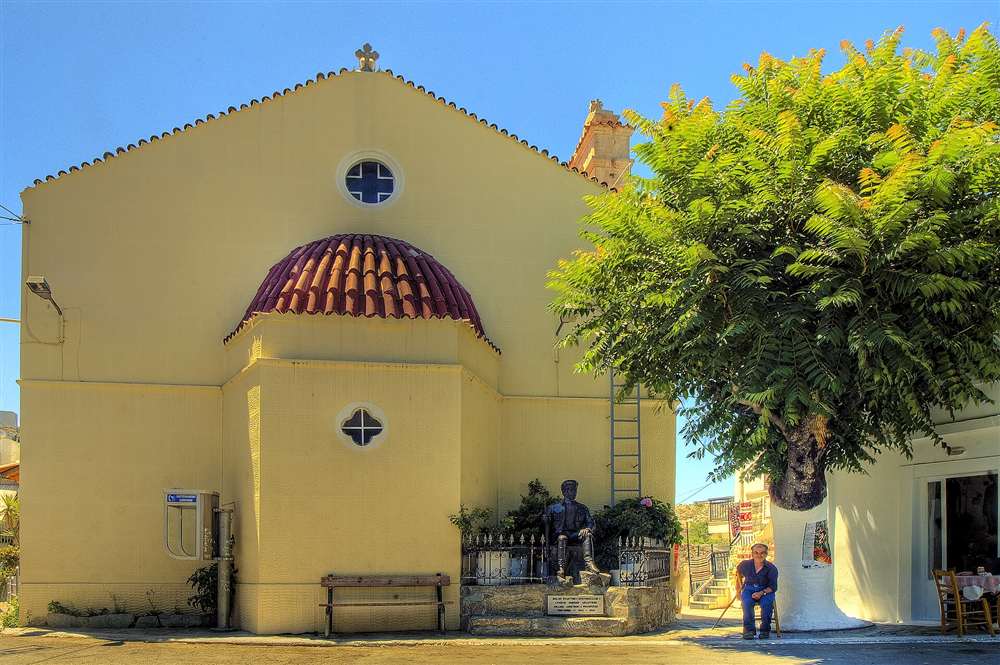
Anogia is a proud, resolutely traditional mountain village built in tiers up the slope of Psiloritis and split into an upper and a lower quarter. It is a stronghold of Cretan identity \u2014 a home of lyra music, handwoven textiles and mountain shepherding, rebuilt after it was razed during the German occupation.
The village is stacked on the hillside in stone terraces, and its two quarters, the upper and the lower, climb one above the other in a knot of steep lanes, arched passages and small squares. Whitewashed and bare-stone houses press close together, black-clad elders sit outside the kafeneia, and the streets ring with the independent, unpolished spirit that Anogia has carried for generations. This is a working mountain community first and a visitor destination second, and it wears that identity openly rather than dressing it up for outsiders.
Music is the beating heart of the place. Anogia is the birthplace of the great Cretan lyra players Nikos Xylouris and his brother Psarantonis, and the three-stringed lyra and the laouto are woven into daily life here as nowhere else on the island. The village produced a lineage of musicians whose songs carry the sound of the mountain, and lyra melodies still drift from tavernas and gatherings. Alongside the music runs a living craft of weaving: Anogia is famous for its handwoven textiles, and weaving workshops in the village still turn out rugs, blankets and cloth on traditional looms, patterns passed down through the women of the community.
Under all of it lies a hard history that shapes the village’s character. Anogia was razed to the ground during the German occupation as a reprisal, its houses dynamited and burned, and the settlement that stands today was rebuilt on the ruins by the survivors. That memory of destruction and defiant reconstruction runs through Anogia’s fierce pride and its refusal to be tamed. Shepherding binds the whole picture together: the men of Anogia have herded sheep and goats on the high pastures of Psiloritis for centuries, and the flocks, the cheese and the slow-cooked lamb of the mountain are the foundation of both the economy and the table. To walk Anogia’s tiers is to move through a place that has kept its music, its looms, its flocks and its long memory intact.
What lies above Anogia on Mount Psiloritis?
Above Anogia the mountain road climbs to the Nida plateau high on Psiloritis, where you reach the Ideon Cave (Ideon Andron) that myth names as the place the infant Zeus was raised by the Kouretes. The Skinakas Observatory and the trailhead for the 2,456-metre summit, the highest peak on Crete, lie up here too.
Anogia is the gateway to the roof of Crete. From the village a mountain road pushes south and upward onto the high pastures, and after a long, empty climb it opens onto the Nida plateau, a wide grassy bowl ringed by bare peaks at high altitude. The plateau is grazing land dotted with stone shepherds’ huts called mitata, where cheese has been made in the old way for generations, and it serves as the staging ground for everything higher on the massif. The drive up to Nida from Anogia is itself an event, a slow ascent through rock and thinning air into a landscape that feels closer to alpine than Mediterranean.
At the edge of the plateau sits the Ideon Cave, the Ideon Andron, a storied cave of Greek myth. Tradition holds that the infant Zeus was hidden and raised here, guarded by the armoured Kouretes who clashed their shields to drown out his cries from his father Kronos. The cave was a major place of worship in antiquity, and the walk up to its mouth crosses ground layered with legend. Higher and to the east stands the Skinakas Observatory, a working astronomical station perched on a ridge of Psiloritis, chosen for its clear mountain skies and reached by the same high-country roads.
For walkers, the Nida plateau is the launch point for the summit of Mount Psiloritis at 2,456 metres, the highest peak on the whole of Crete. The trail climbs from the plateau to the chapel of Timios Stavros at the top, a demanding hike rewarded with a view that on a clear day spans the island from sea to sea. Below Anogia, in the opposite direction near the village of Zoniana, lies the Sfendoni Cave, the largest, best-decorated show cave in the region, a chamber of stalactites and stalagmites that rounds out the underground and mountain circuit around the village. Together the plateau, the cave of Zeus, the observatory, the summit and the Sfendoni Cave make Anogia the base camp for the Psiloritis high country.
What is the food and culture of Anogia?
Anogia’s food is mountain shepherd fare built on its flocks: slow-cooked lamb and goat, ofto grilled meat, hard grey mountain cheeses and myzithra, all matched to lyra music, weaving and a fiercely independent Cretan culture. The village eats and sings the way it herds \u2014 from the land of Psiloritis.
The table in Anogia is a direct expression of the mountain around it. Centuries of shepherding put lamb and goat at the centre of every meal, and the signature dish is the slow-cooked meat of the flocks: ofto, meat grilled upright over embers until the fat crisps, and lamb baked for hours until it falls from the bone. Cheese runs through everything, because the mitata of the high pastures turn the sheep’s and goat’s milk into hard grey graviera, sharp kefalotyri and soft myzithra, and those cheeses fill the pies and dress the plates of the village. The cooking is unfussy and generous, seasoned with wild mountain herbs and finished with raki, the clear Cretan spirit poured at the end of every meal.
Culture and food are inseparable here, and the lyra is the thread that ties them. A meal in Anogia is bound up with music: the three-stringed lyra of Nikos Xylouris and Psarantonis is the village’s gift to Crete, and its melodies still fill the tavernas and the feasts. The weaving tradition sits alongside the music as the other great craft of the village. Anogia’s women work the looms of the workshops that line its lanes, and the rugs, blankets and woven cloth they produce carry the patterns of the mountain into the homes and shops of the upper and lower quarters. Buying a woven piece here is buying a living craft rather than a souvenir.
Underneath the raki and the songs runs the same defiant pride that rebuilt the village from its ashes. Anogia’s culture is one of resistance, memory and mountain self-reliance, and that spirit gives its hospitality an edge that beach resorts lack. Sit in a kafeneio in the upper quarter, and the conversation turns to flocks, family lines and the war; sit down to eat, and the meal is the produce of the pasture on the ridge above your head. To taste Anogia is to taste Psiloritis itself: the grass, the milk, the smoke of the fire and the long tradition of a people who have never let go of who they are.
Is the trip from Chania to Anogia worth it, and when to go?
The trip is worth it for travellers who want the real mountain Crete of shepherds, lyra music and the myth of Psiloritis rather than another beach. Go in late spring, early summer or autumn, when the plateau is open and the heat is mild; the high roads to Nida turn hard in deep winter snow.
Weigh the trip honestly against its cost in time. From Chania it is a 135-kilometre, 2 to 2.5-hour drive each way, and by public transport it is a full day of relayed buses through Heraklion. That is a long reach for a single village. What it buys is the strongest concentration of authentic mountain culture on Crete: the tiered stone quarters of Anogia, the birthplace of Cretan lyra, the living weaving workshops, and above the village the Nida plateau, the Ideon Cave of Zeus, the Skinakas Observatory and the 2,456-metre summit. For anyone drawn to the interior rather than the coast, that combination justifies the drive in full, and it pairs naturally with the caves and mountain villages of the Mylopotamos valley for a full day out.
Timing shapes the whole experience. Late spring brings green pastures, wildflowers on the plateau and comfortable temperatures on the exposed mountain shelf, and it opens the high roads to Nida after the winter. Early summer holds that window, with long light for the drive up to the plateau and the caves. Autumn is the other strong season: the fierce heat has broken, the harvest and shepherding rhythm are in full swing, and the light on the massif is at its clearest. These shoulder seasons also spare you the peak-summer traffic on the coastal E75/A90 that feeds the first half of the route.
Deep winter is the season to weigh with care. Snow settles heavily on Psiloritis, and the high road from Anogia to the Nida plateau turns hard and closes under snowfall, cutting off the Ideon Cave, the observatory and the summit trail even when the village itself stays reachable. Midsummer works for the village and its food, but the summit hike and the exposed plateau bake under the sun, so start early and carry water. Plan the day to arrive in Anogia by mid-morning, eat in the village, and push up to Nida in the afternoon light; for a trip from Chania a rental car is what makes that full sequence possible in a single day.
The drive itself earns its place in the trip. The climb from the coast through Perama and Garazo trades the motorway for a two-lane road that winds up the flank of Psiloritis, past stone villages, olive terraces and grazing flocks, and the temperature drops as the altitude rises to 740 metres. Fuel the tank before the mountain leg, since the stations cluster on the coast, and carry a layer for the cool mountain air even in high summer. Anogia rewards a slow visit: a stop at a weaving workshop, a plate of lamb at a village taverna, and the drive on to the Nida plateau turn the long approach from Chania into a full mountain day rather than a rushed detour.
Frequently Asked Questions
How do you get from Chania to Anogia?
From Chania to Anogia, drive east on the E75/A90 national road past Rethymno, then inland and uphill through Perama and Garazo onto Mount Psiloritis, 135 kilometres in 2 to 2.5 hours. By bus, take the KTEL Chania to Rethymno to Heraklion, then the Heraklion to Anogia mountain bus; a rental car is the practical way.
How far is Anogia from Chania?
Anogia lies 135 kilometres east of Chania, at 740 metres on the northern slopes of Mount Psiloritis in the Rethymno regional unit, 55 kilometres south-west of Heraklion. The drive takes 2 to 2.5 hours, with a winding two-lane mountain leg at the end.
Is the trip from Chania to Anogia worth it?
The trip from Chania to Anogia rewards visitors with the deepest traditions of mountain Crete: weaving, lyra music, slow-cooked lamb, and the Ideon Cave and Mount Psiloritis above. The 135-kilometre distance makes Anogia a mountain day trip or a base for the high country.