
To get from Chania to Makrigialos, drive east on the E75/A90 national road through Rethymno, Heraklion and past Agios Nikolaos to Ierapetra, then east along the south coast for 24 kilometres, about 275 kilometres in 3.75 to 4.25 hours, reaching the low-key resort on the south-east coast of the Lasithi region. Plan the whole trip with Greece Tours.
This guide covers the trip from Chania to Makrigialos in full: where it is, how to drive it, the long KTEL bus corridor with two changes, the former fishing village and its shallow warm beach, the Libyan Sea climate, the Pefki gorge, the stone hamlet of Aspros Potamos, the offshore island of Koufonisi, and whether this far south-east trip is worth it or better as a base.
Where is Makrigialos and how far is it from Chania?
Makrigialos sits on the south-east coast of Crete in the Lasithi regional unit, 24 kilometres east of Ierapetra and 275 kilometres from Chania. The distance places it among the farthest resorts from Chania on the whole island, a full diagonal across Crete from the north-west corner to the sun-baked Libyan Sea coast.
Chania anchors the north-west of Crete, its Venetian harbour and old town facing the Cretan Sea. Makrigialos faces the opposite way, south toward Africa, on the Libyan Sea shore of the Ierapetra district. Between the two lie the whole length of the island: the Rethymno coast, the Heraklion basin, the mountains east of Agios Nikolaos, and the narrow Isthmus of Ierapetra where Crete pinches to 12 kilometres from north coast to south coast. The route crosses four of the island’s regional units in a single journey.
The name Makrigialos means “long shore”, a direct description of the wide, flat sandy beach that gives the resort its identity. Older maps and signs write it as Makry Gialos or Makrys Gialos; all three spellings name the same village. It belongs to the municipality of Ierapetra, the southernmost town in Europe, and shares that town’s dry, hot character. Understanding the geography sets expectations: this is not a short hop from Chania but a cross-island expedition that rewards the effort with a coast the north-shore visitors never reach.
Travellers basing themselves in Chania treat Makrigialos as a destination in its own right rather than an afternoon outing. The 275-kilometre gap is too great to fold into a casual day, and the smart plan is an overnight or a multi-night stay on the south-east coast. For shorter outings closer to base, the range of day trips from Chania covers the western sights, while Makrigialos belongs to a slower, longer itinerary that treats the drive itself as part of the trip.
How do you drive from Chania to Makrigialos?
Drive east from Chania on the E75/A90 national road through Rethymno and Heraklion to the Agios Nikolaos area, turn south across the Isthmus of Ierapetra to Ierapetra, then follow the south coast road east for 24 kilometres to Makrigialos. The total is 275 kilometres and 3.75 to 4.25 hours of driving.
The first stage runs along the north coast on the E75, the island’s main artery. Leaving Chania the road climbs and dips past Georgioupolis and the bay before reaching Rethymno at the 60-kilometre mark. The carriageway here is a mix of dual and single sections, with slower stretches at villages and the odd tunnel. Rethymno to Heraklion is the fastest part, a wide, fast road that covers 80 kilometres past Bali and the Talos bridges into the Heraklion basin. Heraklion itself sits at the halfway point of the whole journey.
Past Heraklion the E75 continues east toward Agios Nikolaos, tracing the Gulf of Mirabello with sea views on the left. Near Agios Nikolaos the plan turns inland and south: the road crosses the Isthmus of Ierapetra, the slim waist of Crete, dropping from the north coast to the south coast in 12 kilometres. This brings you to Ierapetra on the Libyan Sea. From Ierapetra the final leg heads east along the south coast road, a two-lane route hugging the shoreline through greenhouse country and small settlements for 24 kilometres to Makrigialos.
Fuel the car before the last stage, because filling stations thin out east of Ierapetra. The drive is straightforward but long, and splitting it with a stop in Rethymno or Heraklion turns a tiring push into a comfortable half-day. A morning departure from Chania puts you on the Makrigialos seafront in early afternoon with the light still high over the Libyan Sea.
How do you get from Chania to Makrigialos by KTEL bus?
No direct KTEL line connects Chania to Makrigialos. The journey needs three buses and two changes: Chania to Heraklion on the coastal KTEL in 2.75 to 3 hours, Heraklion to Ierapetra in 2 to 2.5 hours, and the Ierapetra to Sitia bus east along the coast that stops at Makrigialos in 30 minutes. It is a full travel day.
The first leg is the busy coastal service between Chania and Heraklion, the busiest intercity route on Crete, with departures through the day from the Chania KTEL terminal. This bus runs the same E75 corridor as the car, calling at Rethymno on the way, and sets you down at the central Heraklion bus station beside the port. From there the eastbound network takes over.
At Heraklion you change to the service bound for Ierapetra, which crosses the island via Agios Nikolaos and the isthmus to reach the south coast. That ride runs 2 to 2.5 hours depending on the stops. Ierapetra is the transfer hub for the whole south-east: from its bus station the coastal service toward Sitia runs east and calls at Makrigialos after 30 minutes of shoreline road. Confirm the connection times, because the Ierapetra to Sitia frequency is thinner than the north-coast trunk routes and a missed link stretches the wait.
Budget a full day, start early, and carry the timetable for each leg. The two changes make this the slow option, but it removes the strain of a 275-kilometre drive and the cost of car hire. For a single traveller without a vehicle it is the practical way to reach the south-east coast, and the eastern buses run through scenery the E75 never shows.
What is Makrigialos like as a resort?
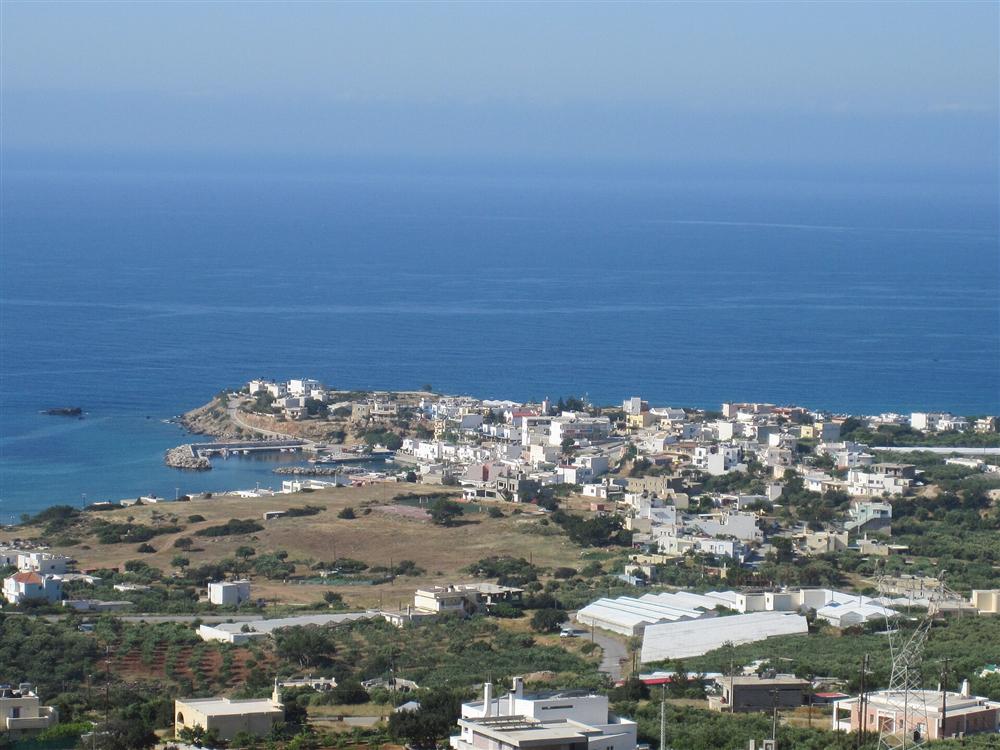
Makrigialos is a former fishing village turned low-key resort. A seafront of fish tavernas lines a long sandy beach, a small harbour shelters the local boats, and the pace stays slow. There are no high-rise blocks or loud strips here, just a sun-baked south-coast village on the warm Libyan Sea.
The heart of the resort is the waterfront, where tavernas set their tables at the edge of the sand and the harbour holds a handful of fishing craft alongside pleasure boats. Grilled fish, fresh from the day’s catch, and the vegetables of the Ierapetra greenhouse belt fill the menus. Behind the seafront the village keeps its everyday face: a bakery, a mini-market, family-run rooms and small studio complexes rather than sprawling hotels. The scale stays human, and repeat visitors return for exactly that quiet.
Makrigialos blends into its neighbour Analipsi to the west, the two settlements running together along the shore so the resort feels longer than its core. The character is residential and Cretan first, tourist second, which sets it apart from the packaged north-coast towns. Families and couples who want warm water, a gentle beach and unhurried dinners choose it over the nightlife of Malia or the crowds of Chersonisos.
The setting is dramatic in a subtle way. Bare hills rise close behind the coast, the light is hard and clear, and the sea holds its summer warmth deep into autumn. This is the driest, sunniest corner of Crete, sheltered from the north winds that ruffle the far shore, and the climate is a large part of the draw. Makrigialos rewards travellers who cross the island for stillness rather than spectacle.
What are the beach and the Libyan Sea climate like?
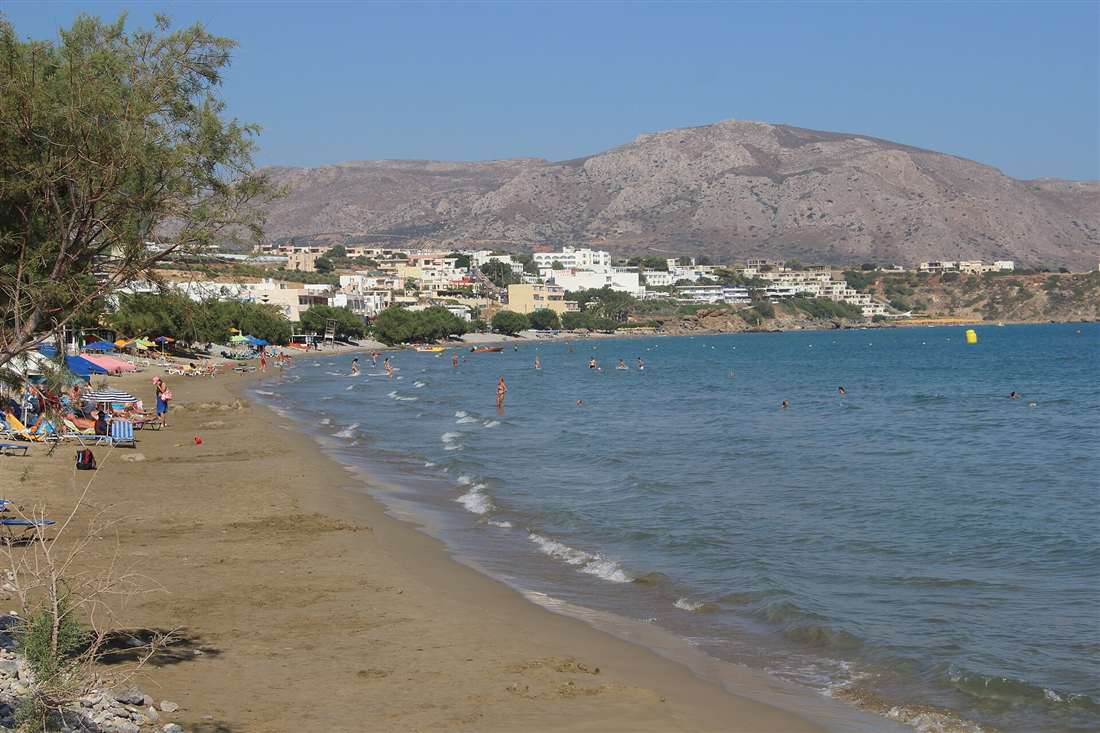
Makrigialos beach is a long, shallow sandy shore that shelves gently into warm, calm water, safe for children and slow to deepen. The Libyan Sea holds its heat into late autumn, and the south-east coast is the driest, best-sheltered corner of Crete, screened from the north winds that trouble the far shore.
The main beach runs for hundreds of metres of soft, pale sand backed by tamarisk trees that throw shade over the shallows. The gradient is the beach’s signature feature: the seabed falls away so slowly that a swimmer wades a long way out before the water reaches the shoulders. That gentle shelf, warmed by the sun through the shallow layer, makes the water noticeably warmer than the open Libyan Sea and turns the beach into a natural paddling pool for young families. Sunbeds and umbrellas line the central stretch, while quieter sand sits at either end.
The climate is the resort’s foundation. This coast faces south toward Africa and lies in the rain shadow of the island’s mountains, so it records the fewest wet days and the highest sunshine hours on Crete. The prevailing summer meltemi blows from the north and spends its force on the Cretan Sea coast; by the time any breeze reaches Makrigialos it is soft, and the sea stays flat. Sea temperatures climb through the summer and stay swimmable long after the north-coast resorts cool.
West of the town the beaches of Diaskari and Analipsi extend the sand, and east of the harbour smaller coves break up the shore. The reliable warmth and shelter draw walkers and swimmers to the south-east through the shoulder months of spring and autumn, when the north coast turns breezy. For a beach holiday built on warm, safe, calm water, this coast has the strongest hand on the island.
What are the Pefki gorge, Aspros Potamos, Koufonisi and the sights nearby?
The sights near Makrigialos pack a Roman villa above the harbour, the Pefki gorge that walks down to the coast, the stone hamlet of Aspros Potamos, the beaches of Diaskari and Analipsi, the offshore island of Koufonisi, and the Kapsa monastery east toward Goudouras \u2014 a dense cluster within a short radius of the resort.
Directly above the harbour stand the ruins of a Roman villa, a reminder that this shore was settled and prosperous in antiquity, its mosaics and walls looking out over the same bay travellers swim in today. Inland, the Pefki gorge cuts down from the mountain village of Pefki to the sea, a walking route of 4.5 kilometres through pine and past rock pools that ends near Makrigialos \u2014 a half-day hike that trades the beach for shade and stone. Threaded into the gorge country is Aspros Potamos, a hamlet of restored stone houses set in a dry riverbed, kept deliberately simple with lamplight and thick walls.
Offshore lies Koufonisi, a low, uninhabited island of pale sand beaches, dunes and the traces of an ancient theatre and purple-dye works, reached by boat from the harbour in summer. Its beaches rank among the finest in the region, empty and clear, a full day out on the water. East along the coast road toward Goudouras the Kapsa monastery clings to the cliff at the mouth of a gorge, a whitewashed retreat built into the rock above the sea with a view along the whole south-east shore.
Closer at hand, the beaches of Diaskari and Analipsi flank the resort with more sand and quieter water, an easy walk or short drive from the centre. The concentration of a Roman site, a gorge walk, a traditional hamlet, an island boat trip and a cliffside monastery inside a small radius gives Makrigialos more to explore than its sleepy seafront suggests, and fills the days between beach mornings.
Is the long trip worth it, and when to go?
The trip is worth it for travellers who want the warmest, calmest sea on Crete and a resort untouched by mass tourism. Go in late spring, early summer or September, when the Libyan Sea is warm, the light is long and the crowds are thin. The 275-kilometre distance earns Makrigialos its quiet.
The verdict turns on what a traveller wants from the south-east. Anyone chasing nightlife, big hotels or headline archaeology finds a better fit closer to the north-coast towns. Anyone who wants a gentle sandy beach, warm shallow water, honest fish tavernas and a village that keeps its Cretan rhythm finds Makrigialos hard to beat. The very distance that makes it a chore to reach is what has kept the coast low-key, and that trade sits at the centre of the decision. Reaching it demands commitment, and the reward is a shore the day-trip crowds never touch.
Timing shapes the experience. Late spring brings warm days, green hills and a sea already heating in the shelter of the coast, with the beaches near-empty. High summer delivers the hottest, driest weather on the island and the calmest water, at the cost of the peak-season pace and full tavernas. September and early autumn hold the sea at its warmest after a summer of heating, the air softens, and the resort empties as the season winds down \u2014 the connoisseur’s window on this coast. Winter is quiet and mild, with the tourist businesses closed.
Plan the logistics to match the distance. Drive it as a half-day with a stop rather than a single push, or take the KTEL chain as a full travel day, and stay at least two nights to justify the crossing. Treat the Pefki gorge, a Koufonisi boat trip and the Kapsa monastery as reasons to linger. Makrigialos is not a stop on a tour of west Crete; it is a destination that repays travellers willing to cross the island to find warm water and a slower coast.
Timing and fuel shape the long haul. Fill the tank at Ierapetra before the final coast leg, since the south-east road thins out toward Goudouras, and break the drive with lunch on the Gulf of Mirabello. The distance rewrites the plan: a base at Makrigialos, Ierapetra or Koutsouras turns the 275-kilometre run from Chania into a single one-way transfer and puts the Pefki gorge, Aspros Potamos, the Roman villa and the Koufonisi boat within a short reach, while a day return from Chania consumes two full days behind the wheel for a few hours on the sand.
Frequently Asked Questions
How do you get from Chania to Makrigialos?
From Chania to Makrigialos, drive east on the E75/A90 national road through Rethymno and Heraklion to Ierapetra, then 24 kilometres east along the south coast, 275 kilometres in 3.75 to 4.25 hours. By bus, take the KTEL Chania to Heraklion, Heraklion to Ierapetra, then the Ierapetra to Sitia bus to Makrigialos.
How far is Makrigialos from Chania?
Makrigialos lies 275 kilometres from Chania on the south-east coast of Crete in the Lasithi regional unit, 24 kilometres east of Ierapetra. It is one of the farthest resorts from Chania on the island, a drive of 3.75 to 4.25 hours.
Is the trip from Chania to Makrigialos worth it?
The trip from Chania to Makrigialos rewards visitors with a long shallow warm-water beach, the driest, sunniest corner of Crete and the Pefki gorge inland. The 275-kilometre distance makes Makrigialos a south-east base rather than a day trip from Chania.