
Athens Marble Carving Workshop
An Athens marble carving workshop is a hands-on studio class in which each guest carves a small block of real marble with a mallet and chisels, guided by an instructor at every stage. It sits among the creative city experiences on Greece Tours, and an Athens marble carving workshop needs no art background or special strength.
The class links a city break to the stone behind Greek sculpture, from the Cycladic figurines of the 3rd millennium BC to the Pentelic marble of the Parthenon. Each Athens marble carving workshop ends with a finished piece to take home, and the instructor sets a pace that suits complete beginners.
What is an Athens marble carving workshop?
An Athens marble carving workshop is a practical lesson in the craft behind Greek sculpture. Guests turn a raw marble block into a relief or a small figure with point, claw and flat chisels, in the same order that ancient sculptors followed.
Marble statues, reliefs and temple fragments fill the museums of Athens, and the Athens marble carving workshop brings that history onto a studio bench. Each guest works with a marble block, a set of steel chisels and a mallet, while the instructor explains how ancient sculptors removed stone layer by layer. The class is a small-scale version of the same process, adapted for people who have never held a chisel.
The appeal lies in the material itself. Marble is a metamorphic rock formed from limestone, and carvers in the Greek islands have shaped it since the Early Cycladic period, more than five thousand years ago. Carving a small block by hand shows how slowly stone gives way to the chisel. After an Athens marble carving workshop, the tool marks left on a statue base or a temple column become easy to read.
Which three formats does the class come in?
Three formats of the Athens marble carving workshop are on offer: a personal symbol of strength carved in relief, a classical Greek motif shaped in the manner of an ancient sculptor, and a Cycladic-style figure carved after an introduction to Cycladic art.
The symbol format centres on meaning. Each guest picks a sign that means strength to them, from an initial to a simple emblem, draws it on a marble tile and carves it in low relief. The design stays simple, so a first-time carver finishes it in one session. This version of the Athens marble carving workshop suits people who want a personal keepsake rather than a copy of a museum piece.
The ancient sculptor format recreates the working method of classical Greek studios. Guests carve a motif from ancient Greek art with the same tool sequence that Greek sculptors used. The Cycladic format of the Athens marble carving workshop opens with an introduction to Cycladic art and its marble figurines, then each guest carves a simplified figure in the same style, with folded arms and a smooth oval face, the traits that mark the originals.
- Symbol of strength – a personal sign carved in relief on a tile.
- Ancient sculptor – a Greek motif carved with classical tools.
- Cycladic art – a Cycladic-style figure carved after an introduction.
Who is an Athens marble carving workshop suited to?
An Athens marble carving workshop suits complete beginners, because no drawing or carving experience is needed. Couples, solo travellers and families with older children book it, and the studio setting makes it a fit for a rainy day in the city.
The instructor breaks the work into small steps and demonstrates each one first, so patience matters more than strength or talent. The chisel does the cutting, and the mallet needs steady, light taps rather than force. Couples carve side by side and compare results, and solo travellers book a single place and work on their own block. The Athens marble carving workshop also serves as a quiet break between busy sightseeing days.
Families with older children get a shared activity with a clear result, because every child ends the class with a real marble object made by hand and sees the whole process, from blank block to finished shape. Check the listing for the minimum age before booking. On a wet day, when outdoor sites turn slippery, an Athens marble carving workshop offers a dry alternative that keeps the day’s sightseeing plan on track.
How does the carving move from sketch to finish?
An Athens marble carving workshop moves through five stages: drawing the design on the block, roughing out with the point chisel, shaping with the toothed claw chisel, refining with the flat chisel, and smoothing with rasps, files and wet abrasive stone.
In an Athens marble carving workshop, the design comes first. Guests draw the outline on the block in pencil, and the instructor checks the proportions before any stone is removed. The point chisel, struck with the mallet, breaks away the waste around the outline in small chips. The toothed claw chisel follows, its row of teeth leaving parallel grooves that level the surface and bring the shape closer to the drawn line.
The flat chisel then removes the claw marks and defines edges, letters and fine lines. Rasps and files take over for curves and corners, shaving the stone into smooth transitions. Sanding comes next: carvers rub the surface with abrasive stone and water, which keeps the dust down and brings out the colour and grain of the marble. Finishing closes the session, with a rinse to clear the slurry and a last pass over any rough edge.
- Point chisel – removes waste stone in small chips.
- Claw chisel – levels the surface with toothed grooves.
- Flat chisel – sharpens edges, lines and letters.
Why do carvers wear goggles, masks and gloves?
Carvers in an Athens marble carving workshop wear goggles because chisel blows throw sharp chips, a dust mask because rasps and files release fine stone dust, and gloves because fresh-cut edges can nick the skin. The instructor sets the pace throughout.
Chips fly in unpredictable directions when the point chisel bites, so goggles stay on from the first blow to the last. Fine marble dust is mostly calcium carbonate, and the mask keeps it out of the lungs during rasping and filing. Gloves protect the hand that holds the chisel, which takes any glancing blow from the mallet. Protective gear differs by studio, so check the listing for what each Athens marble carving workshop provides.
The instructor sets the pace, and every new tool is demonstrated before guests pick it up. Nobody moves to the next stage until the current one is under control. Chisels point away from the body, the block sits firm on a sandbag or in a clamp, and tired hands rest between rounds. Wear clothes that can take dust and closed shoes, since chips land on the floor as well as the bench.
Where does the marble of Greek sculpture come from?
Greek sculpture drew on island and mainland quarries: Pentelic marble from Mount Pentelikon built the Parthenon, Parian marble from Paros was prized for its translucency, and Tinos keeps a living marble craft. An Athens marble carving workshop uses the same kind of stone.
Pentelic marble was quarried on Mount Pentelikon, north-east of Athens, and it is the stone of the Parthenon. Its fine white grain carries a trace of iron, which weathers to the warm golden tone seen on the Acropolis today. Parian marble came from the Cycladic island of Paros, and ancient sculptors prized it for its translucency, since light enters the surface and gives carved skin a soft, lifelike glow in daylight.
Tinos, another Cycladic island, has a marble tradition that never stopped: Tinian marble craftsmanship is inscribed on the UNESCO Representative List of the Intangible Cultural Heritage of Humanity, and the island’s marble craft still decorates doorways, fountains and churches across its villages. Emery from Naxos, a hard, dark rock rich in corundum, has smoothed marble since antiquity, and the abrasive stone used in an Athens marble carving workshop follows the same principle.
- Pentelic marble – Mount Pentelikon, the stone of the Parthenon.
- Parian marble – Paros, prized by sculptors for translucency.
- Tinian marble craft – Tinos, on the UNESCO heritage list.
- Naxos emery – Naxos, an abrasive for smoothing marble.
When were the Cycladic figurines carved, and where are they now?
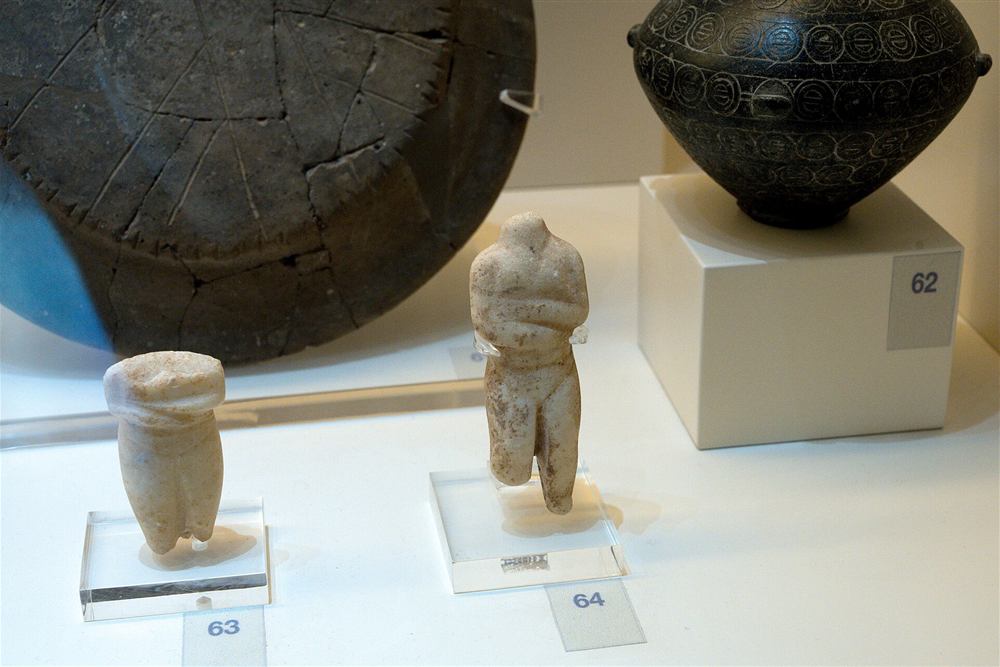
Early Cycladic marble figurines were carved from about 3200 BC to the end of the 3rd millennium BC. They inspire the Cycladic format of the Athens marble carving workshop, and originals stand in the Museum of Cycladic Art and the National Archaeological Museum.
The figurines come from the Cyclades, the island group that includes Paros, Naxos and Tinos. The best-known type shows a standing female figure with arms folded across the body and a flat face tilted back, with the nose carved in relief. Painted details once added eyes and ornaments, and traces of paint survive on some pieces. Their clean geometry makes them a natural model for beginners, because the shapes follow a few simple planes.
The Museum of Cycladic Art in Kolonaki holds a large permanent collection of Early Cycladic figurines and marble vessels. The National Archaeological Museum shows Cycladic figurines in its prehistoric collection, which also covers the Neolithic and Mycenaean periods. Seeing the originals before or after an Athens marble carving workshop links the piece on the bench to the figures that inspired it, and shows how few planes of marble a human form needs.
Can you see marble sculpture in Athens after the class?
Yes. After an Athens marble carving workshop, the Acropolis Museum shows sculpture from the Parthenon, the Parthenon itself stands in Pentelic marble on the Acropolis, and the First Cemetery of Athens holds marble tombs, including the Sleeping Maiden by Yannoulis Chalepas.
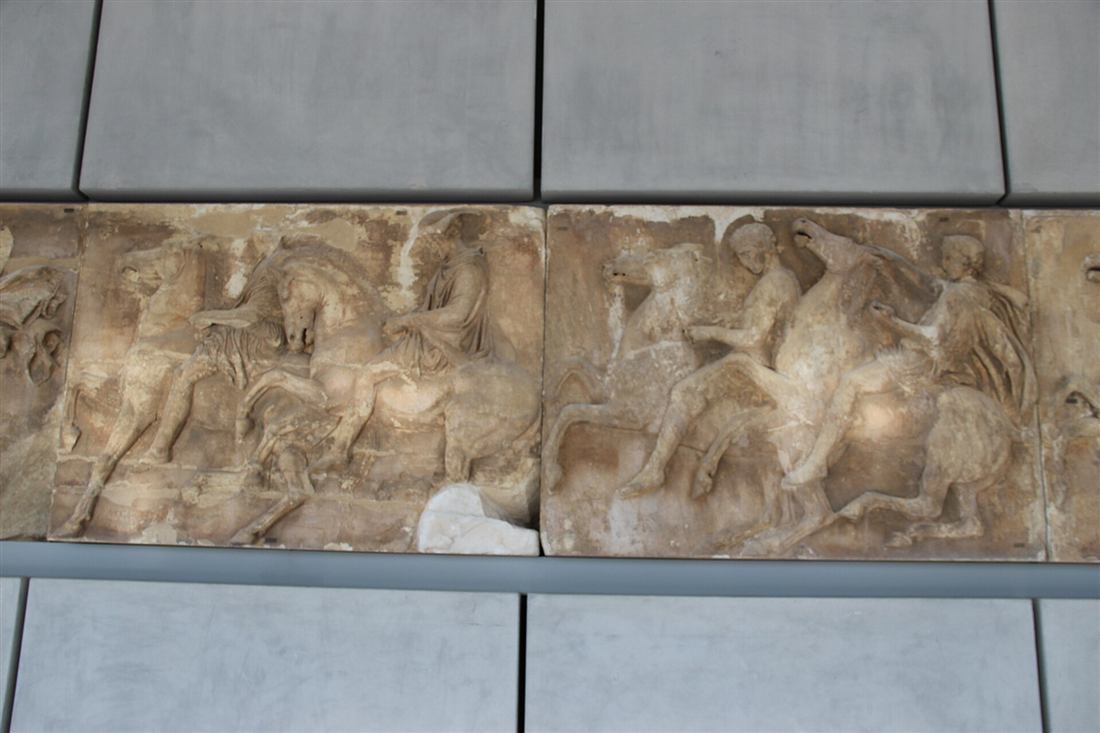
The Acropolis Museum displays the sculpture of the Acropolis: the Parthenon frieze, metopes and pediment figures, the Caryatids of the Erechtheion and the archaic korai. After carving a block, the chisel marks, claw grooves and rasp lines on these works stand out. The Parthenon, on the rock above the museum, shows the same Pentelic marble at the scale of a temple, with columns built from stacked marble drums fitted without mortar.
The First Cemetery of Athens works as an open-air gallery of modern Greek sculpture, with marble tombs carved for statesmen, poets and benefactors. Among them lies the Sleeping Maiden, or Koimomeni, the best-known work of the sculptor Yannoulis Chalepas from Tinos: a marble figure of a young woman asleep on a tomb. The link between Tinos and Athens shows that the marble craft of the islands continued long after antiquity.
The same trip can hold other hands-on classes. An Athens mosaic workshop works with small cut pieces of stone or glass rather than a solid block, and a painting class trains the eye for the line and proportion that carving relies on. Booked on separate days, these classes and the museums turn an Athens marble carving workshop into a short course in Greek craft, from marble figures to mosaic panels.
What do you take home from an Athens marble carving workshop?
Each guest takes home the piece carved during the Athens marble carving workshop, a small relief tile or figure depending on the format. Marble is heavy, so pack it in checked luggage, and check the listing for the size of the block.
The symbol format produces a relief tile, the ancient sculptor format a carved Greek motif, and the Cycladic format a small figure with folded arms. Every piece carries the marks of its maker, from chisel texture to sanded surfaces, and no two pieces in a class look the same. Let it dry fully after the final rinse, then wrap it in clothing and pack it in a checked suitcase, away from the hard sides.
Each format has its own page, so check each Athens marble carving workshop listing for the length of the session, the group size, the teaching language and the meeting point. Book ahead online to secure a place on the chosen date and time, and read the cancellation terms before confirming. Mention any hand, wrist or shoulder injury when booking, since the mallet work puts a steady load on the wrist, elbow and shoulder.
- Length – the session time on the listing.
- Group size – the number of carvers per class.
- Language – the language of the instruction.
Is an Athens marble carving workshop worth it?
Yes, an Athens marble carving workshop is worth it for travellers who want to understand Greek sculpture by making it. The class suits beginners, fills a rainy day and ends with a handmade marble piece to take home.
The value of an Athens marble carving workshop sits in the link between the bench and the city. One session with a chisel explains the Parthenon frieze, the Caryatids and the Cycladic figures more clearly than a museum caption, because the hand learns what the eye only sees. The class needs no talent, and the instructor keeps each stage within reach of a first-time carver, so the finished piece reflects effort rather than skill.
The class suits travellers who enjoy museums, crafts and focused work with their hands. It is a weaker fit for anyone after a fast outdoor activity, because marble carving is slow, precise and dusty work. Paired with the Acropolis Museum and the Museum of Cycladic Art, an Athens marble carving workshop turns a city stay into a practical study of Greek sculpture, with a finished marble piece as the keepsake.
Frequently Asked Questions
Do you need art experience for an Athens marble carving workshop?
No. An Athens marble carving workshop starts from a simple design drawn on the block, and the instructor demonstrates each chisel before guests use it. First-time carvers finish a complete relief or figure within the session, guided at every stage.
Can children join an Athens marble carving workshop?
Yes, families with older children take part together, and parents carve alongside them in the same session. Check the listing for the minimum age, because the chisels are sharp and the mallet work needs steady, controlled hands and patience.
Which marble does the class use?
The stone depends on the studio, so check the listing for the marble used in each Athens marble carving workshop. Greek sculpture history centres on Pentelic marble from Mount Pentelikon, the stone of the Parthenon, and Parian marble from Paros, prized for its translucency.
Can you fly home with a carved marble piece?
Yes. Stone travels well in checked luggage when it is wrapped in clothing at the centre of the case, since marble is heavy and its thin edges chip. Check the airline’s hand luggage rules before carrying a piece from an Athens marble carving workshop in the cabin.
Who carved the Sleeping Maiden in the First Cemetery of Athens?
The Sleeping Maiden, or Koimomeni, is the best-known work of Yannoulis Chalepas, a sculptor from Tinos. The marble figure shows a young woman asleep and lies on a tomb in the First Cemetery of Athens, where marble funerary sculpture lines the paths.