
The Museum of Cycladic Art in Athens displays the elegant marble figurines of the Bronze Age Cyclades that inspired Picasso and Henry Moore, alongside ancient Greek and Cypriot art. Combine it with the city’s headline sights using skip-the-line tickets and tours from My Greece Tours for a richer cultural day. Plan the whole trip with Greece Tours.
This refined museum is a cultural highlight of the Athens travel guide. The sections below cover what it is, the figurines, the collections, highlights and facilities, practical visiting details and how to get there.
What is the Museum of Cycladic Art?
Established to house the Goulandris family collection, this private institution in central Athens is devoted to the ancient cultures of the Aegean, above all the Cycladic civilisation of the 3rd millennium BC, and holds over 3,000 items, praised by The New York Times as among the world’s most significant privately assembled Cycladic collections.
Sleek, modern and beautifully curated, this museum offers one of the most rewarding cultural experiences in Athens. It was founded to give a permanent home to the outstanding private collection assembled by Nikolaos and Dolly Goulandris, members of a prominent Greek shipping family who devoted themselves to ancient Aegean art. The museum’s central focus is the art of the Cyclades, the cluster of Aegean islands whose Bronze Age culture flourished during the third millennium BC, though its scope reaches across the wider ancient Greek and Cypriot worlds as well. In total the permanent collection numbers more than 3,000 objects, and its quality is internationally renowned; a leading international newspaper hailed it as among the world’s most significant privately assembled groups of Cycladic antiquities.
Housed in a purpose-built modern gallery with an adjoining neoclassical mansion, the museum presents its treasures with clarity and elegance, letting the spare beauty of the ancient objects speak for itself. It is compact enough to enjoy in a couple of hours yet deep enough to reward real attention. It pairs naturally with the other cultural institutions of the Kolonaki district nearby. Its famous figurines are the heart of the collection.
What are Cycladic figurines?
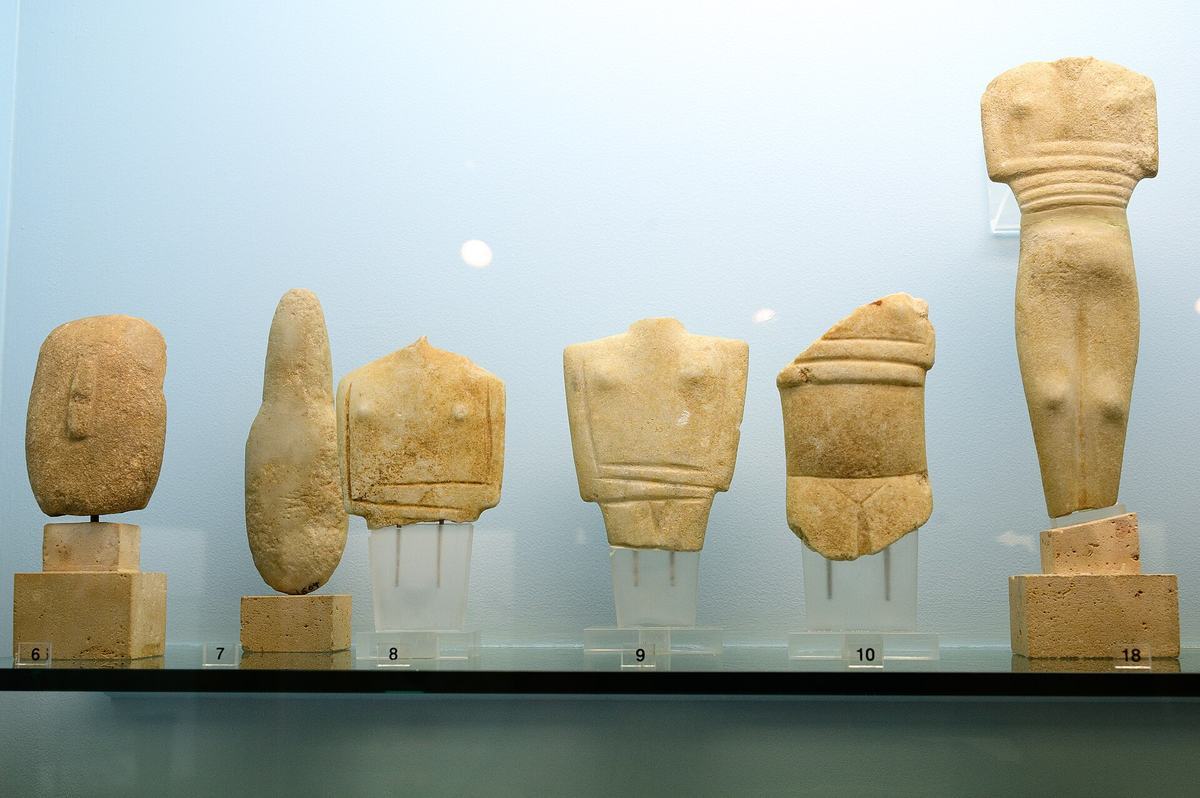
Cycladic figurines are sculpted marble statuettes made in the Aegean islands during the 3rd millennium BC, most depicting stylised, folded-arm female figures with simplified, almost abstract forms. Their clean geometric lines provided archetypes for modern artists such as Picasso and Henry Moore. The museum’s collection ranges from small statuettes to a rare figure about 1.4 metres tall.
The objects that give the museum its name and fame are among the most strikingly modern-looking artefacts to survive from the ancient world. Cycladic figurines are statuettes carved from the fine white marble of the Aegean islands during the Early Bronze Age, roughly 3200 to BC, by the islanders of the Cyclades. The classic type shows a nude female figure with arms folded across the abdomen, the head tilted slightly back, rendered in pure, simplified planes with the features barely indicated, an austere geometric abstraction that feels astonishingly close to twentieth-century sculpture. Their exact purpose remains debated, with most scholars linking them to burial customs, fertility or the divine, since many were found in graves.
What is certain is their influence: the spare, essential forms of these prehistoric figures directly inspired modern masters such as Pablo Picasso, Amedeo Modigliani and Henry Moore, who admired their reduction of the human body to elegant fundamentals. The museum’s holdings range from palm-sized examples to a remarkable figure standing about 1.4 metres tall, the second-largest known example anywhere. Seeing them gathered together is a quietly powerful experience. Their abstraction influenced the modern art the city also celebrates. The wider collection broadens the story.
What collections does the museum hold?
The permanent display splits into three parts over four floors: Cycladic, ancient Greek and Cypriot art. The Cycladic galleries display the famous marble figurines and vessels; the Ancient Greek section spans the 2nd millennium BC to the Roman era; and the Cypriot collection, one of the most important outside Cyprus, shows pottery, sculpture and metalwork.
Beyond its signature figurines, the museum offers a well-rounded tour of ancient Aegean and eastern Mediterranean art arranged over four floors. The permanent display is organised into three distinct sections. The first and most celebrated is the Cycladic Art collection, presenting not only the marble folded-arm figurines but also the islanders’ marble vessels, tools and pottery, including the notable “Vase Pigeon”, the most complete example of its kind decorated with sculpted birds. The second section covers Ancient Greek Art in a broad chronological sweep from the second millennium BC down through the Archaic, Classical and Hellenistic periods to Roman times, with pottery, bronzes, figurines and everyday objects that illuminate daily life, religion and warfare across Greek antiquity.
The third section is devoted to Cypriot Art and ranks among the most important collections of its kind outside Cyprus itself, displaying distinctive pottery, sculpture, jewellery and copper-age metalwork that reveal the island’s unique culture at the crossroads of the ancient world. Temporary exhibitions, often of high international standing, are staged in the adjoining Stathatos Mansion. This range turns a visit into a compact journey through the ancient Aegean. The Aegean theme connects to the islands reached on a Hydra day trip from Athens. A few features deserve special note.
What are the highlights and facilities?
Highlights include the tall 1.4-metre figurine, the bird-decorated “Vase Pigeon”, and the elegant Stathatos Mansion that hosts temporary exhibitions. Facilities include a stylish café designed as part of the experience, with a Cycladic-inspired menu and garden-like feel, plus a well-stocked shop. The museum is fully accessible and a comfortable, air-conditioned visit in any season.
Several individual works and amenities lift the museum experience above the ordinary. Among the must-see objects are the exceptional 1.4-metre marble figurine, one of the largest Cycladic statues ever found, and the “Vase Pigeon”, prized as the most complete surviving example of a particular vessel type adorned with sculpted birds, both of which reward close study. The museum’s temporary exhibitions, frequently of international calibre, are held in the adjoining Stathatos Mansion, a graceful 19th-century neoclassical residence with a porticoed entrance, rooftop statuary and an elegant atrium, worth visiting in its own right and linked to the main building. On the practical side, the museum is known for its excellent café, which has been thoughtfully designed as part of the visit, with uplifting lighting and a fresh, garden-like atmosphere; its menu draws on Cycladic flavours and makes it a pleasant spot for breakfast, brunch, lunch or simply a coffee break.
A well-stocked shop sells quality reproductions and design objects inspired by the collection. The galleries are modern, accessible and air-conditioned, making this a comfortable visit even in the height of summer. Together these touches make the museum as enjoyable as it is enlightening. The neoclassical setting echoes the grand mansions of nearby museum Athens. Planning the visit is straightforward.
How do you visit the Museum of Cycladic Art?
The museum sits on Neofytou Douka Street in Kolonaki, near Evangelismos metro station on line 3 and a short walk from Syntagma. Admission to the permanent exhibitions is around €12 for adults, with reductions for seniors and ages 19 to 26, and free entry up to age 18. Allow about one and a half to two hours, and combine it with the Benaki Museum nearby.
A visit to the Museum of Cycladic Art is easy to arrange and slots neatly into a cultured day in central Athens. The museum stands on Neofytou Douka Street in the smart Kolonaki district, just off Vasilissis Sofias Avenue, placing it within a couple of minutes’ walk of Evangelismos station on metro line 3 and a short stroll from Syntagma Square, so it is simple to reach on foot or by metro. Admission to the permanent collections costs around €12 for adult visitors, with reduced rates of about €9 for those over 65 and for young people aged 19 to 26, while entry is free for children and teenagers up to the age of 18; temporary exhibitions may carry a separate or combined ticket.
To enjoy the three permanent sections plus any temporary show at a relaxed pace, set aside roughly one and a half to two hours, leaving time for the café. Because the Benaki Museum, the Byzantine and Christian Museum and the green spaces of Kolonaki all lie close by, the museum combines beautifully with them into a single rewarding afternoon. Checking the current opening days, as it closes on certain days, helps you plan. The local routes are explained in the guide to getting around Athens. The questions below cover the points visitors ask most.
Why visit the Museum of Cycladic Art?
Visit the Museum of Cycladic Art for its uniquely beautiful prehistoric figurines, its calm and modern galleries, and its central location in Kolonaki near other top museums. It rewards art lovers with objects that shaped modern sculpture, offers families an accessible, manageable size, and provides an elegant café, making it one of the most enjoyable museum experiences in Athens.
Several reasons make this refined museum a standout choice among the many in the capital. Above all, it offers an intimate encounter with the Cycladic figurines, ancient objects of astonishing, almost modern beauty whose pure forms directly influenced giants of twentieth-century art such as Picasso and Henry Moore, so that a visit feels like discovering the prehistoric roots of modernism. The galleries themselves are a pleasure: cool, quiet, well-lit and clearly explained, never overwhelming in scale, which makes the museum easy to enjoy in a focused hour or two rather than the exhausting marathon of a vast national collection.
Its location in the smart Kolonaki district places it within a short walk of the Benaki Museum, the Byzantine and Christian Museum and the green slopes of Lycabettus, so it slots neatly into a cultured day. Families appreciate its manageable size and the engaging, accessible displays, while everyone enjoys the stylish café and the well-stocked design shop. For travellers wanting a rewarding museum that is beautiful, comfortable and not too large, it is an ideal choice. It combines naturally with the collections of the nearby Benaki Museum. The questions below cover the points visitors ask most.
Frequently Asked Questions
What is the Museum of Cycladic Art famous for?
The Museum of Cycladic Art is famous for its collection of marble Cycladic figurines from the 3rd millennium BC, whose stark, simplified forms inspired modern artists like Picasso and Henry Moore. It also holds important ancient Greek and Cypriot collections and is regarded as one of the finest Cycladic collections in the world.
How much does the Museum of Cycladic Art cost?
Admission to the permanent exhibitions of the Museum of Cycladic Art is around €12 for adults, about €9 for visitors over 65 and those aged 19 to 26, and free for children and teenagers up to age 18. Temporary exhibitions may require a separate or combined ticket.
Where is the Museum of Cycladic Art in Athens?
The Museum of Cycladic Art is on Neofytou Douka Street in the Kolonaki district of central Athens, just off Vasilissis Sofias Avenue. It is a couple of minutes’ walk from Evangelismos metro station on line 3 and a short stroll from Syntagma Square and the Benaki Museum.