
Athens Jewelry Workshop
An Athens jewelry workshop is a hands-on class in which a local maker teaches travellers to design and make their own piece of jewelry, mostly in sterling silver, and the finished piece goes home with them the same day. It belongs to the craft-based Greece Tours that swap sightseeing for making, and every Athens jewelry workshop pairs expert guidance with a guest’s own design.
The four formats on sale range from a class with a local creator to a relaxed session with a drink, in studios from Exarcheia and Psiri to the northern suburbs, and the craft reaches back to the gold of Mycenae. Each Athens jewelry workshop listing states its length, group size and language.
What is an Athens jewelry workshop?
An Athens jewelry workshop is a guided session at a studio bench, where guests work with saws, files, hammers, letter punches and polishing cloths to turn a first sketch into a ring, pendant, bracelet or pair of earrings.
Each session starts at a worktable set with metal sheet, wire, hand tools and paper for sketching. The maker demonstrates every tool first, then guides each step while the guests do the cutting, shaping and polishing themselves, so the finished piece carries their own marks. An Athens jewelry workshop swaps the queues of the Acropolis for a quiet bench, and it gives a trip to Athens something made by hand to carry home.
The result is a wearable piece rather than a practice sample. Guests pick the design, the metal and the finish, and the maker checks the work at every stage, including any step that needs a flame. That balance of personal choice and expert control separates an Athens jewelry workshop from a souvenir bought over a counter, because the piece records a place, a day and a pair of hands that no shop can sell.
Which formats does an Athens jewelry workshop come in?
Four Athens jewelry workshop formats are on sale: a hands-on class with a local creator, a silver workshop where guests design and finish their own accessory, a relaxed session with a drink, and a personal-story design session in Chalandri.
The four formats share the same kind of bench work and differ in pace and in how much of the design the guest controls. The class with a local creator follows the maker’s lead from sketch to polish. The silver workshop hands the design to the guest, who draws an accessory first and then cuts, forms and finishes it. An Athens jewelry workshop with a drink trades speed for conversation around the table.
The personal-story session takes place in Chalandri, a northern suburb of Athens, and builds a piece around a name, a place, a date or a symbol with private meaning, so the design starts from a story rather than a sketch. The drink session and the local-creator class suit a first try at the craft, while the silver workshop and the story session reward a guest who arrives with a clear idea.
- Local-creator class – a maker leading each step at the bench.
- Silver design workshop – an accessory designed and finished by the guest.
- Drink session – the same bench work at a social pace.
- Personal-story session – a story-led design made in Chalandri.
Who is a jewelry-making class in Athens suited to?
An Athens jewelry workshop suits beginners, couples, friends, teenagers and solo travellers alike, because the maker teaches each technique from the first cut and every guest makes an individual piece, and the class fills a rainy day with indoor work.
Beginners need no drawing skill or tool experience, since the maker demonstrates each cut, file stroke and hammer blow before the guest repeats it. Couples use the bench to make matching rings, or a piece for each other, with a stamped date or a pair of initials to mark the trip. The Athens jewelry workshop with a drink suits groups of friends, since the social pace of the session matters to them as much as the finished piece.
Teenagers take well to the hands-on steps of sawing, hammering and stamping, and the tour listing gives any minimum age for each format. Solo travellers join other guests at the bench, share the tools and the talk, and leave with a piece of their own. When rain sets in, an Athens jewelry workshop keeps the day indoors and busy, a practical swap for a wet morning of queues at open-air sites.
How does a piece take shape at the workbench?
A piece takes shape in clear stages at an Athens jewelry workshop: the guest chooses a design, saws and files the metal sheet or shapes the wire, adds texture, letters or stones, and polishes the result, with any soldering done under the maker’s supervision.
Work starts on paper, where the guest draws the outline and the maker adjusts it to what the metal allows. The outline goes onto the sheet and is cut with a fine piercing saw, a slow and steady motion that takes patience. Files then smooth the edges and round the corners. Wire pieces skip the saw, since pliers and a steel mandrel bend the wire into a ring, a loop or an ear hook.
Texture comes from hammers: a ball-peen hammer on a steel block leaves a dimpled surface, and a flat face smooths the metal again. Letter punches stamp names, dates or initials one character at a time. Beads thread onto wire, and small stones sit in bezels or claws. Soldering joins parts with a small torch, and at every Athens jewelry workshop on sale the maker supervises that step. Sandpaper and a polishing cloth bring the final shine.
- Saw – cuts the outline from metal sheet.
- File – smooths edges and rounds corners.
- Hammer – adds a dimpled or smooth texture.
- Letter punch – stamps names, dates and initials.
- Torch – joins parts under the maker’s supervision.
Do the classes work in real sterling silver?
Yes, an Athens jewelry workshop works in sterling silver, stamped 925 for its 92.5% silver content, alongside brass and copper, while beads and semi-precious stones add colour; each listing names the metals its format uses.
Sterling silver is an alloy of 92.5% pure silver and 7.5% other metal, mostly copper, which makes it hard enough to hold a shape and a setting. The 925 stamp on sterling pieces records that standard. Pure silver bends too easily for rings and clasps, which is why makers work in sterling. At an Athens jewelry workshop the silver arrives as flat sheet or round wire, ready to cut, bend and hammer.
Brass, an alloy of copper and zinc, gives a gold tone, and copper gives a warm red-brown; both cut and hammer like silver and suit a first practice piece. Beads of glass, ceramic or stone thread onto wire for colour, and small semi-precious stones sit in simple settings. Brass and copper darken faster than silver and can mark skin green, so a piece for daily wear works best in sterling.
- Sterling silver – a hard alloy of 92.5% silver, stamped 925.
- Brass – a copper and zinc alloy with a gold tone.
- Copper – a soft red-brown metal for practice pieces.
- Beads and stones – small accents of colour on wire or in settings.
Which Greek motifs suit a handmade piece?
The meander or Greek key, the owl of Athena, olive leaves, the evil eye and the Byzantine cross all translate well into metal at an Athens jewelry workshop, and each carries a meaning rooted in Greek history or belief.
The meander is a continuous line that turns back on itself at right angles, and it runs as a border on ancient vases and temple friezes. On a ring or cuff it becomes a band of repeating keys, cut with the saw or stamped. The owl of Athena, the goddess who gave Athens its name, appeared on the silver coins of the ancient city, so a small owl pendant links a modern piece to Athenian silver.
Olive leaves recall Athena’s gift of the olive tree to the city and the olive wreaths of the ancient games, and a file line marks each vein. The evil eye, a blue eye charm against envy, works as a bead on a silver wire bracelet. A Byzantine cross with arms of equal length suits a pendant cut from sheet. At an Athens jewelry workshop the maker helps scale each motif to the piece.
- Meander – a band of repeating keys.
- Owl of Athena – a small cut-out pendant.
- Olive leaves – a leaf or wreath outline.
- Evil eye – a blue bead on wire.
- Byzantine cross – a pendant cut from sheet.
What jewelry tradition stands behind the classes?
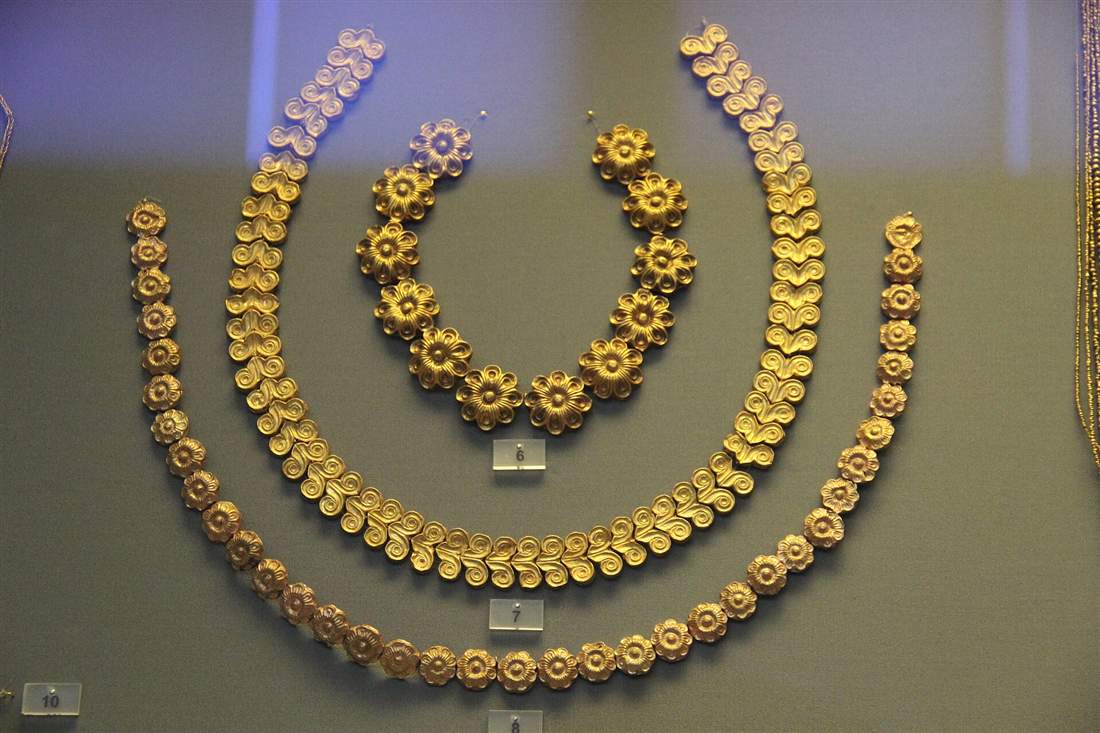
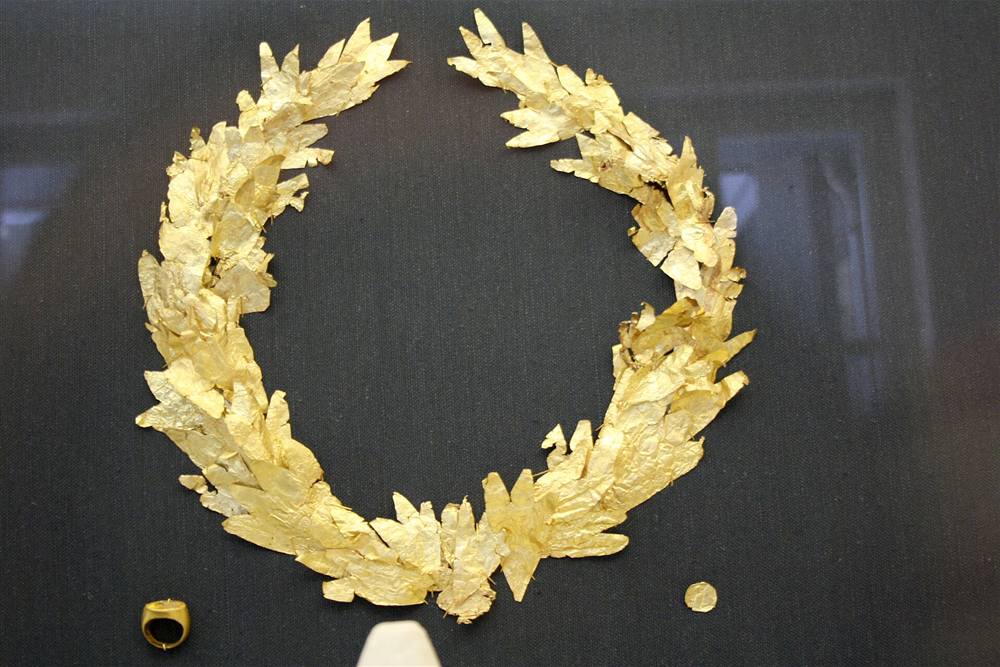
An Athens jewelry workshop draws on more than three thousand years of Greek metalwork, from the gold of Mycenae and the gold wreaths of Hellenistic goldsmiths to Byzantine jewelry, and the originals sit in the city’s museums.
The National Archaeological Museum holds the gold of Mycenae, including the so-called Mask of Agamemnon, beaten from gold sheet by Bronze Age smiths. Later, Hellenistic goldsmiths made gold wreaths of oak and olive leaves, each leaf cut, veined and wired to a stem, the same cutting and shaping that guests practise in silver at an Athens jewelry workshop. Seeing those pieces before the class gives a design a clear starting point.
Byzantine jewelry, including gold crosses, rings and earrings, is on show at the Byzantine and Christian Museum, where the cross motif appears in its original gold. The Benaki Museum collection follows Greek adornment from ancient gold to the silver of regional dress, and the jewelry museum below the Acropolis, founded by a leading Greek goldsmith, shows modern pieces drawn from ancient forms. Together they trace the line that an Athens jewelry workshop continues.
Where in Athens do the workshops take place?
Athens jewelry workshops take place in makers’ studios in Exarcheia’s creative quarter, around Monastiraki and Psiri near the markets, and in Chalandri in the northern suburbs, and each listing names the exact studio as the meeting point.
Exarcheia is the creative quarter of central Athens, a grid of bookshops, print studios, street art and small ateliers beside Strefi Hill. The quarter borders the National Archaeological Museum, so the gold of Mycenae and a session at the bench fit into one day on foot. An Athens jewelry workshop in Exarcheia sits among working studios rather than tourist shops, with coffee shops nearby for a break before or after the class.
Monastiraki and Psiri surround the flea market and the old craft streets below the Acropolis, where leather sandal makers and metal shops still trade, so an Athens jewelry workshop there fits between market browsing and lunch. Chalandri, home of the personal-story session, is a leafy residential suburb in the north of the city. All three areas are reached by metro from Syntagma, and the meeting point on each listing fixes the final walk to the studio.
How is an Athens jewelry workshop booked?
An Athens jewelry workshop is booked online through its tour listing, which sets the date, start time, meeting point, length, group size, language and what is included, so every practical detail is fixed before the day of the class.
The listings on this page show live dates and open places, and the booking confirmation repeats the meeting point. Bench space in any studio is limited, so booking some days ahead holds a place, above all for couples or friends who want to sit together. Group size, length and teaching language differ by format, so check the tour listing for each one before choosing a date for an Athens jewelry workshop.
Clothes that can take a little metal dust suit the bench, and long hair tied back stays clear of the saw and the flame. Rings and bracelets come off before work starts, since hands do the cutting and filing. A design idea, a photo of a motif or a word to stamp saves time at the sketch stage, and guests with sensitive skin choose sterling silver over brass or copper for the finished piece.
- Length – the running time of the session.
- Group size – the number of guests at the bench.
- Language – the language the maker teaches in.
- Meeting point – the address where the session starts.
- Inclusions – the metals, tools and any drink served.
Is an Athens jewelry workshop worth it?
Yes, an Athens jewelry workshop is worth it for travellers who want hands-on time with a working maker, a finished piece made by their own hands, and a direct link to the metalwork in the city’s museums.
The class gains depth when it follows a morning in a museum, because a motif seen in a glass case becomes a design on the bench that same afternoon. The same trip pairs well with an Athens mosaic workshop or an Athens painting class, which follow the same hands-on format with stone and paint in place of metal. Together they give a city break a run of days spent making things by hand.
The finished piece travels home in hand luggage and needs little care. Silver darkens with air and humidity, and a soft polishing cloth lifts that tarnish in a few strokes. Storing the piece in a dry pouch slows the change, and taking it off before a swim in the sea or a pool keeps salt and chlorine away from the metal. Cared for this way, a piece from an Athens jewelry workshop keeps its shine for decades.
Frequently Asked Questions
Is soldering safe at an Athens jewelry workshop?
Yes. Soldering runs under the maker’s supervision on a heat-proof block, with long hair tied back and sleeves clear of the flame, and the maker sets up the torch and checks every joint before the piece moves on to polishing.
Can a name or a date be stamped on the piece?
Yes. Letter and number punches stamp a name, initials or a date into the metal one character at a time, and short words fit best on rings and narrow bands, while pendants, tags and cuffs leave room for longer text or a full date.
Do guests make pieces as gifts for someone at home?
Yes. Guests at an Athens jewelry workshop design pieces for partners, parents or friends as well as for themselves, and bringing the recipient’s ring size, initials or a meaningful symbol lets the maker plan the fit and the design before cutting starts.
How long does an Athens jewelry workshop last?
The running time differs by format, so check the tour listing, which states the exact length of each session. That time covers the sketch, the cutting and shaping, any stamping or setting, and the final polish, and guests leave with the finished piece in hand.
Can teenagers join an Athens jewelry workshop?
Yes. Teenagers join an Athens jewelry workshop alongside adults and use the same saws, files and hammers under the maker’s eye, and each tour listing states any minimum age, so a family checks that line before booking places for younger guests.