
Athens Painting Class
An Athens painting class is a hands-on art session in the Greek capital where a local artist teaches travellers to paint and every guest leaves with a finished piece of their own. Among the Greece Tours on offer in the city, an Athens painting class is the one where the traveller makes the souvenir instead of buying it.
Formats run from studio canvases and outdoor painting in the centre to craft workshops on statues, mugs, tote bags and wine bottles. Each Athens painting class draws on a city where ancient sculptors coloured their marble statues and potters painted the black-figure and red-figure vases of antiquity.
What is an Athens painting class?
An Athens painting class is a teacher-led session, held in a studio, a café or outdoors in the historic centre, in which guests paint a canvas or decorate an object under a local artist’s guidance and finish with a signed piece to keep.
The class links the city’s ancient art to a hands-on session. Athens is the capital of Greece, and the Acropolis with the Parthenon dominates its centre, so the rock and its temples are a natural subject for a first canvas. An Athens painting class pairs a teacher with a workspace and art materials, and the listing states what is included. The result records a real moment of the trip in the guest’s own hand.
A painting class differs from a gallery visit because the guest makes the art instead of viewing it, and it differs from souvenir shopping because the object carries the memory of the making. The teacher sets the pace for complete beginners, so the session asks for curiosity rather than talent. Each Athens painting class fits into a wider Athens itinerary alongside the Acropolis, the museums and the old quarter of Plaka.
Which class formats are on sale in Athens?
The Athens painting class formats on sale are a studio canvas class, outdoor painting in the centre, an Acropolis landscape workshop and paint-and-sip, plus craft workshops that paint statues, plaster, mugs, tote bags, candleholders, wine bottles and Maneki-Neko cat figures.
The studio canvas class is the core format, listed as a class to create an original work of art. Guests work at an easel and paint a subject, such as a Greek landscape, with step-by-step guidance from the artist. An Athens painting class of this type teaches real technique, so the finished canvas reads as a painting and not as a craft object. Studio classes run indoors, which keeps them independent of the weather.
Outdoor painting in central Athens moves the easel into the street, and the Acropolis landscape workshop pairs the guest with a local artist to paint the rock and its temples. Paint-and-sip adds a drink to a relaxed canvas session in the centre. The craft formats paint on objects instead of canvas, and every Athens painting class in that group ends with a finished item that the guest carries home or collects later.
- Statue and plaster – guests paint and decorate a statue or a plasterwork piece by hand.
- Pottery and mug – guests shape clay on the pottery wheel and then paint a mug.
- Graffiti and tote bag – guests practise spray-paint technique and then paint a tote bag.
- Candleholder and bottle – guests make and paint a candleholder or paint a Greek wine label bottle.
- Maneki-Neko figure – guests paint the Japanese beckoning cat at a cat café.
Who does an Athens painting class suit?
An Athens painting class suits beginners with no drawing experience, couples looking for a shared activity, families with children, solo travellers who want company and a creative focus, and any visitor who needs an indoor plan for a rainy day in the city.
No experience is needed, because the artist breaks the work into small steps and demonstrates each one before the guest repeats it. The first sketch and the first colour mix are the two stages where new painters need the most help. An Athens painting class also works for experienced amateurs, who use the session to try a new medium, such as spray paint or ceramic glaze, with a teacher on hand.
Couples choose paint-and-sip or the wine-bottle class, which pair painting with a drink or a bottle to keep. Solo travellers join shared sessions with other visitors. Families pick the craft formats, since a mug, a tote bag or a Maneki-Neko figure holds a child’s attention, and the Athens with kids page lists more ideas for the same trip. On a rainy day, a studio Athens painting class keeps the plan indoors.
What does a session cover from first sketch to signature?
An Athens painting class session moves through five stages that every guest completes: the artist’s demonstration, a light sketch, colour mixing, brush work in layers and the finishing details, and it closes with the guest signing the finished piece.
The demonstration comes first, as the artist paints the key steps and explains the choices behind them, from the horizon line to the order of colours. Guests then sketch the outline in pencil or thin paint, which fixes the composition before any colour goes down. Colour mixing follows, and the artist shows how three primaries and white produce the blue of the Aegean sky, the ochre of old stone and the white of marble.
Brush work builds the picture in layers, from large areas of flat colour to small strokes of light and shadow. The final stage adds details such as window frames, olive leaves or the columns of a temple, and the guest signs the corner with a fine brush. An Athens painting class keeps the pace steady, so each guest reaches the signature stage with a complete piece instead of a half-finished one.
Which paints and mediums do the classes use?
Acrylic is the main medium of an Athens painting class on canvas, because it dries fast and travels well; some sessions use watercolour on paper, the craft workshops use plaster and ceramic paints, and the graffiti workshop teaches spray paint.
Acrylic is water-based, so brushes clean with water and no solvent smell fills the room, and the dry paint stays flexible on canvas. Watercolour works on paper and gives soft, transparent washes that match the light of an Athens sky. An Athens painting class that uses watercolour asks for a lighter hand, since the paper shows every stroke and the white of the page acts as the brightest colour in the picture.
Plaster and ceramic paints cover the craft formats, including the statue and plasterwork workshops. Plaster takes paint like a porous wall, so colours soak in and dry with a matte finish. Ceramic paints and glazes go onto mugs before firing in a kiln, which fixes the colour for daily use. Spray paint belongs to the graffiti workshop, where guests learn can control, outlines and layering before they decorate a tote bag.
- Acrylic – fast-drying, water-based and flexible, used on canvas.
- Watercolour – transparent and light, used on paper.
- Plaster and ceramic paint – matte or glazed, used on statues, plaster and mugs.
- Spray paint – quick and bold, used in the graffiti workshop.
Why does ancient Athenian art matter to a painting class?
Ancient Athenian art matters because an Athens painting class continues a local craft from antiquity: sculptors painted their marble statues in bright colours, and Athens was the centre of black-figure and red-figure vase painting in the 6th and 5th centuries BC.
The white marble of today’s museums is not the original look of Greek sculpture. Research on ancient statues shows traces of original paint, and the practice of colouring sculpture, called polychromy, gave skin, hair, eyes and clothing their own colours. The statue painting workshop repeats that step on a small scale, as guests colour a figure in bright tones, and an Athens painting class of this type turns an art-history fact into a hands-on lesson.
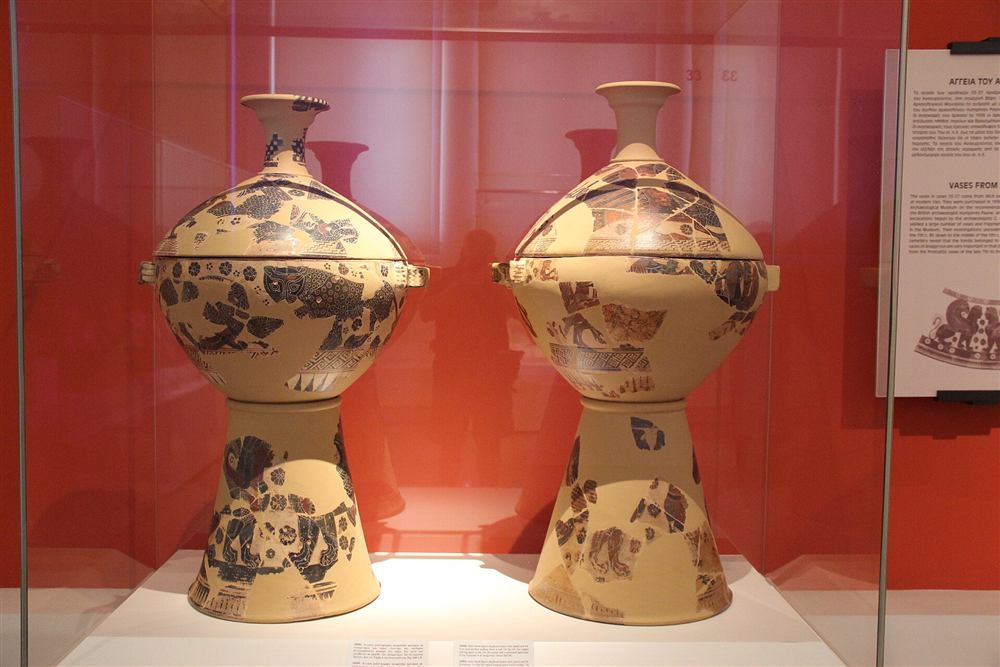
Vase painting is the second root. Attic black-figure vases show dark figures on orange clay, and red-figure vases reverse the scheme, with figures in the colour of the clay against a black ground. The potters worked in Kerameikos, the ancient potters’ district and cemetery whose name gave the word “ceramic”, and the National Archaeological Museum displays their vases beside ancient sculpture. The pottery wheel and mug class uses the same pairing of clay and paint today.
Where are the clearest views to paint in Athens?
The clearest views to paint in Athens are the Acropolis from the Areopagus rock and from Philopappos hill, the lanes of Plaka and Anafiotika, and Monastiraki square; an outdoor Athens painting class meets at the spot named on the tour listing.
The outdoor Athens painting class in the centre follows the plein-air method, in which the painter reads the light on the spot and turns a busy street into simple shapes. The Acropolis landscape workshop centres on the rock itself. From the Areopagus rock, beside the Acropolis entrance, the walls and the Propylaia gateway rise close above the painter, while Philopappos hill faces the Acropolis from the southwest and sets the Parthenon on the skyline.
Light and heat shape an outdoor session. Morning and late-afternoon light throws long shadows across the marble and warms the stone, while midday light flattens colours and brings the strongest sun of the day. The shaded lanes of Plaka and the whitewashed steps of Anafiotika give cooler corners in summer, wind on the open hills lifts loose paper, and guests on an outdoor Athens painting class bring a hat, water and sunscreen on warm days.
- Areopagus rock – a close view of the Acropolis walls and entrance.
- Philopappos hill – a full view of the Parthenon on the skyline.
- Plaka lanes – a street view of doorways, balconies and tiled roofs.
- Anafiotika – a village view of whitewashed island-style houses.
- Monastiraki square – a market view with the Acropolis above the roofs.
Which Athens neighbourhoods hold the studios and street art?
The studios and street art of Athens cluster in five central neighbourhoods, Plaka, Psiri, Monastiraki, Exarchia and Metaxourgeio, all within reach of the Acropolis, and each Athens painting class names its exact meeting point on the listing.
Plaka and Monastiraki hold the craft shops and small studios closest to the monuments, and their streets frame the Acropolis at the end of a lane. Psiri, just north of Monastiraki, mixes workshops, cafés and murals on shutters and walls. The neighbourhood works as an open-air lesson for the graffiti and tote-bag format, and an Athens painting class that starts or ends there gives guests its street art as a reference.
Exarchia and Psiri hold the densest street art in Athens, and the walls around Exarchia square carry murals, stencils and political slogans. Metaxourgeio, west of Omonia, adds artist studios and gallery spaces in older buildings, and large murals of its own. A walk through these areas before a class shows how local artists handle colour, scale and lettering on a public wall, which feeds into an Athens painting class on canvas or tote bag.
Can the finished artwork travel home in a suitcase?
Yes, most pieces from an Athens painting class travel home in a suitcase: acrylic canvases dry fast and roll into a tube, paper works lie flat in a folder, and fired ceramics are collected later or shipped, as the listing states.
Dry time depends on the medium and the paint thickness. Acrylic dries to the touch fast, but thick strokes stay soft underneath for longer, so a new canvas travels with no pressure on its face. A canvas without a frame rolls into a tube with the painted side facing out, which protects the surface from cracking. An Athens painting class on paper packs even more easily, since a dry watercolour slips into any folder.
Ceramics follow a different route. A mug from the pottery wheel class needs drying and kiln firing after the session, so the studio either holds it for collection or ships it abroad, and the listing states which option applies. Statues, plaster pieces and candleholders travel best wrapped in clothing inside hand luggage. For an Athens painting class near the end of a trip, a canvas or paper format avoids the wait for firing.
- Canvas – rolled in a tube with the paint facing out.
- Ceramics – collected after firing or shipped, as the listing states.
- Tote bag – folded flat once the paint is fully dry.
- Wine bottle – packed in checked luggage when it holds wine.
How is an Athens painting class booked?
An Athens painting class is booked online through its tour listing, which holds every detail that changes between formats, so the length, group size, language and inclusions are checked there before a date and start time are chosen.
Booking runs through the date picker on the listing, which shows the open days and start times for each format. Athens receives the most visitors between spring and autumn, so an Athens painting class booked ahead keeps the chosen day and time. The confirmation names the meeting point, which matters for outdoor classes and for studios on the narrow streets of Plaka, Psiri and Monastiraki, where a small doorway is easy to miss on the first visit.
Timing within the trip matters as much as the date. A studio class fills a rainy morning or a hot afternoon, while an outdoor class in the morning or early evening avoids the strongest sun. A ceramic class early in the stay leaves time for firing and collection before the flight home. Travellers who combine an Athens painting class with other hands-on sessions spread them across different days, which keeps each one unhurried.
- Length – the listed duration of the session.
- Group size – the maximum number of guests in the class.
- Language – the language of the artist’s instruction.
- Inclusions – the materials, aprons and drinks on the list.
- Collection – the pick-up or shipping terms for fired pieces.
What galleries and museums pair with a painting class?
The National Gallery, the Museum of Cycladic Art and the National Archaeological Museum pair best with an Athens painting class, because together they hold Greek art from prehistoric to modern times and give the guest subjects, colours and techniques to study.
The National Gallery, known in Greek as the Ethniki Pinakothiki, holds Greek painting and sculpture, and its landscapes and portraits show how Greek painters handled the light of their own country. The Museum of Cycladic Art holds the prehistoric marble figures of the Cyclades, whose simple, flat forms influenced modern artists. The National Archaeological Museum completes the set with ancient sculpture and painted vases from Athens and the rest of Greece.
The order of the day shapes the result. A museum visit before an Athens painting class fills the sketchbook with ideas, while a visit after it lets the guest look at brushwork with a painter’s eye. The National Archaeological Museum suits guests on the statue and pottery formats, the National Gallery suits canvas painters, and the Museum of Cycladic Art suits guests drawn to the clean lines and the white marble of the islands.
Is an Athens painting class worth it?
Yes, an Athens painting class is worth it for travellers who want a hands-on memory of the city, because it combines a lesson from a local artist, a subject rooted in Greek art and a finished piece that no shop sells.
The class gives a slower kind of time in a busy capital. Monument visits are about looking, while painting is about looking closely, and a guest who has painted the columns of the Parthenon remembers their proportions and colours long after the trip. An Athens painting class also fills the gaps that midday heat in summer and rain in winter leave in a sightseeing plan, because the studio formats run indoors.
The format decides what the class delivers. Canvas and outdoor classes suit travellers who want to learn to paint, the craft workshops suit families and gift hunters, and paint-and-sip suits couples and friends who want a social session with a drink in hand. A check of the tour listing for length, language and collection terms before booking makes sure the chosen Athens painting class fits the rest of the trip.
Frequently Asked Questions
Is painting experience needed for an Athens painting class?
No painting experience is needed for an Athens painting class, because the artist demonstrates each stage, from the first sketch to the final details, and guides every beginner through colour mixing and brush work until the finished piece is ready to sign.
Can children join an Athens painting class?
Children join the craft formats most easily, such as mug, tote-bag, candleholder and Maneki-Neko painting, since each one ends with an object they keep. The minimum age and the rules for accompanying adults differ by class, so the tour listing gives the exact terms.
What clothing suits a painting class in Athens?
Old clothes or dark layers suit an Athens painting class, because acrylic and spray paint stain fabric once dry. The tour listing states whether aprons are provided, and outdoor sessions also call for a hat, sunscreen and water in the warm months.
Does an Athens painting class run in English?
The language of each Athens painting class is stated on its tour listing, so the listing confirms whether the artist teaches in English before booking. A check of that line ensures that each instruction, from sketching to colour mixing, reaches the guest clearly.
What happens to an outdoor painting class in Athens when it rains?
An outdoor class in rain follows the weather terms on its tour listing, which set out the options for a wet day. Studio formats, from the canvas class to paint-and-sip, run indoors, so an Athens painting class in a studio stays on schedule in any weather.