
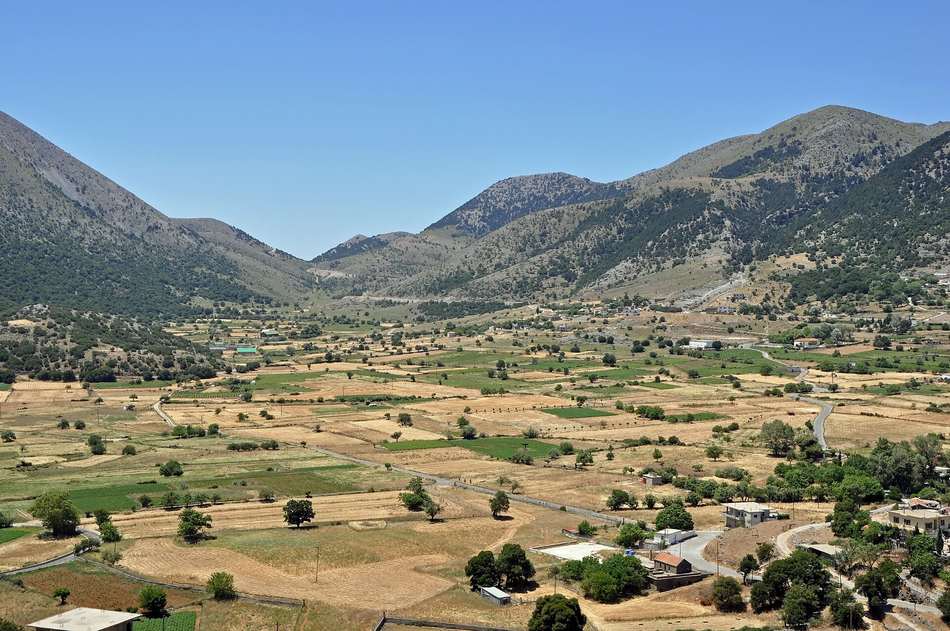
Askyfou is a fertile mountain plateau high in the White Mountains, in the Sfakia region of western Crete, at around seven hundred metres above sea level. The basin sits within the Chania district, ringed by peaks and cooled by highland air even at the height of summer. The main road from Vryses down to the south coast at Chora Sfakion crosses the plateau. Every traveller driving over the mountains to the Libyan Sea passes through it. Villages, a ruined Ottoman fortress and family tavernas give the plateau its character. Plan a highland detour, a war-museum visit and a slow mountain lunch on the road to Sfakia with My Greece Tours.
The plateau is dotted with the villages of Petres, Kares and Ammoudari, and a ruined Ottoman fortress, the Koules, crowns a low hill at the centre of the basin. Ammoudari holds a private war museum, gathered over decades by a local family, and the road continues south toward the northern entrance of the Imbros Gorge. The sections below cover the geography of the basin, the Koules and the war museum, the food grown here, and how the plateau fits a drive to the south coast. For the wider region, read our Crete travel guide before you set off over the White Mountains.
Where is the Askyfou plateau in Crete?
Askyfou is a fertile mountain plateau high in the White Mountains of the Sfakia region in western Crete, inside the Chania district, at around seven hundred metres above sea level, ringed by peaks and dotted with three villages.
The plateau forms a wide basin scooped into the eastern flank of the White Mountains. This great limestone massif fills the interior of the Chania district. At around seven hundred metres above sea level, the air stays cool through the summer. The surrounding peaks hold snow well into spring. The floor of the basin is fertile ground. The villages of Petres, Kares and Ammoudari sit around its edge rather than at its centre, leaving the flat land for orchards and fields. This highland setting places Askyfou firmly among the hidden gems in Crete. It is a green mountain bowl reached only by the road that leaves the north coast behind.
That road rises steadily into the heart of the western mountains, climbing past sheer rock and terraced slopes toward the quiet fields of the plateau above.
Reaching the plateau means driving up from Vryses on the north side and dropping through bends into the basin. The road enters from the north, crosses the flat floor past the villages, and climbs out again toward the south coast, so travellers take in the whole plateau from the car. This is the heart of Sfakia, the rugged mountain district that reaches down to the Libyan Sea. The plateau works as a natural threshold: to the north lie the towns and beaches of the coast, and to the south the land tips sharply toward the sea through gorges and cliffs.
Few visitors stop here, which is exactly why the basin keeps its unhurried, working-village feel and its quiet mountain pace all through the tourist season.
What is the Koules fortress on the plateau?
The Koules is a ruined Ottoman fortress that crowns a low hill in the centre of the Askyfou basin. It stands as a stark stone marker of the plateau’s strategic place on the mountain road into Sfakia.
The fortress sits on a low, isolated hill that rises from the flat floor of the basin. Its position gives it a clear view over every approach to the plateau. The Ottomans built it to hold the mountain route. The Koules commanded the road that armies and traders had to follow across the pass into rebellious Sfakia. Only walls and shell remain, weathered grey against the green fields below. Even so, the ruin still reads clearly as a watchpost raised to control a stubborn highland region. Standing beside it, a visitor understands why the plateau mattered: whoever held this hill held the pass. The peaks of the White Mountains close the horizon on every side.
They made the surrounding villages hard for any occupier to subdue for long.
The Koules belongs to the same long story of resistance that runs through all of Sfakia, a district that fought occupiers from the mountains for generations. A short walk from the road brings you to the base of the hill, and the climb rewards you with the fullest view of the plateau, its orchards, its scattered houses and the road threading through. Photographers come for the contrast of the dark ruin against the cultivated basin. The fortress makes a natural first stop for travellers pausing here, and it sits high on any list of things to do in Crete for those who prefer history in the open air to crowded museums.
Bring sturdy shoes for the rocky path to the summit and allow time for the wide views.
Why is there a war museum in Ammoudari?
Ammoudari holds a private war museum, gathered over decades by a local family, that displays weapons and relics from the Battle of Crete and the wartime evacuation of Allied soldiers over the mountains into Sfakia.
The plateau lay directly on the escape route during the wartime evacuation, when Allied soldiers retreated south over the mountains toward the coast at Chora Sfakion to be taken off by sea. Askyfou stood on that hard mountain path, and the villagers of the basin sheltered and guided men moving through. The museum in Ammoudari grew from that memory: a local family gathered weapons, uniforms and relics over decades and set them out in a private collection rather than a state institution. The result is personal and unpolished, closer to a family archive than a formal gallery, and all the more moving for it.
The collection ties the quiet plateau to one of the defining episodes of the island’s modern history and keeps that memory rooted in place.
Walking through the rooms, visitors see the physical remnants of the Battle of Crete laid out by people whose grandparents lived it, which gives the collection a weight no caption can add. The family’s care keeps the memory grounded on the very ground the soldiers crossed. A stop here pairs naturally with a plate of Cretan food in one of the village tavernas and with the drive onward toward the coast. Set aside time to talk with whoever is keeping the museum, since the stories told over the display cases often matter more than the objects themselves.
The museum closes the loop between the plateau’s peaceful present and its wartime role on the road down to the Libyan Sea, and it draws travellers with a serious interest in the island’s history.
What food does the Askyfou basin in Crete produce?
Potatoes, apples and cherries grow in the fertile floor of the Askyfou basin, and the tavernas serve mountain lamb and local cheese. The cool highland climate suits orchard fruit that lowland Crete cannot ripen as well.
The flat, fertile floor of the basin is worked hard for its size. Potatoes come out of the dark plateau soil. Apple and cherry trees fill the orchards that ring the villages, ripening in the cool air that the altitude provides. This produce sets Askyfou apart from the hot lowlands, where such orchard fruit struggles to ripen. The harvest feeds the plateau’s kitchens directly. The tavernas of Petres, Kares and Ammoudari lean on this bounty. They serve mountain lamb raised on the surrounding slopes alongside cheese made from the flocks that graze the high pastures.
A plate here is highland cooking at its most direct: meat, cheese and fruit drawn from ground you can see through the taverna window. The kitchens prepare it without fuss and without pretence, in the plain manner of the mountain villages.
Eating on the plateau means eating what the season delivers, and the mountain setting shapes every dish. Lamb slow-cooked over wood, sharp local cheese and fresh bread make the standard highland meal, and in late spring and summer the cherry and apple harvest reaches the table. The cool air makes a long lunch pleasant even when the coast below bakes, which is one reason drivers time their journey to stop here at midday. The tavernas keep the pace slow and the portions generous, matching the unhurried rhythm of the villages themselves.
This working, seasonal cooking rewards travellers who treat the plateau as a destination for the table and not only a point on the route down to Sfakia and the sea beyond, with meals that linger.
How does the plateau fit a drive across Crete’s south coast?
The plateau sits on the route from Vryses to Chora Sfakion, a natural stop for travellers driving over the mountains to the Libyan Sea, and it lies a short drive north of the Imbros Gorge entrance.
The main road from Vryses on the north coast down to Chora Sfakion on the south crosses the plateau. Askyfou therefore falls squarely on the way to the Libyan Sea rather than off to one side. Drivers climbing into the mountains reach the basin after a run of bends. The flat crossing offers a welcome pause before the road tips down toward the coast. The plateau also sits at the top of the route to the Imbros Gorge, whose northern entrance lies a short drive south. Walkers heading into that gorge pass through the basin first.
That makes Askyfou a logical place to fuel up, take a coffee and see the Koules fortress before starting the long descent on foot toward the sea below the mountains.
Building the plateau into a day works cleanly: a morning drive up from Vryses, a stop for the fortress and the war museum, a mountain lunch, then the short run south to the gorge or on to Chora Sfakion and the sea. The cool air and the authentic villages make the plateau worth more than a quick photo halt, and its position on the only main road over this stretch of mountain means most travellers to southern Sfakia pass it anyway. Treat it as the highland heart of the journey rather than a hurdle to clear. Askyfou offers a cool, authentic taste of the western mountains.
It is a natural break for anyone driving over the passes toward the Libyan Sea. It is a fine last taste of the highlands before the road drops to the water. At the northern foot of that road, the plane-shaded springs of Vryses mark the way up from the coast.
Frequently Asked Questions
How high is the Askyfou plateau and how cool does it stay?
The Askyfou plateau sits at around seven hundred metres above sea level, high in the White Mountains of the Sfakia region in the Chania district of western Crete. That altitude keeps the basin noticeably cooler than the coast below, even through the hottest part of the summer, and the surrounding peaks hold snow into spring. The cool air is one of the plateau’s real pleasures: a midday meal on the mountain feels comfortable while the towns on the coast bake. The same climate lets orchards of apples and cherries thrive on the fertile basin floor, fruit that struggles in the hot lowlands of the island.
Travellers driving up from Vryses feel the temperature drop as the road climbs into the mountains, and they often time their crossing to enjoy lunch in the highland air. Pack a light layer even in summer, because the plateau can turn cool once the sun drops behind the ridges that ring the basin and evening settles over the fields.
What is there to see and do on the plateau?
The plateau rewards a stop with a mix of history, food and quiet mountain scenery. At its centre a low hill carries the ruined Ottoman fortress, the Koules, which once guarded the mountain road and now gives the best view over the basin. The village of Ammoudari holds a private war museum, built over decades by a local family, that displays weapons and relics from the Battle of Crete and the wartime evacuation over the mountains. The villages of Petres, Kares and Ammoudari keep working tavernas that serve mountain lamb, local cheese and orchard fruit grown on the plateau. Walkers use Askyfou as the gateway to the Imbros Gorge, whose northern entrance lies a short drive south.
Together the fortress, the museum and the tavernas make the plateau a rewarding highland stop for travellers who want history and mountain food in one unhurried place, well away from the crowds of the coast, and reached by a scenic mountain road.
Is the plateau worth a stop on the way to Chora Sfakion?
Askyfou is well worth a stop, and the main road from Vryses to Chora Sfakion crosses the plateau anyway, so pausing here costs little detour. The basin makes a natural break on the long climb over the mountains to the Libyan Sea, with the Koules fortress, the Ammoudari war museum and a run of tavernas all within reach of the road. Drivers heading for the Imbros Gorge pass through the plateau on the way to its northern entrance, which makes Askyfou a sensible place to eat and rest before a walk down the gorge. A meal here shows off highland cooking at its most authentic: mountain lamb, local cheese and orchard fruit from the fertile basin.
The cool air and the working villages give the plateau a genuine character that a straight drive to the coast would miss, so treat Askyfou as part of the journey rather than an obstacle on the road to Chora Sfakion and the sea beyond the mountains.