
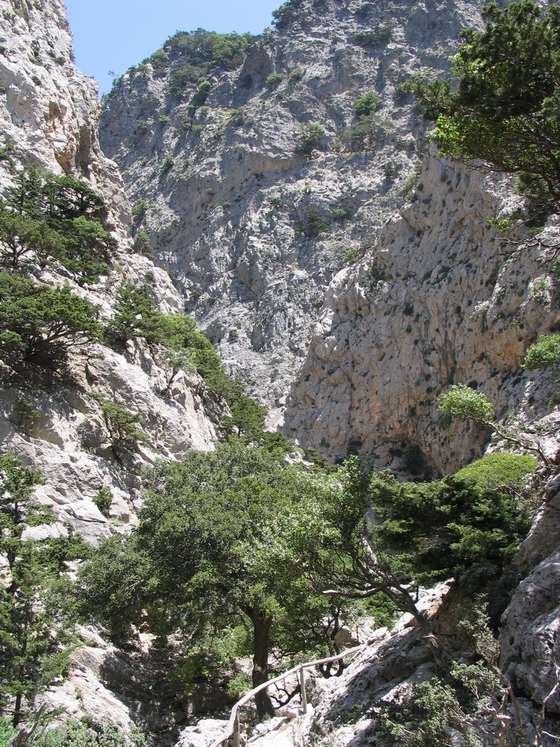
Rouvas Gorge is the green counterweight to the bare, sunbaked ravines of southern Crete. This wooded ravine cuts the southern slopes of Psiloritis above the village of Zaros, in the Heraklion district of central Crete. It shelters one of the largest surviving holm-oak forests on the island. Walkers arrive here for shade, running water and forest rather than heat and rock. Old stone steps, wooden bridges and a spring-fed lake set the tone for a walk that suits families on the lower stretch and hardened hikers on the climb toward the high peaks. Plan your route through this protected Cretan ravine with My Greece Tours.
The sections below cover where the gorge sits, how the walk begins at Lake Votomos, what the holm-oak forest and the Agios Nikolaos chapel add to the route, how far the path climbs toward the Prinos refuge and the Nida plateau, and the seasons that show Rouvas at its best. Read each answer first for the quick fact, then the paragraphs beneath for the detail. Set Rouvas beside the wider Crete travel guide and you have a clear picture of a forest walk that trades the crowds of the coast for oak shade, birdsong and a trout lunch beside the water at Zaros.
Where is Rouvas Gorge in Crete?
Rouvas Gorge sits on the southern slopes of Psiloritis above the village of Zaros, in the Heraklion district of central Crete. The wooded ravine climbs inland toward the high peaks, far from the south coast.
Zaros anchors the gorge on the map. This spring-fed village rests on the southern flank of Psiloritis in the Heraklion district, and the ravine opens directly above it. The gorge climbs north into the massif rather than draining toward the sea, and that inland line explains the whole character of the walk. Rouvas keeps its shade, its running water and its forest because it sits high on the mountain, away from the heat that scorches the southern shore. Drivers reach Zaros through the farmland and olive groves of central Crete, and the trailhead waits a short distance beyond the village at Lake Votomos. The gorge belongs firmly to the mountain world of the interior.
It is one of the quieter corners among the things to do in Crete that most coastal visitors never reach on a beach holiday.
The gorge forms part of a protected Natura area, and a European long-distance path threads through it. The ravine therefore links into a wider network of mountain trails rather than standing alone. That protected status guards the forest, the water and the wildlife that make Rouvas distinct from the dry gorges further south. The village of Zaros gives the walk its base, its parking and its lakeside tavernas, and the whole route reads as a climb from settled valley into wild forest. Position matters here on the island map.
Rouvas rewards the walker who wants central Crete’s green heart, the shaded slopes of Psiloritis above the plain, in place of the better-known seaside canyons and their fierce midday sun. The mountain setting is the draw, and the interior keeps this ravine cool and green through the driest weeks of summer.
How does the Rouvas Gorge walk begin at Lake Votomos?
The walk usually starts at Lake Votomos, a small spring-fed reservoir near Zaros, then climbs past the chapel and old monastery of Agios Nikolaos into the gorge, where stone steps and running water take over.
Lake Votomos sets the scene at the trailhead. This small spring-fed reservoir sits near Zaros, ringed by tavernas that serve trout raised in the cold mountain water, and its calm surface gives walkers an easy landmark before the climbing begins. The path leaves the lake and rises past the chapel and old monastery of Agios Nikolaos, a quiet religious site tucked into the lower slope, then slips into the mouth of the gorge itself. From that point the walk changes footing. Old stone steps, wooden bridges and running water guide the route beneath the oaks, and the forest closes overhead. This lower stretch, lake to chapel and a little beyond, works well for families.
They gain the atmosphere of the ravine without committing to the full mountain ascent above.
The design of the lower path makes it forgiving. Stone steps hold the steeper pitches, wooden bridges carry walkers back and forth across the stream, and the running water keeps the air cool even in high summer. Trout lunch beside the lake at Zaros pairs naturally with the walk, so a morning in the gorge rounds off with a meal at the water’s edge. Rouvas earns its place among the ravines that reward hiking in Crete precisely because that opening section stays gentle. The gradient builds only once the path leaves the chapel behind and turns toward the forest and the refuge.
That layout gives each walker a natural place to judge how far up the mountain to press on, and a clean point to turn back toward the lake and lunch when the children tire.
What makes the holm-oak forest inside the gorge special?
Inside the ravine grows one of the largest surviving holm-oak forests in Crete, shading the path with dense evergreen cover. Old stone steps, wooden bridges and running water thread the forest, cooling the whole route.
The holm-oak canopy defines Rouvas. One of the largest surviving forests of this evergreen oak in Crete fills the gorge, and its dense leaf cover keeps the path shaded through the hottest hours of the day. That shade is the point. The dry gorges of the south coast leave walkers exposed to the sun on bare rock, while Rouvas holds coolness under the oaks and beside the stream that runs the length of the ravine. Old stone steps and wooden bridges thread through the trees, so the forest never feels pathless underfoot.
The gorge counts among the hidden gems in Crete, a wooded refuge on the mountain that coach tours and beach crowds tend to pass by entirely. Shade, water and green cover set it apart from the island’s famous coastal canyons and their glare.
Life gathers where the water and shade meet. The running stream feeds the oaks and the undergrowth, birdsong fills the canopy, and the protected Natura status of the area guards the whole living system from harm. Walkers who reach Rouvas for shade, water and forest, rather than the bare heat of the coastal canyons, find exactly that character under the oaks. The forest also serves as the green gateway to the higher ground. The same path that shelters families near the chapel climbs on into the Rouvas forest proper and toward Psiloritis. The trees mark the transition from settled valley to wild mountain.
Holm-oak below gives way to open slope and bare rock as the trail gains height, so the forest reads as the first, gentlest stage of a much longer climb.
How far does the Rouvas Gorge trail climb into the mountains?
The full route climbs through the Rouvas forest to the Prinos refuge on the way toward the Nida plateau and the high peaks, a demanding full-day hike. A shorter there-and-back walk to the chapel suits families.
The trail offers two different journeys from the same start. The full route climbs steadily through the Rouvas forest to the Prinos refuge, then continues toward the Nida plateau and the high peaks of Psiloritis. It is a demanding full-day hike that asks for fitness, water and an early start. This upper section leaves the shaded ravine and gains real height, so it belongs to walkers ready for a long mountain day rather than a gentle stroll. The refuge marks a natural milestone on the ascent, a shelter set on the slope between the forest below and the open plateau above.
Reaching it, and pushing on toward Nida, turns Rouvas from a family outing into a serious traverse of the central Cretan mountains. Turn there and the return retraces the same shaded forest path back to the lake.
The shorter option keeps the reward without the full effort. A there-and-back walk to the chapel of Agios Nikolaos and a little way into the gorge gives families the forest, the stone steps and the running water, then returns to the lake for lunch. That flexibility sets Rouvas apart from the strict linear canyons of the coast. The gorge shares the demanding, protected mountain character of the Samaria Gorge, yet it lets each walker choose the distance. You can turn back at the chapel or climb on to the refuge and beyond. A European long-distance path threads through the whole ravine, linking the gentle lower stretch to the high traverse toward the Nida plateau and the peaks.
One trailhead at Lake Votomos thus serves both the casual family and the committed mountain walker.
Which seasons show Rouvas Gorge in Crete at its best?
Spring brings wildflowers and birdsong to the ravine, and autumn turns the oaks, so both seasons show Rouvas at its best. The forest shade and running water also keep the lower walk cool through summer.
Spring dresses the gorge in colour and sound. Wildflowers open along the stream and across the forest floor, birdsong fills the holm-oak canopy, and the running water flows strong after the winter, so the whole ravine feels alive. Autumn offers a second window, when the oaks turn and the light softens, giving the forest a quieter, warmer palette. These two seasons frame the ideal times to walk Rouvas. The temperatures stay comfortable for the long climb toward the refuge, and the ravine puts on its best display of flowers, foliage and water. Central Crete sees fewer walkers on the mountain in these months than the coast draws in high summer.
The forest paths and the lakeside tavernas at Zaros feel calmer and more welcoming as a result, and photographs come out richer.
Summer still works for the shaded lower walk. The holm-oak forest and the running stream keep the air cool where the coastal gorges bake, so a morning start on the lower path stays pleasant even in the heat. The full climb to the Prinos refuge and the Nida plateau, though, asks for the milder temperatures of spring and autumn and an early departure, since the upper slopes leave the shade behind. Whatever the season, the walk pairs naturally with a trout lunch beside the lake at Zaros, cold spring water on one side and the forest on the other. Rouvas rewards the walker who times the visit to the conditions.
Gentle shade carries the lower path in summer, while colour and cooler air in spring and autumn suit the long reach toward the high peaks of Psiloritis.
Frequently Asked Questions
Is Rouvas Gorge suitable for families with children?
The lower part of Rouvas Gorge suits families well. The walk starts at Lake Votomos, a small spring-fed reservoir near Zaros, and rises past the chapel and old monastery of Agios Nikolaos into the mouth of the ravine. Along this stretch, old stone steps, wooden bridges and running water guide the path beneath the holm-oak canopy, and the forest shade keeps children cool even in summer. A there-and-back walk to the chapel gives young families the atmosphere of the gorge without the demanding full-day climb toward the high peaks. The lake itself rounds off the outing, since the tavernas on its shore serve trout raised in the cold mountain water.
Parents who want more can press on toward the Rouvas forest and the Prinos refuge. The beauty of this ravine is the choice it offers, a gentle forest walk near the water or a serious mountain ascent from the same trailhead at Zaros, and either one ends with lunch beside the lake.
How does Rouvas Gorge differ from the gorges of southern Crete?
Rouvas Gorge trades bare rock and fierce sun for shade, water and forest. The ravine sits on the southern slopes of Psiloritis above Zaros, in the Heraklion district of central Crete, and holds one of the largest surviving holm-oak forests on the island. That dense evergreen canopy shades the path, while a stream runs the length of the gorge and old stone steps and wooden bridges carry walkers through the trees. The sunbaked gorges of the south coast leave walkers exposed on open rock, whereas Rouvas keeps the air cool under the oaks. The protected Natura status of the area guards this forest and its wildlife, and birdsong fills the canopy through spring.
Rouvas rewards walkers after green mountain scenery rather than dramatic coastal cliffs. It links directly to the high country, climbing through the forest toward the Prinos refuge, the Nida plateau and the peaks of Psiloritis above, so one path serves both a shaded stroll and a demanding full-day mountain hike.
What can I combine with a walk in Rouvas Gorge?
A visit to Rouvas Gorge pairs naturally with the village of Zaros and its lake. Lake Votomos, the spring-fed reservoir at the trailhead, is ringed by tavernas that serve trout raised in the cold mountain water, so a morning in the ravine ends with a lakeside lunch. Walkers with the fitness and time can extend the day upward, climbing through the Rouvas forest to the Prinos refuge and on toward the Nida plateau and the high peaks of Psiloritis, a demanding full-day mountain hike. A European long-distance path threads through the gorge, so the ravine also links into a wider network of trails across central Crete for anyone planning a longer walking trip.
The forest shows best in spring, when wildflowers and birdsong fill it, and in autumn, when the oaks turn gold. Rouvas fits any itinerary that leans toward the mountains and the quiet green interior rather than the busy beaches of the coast, and it rewards early starts with cool, shaded air.