
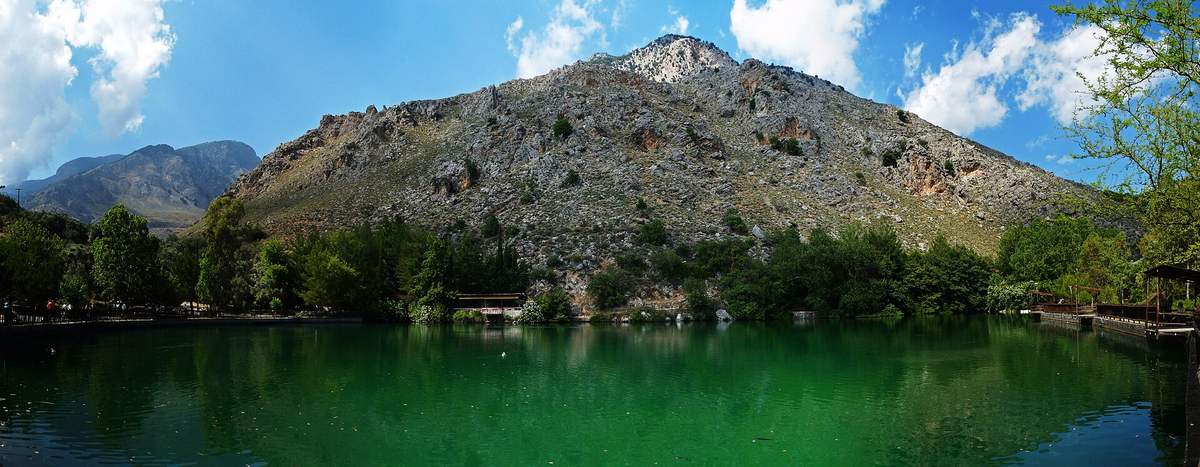
Zaros rests on the southern slopes of Mount Psiloritis in central Crete, a green oasis fed by mountain springs that give the village its reputation across the island. The small Lake Votomos glimmers beside tavernas serving fresh trout raised in the clear water, and the Rouvas Gorge climbs through ancient oak forests to remote chapels in the highlands. Byzantine monasteries with frescoes stand within walking distance, and the village offers a quiet base for exploring the Messara plain and the archaeological sites of southern Crete. Walkers and travellers seeking a cooler, watered retreat find Zaros a peaceful alternative to the coast with My Greece Tours.
The village sits in the Heraklion region, equidistant from the north coast and the southern Messara, making it a practical stop for those touring the interior. Spring water bottled here is sold throughout Crete, and the landscape remains lush even in high summer. The sections below cover the gorge walks, lakeside dining, monastery visits and practical details for planning a stay in this mountain village. Travellers can consult our Crete travel guide for broader context on the island’s regions and routes.
What makes Zaros distinctive among Crete’s mountain villages?
Zaros owes its character to abundant spring water flowing from Mount Psiloritis, creating a green microclimate rare in southern Crete. The springs feed Lake Votomos and trout farms, and the village bottles water sold island-wide.
The village spreads across terraced slopes where plane trees and fruit orchards thrive on constant irrigation from underground sources. Lake Votomos, a small artificial reservoir fed by the springs, anchors the settlement and provides a cool gathering point for locals and visitors. Tavernas line the shore, their tables shaded by greenery, and the water remains cold even in August. Trout farming began here decades ago, taking advantage of the pure, oxygen-rich flow, and the fish now feature on every menu. The landscape contrasts sharply with the dry hills surrounding the Messara plain just to the south.
Walkers appreciate the shade and the sound of running water, and the village serves as a staging point for things to do in Crete that involve cooler altitudes and forested trails.
The bottled water industry employs residents and has made the village name familiar across the island. Trucks carry the product to Heraklion and beyond, and the springs themselves remain a point of local pride. The combination of water, altitude and proximity to both coast and mountain makes Zaros a functional base for touring. Visitors can reach the Minoan palace of Phaistos in half an hour, explore the Messara villages or head uphill into the Psiloritis massif. The village itself offers modest accommodation, traditional tavernas and a slower pace than the coastal resorts. The green setting and reliable water supply have sustained settlement here for centuries, and the modern village continues to draw those seeking a quieter Crete experience.
How does the Rouvas Gorge walk work from Zaros?
The Rouvas Gorge trail begins near Lake Votomos and ascends through one of Crete’s largest oak forests to high-altitude chapels. The route climbs steadily, offering shade, seasonal streams and views into the Psiloritis wilderness.
The trailhead lies just beyond the lake, marked by signs and a small parking area. The path enters dense oak woodland almost immediately, and the canopy provides welcome shade during the climb. The gorge itself is less dramatic than the island’s deep coastal ravines but compensates with forest cover and a sense of seclusion. The route follows a stream bed for much of the way, dry in summer but flowing in spring and autumn. Stone chapels dedicated to mountain saints appear at intervals, their whitewashed walls and red-tile roofs visible through the trees. The main trail reaches the chapel of Agios Ioannis after roughly two hours of steady ascent, though fitter walkers continue higher into the Psiloritis range.
The return follows the same path, and the descent takes less time. A short drive west stands the frescoed Vrondisi monastery on the mountain’s flank.
The oak forest here represents a remnant of the woodland that once covered much of Crete’s interior before centuries of grazing and charcoal burning. The trees grow tall and gnarled, their roots gripping the rocky slopes, and the understory includes wild herbs and seasonal flowers. Birdwatchers note the variety of species in the canopy, and the cooler microclimate supports plants rare elsewhere on the island. The trail requires sturdy footwear and water, and early morning starts avoid the midday heat. Hikers often combine the gorge walk with a meal at the lakeside tavernas, and the route suits those seeking a half-day excursion from the village.
The path is well-trodden and easy to follow, and the forest offers a different perspective on Crete’s landscape.
What can visitors expect at the monasteries near Zaros in Crete?
The monasteries of Vrontisi and Agios Nikolaos stand within short drives of Zaros, both preserving frescoes and architectural details from the Venetian period. The sites offer quiet courtyards, religious art and views over the surrounding countryside.
Vrontisi Monastery lies a few kilometres north of the village, reached by a narrow road that winds through olive groves and scrub. The complex dates to the fourteenth century and served as a centre of learning during the Venetian occupation. The katholikon, or main church, retains frescoes attributed to the Cretan School, and the courtyard features a Renaissance fountain decorated with relief carvings. The monastery is no longer inhabited by a full community, but a caretaker maintains the buildings and welcomes visitors. The setting is peaceful, with views across the valley toward Mount Psiloritis, and the architecture blends Byzantine and Venetian elements. The site is open most days, and modest dress is expected.
Visitors interested in Cretan food traditions will find that the monastery once produced wine and olive oil, and the old presses remain in the outbuildings.
Agios Nikolaos Monastery sits closer to Zaros, accessible by a short walk or drive. The church here also preserves frescoes, though the complex is smaller and less visited than Vrontisi. The quiet allows for contemplation, and the surrounding landscape of terraced fields and cypress trees typifies the rural interior. Both monasteries played roles in Cretan resistance during Ottoman rule, and local guides recount stories of hidden manuscripts and secret schools. The visits require little time but add historical depth to a stay in the village. Travellers exploring Matala and the Messara can easily include the monasteries in a loop through the region, and the combination of religious art, architecture and landscape makes the detour worthwhile.
Where should visitors eat and stay in Zaros?
Tavernas beside Lake Votomos specialize in trout raised in the spring water, grilled or fried and served with local greens. Accommodation options include small guesthouses and rooms to rent, all modest and family-run.
The lakeside tavernas operate year-round, their menus built around the fresh trout pulled from the nearby ponds. The fish arrives at the table quickly, simply prepared with lemon and olive oil, and the setting under plane trees adds to the appeal. Salads feature greens and herbs grown in local gardens, and the bread is often baked on the premises. Prices remain reasonable compared to coastal resorts, and the atmosphere is relaxed and unhurried. The tavernas also serve lamb, pork and vegetarian dishes, but the trout is the signature offering. Visitors often stop for lunch after a morning walk in the gorge, and the cool water and shade make the lakeside a pleasant place to linger.
The village itself has a handful of kafeneia and a small shop for basic supplies.
Accommodation in Zaros consists of traditional guesthouses and rooms in village houses, most with simple furnishings and private bathrooms. The properties are family-run, and hosts often provide local advice and route suggestions. The village does not offer luxury hotels, and travellers seeking more amenities base themselves in Anogeia or on the coast. The quiet and the cooler nights appeal to those tired of beach crowds, and the location allows day trips to Phaistos, the Messara villages and the north coast. Booking ahead in high season is advisable, and the village sees fewer visitors than the coastal towns.
Travellers considering where to stay in Crete will find Zaros a practical choice for exploring the interior without daily drives from the coast.
How does Zaros fit into a broader Crete itinerary?
Zaros serves as a quiet inland base within reach of Phaistos, the Messara plain and the north coast. The village suits travellers seeking cooler altitudes, walking routes and a break from coastal tourism.
The village lies roughly equidistant from Heraklion and the southern coast, making it a convenient overnight stop on cross-island routes. Drivers heading from the north to the Messara or the south coast beaches pass near Zaros, and the detour adds little time. The proximity to Phaistos, one of Crete’s major Minoan palaces, makes the village a logical base for archaeological touring. The palace sits less than thirty kilometres to the southwest, and the drive takes under an hour. The Messara plain itself offers traditional villages, olive groves and a slower pace, and Zaros provides a cooler retreat after a day of sightseeing in the heat.
The village also works as a starting point for mountain excursions into Psiloritis, and the Rouvas Gorge is just the most accessible of the trails in the area.
Travellers planning multi-day itineraries often spend one night in Zaros to break up coastal stays and add variety to the trip. The village contrasts with beach resorts and offers a glimpse of rural Crete that remains largely unchanged by tourism. The spring water, the lake, the gorge and the monasteries provide enough interest for a full day, and the setting encourages a slower pace. The village is not a destination for nightlife or shopping, and visitors seeking those amenities should look elsewhere. The appeal lies in the landscape, the walking and the simplicity of the tavernas and guesthouses.
The combination of accessibility, natural beauty and cultural sites makes Zaros a useful addition to a Crete itinerary focused on the interior and the south.
Frequently Asked Questions
What is the best time of year to visit Zaros?
Spring and autumn offer the most comfortable conditions for walking the Rouvas Gorge and exploring the surrounding countryside. Temperatures remain moderate, the oak forest is lush, and seasonal streams flow through the gorge. Wildflowers bloom in April and May, and the landscape is green after winter rains. Summer brings heat, but the altitude and the shade from the trees keep Zaros cooler than the coast, and the lakeside tavernas provide relief. Winter can be cold, and snow occasionally falls on the upper slopes of Psiloritis, though the village itself rarely sees significant accumulation. The monasteries and the lake are accessible year-round, and the village remains quiet even in high season.
Travellers seeking solitude and cooler weather will find Zaros appealing outside the peak summer months, and the spring water and the trout tavernas operate regardless of the season.
Can Zaros be visited as a day trip from Heraklion?
Zaros lies roughly fifty kilometres south of Heraklion, and the drive takes just over an hour on the main road toward the Messara. Day-trippers can leave the city in the morning, walk part of the Rouvas Gorge, have lunch at the lakeside tavernas and visit one or both of the nearby monasteries before returning in the afternoon. The route is straightforward, and the village makes a practical escape from the urban heat and crowds. Combining Zaros with a visit to Phaistos or the Messara villages creates a full-day itinerary that covers archaeology, nature and traditional food.
The lack of major tourist infrastructure means the village retains an authentic character, and the spring-fed landscape offers a different perspective on Crete. Drivers should allow time for the winding roads near the village and for the slower pace of the tavernas, and an early start maximizes the day.
Is Zaros suitable for families with children?
The village offers a safe, quiet environment with easy walks around Lake Votomos and the lower sections of the Rouvas Gorge. Children enjoy feeding the ducks at the lake, and the tavernas welcome families with simple menus and outdoor seating. The trout farms sometimes allow visitors to see the fish in the ponds, and the cool water and shade make the lakeside a comfortable place to spend a few hours. The gorge trail is manageable for older children accustomed to walking, though the ascent requires stamina and the path can be rocky in places. The monasteries provide a cultural element, and the quiet roads around the village are suitable for cycling.
Zaros lacks the entertainment and facilities of coastal resorts, and families seeking playgrounds, organized activities or beaches should base themselves elsewhere. The appeal for families lies in the natural setting, the slower pace and the opportunity to experience rural Crete away from the tourist centres.