
Arcadia tours cover the mountain interior of the Peloponnese: the stone villages of Dimitsana, Stemnitsa, Karytaina and Vytina, the cliff monasteries of the Lousios gorge, the Menalon Trail across Mainalo, the ancient cities of Tegea, Mantineia and Megalopoli, the altar on Mount Lykaion, the temple of Apollo at Bassae, and the Tsakonian coast at Leonidio under its red cliffs. Plan the rest of the trip with Greece Tours.
This page covers the Arcadia tours you can book from Athens, Tripoli and Dimitsana, what each part of the region holds, the gorges, monasteries and ancient sites, the walking, climbing and skiing, the wine and the food, the history from the Arcadian League to 1821, and how the roads and the seasons shape the route.
What do Arcadia tours cover?
Arcadia tours cover the mountain interior of the Peloponnese: the stone villages of Dimitsana, Stemnitsa and Karytaina, the monasteries of the Lousios gorge, the Menalon Trail, ancient Tegea, Mantineia and Megalopoli, the temple at Bassae, and the Tsakonian coast at Leonidio.
Arcadia takes its name from Arcas and was the home of Hermes and Pan. The Renaissance turned it into the image of an unspoiled country, and the modern regional unit, the largest in the Peloponnese, still carries that: fir forest, gorges, walled villages at 900 to 1,100 m, and a coast on the Argolic Gulf reached over a pass.
Tripoli, at 650 m in the central plain, is the capital and the road hub; Dimitsana and Stemnitsa hold the Gortynia villages in the west; Megalopoli sits on the southern plain with its ancient theatre and its lignite mines; and Leonidio, Tyros and Astros lie on the eastern shore under Parnon.
Which formats do Arcadia tours take?
- Guided hikes in the Lousios gorge to the cliff monasteries and ancient Gortys.
- Village days from Athens or Tripoli to Dimitsana, Stemnitsa, Karytaina and Vytina.
- Monastery tours to Agia Theodora, Philosophou and Prodromos.
- Wine days in the Mantineia vineyards, with the caves and a tasting lunch.
- Climbing courses at Leonidio, the sport-climbing centre of southern Greece.
- Multi-day Peloponnese routes that join Arcadia with Nafplio, Olympia and Hydra.
Our pages on Peloponnese tours and Mani tours cover the neighbouring parts of the peninsula, and Greece Tours sets out the rest of the country.
Where is Arcadia and what does it hold?
Arcadia lies in the centre of the Peloponnese, bordered by Achaea and Corinthia to the north, Argolis and Laconia to the east and south, and Elis and Messenia to the west. Its regional unit covers 4,419 square kilometres, the largest in the peninsula, with Tripoli as its capital.
The land is high and closed. Mainalo runs down the middle at 1,981 m, Parnon walls the east at 1,935 m, Lykaion and Artemisio hold the south and north, and the plains of Tripoli, Megalopoli and Mantineia lie between them at 600 to 700 m. Two rivers cut through: the Alfeios, which runs west to Olympia, and its tributary the Lousios in its gorge.
- Tripoli – the capital on the central plain, 160 km from Athens.
- Gortynia – Dimitsana, Stemnitsa, Karytaina, Zatouna and the Lousios villages.
- Mainalo – the fir mountain with the ski centre and the Menalon Trail.
- Megalopoli – the southern plain, with the ancient theatre and the lignite basin.
- Kynouria – the eastern coast at Astros, Tyros and Leonidio under Parnon.
- Mantineia and Tegea – the ancient cities and the vineyards north and south of Tripoli.
Arcadia has no airport and no motorway exit that lands in a village, which is why it stayed quiet while the coasts filled. Arcadia tours drive in from Athens, Nafplio, Kalamata or Olympia, all within two hours of Tripoli.
Which Arcadia tours run from Athens and Tripoli?
Arcadia tours from Athens run the villages day trip with a clifftop monastery, the best of the Peloponnesian villages private tour, and three-day routes that join Nafplio, Vytina and Hydra. From Dimitsana they run the Lousios gorge hike and the monastery days.
The region works as a driving destination. Athens to Tripoli takes about two hours on the motorway, and the villages lie 30 to 60 km further west on mountain roads. “Villages of Arcadia and Clifftop Monastery Private Day Trip” and “Athens: Best Peloponnesian Villages Full-Day Private Tour” run that route in a long day.
The walking tours start inside the region. “Lousios Gorge Guided Hike to Ancient Gortyna” leaves Dimitsana for the monasteries and the ruins in the riverbed; “One-Day Private Tour in Arcadia: Agia Theodora and the Monasteries of Filosofos” links the three sanctuaries; and “Mantinia Caves and Wine Tasting Lunch Tour” works the vineyards north of Tripoli.
Arcadia tours that stay longer use Dimitsana, Stemnitsa or Vytina as a base, with two or three nights, and cover the gorge, the Menalon Trail and the ancient sites from there. Multi-day Peloponnese routes add Nafplio and Olympia on either side.
What do Arcadia tours see at Dimitsana?
Arcadia tours at Dimitsana see a stone village at 950 m above the Lousios, built on ancient Teuthis, with the Open-Air Water Power Museum, the library of 5,000 volumes, the gunpowder mills that supplied the revolution and the view south to Taygetus.
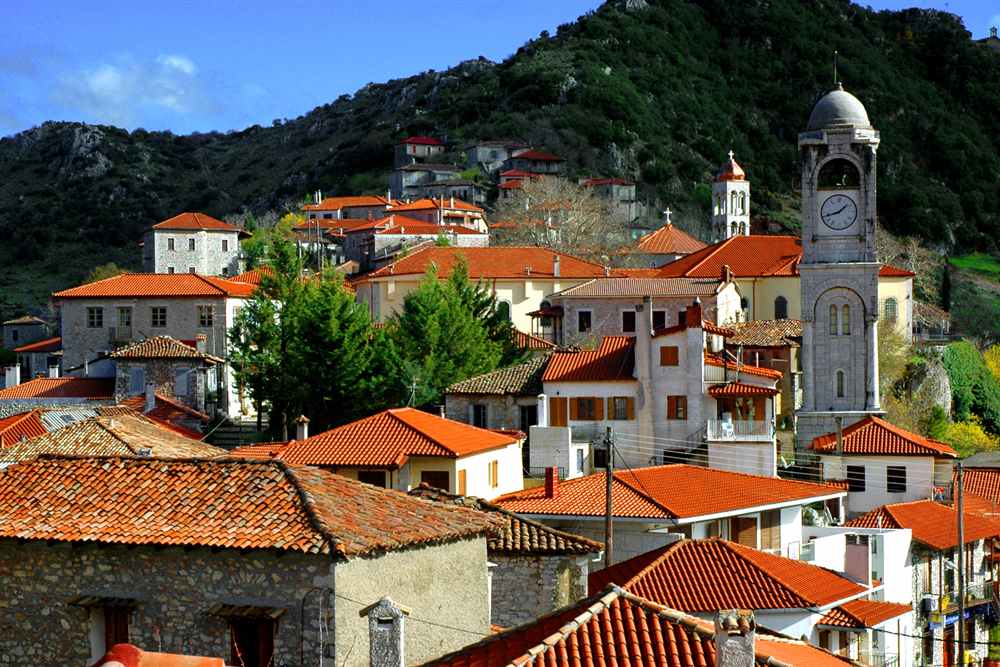
Dimitsana sits on a slope in tiers of grey stone with tiled roofs and bell towers, 31 km north-west of Tripoli. It was a school town under Ottoman rule: its Greek school taught Patriarch Gregory V and Germanos of Patras, and its library, founded in 1764, still holds manuscripts and early printed books.
Water powered the place. The Lousios below the village drove tanneries, fulling mills, flour mills and, from the 18th century, fourteen gunpowder mills that supplied the armies of 1821. The Open-Air Water Power Museum, in the ravine below the village, has restored a mill, a tannery, a fulling machine and a powder mill, all working on the same stream.
The village keeps a folklore museum, the ecclesiastical museum in the metropolitan church, and a cluster of tavernas in the square that cook the mountain menu. Below it the road drops to the Lousios monasteries and the trail into the gorge.
Arcadia tours give Dimitsana half a day with the museum and the walk to the river, and use it as the base for Gortys and Prodromos.
What do Arcadia tours see at Stemnitsa?
Arcadia tours at Stemnitsa see a village of stone towers at 1,050 m on the west edge of Mainalo, the silversmithing school that keeps its metalwork trade alive, the folklore museum and the churches of the old quarters above the Lousios.
Stemnitsa lies 6 km south-east of Dimitsana and 26 km west of Tripoli, identified with ancient Hypsous. It is built in four quarters on both sides of a ravine, with the bell tower of Agios Georgios over the square and tower houses among the fir and walnut trees. The whole settlement is listed as traditional.
Silver and gold made it. Its smiths worked for the whole Peloponnese, and the village still runs a school of silversmithing and jewellery, one of two in the country, whose workshops and shop are open to visitors. The folklore museum in the Savopoulos mansion shows the crafts, the costumes and the reconstructed workshops of the 19th-century village.
The first Greek provisional government met here in 1821 for a few days, which the village marks with a plaque on the school. Above it the Menalon Trail begins, and the path down to the Lousios monasteries takes an hour and a half.
Arcadia tours pair Stemnitsa with Dimitsana in the same day, since the two villages face each other across the gorge and the road between them runs 6 km.
What do Arcadia tours see in the Lousios gorge?
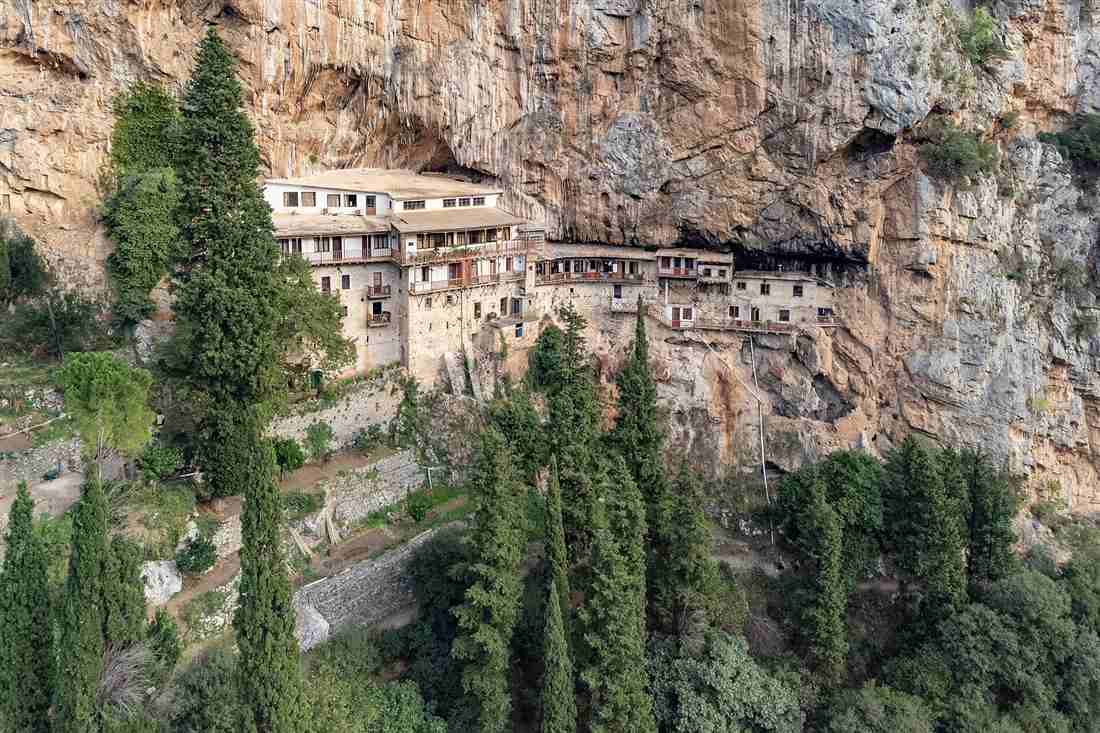
Arcadia tours in the Lousios gorge see the monastery of Prodromos built into the cliff, the old and new Philosophou monasteries, Aimyalon above the river, and the ruins of ancient Gortys with its sanctuary of Asklepios and its baths in the riverbed.
The Lousios runs 15 km from Karytaina to the Alfeios in a gorge 300 m deep between Dimitsana and Stemnitsa. The Greeks called it the washing river because Zeus was bathed in it after his birth on Lykaion, and its cold water kept the monasteries and the mills supplied through the summer.
Prodromos is the picture of the gorge: a monastery of the 16th century wedged under an overhang halfway up the cliff, reached by a stepped path, with cells stacked against the rock and a church cut into it. Monks still live there and admit visitors in the morning and late afternoon.
- Prodromos monastery – built under the cliff face, reached on foot from the road or the river path.
- Old Philosophou – of 963, hidden in the rock and used as a secret school under Ottoman rule.
- New Philosophou – of 1691, on the slope above the old one.
- Aimyalon – the 16th-century monastery on the Dimitsana side of the gorge.
- Ancient Gortys – the Asklepieion, baths and walls beside the river below Elliniko.
- Water Power Museum – the restored mills at the top of the gorge below Dimitsana.
The walking route runs from Dimitsana or Stemnitsa down to the river, along it past the monasteries to Gortys, and up the far side in four to six hours. Arcadia tours book it with a guide, because the path crosses the river on plank bridges and the descents are steep.
What do Arcadia tours see at Karytaina?
Arcadia tours at Karytaina see the Frankish castle of 1254 on its rock above the Alfeios, the Byzantine churches of the village below it, the medieval bridge over the river, and the house of Kolokotronis, who held the castle against Ibrahim Pasha in 1826.
Karytaina stands where the Lousios joins the Alfeios, on a cone of rock that commands both valleys. Geoffrey of Briel, baron of the Frankish Principality of Achaea, built the castle in the mid-13th century, and the village grew under it; the Byzantines took it back in 1320 and the Ottomans in 1460.
The castle is entered by a gate in a curtain wall and holds a hall, cisterns and towers, with the whole Megalopoli plain and Taygetus in the view. Theodoros Kolokotronis fortified it in 1826 and held it while Ibrahim burned the Peloponnese; the old 100-drachma note carried his portrait with the castle behind it.
Below the rock the village keeps the churches of Panagia tou Kastrou and Agios Nikolaos with 13th-century frescoes, stone houses on stepped lanes, and the medieval bridge across the Alfeios, six arches of which four survive, with a chapel built into the pier.
Arcadia tours stop here between Megalopoli and Dimitsana; the climb to the castle takes fifteen minutes from the square.
What do Arcadia tours see at Vytina and on Mount Mainalo?
Arcadia tours at Vytina see a fir-forest village at 1,030 m with a woodcarving tradition and a winter season, and on Mainalo above it the ski centre at Ostrakina, the fir forest of the Menalon massif and the summit at 1,981 m.
Vytina lies on the road between Tripoli and Olympia, 34 km from the capital, in a bowl of fir and walnut. It has been the mountain resort of the Peloponnese since the 19th century, with stone hotels, a square of cafes and a line of shops selling honey, hilopites, wooden spoons and woven goods.
Mainalo, the mountain of Pan, runs above it. The ski centre at Ostrakina, at 1,600 m, has runs, a lodge and a road kept open through winter; in summer the same slopes carry mountain-bike routes and the paths into the fir. The summit ridge reaches 1,981 m and looks across the whole central Peloponnese.
- Vytina – the fir village, its square and its wood and honey shops.
- Ostrakina ski centre – runs and a lodge at 1,600 m on Mainalo.
- Elati and Nymfasia – the neighbouring villages in the same forest.
- Menalon Trail – the marked long-distance route across the massif.
- Mainalo summit – 1,981 m, walked from Ostrakina in about three hours.
- Kokkinorachi and Dara – the eastern villages with their stone bridges.
Arcadia tours use Vytina as the winter base and Dimitsana as the summer one, which is how the region splits its seasons.
What is the Menalon Trail?
The Menalon Trail is a marked long-distance path of 75 km in eight sections, from Stemnitsa to Lagkadia across the Mainalo massif and the Lousios and Mylaon gorges. In 2015 it became the first Greek route certified by the European Ramblers Association as a Leading Quality Trail.
The trail links the villages rather than the summits. It runs Stemnitsa to Elliniko through the Lousios gorge and its monasteries, Elliniko to Dimitsana, Dimitsana to Zygovisti and Nymfasia, Nymfasia to Vytina, Vytina to Magouliana and Valtesiniko, and on to Lagkadia, with sections of two to six hours each.
- Section 1 – Stemnitsa to Elliniko, through the gorge past Prodromos and Philosophou.
- Section 2 – Elliniko to Dimitsana, past ancient Gortys and the water mills.
- Section 3 – Dimitsana to Zygovisti, on the old paths above the gorge.
- Section 4 – Zygovisti to Elati and Nymfasia in the fir forest.
- Section 5 and 6 – Nymfasia to Vytina and Magouliana, the highest ground.
- Sections 7 and 8 – Valtesiniko to Lagkadia, ending above the Mylaon.
Walkers take four to six days over the whole route and sleep in the villages, which is the point of the design: every stage ends at a guesthouse and a taverna. Arcadia tours sell single sections as day walks from Dimitsana and Vytina.
What do Arcadia tours see at Tripoli?
Arcadia tours at Tripoli see the Archaeological Museum in a Ziller building, the Malliaropouleio theatre, the Areos square with its plane trees, the war museum and the memory of Tripolitsa, the Ottoman capital of the Morea stormed in September 1821.
Tripoli stands at 650 m in the middle of the Arcadian plain, a town of about 30,000 people and the administrative centre of the region. Under Ottoman rule it was Tripolitsa, the seat of the pasha of the Morea, which is why the revolution turned on it: Kolokotronis took the town on 23 September 1821 after a siege, and the massacre that followed marked the war.
The Archaeological Museum, in a neoclassical building designed by Ernst Ziller as a hospital, holds the finds of Tegea, Mantineia, Lykosoura and the prehistoric sites of the plain, with Mycenaean pottery and Roman sculpture. The Malliaropouleio theatre of 1910 still stages a season, and the Areos square is one of the largest in Greece.
The town is the road hub of the Peloponnese: the motorway from Athens ends here, and the roads run west to Olympia, south to Sparta and Kalamata, and east to Argos and Nafplio. Arcadia tours pass through it and stop for the museum rather than sleep in it.
What do Arcadia tours see at Gortys and the ancient sites of the gorge?
Arcadia tours at ancient Gortys see the Asklepieion on the bank of the Lousios, its round bath house of the 4th century BC, the temple terrace, the fortified acropolis above, and the chapel of Agios Andreas built into the sanctuary wall.
Gortys lies on the west bank of the river below Stemnitsa, an hour’s walk from the Prodromos monastery on the gorge path. The healing sanctuary used the cold water of the Lousios itself, and its bath building, a round hall with a domed pool, is one of the earliest of its type in Greece.
The sanctuary held a statue of Asklepios as a beardless youth, which Pausanias saw and described when he came through in the 2nd century AD; the same passage gives the river its name, Lousios, from the washing of the newborn Zeus. Above the sanctuary the acropolis carries a circuit of polygonal walls and towers on the ridge.
- Asklepieion – the temple terrace, the altar and the priests’ rooms on the river bank.
- Round bath – the domed hall of the 4th century BC, fed from the Lousios.
- Agios Andreas – the small church built inside the ancient enclosure.
- Acropolis of Gortys – polygonal walls and towers on the hill above the river.
- Gorge crossing – the plank bridge that carries the path from the Dimitsana side.
- Atsicholos – the village on the ridge with the road access and the taverna.
The site is unfenced and free, and the river runs through the middle of it. Arcadia tours reach it on foot from Elliniko or Atsicholos in twenty minutes, or on the gorge walk from Dimitsana in three hours.
How do Arcadia tours drive the region’s roads?
Arcadia tours drive the Moreas motorway between Athens, Tripoli, Megalopoli and Kalamata, the mountain roads west into Gortynia at 40 km an hour, the Parnon pass east to Leonidio, and the Ladon valley road north-west towards Olympia.
The motorway is the spine. It crosses the region from the Corinthia border to the Messenian one with exits at Nestani, Tripoli, Megalopoli and Karytaina, and it turns what was a four-hour climb from Athens into two hours of steady driving at motorway speed with a tunnel under the Artemisio ridge.
Everything off it is slow. The road from Tripoli to Dimitsana covers 55 km in an hour through Vytina and the fir forest; the Parnon crossing to Leonidio climbs to 1,200 m at the Kosmas saddle before dropping 80 km to the sea; and the Gortynia roads between villages run 10 to 20 km in twenty minutes of bends.
- Moreas motorway – Athens to Tripoli in two hours, Kalamata in three.
- Tripoli ring – the junction of the Argos, Sparta, Kalamata and Pyrgos roads.
- Gortynia roads – Vytina, Dimitsana, Stemnitsa and Karytaina on single carriageway.
- Parnon pass – Tripoli to Leonidio by Kosmas, with the Elona turning.
- Ladon valley – the quiet route to Olympia by Tropaia and Lampeia.
- Fuel and services – Tripoli, Megalopoli, Vytina, Dimitsana and Leonidio.
Snow closes the Mainalo and Parnon passes for a few days each winter, and the forest roads above Vytina need clearance in January and February. Arcadia tours in a hire car allow an hour for every 50 km off the motorway, which is the figure the local drivers use.
Kosmas sits at the top of the Parnon crossing at 1,150 m, a plane-shaded square of tavernas and a church where the road from Tripoli meets the one from Sparta. It is the halfway stop of the coastal day, and the last fuel before the descent through the chestnut forest to Leonidio.
Public buses run from the Kifissos terminal in Athens to Tripoli through the day, and on from Tripoli to Vytina, Dimitsana, Megalopoli and Leonidio on timetables built for residents, which means an early departure and a late return with nothing in between. Tripoli also has the railway station of the closed Corinth line, kept for the buses that replaced it.
What do Arcadia tours see at ancient Tegea and Mantineia?
Arcadia tours at Tegea see the temple of Athena Alea, rebuilt by Skopas in the 4th century BC, and the museum at Alea; at Mantineia they see the circuit of walls with its towers, the theatre and the modern church of Agia Fotini north of Tripoli.
Tegea and Mantineia were the two powers of the Arcadian plain and fought each other for it. Tegea, 8 km south-east of Tripoli, held the sanctuary of Athena Alea, whose temple Skopas rebuilt after a fire in 395 BC with the hunt of the Calydonian boar on its pediment; the museum beside the site holds the sculpture.
Mantineia, 12 km north, kept a wall circuit of 4 km with more than a hundred towers, built after the Spartans destroyed the city in 385 BC. Two battles were fought on its plain: in 418 BC, when Sparta beat the Argive alliance, and in 362 BC, when Epaminondas of Thebes won and died in the same hour.
- Temple of Athena Alea – the 4th-century BC rebuilding by Skopas at Tegea.
- Museum of Tegea – the pediment sculpture and the finds of the sanctuary.
- Mantineia walls – the oval circuit and towers on the plain north of Tripoli.
- Mantineia theatre – the ruins beside the agora inside the walls.
- Agia Fotini – the eccentric modern church of the 1970s beside the ancient site.
- Nestani and Artemisio – the villages under the pass to the Argolid.
Both sites lie in fields with few visitors and no cafes. Arcadia tours take them with the Mantineia vineyards, which work the same plain, and the Tripoli museum, which holds what was found in them.
What do Arcadia tours see at Megalopoli and Lykosoura?
Arcadia tours at Megalopoli see the largest theatre of the ancient Greek world, seating about 20,000, and the Thersilion assembly hall beside it; at Lykosoura, 12 km west, the sanctuary of Despoina and the museum with the colossal group by Damophon.
Megalopoli was built to order. Epaminondas of Thebes founded it in 371 BC after breaking Sparta, gathering the villages of southern Arcadia into one city to block the road north from Laconia. Its theatre cut into the hillside held the federal assembly of the Arcadian League, which met in the Thersilion below it.
Lykosoura claims to be the oldest city in the world in Pausanias, and its sanctuary of Despoina, the Mistress, kept a cult that predated the Olympian gods. Damophon of Messene carved the group of Despoina, Demeter, Artemis and the Titan Anytos in the 2nd century BC; the heads are in Athens and the rest in the site museum.
The modern town lives on lignite. The basin south of it holds the open mines and the power stations that carried much of the Greek grid, and the landscape between the ancient theatre and the cooling towers is the strangest in the Peloponnese.
Arcadia tours take Megalopoli on the road between Tripoli and Kalamata, and Lykosoura with Mount Lykaion in the same half day.
What do Arcadia tours see on Mount Lykaion?
Arcadia tours on Mount Lykaion see the ash altar of Zeus on the southern summit at 1,382 m, the stadium and hippodrome of the Lykaia games on the terrace below it, and the two columns that carried gilded eagles above the sanctuary.
Lykaion was the birthplace of Zeus in the Arcadian version of the myth, against the Cretan claim. Its altar is a mound of ash and burnt bone that excavation has dated back to about 1500 BC, a thousand years before the first Olympic Games, which makes it one of the oldest continuous cult places known in Greece.
The rites were remembered as dark. Pausanias reports a human sacrifice and a feast at which a man became a wolf for nine years, the story behind the word lycanthropy, and he says no shadow falls inside the temenos. The Lykaia games were held here from the 6th century BC, and the stadium, hippodrome, bath and fountain house of the athletic complex lie on the plateau at 1,200 m.
The mountain has two peaks, Stefani at 1,421 m in the north and Agios Ilias at 1,382 m in the south, where the altar stands beside a chapel. The road climbs from Ano Karyes, and the last stretch is walked.
Arcadia tours put Lykaion with Lykosoura and the Megalopoli theatre, and the drive between them crosses the emptiest country in the Peloponnese.
What do Arcadia tours see at Bassae?
Arcadia tours at Bassae see the temple of Apollo Epikourios of about 420 BC at 1,131 m, designed by Iktinos, with the earliest Corinthian capital known and a continuous Ionic frieze now in the British Museum. It was the first Greek monument inscribed by UNESCO, in 1986.
The temple stands alone on the slope of Kotylion, above Andritsaina and south of Megalopoli, in country that has no town near it. The people of Phigaleia built it to Apollo the helper after a plague, and Pausanias ranked it second only to the temple at Tegea among Peloponnesian temples for its stone and its proportion.
It is the most studied temple in Greece after the Parthenon. It combines all three orders, faces north instead of east, and keeps its columns standing because the site is remote; a white tent has covered it since 1987 while the restoration works, which is how visitors see it today.
The frieze of 23 marble slabs, showing Greeks against Amazons and Lapiths against Centaurs, was removed in 1814 and sold to the British Museum, where it stands in its own room. The Andritsaina library, 14 km away, holds one of the largest old book collections in Greece.
Arcadia tours reach Bassae on the mountain road from Megalopoli or Andritsaina, about an hour of climbing in either case, and combine it with Olympia, which is 65 km north-west.
What do Arcadia tours see on the Arcadian coast?
Arcadia tours on the east coast see Leonidio under its red cliff, where Tsakonian, the last descendant of Doric Greek, is still spoken, the Elona monastery in a cleft of Parnon, the villages of Tyros and Sampatiki, and the beach town of Paralio Astros under its castle.
Kynouria is the coastal strip between Parnon and the Argolic Gulf, reached from Tripoli over a 1,200 m pass or along the shore from Astros. Leonidio, with 3,826 people, sits at the mouth of the Dafnon gorge between two walls of red rock, and the town is listed as a traditional settlement.
Its language sets it apart. Tsakonian descends from the Doric of ancient Laconia rather than from the koine that produced modern Greek, and a few hundred speakers keep it; the town is called Agie Lidi in it, and street signs carry both forms.
- Leonidio – the town under the red cliff, with the Dafnon gorge behind it.
- Elona monastery – built into a cleft of Parnon on the road to Kosmas, at 650 m.
- Plaka – the harbour of Leonidio, with fish tavernas on the quay.
- Tyros and Sampatiki – the coastal villages north of it, with pebble coves.
- Paralio Astros – the beach town under a Frankish castle, with the Moustos lagoon beside it.
- Kastanitsa and Prastos – the Tsakonian mountain villages inland under Parnon.
The Tsakonian aubergine of Leonidio, long, striped and sweet, carries a protected designation and has its own festival in August. Arcadia tours reach the coast in an hour and a half from Tripoli and in two and a half from Nafplio.
Which caves do Arcadia tours visit?
Arcadia tours visit the cave of Kapsia north of Tripoli, with its red and white stalactites, its underground lake basins and the human bones of the flood that trapped people in it, and the smaller caves of the Mantineia plain shown with the wine tastings.
Kapsia lies 15 km north of Tripoli at the edge of the Mantineian plain, which has no outlet and drains through sinkholes into the limestone. The cave runs about 6,500 square metres on two levels, of which a lit circuit of 350 m is open, through chambers of stalactites coloured red and ochre by iron oxides.
It was found in 1887 by a French engineer working on the drainage of the plain. Excavation found human skeletons and Roman lamps in the lower galleries, evidence that people sheltered there and were caught by rising water, which the cave still takes in wet winters.
- Kapsia cave – the lit circuit, the coloured formations and the flood chambers.
- Mantineia sinkholes – the katavothres that drain the closed plain.
- Cave tours with wine – the tasting lunch that pairs the caves with the Moschofilero cellars.
- Chelmos and Parnon caves – the smaller systems on the region’s borders.
- Prodromos rock – the overhang the monastery is built under in the Lousios.
- Dafnon gorge – the rock shelters and climbing caves above Leonidio.
The temperature inside holds near 17 degrees through the year, which makes the cave the coolest stop of an Arcadian summer day. Arcadia tours pair it with Mantineia and the Tripoli museum.
Which museums do Arcadia tours visit?
Arcadia tours visit the Archaeological Museum of Tripoli, the Open-Air Water Power Museum and library at Dimitsana, the folklore museum of Stemnitsa, the site museums of Tegea and Lykosoura, and the archaeological museum of Astros with the Herodes Atticus finds.
Tripoli holds the regional collection: the finds of Tegea, Mantineia, Lykosoura, Asea and Orchomenos in a Ziller building, from Neolithic pottery to Roman portraits, with the Arcadian bronzes among them. Tegea keeps its own museum beside the temple, rebuilt in 2014, with the Skopas sculpture and the votives of Athena Alea.
- Archaeological Museum of Tripoli – the regional collection in the Ziller hospital building.
- Water Power Museum, Dimitsana – the working mill, tannery, fulling machine and powder mill.
- Dimitsana library – 5,000 volumes and manuscripts, founded in 1764.
- Folklore museum, Stemnitsa – the crafts and reconstructed workshops of the village.
- Museum of Tegea – the pediment sculpture by Skopas and the sanctuary finds.
- Museum of Lykosoura – the colossal group by Damophon from the sanctuary of Despoina.
Astros, on the coast, holds the marbles and mosaics from the villa of Herodes Atticus at Eva, 4 km inland, which was one of the largest private estates of the Roman world. Arcadia tours fit the museums into the driving days, since none needs more than an hour.
What do Arcadia tours see at Astros and the Moustos wetland?
Arcadia tours at Astros see the castle above the town, the archaeological museum with the Herodes Atticus sculpture, the villa and stadium at Eva-Loukou with its mosaics, and the Moustos lagoon, a protected wetland with herons, flamingos and the Parnon juniper forest behind it.
Paralio Astros stands on a headland with a Frankish castle on top and a long beach each side. The old town climbs to the walls in whitewashed lanes, the harbour takes fishing boats, and the National Assembly of Astros met here in 1823, the second of the revolutionary assemblies.
Four kilometres inland, at Eva, Herodes Atticus built a villa of about 20,000 square metres in the 2nd century AD, with mosaics, a stadium, baths and a collection of sculpture that the Astros museum now holds. The monastery of Loukou stands on part of the site and has ancient blocks and reliefs built into its walls.
Moustos, south of the town, is a shallow coastal lagoon of about 1,000 hectares inside the Parnon protected area. It carries herons, egrets, glossy ibis, flamingos in winter and otters in the channels, with hides on the shore and a path around it.
Arcadia tours take Astros as the first stop of the coastal day, with Leonidio 40 km south and Nafplio 45 km north.
Which wildlife and landscapes do Arcadia tours cross?
Arcadia tours cross the fir forest of Mainalo, the black pine and juniper of Parnon, the gorges of the Lousios and the Dafnon, the closed plains of Tripoli and Mantineia with their sinkholes, and the wetlands of Moustos on the coast.
The region has more forest than any other part of the Peloponnese. Greek fir covers Mainalo between 1,000 and 1,700 m, chestnut and black pine hold Parnon, and the Parnon juniper forest at Moustos, a stand of Juniperus drupacea, grows nowhere else in Europe outside two other Greek sites.
Water runs where the limestone allows. The Tripoli and Mantineia plains have no rivers out of them and drain through katavothres into the rock, which is why the cave of Kapsia floods; the Lousios and the Alfeios cut west to Olympia; and the Dafnon comes down its red gorge to Leonidio.
- Mainalo fir forest – the largest continuous fir cover in the Peloponnese.
- Parnon – black pine, chestnut and the unique juniper forest at Moustos.
- Lousios gorge – 300 m deep between Dimitsana and Stemnitsa.
- Katavothres – the sinkholes that drain the closed Arcadian plains.
- Moustos lagoon – herons, flamingos and otters on the Kynourian coast.
- Golden eagles and wolves – on Mainalo, Parnon and Lykaion.
Snow lies above 1,200 m from December to March, and the fir forest is green through the summer when the coasts burn brown. Arcadia tours in July and August work the mountain and leave the shore for the evening.
Which walks do Arcadia tours take besides the Menalon Trail?
Arcadia tours walk the Lousios gorge between the monasteries, the Dafnon gorge above Leonidio, the summit path on Mainalo from Ostrakina, the climb to the altar on Mount Lykaion, the Parnon paths from Kastanitsa and the old road between Stemnitsa and Karytaina.
The gorge walks are the region’s signature. The Lousios route runs four to six hours between Dimitsana, the monasteries, Gortys and Stemnitsa, crossing the river on plank bridges; the Dafnon at Leonidio climbs from the town to Elona monastery in about five hours on an old mule path.
- Lousios gorge – Dimitsana to Stemnitsa past Prodromos, Philosophou and Gortys.
- Dafnon gorge – Leonidio to Elona monastery on the Parnon path.
- Mainalo summit – Ostrakina to the ridge at 1,981 m, about three hours.
- Mount Lykaion – Ano Karyes to the ash altar on Agios Ilias at 1,382 m.
- Kastanitsa chestnut paths – the Parnon routes between the Tsakonian villages.
- Stemnitsa to Karytaina – the old road above the Lousios, three hours.
The paths are marked on the Menalon and Parnon networks and rougher elsewhere. Arcadia tours book a guide for the gorges, where the river crossings change with the water, and walk the ridges unguided in settled weather.
Where do Arcadia tours hear the Tsakonian language?
Arcadia tours hear Tsakonian in Leonidio, Tyros, Pramatefti, Melana, Sapounakeika and the Parnon villages of Prastos and Kastanitsa. It descends from ancient Doric rather than from the common Greek of the rest of the country, and UNESCO lists it as severely endangered.
Tsakonian is the one living descendant of Doric, the dialect of Sparta, and it survived because the eastern slope of Parnon was cut off from the sea by cliffs and from the plain by the pass. Its speakers count in the low thousands, most of them over sixty, and the town of Leonidio carries street signs in both Tsakonian and standard Greek.
The differences are audible rather than academic. Tsakonian keeps the Doric long alpha where standard Greek has eta, turns other sounds in ways no other dialect does, and builds its present tense with a participle and the verb to be, so a sentence sounds foreign to a Greek ear from Athens.
- Leonidio – bilingual signage, the cultural association and the dialect archive.
- Tyros and Melana – the coastal villages which hold the largest body of speakers.
- Prastos – the old Tsakonian capital high on Parnon, now half empty.
- Kastanitsa – the chestnut village with its own variant of the dialect.
- Tsakonikos dance – the chain dance danced at the village feasts, read as a survival of the Delian crane dance.
- Tsakonian aubergine – the protected crop that carries the name into the markets.
Teachers run classes in the schools of Leonidio and Tyros, and the associations publish a dictionary and record the elders. Arcadia tours that reach the coast in August meet the dialect at the aubergine festival, where the songs are sung in it.
Which myths do Arcadia tours follow?
Arcadia tours follow Pan, born on Mainalo and worshipped across the region, Zeus Lykaios on his mountain altar, Callisto and her son Arcas who gave the country its name, the nymph Daphne on the Ladon, and the pastoral Arcadia that Virgil made into a literary country.
Pan belongs here before he belongs anywhere. The goat-legged god of herds and panic was an Arcadian, raised on Mainalo, honoured on the mountains and in caves rather than in temples, and the Athenians only took him up after Marathon, when the runner Pheidippides reported meeting him on the road through Arcadia.
Arcas gave the region its name. Zeus fathered him on the nymph Callisto, Hera turned her into a bear, and Arcas grew up to teach the Arcadians bread, weaving and the plough; both were set in the sky as the Great and Little Bears, which is why the Arcadians called themselves older than the moon.
- Mount Lykaion – the ash altar of Zeus Lykaios and the legend of Lykaon’s sacrifice.
- Mainalo – the mountain of Pan, with the Maenalian shepherds of the poets.
- The Ladon – the river god whose daughter Daphne fled Apollo and became the laurel.
- Lykosoura – the sanctuary of Despoina, the mystery cult of the Arcadian goddess.
- Stymphalos and Erymanthos – the labours of Herakles on the region’s northern borders.
- Pastoral Arcadia – the country Virgil and the Renaissance turned into the home of shepherds and song.
The literary Arcadia came later and from outside. Virgil set his Eclogues in it, Sannazaro and Sidney wrote it into European letters, and Poussin painted shepherds reading a tomb in it, which is why the word still means an ideal countryside in half a dozen languages. Arcadia tours walk the real one, which is harder and colder than the painting and keeps the same names.
What do Arcadia tours see at ancient Orchomenos, Asea and Pallantion?
Arcadia tours at Arcadian Orchomenos see the acropolis above Levidi with its theatre and walls, at Asea the twin-peaked acropolis south of Tripoli with its Bronze Age and Hellenistic layers, and at Pallantion the site the Romans took for the mother city of Rome.
Orchomenos of Arcadia, not the Boeotian city of the same name, sits on a ridge at 900 m above Levidi, 25 km north of Tripoli. Its walls, agora, theatre and the temple terrace stand in open ground with the Mantineian plain on one side and the Feneos basin on the other, and the site is unfenced.
Asea, 15 km south-west of Tripoli, holds a low acropolis with two summits and a sequence that runs from the Early Helladic through the Mycenaean to a Hellenistic refoundation; Swedish excavation dug it in the 1930s. The springs of the Alfeios and the Eurotas rise on the same plain, which the ancients treated as a wonder.
Pallantion, near modern Pallantio, gave Rome a founding legend: Evander was said to have come from it to the Palatine, which took its name from the city, and the emperor Antoninus Pius rewarded the village with privileges for it. Four temple foundations and a wall circuit survive on the hill.
Arcadia tours reach all three within half an hour of Tripoli, and the museum in the town holds what came out of them.
Which crafts do Arcadia tours buy?
Arcadia tours buy silver and jewellery from the Stemnitsa workshops, carved wood and spoons from Vytina, honey, hilopites and trahana from the mountain villages, woven rugs from Kynouria, and the herbs and mountain tea of Mainalo and Parnon.
Stemnitsa is the metal town. Its silversmiths supplied the Peloponnese for centuries, and the school of silversmithing and jewellery that opened in 1978 keeps the trade in the village, with workshops that take visitors and a shop that sells what the students and masters make.
- Stemnitsa silver – rings, crosses and filigree from the school and the workshops.
- Vytina woodwork – carved spoons, bowls and furniture from the fir and walnut.
- Honey – fir and wildflower honey from Mainalo, Parnon and the Lousios valleys.
- Hilopites and trahana – egg pasta and soured wheat made in the villages.
- Weaving – rugs and blankets from the Kynourian and Tsakonian looms.
- Mountain tea and herbs – sideritis, oregano and sage gathered above 1,200 m.
The shops sit on the village squares rather than in markets, and most producers sell from the workshop. Arcadia tours build the stop into the walking day, since Dimitsana, Stemnitsa and Vytina each hold their trades on one street.
Which Byzantine churches do Arcadia tours visit?
Arcadia tours visit Panagia tou Kastrou and Agios Nikolaos at Karytaina with their 13th-century frescoes, the Zoodochos Pigi at Elona, the katholikon of Prodromos in the gorge, Agia Theodora at Vasta and the Episkopi church above Piana.
The region kept its painting because it was poor and remote. Karytaina holds the best of it: Panagia tou Kastrou below the castle and Agios Nikolaos on the river path carry frescoes of the 13th and 14th centuries, painted while the Franks held the barony and the Byzantines were taking it back.
The gorge churches are smaller and older in feel. Prodromos has a nave cut against the rock with 16th-century painting; Old Philosophou keeps traces of the 10th-century foundation; Aimyalon carries a cave chapel with a frescoed apse; and the chapels along the river path were built by the mill families.
- Panagia tou Kastrou, Karytaina – 13th-century frescoes under the Frankish castle.
- Agios Nikolaos, Karytaina – the painted church on the old river path.
- Prodromos katholikon – the rock-cut nave of the cliff monastery.
- Agia Theodora, Vasta – the 12th-century chapel with trees growing from its roof.
- Elona – the Zoodochos Pigi in the Parnon cliff above Leonidio.
- Episkopi, Piana – the Byzantine church on the old bishop’s seat west of Tripoli.
Most of these open in the morning, and the village keeper holds the key where they do not. Arcadia tours ask at the square, which is how the region has always worked.
What do Arcadia tours see at Andritsaina and the western edge?
Arcadia tours at Andritsaina see a stone village on the road to Bassae, its library of 30,000 volumes given by Konstantinos Nikolopoulos in 1840, the marble fountain in the square, and the mountain road that climbs to the temple of Apollo Epikourios.
Andritsaina stands at 765 m on the western edge of the Arcadian mountains, just over the boundary into Elis, and it has been the approach to Bassae since travellers began coming in the 18th century. Its houses step down a slope with wooden balconies, and the plane tree and fountain in the square are the meeting point.
The library is the surprise. Nikolopoulos, a scholar in Paris, left his collection to the village in 1840, and it holds about 30,000 volumes, among them 16th-century printed books and the first editions that reached Greece after independence, in a building beside the square.
The road to Bassae climbs 14 km from the village to 1,131 m, with the temple under its tent on the shoulder of Kotylion. Beyond it the road drops to Figaleia, the city that built the temple, whose walls and towers stand above the Neda gorge.
Arcadia tours take Andritsaina on the way between Megalopoli and Olympia, which turns a motorway hour into a mountain half-day.
What do Arcadia tours see in the Ladon and Alfeios valleys?
Arcadia tours in the western valleys see Lake Ladon behind its dam of 1955, the Ladon river in its wooded gorge, the Alfeios running west past Karytaina towards Olympia, and the stone bridges and watermills along both of them.
The Ladon rises in Achaea and runs south into Arcadia through a forested gorge that carries kayaks in spring. Its dam, built in 1955, made a narrow lake at 400 m among oaks and firs, with the village of Daphni above it, and the water is turned west into the Alfeios below.
The Alfeios is the long river of the Peloponnese. It gathers the Lousios and the Ladon in Arcadia and runs west through Olympia to the Ionian, and the myth of the river god pursuing the nymph Arethusa to Sicily belongs to it. The medieval bridge at Karytaina crosses it where the two rivers meet.
- Lake Ladon – the 1955 reservoir in the oak and fir gorge of western Arcadia.
- Ladon river – kayaking and rafting in spring, fishing through the year.
- Alfeios valley – the road west from Karytaina towards Olympia.
- Karytaina bridge – the medieval crossing with its chapel on a pier.
- Watermills – the restored mills of the Lousios and the ruins along the Ladon.
- Tropaia and Kontovazaina – the western villages above the lake.
The road along the lake is the quiet route between Arcadia and Olympia. Arcadia tours take it when the trip continues to Elis, which adds an hour and cuts the motorway out of the day.
Which trips combine with Arcadia tours?
Arcadia tours combine with Nafplio and Mycenae an hour east, Olympia two hours west, Sparta and Mystras an hour south, Kalamata and Messene an hour and a half south-west, and the Mani beyond them.
The region sits in the middle of the Peloponnese, which makes it the natural second stop of any peninsula route. Most visitors reach it from Nafplio or Kalamata and leave towards Olympia, and the drives are short because the motorway crosses the middle of the region.
- Nafplio and Mycenae – an hour east of Tripoli, the Argolid sites.
- Olympia – two hours west through Lagkadia or the Ladon valley.
- Sparta and Mystras – an hour south on the Laconia road.
- Kalamata and Ancient Messene – an hour and a half south-west on the motorway.
- Monemvasia – two and a half hours south-east by Sparta or the coast.
- Athens – two hours by motorway, which makes the day trips work.
Our pages on Mystras tours and Ancient Messene cover the sites south of the region, and Olympia the one to the west.
Which visitors do Arcadia tours suit?
Arcadia tours suit walkers on the Menalon Trail and in the Lousios gorge, climbers at Leonidio, visitors after stone villages and monasteries, wine travellers in the Mantineia vineyards, and anyone looking for the mountain Peloponnese rather than its coasts.
The region is not a beach destination and does not pretend to be. Its coast is 40 km of Kynouria with a few small towns; everything else is above 600 m. That makes it the counterweight to the Peloponnesian circuit of Mycenae, Nafplio, Olympia and the Mani, and the place where those routes get their walking.
- Walkers – the Menalon Trail in eight sections and the gorge routes.
- Climbers – Leonidio from October to April, with schools and guides.
- Architecture and history – the stone villages, the Frankish castle and the Byzantine monasteries.
- Wine visitors – Moschofilero at Mantineia, tasted with the caves.
- Families in summer – the fir forest at 1,000 m when the coast is at 38 degrees.
- Skiers – Ostrakina on Mainalo from December to March.
Arcadia tours work in small groups and in hire cars, because the roads are narrow, the villages are small and the sites have no coach parks. A driver-guide covers the gorge and three villages in one day, which a bus timetable cannot.
Where do Arcadia tours stay?
Arcadia tours stay in the stone guesthouses of Dimitsana, Stemnitsa and Vytina, in the mountain hotels of Elati and Valtesiniko, in Tripoli for one night on the road, and at Leonidio or Plaka for the coast and the climbing.
The region rebuilt itself on guesthouses. Dimitsana and Stemnitsa hold a dozen each in restored houses with fireplaces and thick walls, Vytina has the largest number and the winter trade, and the smaller villages keep two or three apiece, which is why weekends and holidays fill months ahead.
- Dimitsana – the base for the Lousios gorge, the mills and the monasteries.
- Stemnitsa – quieter, with the Menalon Trail starting at the square.
- Vytina – the fir-forest resort and the ski base, busiest in winter.
- Tripoli – hotels for one night, with the museum and the road links.
- Leonidio and Plaka – the climbing and the coast, open through the winter.
- Astros – the beach base at the northern end of the Kynourian shore.
Two nights in Gortynia and one on the coast makes the standard three-day trip. Arcadia tours that add the Menalon Trail sleep in a different village each night, which is how the route is designed.
What do Arcadia tours cover in a week?
A week of Arcadia tours takes two nights at Dimitsana for the gorge and the monasteries, one at Vytina for Mainalo, one at Tripoli for Tegea, Mantineia and the wine, and two at Leonidio for the coast, the climbing and the Parnon villages.
The region divides into three blocks that link in a loop: Gortynia in the west, the plain in the middle and Kynouria on the east coast. The drive between them is short, but the roads are slow, so a week covers the whole of it without long days.
- Day 1 – Athens or Nafplio to Tripoli, with Mantineia and the Kapsia cave.
- Day 2 – Dimitsana, the Water Power Museum and the walk to Prodromos.
- Day 3 – the Lousios gorge to Gortys and Stemnitsa, with the silversmiths.
- Day 4 – Karytaina, Megalopoli, Lykosoura and Mount Lykaion.
- Day 5 – Vytina, Mainalo and a section of the Menalon Trail.
- Day 6 – over Parnon to Leonidio, with Elona monastery on the way.
- Day 7 – the coast at Plaka and Tyros, Astros and the Moustos lagoon.
Shorter versions cut the coast. Three days cover Dimitsana, Stemnitsa, the gorge and Karytaina; two cover the gorge alone; and one, from Athens, covers two villages and a monastery. Arcadia tours built this way drive 80 to 150 km a day on mountain roads.
Which climbing and outdoor tours run in Arcadia?
Outdoor Arcadia tours climb at Leonidio, which holds more than 2,000 sport routes on its red limestone, walk the Menalon Trail and the Lousios gorge, ski at Ostrakina on Mainalo, raft the Lousios and the Alfeios in spring, and ride the forest roads of Gortynia.
Leonidio has become the winter climbing destination of southern Europe. The red conglomerate walls above the town were bolted from 2009 onwards, the sectors now run to thousands of routes from easy to hard, and the season runs from October to April when the north of Europe is frozen; guided courses work out of the town.
- Leonidio climbing – sport routes on red rock, best from October to April.
- Menalon Trail – 75 km in eight sections, certified by the European Ramblers Association.
- Lousios gorge – the monastery walk, and rafting and kayaking in spring.
- Ostrakina – the Mainalo ski centre at 1,600 m, open from December.
- Mountain biking – the forest roads around Vytina, Elati and Valtesiniko.
- Parnon and Moustos – walking in the eastern range and birding on the lagoon.
The seasons run against the coast: the mountains work in spring and autumn, the climbing in winter, the ski centre from December to March, and the gorges in April and May when the rivers are full. Arcadia tours therefore sell the region year-round.
Which monasteries do Arcadia tours visit?
Arcadia tours visit Prodromos and the two Philosophou monasteries in the Lousios gorge, Aimyalon above the river, Agia Theodora at Vasta with seventeen trees growing out of its roof, Elona in its cleft of Parnon and Kaltezon south of Tripoli.
Agia Theodora is the strangest church in Greece. The chapel at Vasta, near Megalopoli, is a small 12th-century building whose roof carries seventeen mature holm oaks and maples; their trunks rise out of the stone, their roots run down the walls, and a spring comes out beneath the floor without cracking it.
The Lousios monasteries hold the region’s Byzantine record. Old Philosophou, founded in 963 and hidden in a fold of the cliff, served as a secret school in the Ottoman centuries; New Philosophou of 1691 stands above it; Prodromos is built under an overhang across the gorge; and Aimyalon, on the Dimitsana side, keeps its frescoed cave church.
- Prodromos – the cliff monastery of the Lousios, still inhabited.
- Old and New Philosophou – the 10th-century hidden house and its 17th-century successor.
- Aimyalon – the 16th-century monastery below Dimitsana.
- Agia Theodora, Vasta – seventeen trees growing from the roof of a chapel.
- Elona – the white monastery in the red cliff on the Parnon road above Leonidio.
- Kaltezon and Malevi – the monasteries of the Tripoli plain and Parnon.
Most keep the usual hours, closing in the early afternoon, and ask for covered shoulders and knees. Arcadia tours take two or three of them in a day, since the gorge holds four within an hour’s walk.
Which villages do Arcadia tours reach?
Arcadia tours reach Dimitsana, Stemnitsa, Karytaina, Vytina, Zatouna, Lagkadia, Valtesiniko, Magouliana and Elati in the mountains, Kastanitsa and Prastos on Parnon, and Nestani and Levidi on the plain.
The Gortynia villages are the core. Lagkadia hangs on a slope above the Olympia road, built by masons whose work is all over the Peloponnese; Zatouna looks across the Lousios at Dimitsana and kept Mikis Theodorakis in internal exile in 1968; Magouliana, at 1,250 m, is one of the highest villages in the peninsula.
- Lagkadia – the masons’ village in tiers above the road to Olympia.
- Zatouna – across the gorge from Dimitsana, with the Theodorakis house.
- Valtesiniko and Magouliana – the high fir villages on the Menalon Trail.
- Elati and Nymfasia – the forest villages above Vytina.
- Kastanitsa and Prastos – the Tsakonian villages of Parnon, in chestnut forest.
- Levidi and Nestani – the plain villages north of Tripoli under Mainalo.
Almost all of them are stone, listed as traditional settlements and kept alive by weekend visitors from Athens. Arcadia tours string four or five together in a day, since the roads between them run 10 to 20 km.
What do Arcadia tours eat and drink?
Arcadia tours drink Moschofilero from the Mantineia vineyards, eat the Tsakonian aubergine of Leonidio, trout from the Lousios, hilopites and trahana from the mountain villages, pork with prunes, and the honey and walnut sweets of Vytina and Dimitsana.
Mantineia is the wine name. Moschofilero, a pink-skinned grape that makes a white with rose and citrus in it, grows on the plain at 650 m north of Tripoli and carries its own appellation; the estates around Mantineia and Nestani take visitors, and the caves of the plain are shown on the same tours.
- Moschofilero of Mantineia – the white appellation of the Arcadian plain.
- Tsakonian aubergine – the long striped aubergine of Leonidio, with its own designation.
- Trout – farmed and wild in the Lousios and the Ladon.
- Hilopites and trahana – the egg pasta and soured wheat of the mountain kitchens.
- Honey and walnuts – from the fir and walnut forests around Vytina.
- Kaltsounia and diples – the sweets of the village bakeries.
The mountain tavernas cook pork, goat and kokoras in the oven, with wild greens and the local cheese. Arcadia tours book the Mantineia cellars with the Tripoli museum, since the two sit twenty minutes apart.
What history do Arcadia tours tell?
Arcadia tours tell of the Arcadian League and the founding of Megalopolis in 371 BC, of the Frankish barony of Karytaina, of the gunpowder mills of Dimitsana, of Kolokotronis and the fall of Tripolitsa in September 1821, and of the emigration that emptied the villages after 1900.
The Arcadians were the oldest people of the Peloponnese by their own account, autochthonous and never conquered by the Dorians. Their towns formed a loose league that held Sparta off in the 7th century BC, and after Leuctra, Epaminondas gathered them into Megalopolis as a counterweight to Laconia.
The Middle Ages brought the Franks. Karytaina became a barony of the Principality of Achaea in 1205, the castle went up in the 1250s, and Byzantium recovered the region in 1320 before the Ottomans took it in 1460. Under Ottoman rule Tripolitsa became the capital of the Morea and Dimitsana became its powder magazine.
The revolution began here in March 1821, and Kolokotronis, born in Messenia and raised in Arcadian country, took Tripolitsa in September. The mills of Dimitsana supplied his armies, the monasteries hid his men, and Karytaina held out against Ibrahim in 1826.
What followed was emptying. Arcadia sent more emigrants to America than any other Greek region in proportion to its size, and its villages lost their people through the 20th century; the ones that survived did so as weekend and summer places, restored in stone.
Which festivals do Arcadia tours meet?
Arcadia tours meet the Easter balloons of Leonidio, when hundreds of paper lanterns rise over the town at midnight, the Tsakonian aubergine festival in August, the chestnut festivals of Parnon in October and the village panigyria of the mountains through the summer.
Leonidio’s Easter is the best known. At the Resurrection the parishes launch hot-air paper balloons from the churchyards and the roofs, and hundreds of them drift up the gorge in the dark, a custom the town has kept since the 19th century and the picture that carries it abroad.
- Leonidio, Easter Saturday – the launch of the paper balloons at midnight.
- Leonidio, August – the Tsakonian aubergine festival on the quay at Plaka.
- Parnon villages, October – chestnut festivals at Kastanitsa and Agios Petros.
- Vytina and Dimitsana, August – the village panigyria with mountain music.
- Tripoli, 23 September – the anniversary of the fall of Tripolitsa in 1821.
- Stemnitsa, summer – the silversmithing school’s exhibitions and the village feast.
Arcadia tours in Holy Week and in August book months ahead, because the villages hold a few dozen rooms each. The rest of the year the same rooms are open and empty.
How do visitors reach Arcadia, and when do the tours run?
Visitors reach Arcadia by motorway from Athens to Tripoli in about two hours, from Kalamata in an hour, from Nafplio in an hour and from Olympia in two. The tours run year-round: walking in spring and autumn, climbing in winter, the ski centre from December and the coast in summer.
Tripoli is the hub. The Moreas motorway runs Athens to Tripoli and on to Kalamata, the old roads climb west into Gortynia and east over Parnon to the coast, and there is no airport, so every arrival is by road. Buses run from Athens to Tripoli, Dimitsana, Vytina and Leonidio, but they are built for residents.
- Athens to Tripoli – 160 km, about two hours on the motorway.
- Tripoli to Dimitsana – 55 km, about an hour on the mountain road.
- Tripoli to Leonidio – 80 km over the Parnon pass, about an hour and a half.
- Nafplio to Tripoli – 60 km, about an hour.
- Kalamata to Megalopoli – 55 km on the motorway.
- Olympia to Dimitsana – 75 km through Lagkadia, about an hour and a half.
Spring brings the rivers and the flowers, autumn the chestnuts and the vintage, winter the snow on Mainalo and the climbing at Leonidio, and summer the cool at 1,000 m while the coast bakes. Arcadia tours base themselves at Dimitsana or Stemnitsa for the gorge, at Vytina for the forest and at Leonidio for the rock, and three or four days cover the region.
Frequently Asked Questions
Where is Arcadia?
In the centre of the Peloponnese, bordered by Achaea and Corinthia to the north, Argolis and Laconia to the east and south, and Elis and Messenia to the west. Its regional unit is the largest in the peninsula, with Tripoli as its capital.
How long do Arcadia tours take?
A day from Athens for two villages and a monastery, three days for the Lousios gorge and Gortynia, and a week for the region with the coast at Leonidio and the Menalon Trail.
What is the Menalon Trail?
A marked path of 75 km in eight sections from Stemnitsa to Lagkadia across Mainalo and the Lousios gorge. In 2015 it became the first Greek route certified by the European Ramblers Association as a Leading Quality Trail.
Which villages do Arcadia tours include?
Dimitsana and Stemnitsa above the Lousios, Karytaina under its Frankish castle, Vytina in the fir forest, Lagkadia on the Olympia road and Leonidio on the coast.
What is in the Lousios gorge?
The cliff monastery of Prodromos, the old and new Philosophou monasteries, Aimyalon, and the ruins of ancient Gortys with its Asklepieion and baths, linked by a path of four to six hours.
What is Agia Theodora?
A 12th-century chapel at Vasta near Megalopoli with seventeen mature trees growing out of its roof and a spring running from beneath its floor.
Which wine comes from Arcadia?
Moschofilero from the Mantineia appellation, grown at about 650 m on the plain north of Tripoli and made into a dry white with rose and citrus aromas.
Why do climbers go to Leonidio?
The red limestone walls above the town carry more than 2,000 sport routes, bolted since 2009, and the climbing season runs from October to April when northern Europe is frozen.
What is the temple at Bassae?
The temple of Apollo Epikourios of about 420 BC at 1,131 m above Andritsaina, designed by Iktinos, with the earliest known Corinthian capital. It was the first Greek monument inscribed by UNESCO, in 1986.
What happened at Tripolitsa in 1821?
Kolokotronis took the Ottoman capital of the Morea on 23 September 1821 after a siege. The town, now Tripoli, keeps the memory in its squares and its war museum.
Can you ski in Arcadia?
Yes, at the Ostrakina centre on Mainalo above Vytina, at about 1,600 m, which works from December to March with runs and a lodge.
When is the best time for Arcadia tours?
April to June and September to October for walking and the gorges, winter for the climbing at Leonidio and the skiing on Mainalo, and July and August for the fir forest at 1,000 m while the coast bakes.