
Boeotia tours cover the plain between Athens and Parnassos: the Byzantine monastery of Osios Loukas with its gold mosaics, ancient Thebes and the museum that holds the Tanagra coffins, Livadia with the Krya springs and the oracle of Trophonios, Orchomenos with the Treasury of Minyas, the drained bed of Lake Kopais, and Arachova and Distomo on the mountain road. Plan the rest of the trip with Greece Tours.
This page covers the Boeotia tours you can book from Athens and Livadia, what each part of the unit holds, the Byzantine and Mycenaean sites, the springs and the gorges, the battlefields that decided Greek history, the food of the plain and the mountain, and how the roads and the seasons shape the route.
What do Boeotia tours cover?
Boeotia tours cover the Byzantine monastery of Osios Loukas, ancient Thebes and its museum, Livadia with the Krya springs and the oracle of Trophonios, Orchomenos and the drained bed of Lake Kopais, Arachova on Parnassos, and the coasts on both gulfs.
Boeotia is the plain between Athens and Central Greece, ringed by Helicon, Parnassos and Kithairon, and crossed by every road going north. Its cities fought the decisive battles of Greek history, and the monastery on the slope of Helicon carries the best Middle Byzantine mosaics in the country.
- Osios Loukas – the 10th-century monastery with gold-ground mosaics, inscribed by UNESCO.
- Thebes – the Kadmeia, the archaeological museum and the Mycenaean palace.
- Livadia – the Krya springs, the clock-tower castle and the oracle of Trophonios.
- Orchomenos – the Treasury of Minyas and the church of the Dormition.
- Arachova and Distomo – the mountain town and the 1944 memorial below it.
- The two coasts – Antikyra on the Corinthian Gulf and Alyki on the Euboean.
Our Central Greece tours page covers the wider region and the Osios Loukas monastery page the mosaics in detail. Boeotia tours work as a day from Athens or as a stop on the road to Delphi.
Where is Boeotia, and what is in each part of it?
Boeotia fills the plain north of Athens: Thebes and the Asopos valley in the east, Livadia and the Kopais basin in the centre, Helicon and the Valley of the Muses in the south-west, Arachova and Distomo on Parnassos, and short coasts on the Corinthian and Euboean gulfs.
The unit is farmland. Cotton, cereals and vegetables fill the drained bed of Lake Kopais, which was the largest lake in southern Greece until engineers emptied it between 1883 and 1931, and the plain runs unbroken from Thebes to Orchomenos with mountains on three sides.
Helicon, at 1,749 m, closes the plain on the south-west and carries the Valley of the Muses, where the poet Hesiod farmed and the sanctuary of the Muses stood. North-west the ground rises to Parnassos, and the ski road from Arachova crosses the boundary into Phocis.
- Thebes and the east – the Kadmeia, the Asopos valley and the Kithairon slopes.
- Livadia and Kopais – the capital, the springs and the drained lake bed.
- Helicon – the Valley of the Muses, the springs and the mountain villages.
- Arachova and Distomo – the Parnassos slope and the road to Osios Loukas.
- Corinthian coast – Antikyra, Agios Isidoros and the bauxite port.
- Euboean coast – Alyki, Skorponeria and the narrows opposite Evia.
The unit covers about 3,211 square kilometres and holds roughly 117,000 people. Boeotia tours drive 30 to 60 km between sites, and the motorway from Athens crosses the whole plain.
What do Boeotia tours see at Osios Loukas?
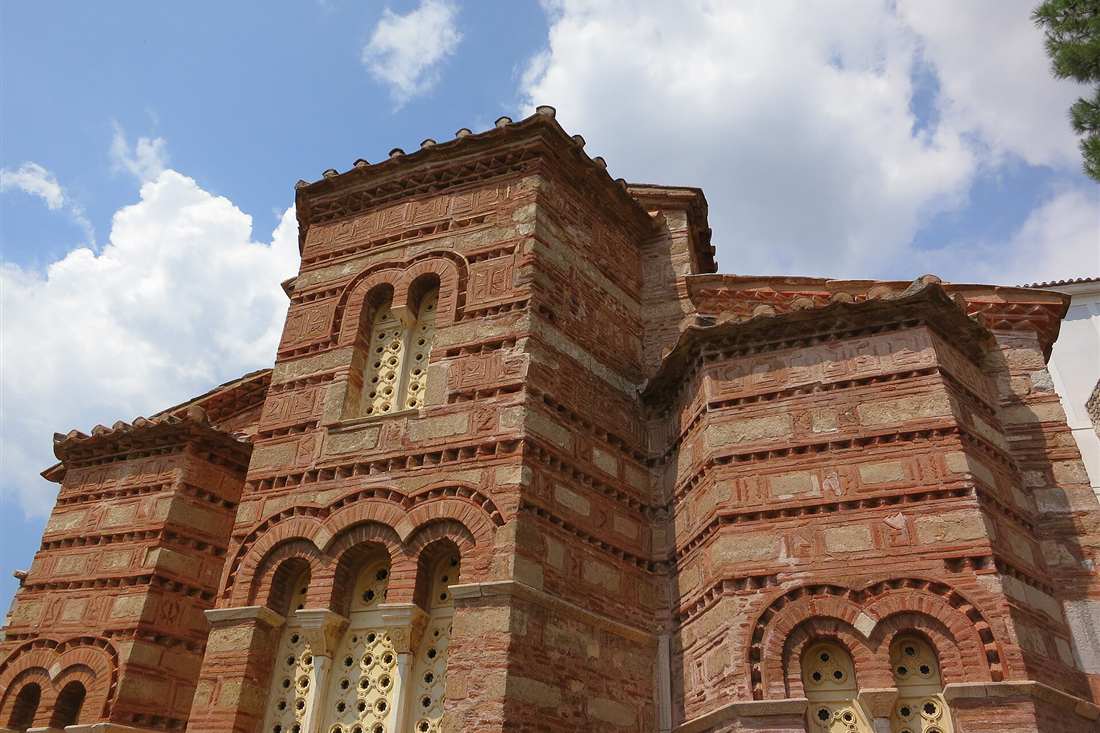
Boeotia tours at Osios Loukas see two joined churches on the slope of Helicon, the Katholikon of about 1011 with gold-ground mosaics and a marble-lined nave, the older church of the Theotokos beside it, the crypt with the saint’s tomb and the monastery buildings round the court.
The monastery grew round the tomb of Luke of Steiris, a hermit who died in 953 and whose relics drew pilgrims and imperial money. Its Katholikon is the largest surviving church of the Middle Byzantine period in Greece and the model for the type, with an octagonal dome carried on squinches.
The mosaics are the reason to come. Made about 1011 to 1020 on gold ground, they show the Nativity, the Presentation, the Baptism and rows of saints, and their survival is unusual because most work of the period was destroyed; UNESCO inscribed the monastery in 1990 with Daphni and Nea Moni.
- Katholikon – the octagonal-domed church of about 1011 with its mosaics.
- Theotokos church – the older 10th-century church joined to it on the north.
- Crypt – the burial chamber with frescoes and the saint’s original tomb.
- Marble revetment – the coloured panels lining the nave walls.
- Monastery court – the cells, refectory and the terrace over the valley.
- UNESCO listing – inscribed in 1990 with Daphni and Nea Moni of Chios.
The monastery stands 13 km from Distomo at 500 m, looking down a valley of olives and almonds. Boeotia tours need an hour, and the site sits half an hour from Delphi, which is why most coach routes take both.
What do Boeotia tours see at Thebes?
Boeotia tours at Thebes see the Archaeological Museum with its Mycenaean larnakes and Linear B tablets, the Kadmeia hill under the modern town, the Mycenaean palace remains, the Electra Gate and the Ismenion hill with its sanctuary of Apollo.
Thebes was the great rival of Athens and Sparta and the city of the Oedipus cycle, but it sits under a living town, so the ancient city appears in fragments between modern streets. The museum, rebuilt and reopened in 2016, gathers the whole unit’s finds in one building beside the Frankish tower.
Its collection is unusual for the painted clay coffins of the Mycenaean period, the larnakes from Tanagra, which carry mourning scenes and processions in red on white, and for the Linear B tablets that show a palace bureaucracy on the Kadmeia in the 13th century BC.
- Archaeological Museum of Thebes – the Tanagra larnakes and the Linear B archive.
- Kadmeia – the citadel hill, with the palace remains under the streets.
- Frankish tower – the 13th-century keep beside the museum.
- Electra Gate – the excavated gate of the classical circuit.
- Ismenion – the hill with the sanctuary of Apollo Ismenios.
- Tanagra – the ancient town 20 km east that gave the terracotta figurines their name.
The museum takes an hour and a half and is the best single collection in Central Greece. Boeotia tours pair it with Livadia, 30 km west along the plain.
What do Boeotia tours see at Livadia?
Boeotia tours at Livadia see the Krya springs where the Erkyna river comes out of the rock, the watermills and stone bridges along it, the Catalan castle on the hill above, the rock-cut niches of the oracle of Trophonios and the clock tower on the summit.
The springs are the town’s centre. Cold water rises from three points at the foot of the castle rock, runs through a gorge planted with plane trees, and passes cafes built on platforms over the water, which is where the whole town sits on a summer evening.
The oracle of Trophonios worked in the same gorge. Consultants bathed in the springs, drank from the waters of Memory and Forgetting, and were lowered into a chasm to receive the answer; Pausanias describes the ritual in detail, and the rock-cut niches above the river are what survives of it.
- Krya springs – the source of the Erkyna under the castle rock, with the cafes.
- Oracle of Trophonios – the niches and chambers cut in the gorge walls.
- Castle of Livadia – the Catalan fortress of the 14th century on the summit.
- Clock tower – the landmark above the town, rebuilt after the war.
- Stone bridges and mills – the crossings and watermills along the Erkyna.
- Agios Georgios – the church with the town’s icon of the patron saint.
Livadia is the capital of the unit and the natural lunch stop between Athens and Delphi. Boeotia tours walk the gorge in half an hour and climb to the castle in twenty minutes more.
What do Boeotia tours see at Orchomenos and Lake Kopais?
Boeotia tours at Orchomenos see the Treasury of Minyas, a Mycenaean tholos tomb with a carved ceiling, the theatre beside it, the 9th-century church of the Dormition built from ancient blocks, and the drained bed of Lake Kopais with the Mycenaean canals that first controlled it.
Orchomenos was the richest Mycenaean city of Boeotia and rivalled Thebes. Its tholos tomb, which Pausanias ranked with the walls of Tiryns and the pyramids, keeps a side chamber whose stone ceiling is carved with rosettes and spirals, the only ceiling of its kind to survive.
Lake Kopais covered about 250 square kilometres of the plain and flooded every winter. Mycenaean engineers cut canals and dykes to control it about 1300 BC, the system failed with the palaces, and a British company finally drained the basin between 1883 and 1931, turning it into the farmland it is now.
- Treasury of Minyas – the tholos tomb with the carved stone ceiling.
- Theatre of Orchomenos – the Hellenistic theatre beside the tomb.
- Church of the Dormition – the 9th-century church built with ancient spolia.
- Kopais basin – the drained lake bed, now cotton and cereal land.
- Mycenaean canals – the Bronze Age dykes still visible at Gla.
- Gla – the vast Mycenaean fortress on a rock in the old lake, with 3 km of walls.
Gla is the largest Mycenaean fortified site in Greece, seven times the area of Tiryns, and stands unfenced in the middle of the fields. Boeotia tours take Orchomenos, Gla and the basin in half a day from Livadia.
What do Boeotia tours see at Arachova and Distomo?
Boeotia tours at Arachova see the stone town at 940 m on the Parnassos slope with its weaving shops and formaela cheese, and at Distomo the memorial and museum of the massacre of 10 June 1944, with Osios Loukas 13 km beyond it.
Arachova belongs to Boeotia although it works as the mountain gate of Delphi, 11 km down the road in Phocis. Its single long street carries the rug shops and cheese stores, the ski road climbs behind it to the Parnassos centre, and the town fills with Athenian visitors from December to March.
Distomo, 20 km west, keeps a harder memory. On 10 June 1944 German troops killed 218 residents in reprisal for a partisan attack, and the mausoleum on the hill above the town holds their remains, with a museum of the occupation beside it.
- Arachova – the weaving, the formaela cheese and the road to the ski centre.
- Distomo mausoleum – the memorial and museum of the 1944 massacre.
- Osios Loukas – 13 km from Distomo on the Helicon slope.
- Antikyra – the small port below Distomo on the Corinthian Gulf.
- Steiri – the village beside the monastery, with the tavernas.
- Parnassos ski road – the climb from Arachova over the unit boundary.
Our Arachova page covers the town and the Phocis tours page the sanctuary next door. Boeotia tours string Arachova, Distomo and Osios Loukas into one mountain day.
Which coasts and beaches do Boeotia tours use?
Boeotia tours use Antikyra and Agios Isidoros on the Corinthian Gulf, the bays of Alyki, Skorponeria and Chalia on the Euboean Gulf opposite Evia, the long shore at Livanates and the coves under Mount Ptoon in the north-east.
The unit touches two seas without being a beach destination. The Corinthian side at Antikyra is a deep bay with clear water and a bauxite loading quay at one end, and the Euboean side is shallow, warm and lined with small resorts that fill with Athenian weekenders in summer.
- Antikyra – the Corinthian Gulf bay below Distomo, with tavernas on the quay.
- Agios Isidoros – the pebble cove west of Antikyra under the cliffs.
- Alyki and Skorponeria – the shallow Euboean bays north of Thebes.
- Chalia and Dilesi – the resorts on the narrows opposite Evia.
- Sarantis and Larymna – the northern coast under Mount Ptoon.
- Paralia Distomou – the small beach the town uses in summer.
The Euboean side is 45 minutes from Thebes and an hour from Athens, which is what keeps it busy. Boeotia tours use the coasts as an afternoon after the mountain sites.
Which walks and outdoor trips run in Boeotia?
Boeotia tours walk the Valley of the Muses under Helicon, the Erkyna gorge at Livadia, the paths on Mount Ptoon and Kithairon, ski at the Parnassos centre above Arachova, and ride the forest roads between the mountain villages.
Helicon is the literary mountain of Greece. Hesiod farmed on its slope and set the Muses on its summit, the sanctuary of the Muses stood in the valley below Askri, and the springs of Aganippe and Hippocrene, struck from the rock by Pegasus in the story, are still pointed out on the path.
- Valley of the Muses – the sanctuary site and the walk from Askri under Helicon.
- Erkyna gorge – the short walk through the springs and mills at Livadia.
- Mount Ptoon – the sanctuary of Apollo Ptoios and the paths above Akraifnio.
- Kithairon – the ridge on the Attica border, with the Plataea battlefield below.
- Parnassos ski centre – reached by the road above Arachova.
- Cycling the Kopais – the flat lanes across the drained lake bed.
The walking season runs from October to May, since the plain is hot and shadeless in summer. Boeotia tours in spring find the Kopais green and the Helicon slopes full of flowers.
What history do Boeotia tours tell?
Boeotia tours tell of Mycenaean Thebes and Orchomenos, of the Theban hegemony under Epaminondas after Leuctra in 371 BC, of the battles of Plataea in 479 BC and Chaeronea in 338 BC, of the destruction of Thebes by Alexander in 335 BC, and of Distomo in 1944.
Thebes rose twice. In the Bronze Age it held a palace with a Linear B archive and fell with the other Mycenaean centres; in the 4th century BC Epaminondas broke Sparta at Leuctra, freed Messenia and made Thebes the leading power of Greece for nine years until he died at Mantinea.
The plain decided Greek history three times. The Greeks destroyed the Persian army at Plataea in 479 BC, Philip II beat Athens and Thebes at Chaeronea in 338 BC and ended the independence of the city-states, and Alexander razed Thebes itself in 335 BC, sparing only the temples and the house of Pindar.
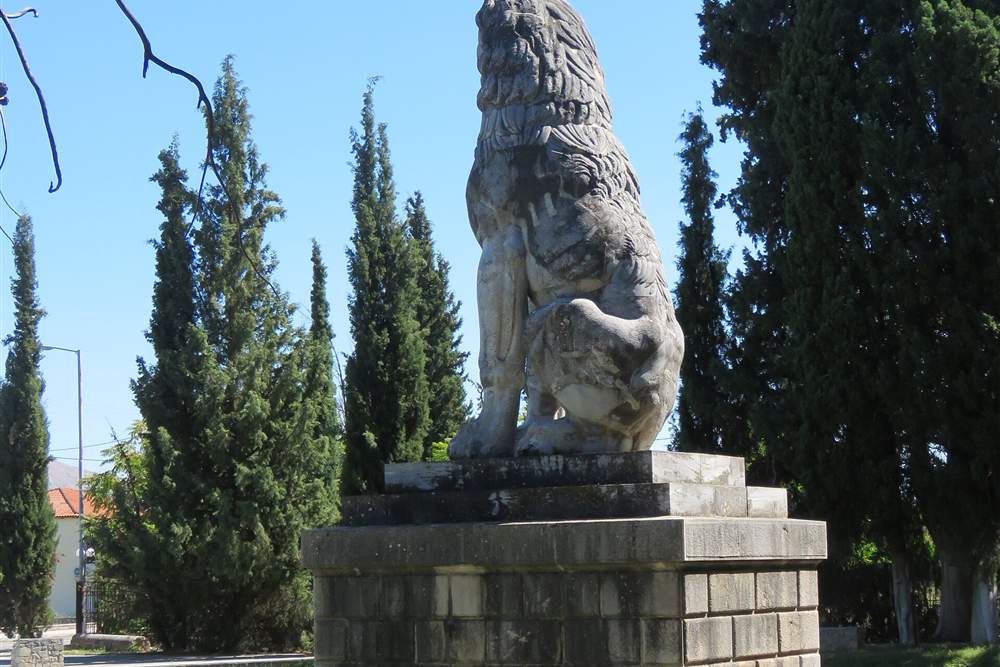
The Lion of Chaeronea still stands over the grave of the Sacred Band, the 300-strong Theban corps that died in the battle line at Chaeronea. It was found in pieces in 1818, rebuilt in 1902, and sits beside the road from Livadia to Lamia.
Boeotia tours read the sequence at Thebes, on the Chaeronea road and at the Distomo mausoleum, where the occupation ended the record in 1944.
What do Boeotia tours eat and drink?
Boeotia tours eat formaela cheese from Arachova, the meat and pies of the mountain villages, eels and fish from the Euboean coast, the cereals and vegetables of the Kopais plain, and drink the red wines of the Asopos valley and Thebes.
The Kopais basin feeds much of Attica. Cotton, maize and vegetables grow on the drained lake bed, and the old lake gave its name to the Kopais eel, which ancient writers ranked as the finest food in Greece and which is still fished in the drainage channels.
- Formaela of Arachova – the cylinder of sheep cheese, fried with lemon.
- Kopais eel – the fish of the old lake, grilled at the village tavernas.
- Mountain pies – the hand-rolled cheese and greens pies of Helicon.
- Thebes and Asopos wine – the reds of the eastern vineyards.
- Livadia sweets – the syrup pastries sold round the Krya springs.
- Olive oil – from the groves round Distomo and Steiri.
The tavernas at the Krya springs and at Steiri beside the monastery are the two places most visitors eat. Boeotia tours book neither, since both work through the day.
How do visitors reach Boeotia, where do they stay, and when do the tours run?
Visitors reach Boeotia by motorway from Athens in about an hour to Thebes and 90 minutes to Livadia, by train on the Athens to Thessaloniki line, and from Delphi in 45 minutes. The tours run all year, with the sites open and the ski centre working from December.
The unit is the easiest day trip from Athens after Attica itself. The motorway crosses it from the Kithairon tunnel to the Kopais plain, the intercity trains stop at Thebes and Livadia, and the Delphi coaches pass through both towns on the way west.
- Athens to Thebes – 85 km, about an hour by motorway.
- Athens to Livadia – 125 km, about an hour and a half.
- Livadia to Osios Loukas – 35 km, about 40 minutes by Distomo.
- Livadia to Delphi – 55 km, about 50 minutes through Arachova.
- Thebes to Orchomenos – 45 km across the plain.
- Where to stay – Livadia for the centre, Arachova for the mountain, Antikyra for the sea.
Spring gives flowers on Helicon and full springs at Livadia, autumn the cotton harvest on the Kopais, winter the snow above Arachova, and summer a hot plain with the two coasts for the afternoon. Boeotia tours take the sites in the morning and the mountain or the sea after.
What do Boeotia tours see at Chaeronea?
Boeotia tours at Chaeronea see the marble Lion of about 338 BC standing over the grave of the Theban Sacred Band, the excavated burial enclosure beside it, the small archaeological museum, and the theatre cut into the rock of the ancient acropolis above the village.
The battle of 2 August 338 BC ended the independence of the Greek city-states. Philip II of Macedon, with his son Alexander commanding the left wing at eighteen, broke the Athenian and Theban line on the plain below the village, and the Sacred Band of 300 Theban soldiers died where they stood.
The Lion was found broken in 1818, and the bones of 254 men were dug from the enclosure beneath it in 1880. The monument was rebuilt on its base in 1902 and sits beside the Livadia to Lamia road, with the plain of the battle in front of it and the acropolis behind.
- Lion of Chaeronea – the 5.5 m marble lion over the Sacred Band’s grave.
- The burial enclosure – the mass grave excavated beneath the monument.
- Archaeological museum – the finds of the battlefield and the ancient town.
- Theatre – the rows cut into the rock of the acropolis above the village.
- Plutarch – the biographer was born and lived here in the 1st century AD.
- The plain – the battlefield of 338 BC between the village and the river.
Plutarch, whose lives of the Greeks and Romans shaped how Europe read antiquity, was born in the town and served as a priest at Delphi 30 km away. Boeotia tours stop at the Lion for twenty minutes on the road between Livadia and Lamia.
Frequently Asked Questions
Where is Boeotia?
In Central Greece, north of Attica, with Thebes in the east, Livadia at the centre, Helicon and Parnassos on the west, and short coasts on the Corinthian and Euboean gulfs.
How long do Boeotia tours take?
A day from Athens for Osios Loukas and Livadia, a second for Thebes, Orchomenos and Gla, and a third for Helicon, Arachova and the coasts.
What is Osios Loukas?
A monastery of about 1011 on the slope of Helicon with the best Middle Byzantine mosaics in Greece, two joined churches and a frescoed crypt. UNESCO inscribed it in 1990.
Is there anything left of ancient Thebes?
The Kadmeia hill under the modern town with the Mycenaean palace remains, the Electra Gate, the Ismenion, and the archaeological museum with the Tanagra larnakes and the Linear B tablets.
What is the oracle of Trophonios?
An oracle in the Erkyna gorge at Livadia where consultants bathed, drank from the waters of Memory and Forgetting and were lowered into a chasm. The rock-cut niches survive above the river.
What is Gla?
The largest Mycenaean fortified site in Greece, seven times the area of Tiryns, standing on a rock in the drained bed of Lake Kopais with about 3 km of walls.
Is Arachova in Boeotia?
Yes. Arachova belongs to Boeotia although it sits 11 km from Delphi, which is in Phocis, and it works as the mountain base for both.
What happened at Distomo?
On 10 June 1944 German troops killed 218 residents in reprisal for a partisan attack. The mausoleum above the town holds their remains and a museum of the occupation stands beside it.
Which battles were fought in Boeotia?
Plataea in 479 BC against the Persians, Leuctra in 371 BC where Thebes broke Sparta, and Chaeronea in 338 BC where Philip II ended the independence of the Greek cities.
When is the best time for Boeotia tours?
March to June and September to November for the sites and the walking, winter for the snow above Arachova, and summer with an early start and the two gulf coasts for the afternoon.