
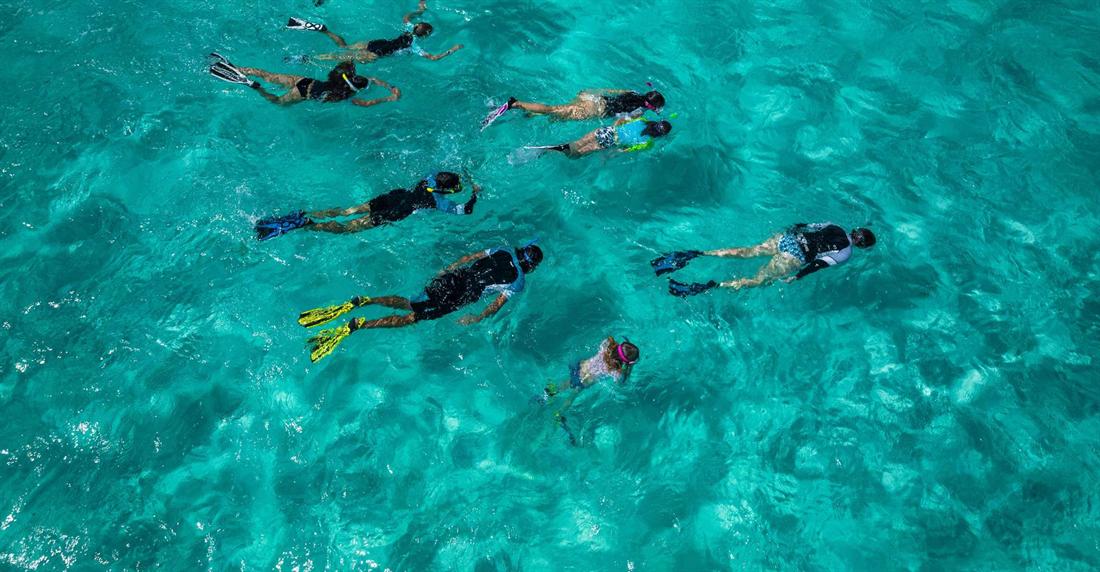
Amorgos snorkeling means mask-and-fins swims over the clear, rocky water of the easternmost Cyclades island, from quiet bays and from small boats. Island trips across the Aegean are gathered on Greece Tours.
This page walks through the spots around Aegiali and Katapola, Agia Anna, the Olympia wreck, boat trips, islets, sea life, gear, safety, wind, the season and diving.
What is Amorgos snorkeling?
Amorgos snorkeling means swimming at the surface with a mask, snorkel and fins along the rocky coasts and coves of Amorgos. It needs no tanks and no dive course. Swimmers start straight from the shore or join a boat trip around the island.
Amorgos sits furthest east of all the Cyclades, out in the Aegean Sea. It lies close to the Dodecanese and belongs to the Naxos regional unit. The municipality covers about 126 square kilometres of land. Visitors reach it only by boat, and the three main bases are Katapola, Aegiali and Chora.
Amorgos snorkeling uses one simple method. You float face down with slow strokes and keep your eyes on the seabed. The snorkel tip stays above the surface, so you breathe without lifting your head. Fins push you along with little effort and without splashing. There are two ways to start the swim:
- From the shore: you walk in from a beach or a flat rock and swim out at your own pace.
- From a boat: you join a sea trip that stops at coves along the coast and swim off the boat.
The film The Big Blue featured the waters of Amorgos. It made the island an international destination for tourists and freedivers. Beaches are not the main draw here; the coast and the water are. Amorgos snorkeling puts that rocky coast within reach of any confident swimmer.
Why is the sea around Amorgos clear for snorkeling?
Amorgos snorkeling enjoys clear water thanks to the island’s rocky and pebble seabed and its steep cliffs. Deep water sits close to shore, and there are hardly any rivers. Little mud or sand reaches the sea, so sunlight travels deep into the water.
The seabed near the shore is rock and pebbles, not fine sand or mud. When waves stir a pebble bottom, the stones sink back at once. Fine silt behaves differently: it hangs in the water and clouds it. A rocky bottom keeps the view sharp for Amorgos snorkeling.
Amorgos rises steeply to a highest point of 823 metres, and cliffs drop straight into the sea. The Panagia Hozoviotissa monastery stands on one of them, northeast of Chora. The Cyclades are the peaks of submerged mountains, so the water gets deep fast. Off these cliffs, waves find little loose sand to lift.
Rivers carry soil and mud into the sea after rain. The Cyclades have a dry, mild climate, and Amorgos has hardly any rivers. With so little runoff, very little soil washes into the bays. That low sediment load keeps the water clear for Amorgos snorkeling. You can pick out the clearest stretches of coast by these signs:
- Rock underfoot: boulders and pebbles at the waterline instead of soft sand.
- Steep sides: a cliff or rocky slope that drops quickly into deeper water.
- No stream mouth: no dry gully or stream bed that empties into the cove.
Which Amorgos snorkeling spots lie around Aegiali?
Amorgos snorkeling around Aegiali covers the sandy bay itself, plus Levrossos, Psili Ammos and Hohlakas on the coast path. Agios Pavlos lies about 5 km away. Sand floors suit beginners, while the rocky edges and pebble coves suit confident swimmers.
Aegiali is the second port of Amorgos. Its long beach of light yellow sand runs around the whole bay, and the water stays shallow. The sandy floor makes an easy first practice ground with a mask. High hills ring the bay, with the villages of Tholaria, Langada and Potamos above.
Levrossos lies across the bay, within easy walking distance of the main beach. It is a sandy beach set among rocky cliffs, and trees along the shore give shade. For Amorgos snorkeling, those cliffs add rock to swim along beside the sand. A parking area sits above, and the last stretch is on foot.
A path along the mountain leads on from Levrossos to two coves without tavernas:
- Psili Ammos: its name means “fine sand” in Greek. It sits about 45 minutes on foot from Aegiali port. A small boat also runs there in high season.
- Hohlakas: a secluded pebble cove past Psili Ammos on the same path, with no facilities on the shore.
Agios Pavlos lies on the coast opposite the islet of Nikouria. Its beach of big white pebbles slopes into shallow blue-green water. Amorgos snorkeling here starts over pebbles rather than sand. Winter storms reshape the narrow isthmus of the beach from year to year.
Which Amorgos snorkeling spots lie near Katapola?
Amorgos snorkeling near Katapola starts on the sandy town beach. It then moves along the coast past Xylokeratidi to Agios Panteleimonas, Maltezi and Plakes. A footpath and beach boats reach the coves, which add pebbles, rocky cliffs and deeper water.
Katapola sits in a horseshoe-shaped bay, with Rachidi and Xylokeratidi along its shore. A sandy beach follows the waterfront between the villages, and the waves stay gentle. Eleni beach, a small sandy strip at the left end of the port, gives a second entry. Finikes, a pebble cove under wild cliffs, lies within walking distance of the port.
The footpath from Xylokeratidi first passes Agios Panteleimonas, a pebble beach with a small chapel on the shore. It then rounds a point past the cemetery and climbs a rock above Maltezi. The walk takes about 30 to 40 minutes, and a beach boat from Katapola makes the trip in about 10 minutes.
Maltezi lies in a sheltered bay with clear blue-green water. Amorgos snorkeling here starts from a pebble shore and heads out over the open bay. A cantina and sunbeds open in high season.
Plakes lies behind the hill past Maltezi. Rocky cliffs ring its bay, and the water runs deep, which suits confident swimmers. The walk over the hill takes real effort, so the beach boat is the practical way in. There is no taverna on the shore.
Can you go Amorgos snorkeling at Agia Anna, the Big Blue bay?
Yes, Amorgos snorkeling works well at Agia Anna, the small rocky bay below the Hozoviotissa Monastery. Deep water starts right off the rocks, and steps lead down from the road. This is the bay where Luc Besson filmed The Big Blue.
There is no sandy entry for Amorgos snorkeling here. Swimmers slip into the sea from flat rocks and pebbles. The rocks meet deep water, so the sea turns dark blue within metres of the edge. The bay is small, so a short swim covers it from side to side.
The film follows two rival freedivers, and this deep, open water suits that story. Besson even appears on screen as one of the divers. From the surface, Amorgos snorkeling at Agia Anna gives a view straight up the cliff to the monastery.
The monastery clings to the rock about 300 metres above the sea. Local tradition says its icon of the Virgin came ashore in this bay. The bay itself takes its name from the small whitewashed chapel of Agia Anna above the rocks. Weddings and christenings take place in the chapel.
- Parking: leave the car above the bay, just off the road from Chora to Hozoviotissa.
- Services: there are no sunbeds, shops or lifeguards, so bring water and shade.
- Crowds: the rocks fill up fast, so arrive early.
- Film and history: see Agia Anna and the Big Blue.
Can you snorkel at the Olympia shipwreck on Amorgos?
Yes, but keep to the open water outside the hull. Amorgos snorkeling at the Olympia wreck gives a clear view of a ship that sits half above the water. It lies in Liveros bay, close to Kalotaritissa beach.
Liveros bay sits in Kato Meria, the south-western corner of Amorgos. The Olympia was a cargo ship under the Cypriot flag. It hit the rocks in a storm while seeking shelter, and the whole crew reached shore safely.
From the water, the rusty bow stands above the surface. The ship’s old name still shows in relief on it. Waves wash through the open holds and break on the rocks behind. The waves slowly break the hull apart. During Amorgos snorkeling here, the submerged half of the hull sits below you.
Rust has left sharp metal on the wreck, and waves push through the holds. Swimming inside the hull is discouraged for this reason. The water right beside the hull is not always clean either. Keep a wide gap from the steel and turn back if the sea picks up.
- Access: an unmarked dirt track runs from the road down to the bay, about an hour there and back on foot.
- Timing: pick a calm day for clearer water near the hull.
- Next swim: after Amorgos snorkeling at the wreck, move on to nearby Kalotaritissa bay, which also appears in The Big Blue.
- Full story: see our Olympia shipwreck page.
How does an Amorgos snorkeling boat trip work?
An Amorgos snorkeling boat trip starts at the Amorgos Diving Center in Aegiali. Guests collect a mask, snorkel and fins, board a boat and ride to a spot around Nikouria Island. They swim there for about an hour, then return.
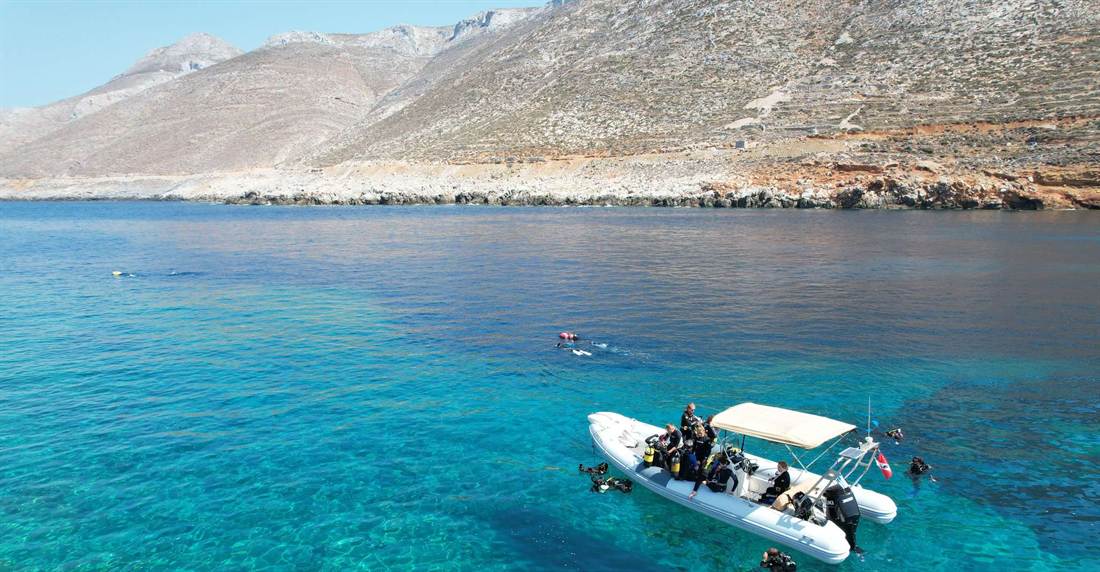
The GetYourGuide listing “Snorkeling Trips in Amorgos” sells this trip. Listings for it place the start at the dive center on Aegiali beach. This Amorgos snorkeling outing runs twice a day and lasts about 2.5 hours. A zodiac, a fast inflatable boat, carries the group across the bay to the islet.
Manawa sells the same Aegiali snorkelling boat excursion as a two-hour trip. An instructor hands out the gear at the center before boarding. About one hour goes to swimming over the site. Guides speak English, French and German. The minimum age is 8, and no past experience is needed.
- Bring a swimsuit, a towel and sunscreen.
- Hotel pickup is not included, so make your own way to the center.
- Manawa offers free rescheduling or a refund if bad weather cancels the trip.
- Another reseller allows free cancellation up to 24 hours before the start.
- Neither listing states a group size, so ask when you book.
One listing shows a 5:00 PM departure for one of the two daily trips. Amorgos snorkeling with the dive center is a short, focused outing. For other ways to explore the coast by sea, see our Amorgos boat trips.
Which islets near Amorgos suit snorkeling?
For Amorgos snorkeling beyond the main coast, two islets have short boat links. Nikouria faces Agios Pavlos beach, and a water taxi crosses in about ten minutes. Gramvousa lies off the south-west tip, with boats from Kalotaritissa beach.
Amorgos has 16 neighbouring islets, and Nikouria is the largest by land area. Nobody lives there. It overlooks Aegiali Bay, about 5 km from the port of Aegiali. It has three beaches, with sand scattered with rocks. Greeka describes the water as clear and good for snorkeling, though cool.
The islet has no cafes or shops. In summer, water taxis leave Agios Pavlos about every half hour. Pack water, food and your own mask before you cross. Amorgos snorkeling by water taxi lets you pick your own cove. The dive-center boat stops at one set spot instead. Our page on Nikouria covers the islet itself.
Gramvousa is uninhabited and sits off the western coast of Amorgos. Its beach mixes sand and pebbles, with rock formations along the shore. Those rocks give Amorgos snorkeling a rugged edge to follow. Reaching it from the main island takes four steps:
- Drive or take public transport to Kalotaritissa beach.
- Stock up at its one small café, since Gramvousa sells no food or drinks.
- Board a boat; in peak season they leave every 30 minutes to an hour.
- Rest on the sun loungers and umbrellas of the islet beach between swims.
What sea life do you see while Amorgos snorkeling?
Amorgos snorkeling shows you octopus, sea bass, eels, shrimps and sponges, the species named on the guided snorkeling trip from Aegiali. Damselfish shoals, ornate wrasse, purple sea urchins and Posidonia seagrass meadows share the same rocky Aegean shallows.
The common octopus lives on shallow, rocky seabeds and hides in a shelter with little of its body showing. It changes colour to match the rocks. During Amorgos snorkeling, scan cracks and ledges for its eyes. It feeds on crabs and cockles, and it breaks open shells with a hard beak. It also pounces on prey that passes by.
The Mediterranean chromis, or damselfish, swims in small shoals in midwater above rocky reefs and seagrass. Adults are dark brown, while the youngest fish shine an iridescent blue. The ornate wrasse has a turquoise tail fin, and males carry red heads with blue markings. It lives among rocks, algae and seagrass from the surface down to 50 metres.
Purple sea urchins cling to rocks and boulders down to 20 metres. Their long spines are purple, brown or olive green. Posidonia oceanica is a flowering seagrass found only in the Mediterranean, not a seaweed. Its ribbon-like leaves reach 45 centimetres. The meadows feed, shelter and raise young fish, so drift slowly over them on an Amorgos snorkeling swim.
What gear do you need for Amorgos snorkeling?
Amorgos snorkeling needs a mask, a snorkel and a pair of fins. Pack a rash vest, water shoes, reef-safe sun cream and a dry bag as well. They protect your skin, feet and phone on every beach or boat swim.
Pick a mask with a soft rubber skirt that covers your nose and seals against your face. The trapped air in front of your eyes lets you see clearly underwater. The snorkel lets you breathe from above the surface while you float face down. Fins add thrust, because bare feet are too small to push much water.
- Rash vest: a long-sleeve top that guards against sunburn and scrapes on rock.
- Water shoes: protect your feet on pebbles, hot rocks and ledges where sea urchins cling.
- Reef-safe sun cream: protects the skin the rash vest leaves bare.
- Dry bag: holds your phone, keys and towel on the beach or the boat deck, safe from spray.
A mask you already own gives a fit you trust, so pack it for Amorgos snorkeling even when a trip supplies gear. Check your snorkel too. A tube that is too long makes breathing harder, and a tube that is too wide is hard to clear of water.
Is Amorgos snorkeling safe for beginners and children?
Yes, Amorgos snorkeling is safe for beginners and children who can swim, stay with an adult buddy and keep to calm water near the shore. The main risks are boat traffic, sunburn and dehydration, and each one has a simple fix.
Snorkeling needs only basic swimming skills and no formal training, so it suits all ages. Still, never snorkel alone. The British Sub-Aqua Club advises a buddy, a guide or a tour group. For a child, the buddy is an adult who stays close and watches how tired the child gets.
The coast of Amorgos is rocky, with underwater cliffs that fall into deep water close to land. Beginners and children keep to the shallow part of a cove, where they can stand and rest. Strong swimmers explore the edge of the drop-off, always with a partner.
On Amorgos snorkeling boat trips, crews can hand out inflatable vests in bright yellow or orange. A vest keeps a swimmer afloat and easy to spot from the deck. It also makes deep dives hard, which keeps a beginner near the surface. Four habits cut the other risks:
- Stay clear of boat lanes. Jet skis and speedboats are the greatest danger to a snorkeler, who floats low with only the tube showing.
- Wear bright clothing or tow a dive flag on a float, and watch for sailboats, which give little warning.
- Cover the back, ankles and backs of the thighs with a rash guard or waterproof sunblock, since these burn badly while you float.
- Drink water before a long swim. Never take fast, deep breaths before a dive, since that can cause a blackout.
How do wind and currents affect Amorgos snorkeling?
The summer meltemi blows from the north and pushes waves onto exposed shores, which makes Amorgos snorkeling rough there. Bays shielded from it keep calmer water. Check a wind forecast on the morning of every swim and boat trip.
The meltemi is a summer wind of the Aegean. It blows from late spring to mid-September and can reach force 7 to 8 on the Beaufort scale. It rises in clear weather without warning, so a sunny sky does not mean a flat sea. It can blow for days without a break.
Bays on Amorgos face different winds. The port of Aegiali is protected from the meltemi but open to south winds. Katapola takes winds from the south-west round to the north-west. Kalotaritissa, in the far south, is a bay sheltered from the wind. On a windy day, plan Amorgos snorkeling on the side away from the wind.
Read a marine forecast the evening before and again in the morning, checking both wind speed and direction. The meltemi is strongest in the afternoon and can drop at night, so morning swims meet calmer water. A hard blow can keep yachts and inter-island ferries in port, and an Amorgos snorkeling trip by boat can move to another day.
When is the season for Amorgos snorkeling, and how warm is the sea?
The season for Amorgos snorkeling runs from late spring to the end of October. Across those months, the sea averages between 19°C and 25°C. The water peaks in August and holds that heat through September, the warmest stretch of the year.
The list below shows monthly sea averages for Amorgos, taken from seatemperature.net. The numbers in brackets give the lowest and highest readings in each month. Outside the season, the sea averages 20°C in November and 19°C in December. From January to March, it sits at 17°C, which keeps winter swims short.
- Late spring: 19°C (16°C to 21°C)
- June: 22°C (18°C to 25°C)
- July: 24°C (21°C to 27°C)
- August: 25°C (22°C to 27°C)
- September: 24°C (21°C to 27°C)
- October: 22°C (19°C to 25°C)
The late-spring warm-up comes fast. The sea gains 2°C from March to late spring, then 3°C more by June. Daytime air already averages 24°C in late spring, with three rainy days in the month. Early swims still feel cool, so short sessions work better at first. By July, Amorgos snorkeling suits long sessions without a chill.
July and August record no rain at the Aigiali weather station, according to Wikipedia. August air reaches a mean daily high of 28.3°C. October water stays 3°C warmer than late spring water, so Amorgos snorkeling suits an autumn visit. To plan the whole trip around the weather, see the best time to visit Amorgos.
How does Amorgos snorkeling compare with scuba diving on Amorgos?
Amorgos snorkeling keeps you at the surface with a mask, snorkel and fins, and it needs no course. Scuba diving on Amorgos takes you deeper on a breathing cylinder after certified training. Divers also stay underwater far longer than snorkelers holding a breath.
Depth is the first difference. A snorkeler floats face down at the surface and breathes through a tube. Any dip below lasts one held breath. Scuba stands for self-contained underwater breathing apparatus. The diver carries a cylinder and a regulator, which delivers gas at the pressure of the surrounding water. That supply lets divers swim along the seabed.
Training is the second difference. Scuba divers learn from instructors linked to certification agencies, which set minimum health and fitness levels. Lessons cover emergency drills for self-rescue and for helping a buddy. Divers wear a buoyancy compensator, weights and a dive computer. Amorgos snorkeling skips the course and the extra kit, so a confident swimmer starts on day one.
The view differs too. Snorkelers watch the sunlit shallows near the coast, while divers reach deeper wrecks and underwater caves. Wikipedia lists scuba diving and free-diving among the island’s activities. To take the next step, read our page on Amorgos diving. The island has two dive centres, and both teach courses:
- Aegiali Bay: a PADI dive centre with a second office in Katapola port
- Katapola: a dive centre based at the Kastanis campsite
How do you protect the sea while Amorgos snorkeling?
Protect the sea while Amorgos snorkeling by floating above the seabed and never touching or standing on rocks or Posidonia meadows. Take no shells or sea urchins, wear reef-safe sun cream and carry every piece of rubbish back to shore.
Posidonia meadows produce oxygen and protect the coastline from erosion. The plant grows very slowly, and its creeping stems add just 1 to 6 cm a year. A fin kick or a dropped anchor tears out growth that takes years to return.
Sun cream washes off your skin into the water. Choose a mineral cream with zinc oxide, or wear a long-sleeve rash vest so you need less of it. Pack a small bag for wrappers and bottles, and carry it back after Amorgos snorkeling. If you spot floating plastic near you, pick it up and take it ashore too.
Follow every local rule on swimming zones and anchoring. If a local sign or your skipper marks a no-swim or no-anchor area, stay out of it. Ask the port police or the boat crew about current rules before you enter the water. On a hired boat, drop anchor on sand or use a mooring buoy, never on seagrass.
Which questions do travellers ask about Amorgos snorkeling?
Do you need to swim well for Amorgos snorkeling?
You need to swim steadily and float without panic, not swim fast. A snorkeler spends long stretches face-down, breathing through a tube, so calm breathing matters more than speed. Start in shallow water close to shore, and swim with a partner every time. Weaker swimmers gain extra float from a snorkel vest.
Can you rent snorkeling gear on Amorgos?
Rental stock changes from shop to shop, so check before you travel. Katapola, Aegiali and Chora hold the island’s main places to stay, which makes them the first places to ask. Packing your own mask and snorkel for Amorgos snorkeling guarantees a set that fits your face. Ask a boat operator whether gear comes with the trip.
Which side of Amorgos has calmer water for snorkeling?
Pick the side away from the day’s wind. A north wind leaves coves that face south flatter, and a south wind does the reverse. The wind section above lists which bays face which way, so read the forecast before Amorgos snorkeling.
Do you need to book an Amorgos snorkeling boat trip in advance?
Yes, booking ahead is the safe plan, since boats carry a set number of guests. Online bookings show open dates and let you compare trips. Pick an option with free cancellation, because skippers call off trips when strong wind makes the sea rough. Keep a spare day in your plan for a rescheduled trip.
Do you need a wetsuit for Amorgos snorkeling?
From July to September the sea sits at 24 to 25°C, so a swimsuit and a rash vest do the job. In late spring and October, a thin shorty wetsuit keeps longer sessions comfortable. Below 20°C, a full wetsuit lets you stay in past a short swim.
How do you stop a mask fogging during Amorgos snorkeling?
Fog forms when warm breath and skin meet the cool glass. Rub a drop of anti-fog gel or baby shampoo inside the lens, then rinse it once in sea water. Breathe out through the snorkel, never through your nose into the mask, and the glass stays clear.
What do you do if you step on a sea urchin?
Leave the water and pull out any visible spine tips with tweezers. Soak the spot in hot water, as hot as you can bear without scalding, to ease the pain. See a doctor for spines lodged deep or for redness that spreads. Water shoes on rocky entries prevent the problem.