
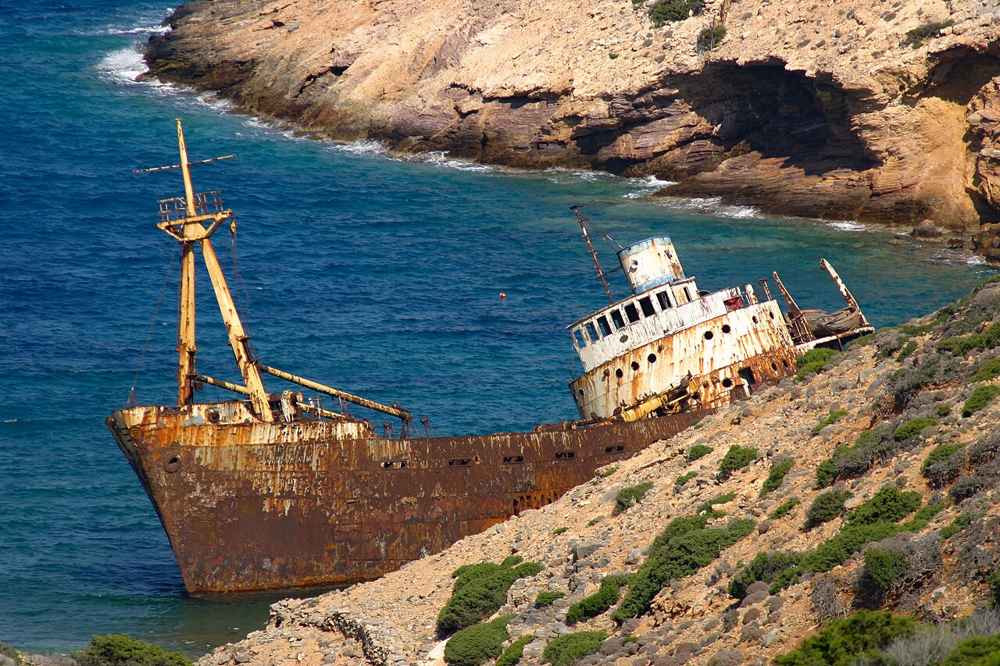
The Olympia shipwreck is one of the most striking and atmospheric sights of Amorgos. The rusting hull of a cargo ship that ran aground in a bay near Kalotaritissa in the wild south of the island in . Famous from Luc Besson’s film The Big Blue, in which it appears in scenes. The wreck lies half-submerged in clear water against a backdrop of cliffs, a dramatic and slightly eerie landmark. Plan the whole trip with Greece Tours.
This guide covers the Olympia shipwreck: its history, its role in The Big Blue. Where it lies and how to reach it, whether you can swim or go inside. What else is nearby. Read it beside the guides to Amorgos and The Big Blue and things to do in Amorgos.
What is the Olympia shipwreck in Amorgos?
The Olympia is a rusting cargo ship that ran aground in a bay near Kalotaritissa in southern Amorgos in and has lain there ever since.
In a small bay in the wild south of Amorgos, near the beach of Kalotaritissa, the wreck of the cargo ship Olympia has lain since it ran aground in . Its rusting, tilted hull, broken into sections in the shallows against a backdrop of steep cliffs and clear turquoise water, makes a dramatic and haunting scene.
Over the decades the sea and the weather have worked on the hull, rusting it to a deep orange and breaking it apart. That it now sits half-submerged and skeletal in the bay. An object of fascination for visitors who come to see it from the shore or the water.
The wreck is one of the island’s most famous and photographed landmarks. Tied above all to The Big Blue. A striking counterpoint to the whitewashed villages and blue coves elsewhere on Amorgos. Reaching it is a rewarding excursion into the island’s remote and beautiful southern end.
What is the history of the Olympia shipwreck?
The Olympia was a commercial cargo ship that reached the coast of Amorgos in February and was driven onto the rocks near Kalotaritissa by strong winds, where it ran aground permanently.
The Olympia was a commercial cargo vessel that came to grief on the coast of Amorgos in February . Caught by strong winds off the island’s southern shore, the ship was driven directly onto the rocks in a bay near Kalotaritissa. Where it ran aground and not be refloated, becoming a permanent fixture of the coast.
Abandoned where it lay, the hull has stayed in the bay for over four decades, slowly rusting and breaking up under the action of the sea and the weather. What began as a maritime accident has become, with time, one of the island’s landmarks and a magnet for visitors and photographers.
The story of the wreck, an ordinary cargo ship lost to a winter storm, is bound up with the island’s seafaring setting and its dramatic, exposed southern coast. Its long afterlife as a landmark owes much to the film that made it famous soon after it sank.
What is the Olympia shipwreck’s connection to The Big Blue?
The Olympia shipwreck was one of the reasons Luc Besson chose Amorgos for The Big Blue, and it appears in scenes of the film.
The wreck is inseparable from The Big Blue, Le Grand Bleu, Luc Besson’s cult film about free-diving. The striking sight of the Olympia in its clear-water bay was among the reasons Besson chose Amorgos as a principal location. The ship features in a number of the film’s scenes, tied to its diving drama.
Through the film, the wreck reached a global audience and became a place of pilgrimage for the film’s fans, who trace its locations across the island. The Olympia is one of the key Big Blue sights on Amorgos, alongside Agia Anna beach, the capital Chora and the Hozoviotissa Monastery.
For visitors, the wreck is both a dramatic sight in its own right and a piece of film history. Seeing it in its bay recalls the images that made the island famous. It is covered as part of the wider story in the guide to Amorgos and The Big Blue.
Where is the Olympia shipwreck and how do you reach it?
The Olympia shipwreck lies in a bay near Kalotaritissa in the far south of Amorgos, reached by the southern road.
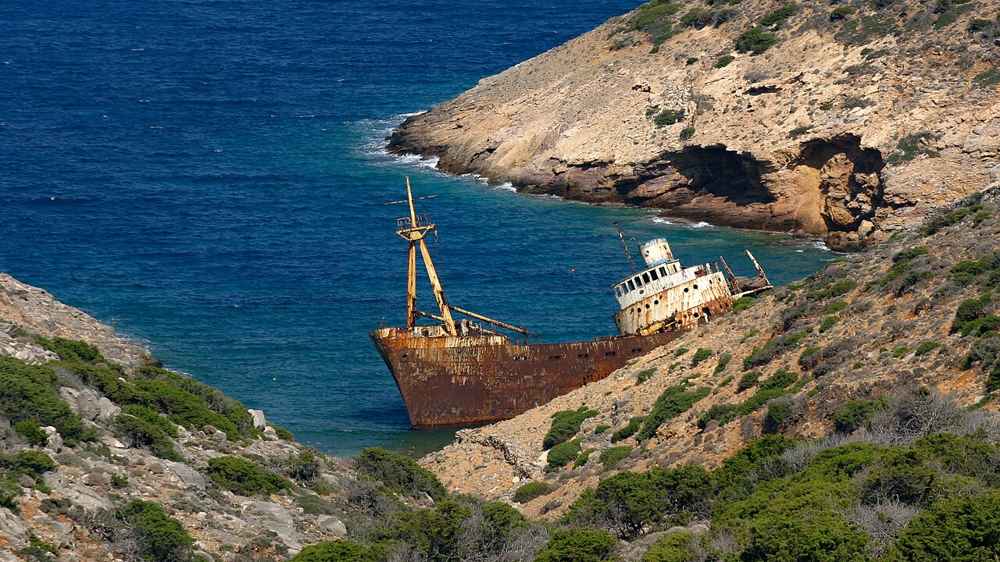
The wreck lies in a small bay in the far south of the island, near the beach of Kalotaritissa. Reached by the winding road that runs south from Chora through Arkesini. As you drive toward Kalotaritissa, the wreck comes into view below on the right. The usual approach is to park at the start of the long straight where you first spot it.
From the roadside, a small downhill path leads to the bay, a walk of around ten to fifteen minutes. The wreck is not visible from the road itself once you set off. It pays to be observant and to note where the path begins. And sturdy shoes help on the rough downhill track.
A hire car or scooter is the practical way to reach this remote southern corner, as the bus does not serve it. The wreck can also be seen from the water on a boat trip along the coast. For getting around, see the guides to car rental and boat trips.
Can you swim at or go inside the Olympia shipwreck?
Swimming around or inside the Olympia shipwreck is discouraged.
Tempting though it looks, swimming to or entering the wreck is not advised. Decades of rusting have left the hull unstable and sharp, with the risk of collapse and injury, so climbing on or into the ship is dangerous. The water immediately around the wreck is also not always clean, given the decaying metal.
The wreck is best enjoyed as a sight rather than a swimming spot: photographed and admired from the shore of the bay. Or seen from the deck of a boat on a coastal trip. A viewpoint above the bay gives the classic photograph, with the rusting hull framed by the cliffs and the clear water.
For a swim, the nearby beach of Kalotaritissa offers clean, sheltered, shallow water in its own bay, a far better and safer place to cool off. Combining a look at the wreck with a swim at Kalotaritissa makes a rewarding half-day in the island’s south.
What is near the Olympia shipwreck?
The Olympia shipwreck lies near the sandy bay of Kalotaritissa in the far south of Amorgos, along with the smaller coves of Paradisia and Ammoudi, the ancient city of Arkesini, and the wild beaches and villages of the island’s quiet.
The wreck sits in the island’s wildest and quietest corner, so it pairs naturally with the other sights of the south. Just nearby, the sheltered sandy bay of Kalotaritissa offers a safe, clean swim, and the smaller coves of Paradisia and Ammoudi lie along the same stretch of coast.
Inland and along the southern road are the remains of the ancient city of Arkesini and the well-preserved Hellenistic Tower of Agia Triada, along with quiet, unspoilt villages such as Vroutsi, covered in the guides to the ancient sites and villages of Amorgos.
Together, the wreck, the southern beaches, the ancient ruins and the villages make a rewarding day exploring the quiet. Dramatic far south of Amorgos, reached by the winding road from Chora.
Is the Olympia shipwreck worth visiting?
Yes. The Olympia shipwreck is one of the most atmospheric and photographed sights on Amorgos, a rusting hull in a clear-water bay famous from The Big Blue.
For most visitors the wreck is well worth the trip. Few sights on Amorgos are as striking or as strange as the rusting Olympia in its bay. Its fame from The Big Blue adds to the draw. Making it a highlight of the island’s south and a favourite photograph.
The excursion combines the wreck with the dramatic, unspoilt scenery of the southern coast and, close by. A clean swim at Kalotaritissa. A visit is as much about the wild landscape as the ship itself. The short downhill walk to the bay is manageable for most with sensible shoes.
The Olympia shipwreck rewards the effort of reaching it, one of the more memorable of the things to do on Amorgos.
Frequently Asked Questions
How do you get to the Olympia shipwreck in Amorgos?
The Olympia shipwreck lies in a bay near Kalotaritissa in the far south of Amorgos, reached by the winding road that runs south from Chora through Arkesini. As you drive toward Kalotaritissa the wreck comes into view below on the right. The usual approach is to park at the start of the long straight and walk down a rough path for about ten to fifteen minutes to the bay. A hire car or scooter is the practical way to reach it, as the bus does not serve the south. It can also be seen from a boat trip along the coast.
Can you swim at the Olympia shipwreck?
Swimming around or inside the Olympia shipwreck is discouraged. The rusting hull is unstable and sharp, with a risk of collapse and injury. The water immediately around it is not always clean given the decaying metal, so the wreck is best admired from the shore or from a boat rather than entered. For a swim, the nearby sandy bay of Kalotaritissa offers clean, sheltered, shallow water, a far better and safer place to cool off in the island’s south.
Why is the Olympia shipwreck famous?
The Olympia shipwreck is famous chiefly through Luc Besson’s cult film The Big Blue. In which the rusting hull in its clear-water bay appears in scenes and was among the reasons Besson chose Amorgos as a location. Beyond the film, the wreck is one of the island’s most striking and photographed sights, a dramatic. Half-submerged hull against the cliffs and clear water of the wild southern coast. A place of pilgrimage for fans of the film.