
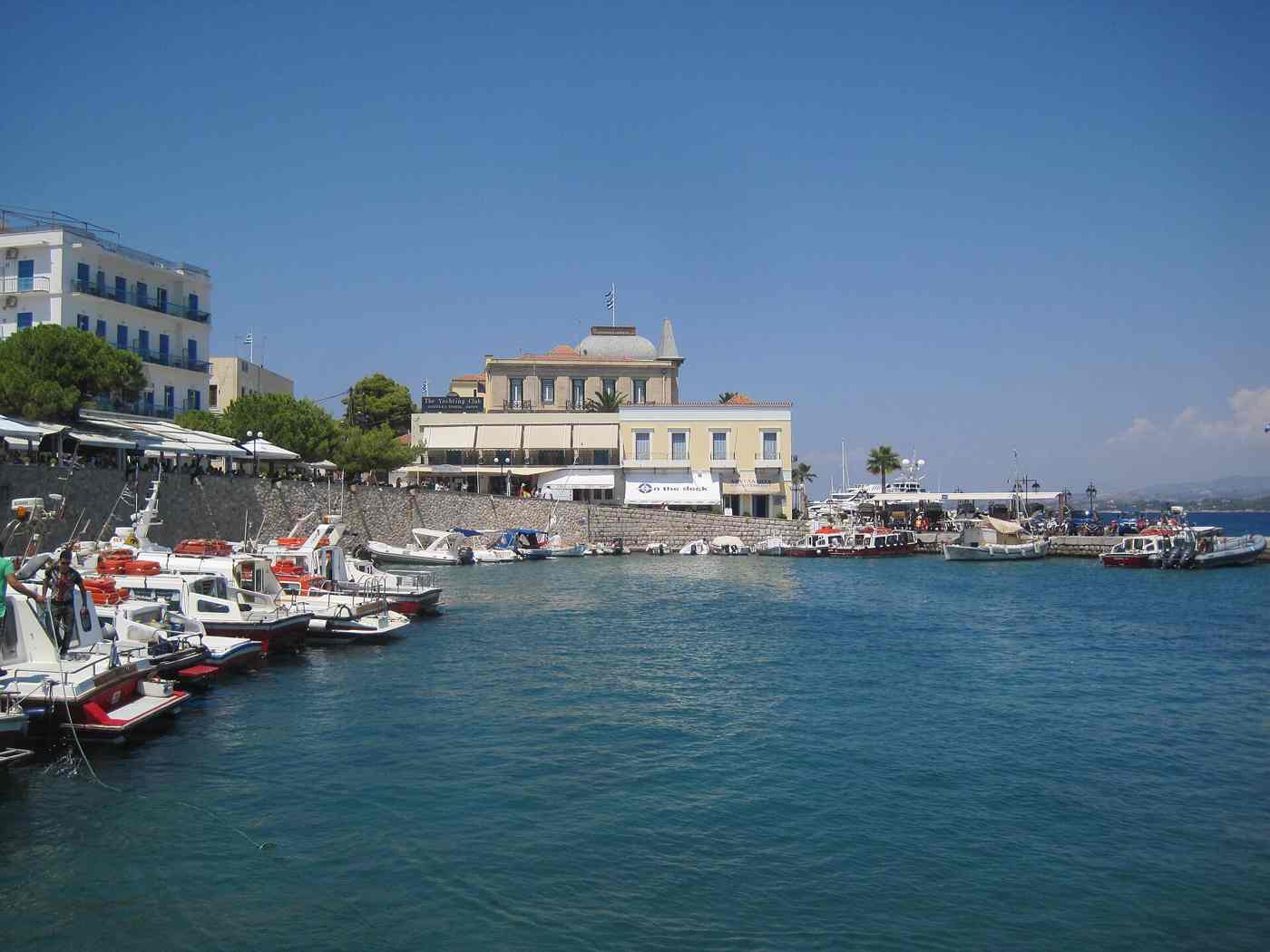
Agios Nikolaos Church is the historic main church of Spetses, standing on the slope above the Dapia and dedicated to Saint Nicholas, the patron of sailors. My Greece Tours has prepared this guide to its story. A former monastery on Spetses, it is where the islanders first raised the flag of the 1821 revolution, and its whitewashed walls, bell tower and pebble-mosaic courtyard overlook the harbour.
This guide follows the full story of Agios Nikolaos Church: its dedication to the patron saint of seafarers, its origins as a monastery, the dramatic morning in 1821 when the Spetsiots raised the banner of revolution beneath its walls, the tradition that the embalmed body of the philhellene Paul-Marie Bonaparte was briefly kept here. Its striking whitewashed architecture with sweeping views over the town and sea. It also explains how to visit this working church respectfully.
What is Agios Nikolaos Church on Spetses?
Agios Nikolaos Church is the historic main church of Spetses, dedicated to Saint Nicholas, the patron of sailors.
Agios Nikolaos Church occupies a commanding position on the hillside above the Dapia, the main quay of Spetses, where its whitewashed walls and bell tower rise above the tiled roofs of the town. As the island’s principal church, it has long functioned as the spiritual centre of the Spetsiot community, a seafaring people who placed their faith in Saint Nicholas, the protector of those who work the sea. The church combines the roles of parish sanctuary, historic monument and national landmark, for it was here that the flag of the 1821 revolution was first raised on the island.
Set among cypress and framed by the blue of the Argo-Saronic, the building embodies the entwined religious, maritime and revolutionary identity that defines Spetses and its captains’ history.
The church stands as one of the most photographed and revered sights on Spetses, its slender bell tower a familiar landmark visible from the harbour and the approaching sea. Beyond its architectural appeal, the building carries a weight of meaning for the islanders, who regard it as the sacred heart of their homeland. Its courtyard, laid with the black-and-white pebble mosaic characteristic of the Saronic islands, opens toward views over Spetses Town and the Dapia and the water beyond. For the visitor, Agios Nikolaos rewards the short climb from the waterfront with a quiet, atmospheric space that gathers together the island’s deepest traditions of faith, seamanship and the fight for freedom in a single, striking whitewashed sanctuary.
Few churches in the Argo-Saronic combine so strands of meaning in one modest yet commanding building above the harbour.
Dedicated to Saint Nicholas, the patron of mariners, the church reflects the identity of an island whose fortune and fame came entirely from the sea. Spetses produced formidable captains and shipowners, and its people looked to Saint Nicholas for protection on their long and perilous voyages. The choice of the saint as the island’s principal patron was therefore no accident but an expression of the community’s dependence on and mastery of the water. The church that bears his name became the natural focus for the prayers, thanksgivings and vows of a maritime society.
Even today the dedication links the building directly to the seafaring heritage that runs through every corner of the island, from the shipyards of the old harbour to the cannon that still guard the Dapia.
For travellers, Agios Nikolaos matters on levels at once, blending faith, history and architecture in one accessible landmark. It is a genuine monument of the Greek War of Independence, the very spot where Spetses declared its uprising. It is also a beautiful example of island church architecture with its whitewashed forms, bell tower and mosaic courtyard. As a working church it continues to serve the community, so a visit connects the modern island to its revolutionary and religious past.
Standing in its courtyard above the harbour, you look out over the town that its captains built and the sea that made them, understanding why this church remains, for Spetsiots and visitors alike, the symbolic and spiritual centre of the whole island.
Why is Agios Nikolaos on Spetses dedicated to Saint Nicholas, patron of sailors?
Agios Nikolaos is dedicated to Saint Nicholas because Spetses was a seafaring island whose captains depended on his protection at sea. The patron of sailors was the natural guardian for a community whose wealth came from the water.
Saint Nicholas holds a special place in Greek Orthodox devotion as the protector of sailors, ships and all who venture onto the sea. No dedication could suit Spetses more completely. The island rose to prominence as a maritime power, its captains commanding fleets that traded across the Mediterranean and later fought in the revolution. For a people whose survival, prosperity and pride were bound to their vessels, the guardianship of Saint Nicholas was a matter of daily faith rather than mere tradition. Sailors prayed to him before setting out, gave thanks to him on returning safely, and named their principal church in his honour.
The dedication of Agios Nikolaos therefore expresses the very essence of Spetsiot identity, uniting the community’s religion with the sea that shaped every part of its life.
The bond between the island and its patron saint reflects the extraordinary seafaring achievements of Spetses across the eighteenth and nineteenth centuries. Local families built and owned substantial merchant fleets, growing wealthy through trade and daring, and later turning their ships and fortunes to the cause of Greek independence. This maritime culture produced legendary figures, among them the naval heroine whose home now houses the Bouboulina Museum, and it is celebrated throughout the island’s history and monuments. In such a society, the church of the sailors’ saint stood at the very centre of communal life.
Weddings, funerals, thanksgivings and vows made before dangerous voyages all unfolded beneath its roof, binding the fortunes of the fleet to the intercession of Saint Nicholas in an unbroken cycle of faith and seafaring.
The dedication also shaped the island’s festive calendar, for the feast of Saint Nicholas is marked with particular devotion on Spetses. As the patron of the island’s principal church, the saint is honoured with services and celebrations that draw the community together in the heart of the town. These observances keep alive the link between the modern island and its seafaring past, reminding residents and visitors alike that Spetses grew great through the sea and looked to Saint Nicholas for protection upon it. The continuity of this devotion, unbroken across centuries of trade, war and change, underlines how deeply the maritime faith is woven into the island’s character.
To understand the dedication is to understand why the sea and the sacred are inseparable in the Spetsiot imagination.
For the visitor, appreciating why the church honours Saint Nicholas adds real depth to a visit, connecting the whitewashed sanctuary to the wider maritime story of the island. Everywhere on Spetses, from the cannon of the Dapia to the shipyards of the old harbour, the sea asserts itself. Agios Nikolaos is the spiritual counterpart to all that visible seafaring heritage. Exploring the church alongside the museums and mansions that record the island’s naval glory reveals a single coherent culture in which faith and seamanship were never separate.
Anyone tracing the history of Spetses will find that the dedication of its main church to the sailors’ saint is not incidental detail but the key to the island’s soul, the point where its religion and its maritime destiny most clearly meet.
Was Agios Nikolaos Church on Spetses originally a monastery?
Agios Nikolaos was originally a monastery before becoming the main church of Spetses.
Agios Nikolaos began its life as a monastery, a religious community established on the slope above what would become the modern harbour of Spetses. Monasteries played a central role in the life of Greek islands during the centuries of Ottoman rule, serving as centres of worship, learning and refuge for local populations. The monastery of Saint Nicholas fulfilled this role for the growing settlement of Spetses, anchoring the community’s faith at a time when the island was developing into a maritime power. Over time, as the town expanded around the harbour and its population swelled with the wealth of seafaring, the monastic church took on the wider function of serving the whole community.
Its monastic origins, however, remained legible in the layout of the complex and the character of the buildings that survive today.
The transition from monastery to principal parish church mirrored the broader story of Spetses as it grew from a modest settlement into a prosperous island of captains and shipowners. As the community flourished, the church of Saint Nicholas naturally assumed the role of the island’s central sanctuary, the place where the whole population gathered for the great occasions of communal and religious life. This evolution gave the building a layered history, combining its earlier monastic identity with its later civic and revolutionary significance. The courtyard, the cells and the ancillary structures of the original foundation lent the site a distinctive character quite different from an ordinary parish church.
Understanding these monastic roots helps explain the scale and the enclosed, contemplative atmosphere of the complex, which retains something of the serenity of its origins even as it serves the busy modern town.
The monastic heritage of Agios Nikolaos connects it to a wider Greek tradition in which island monasteries stood at the heart of local identity through difficult centuries. During Ottoman times these foundations preserved Orthodox worship, sheltered communities and often kept alive a sense of national and religious continuity. On Spetses, the monastery of Saint Nicholas would have been a focus for the faith of a people who were quietly building the maritime strength that would later erupt into revolution. This continuity of the sacred, from monastic foundation to revolutionary rallying point, gives the site an unusual depth.
It was no accident that the islanders chose this ancient and venerated place, rich with the authority of its monastic past, as the setting in which to raise the flag of their uprising against Ottoman rule in 1821.
For the modern visitor, the monastic origins of Agios Nikolaos add a further dimension to a site already rich in history and meaning. Walking through the courtyard and around the whitewashed buildings, you are moving through a complex whose roots reach back far beyond the revolution and the town that now surrounds it. This long religious continuity distinguishes Agios Nikolaos from a purely commemorative monument, giving it the accumulated sanctity of centuries of worship. Appreciating the monastery beneath the cathedral enriches any visit, revealing how the island’s faith deepened and evolved across the ages.
Set against the sweep of the history of Spetses, the church stands as a place where monastic devotion, communal faith and the fight for freedom accumulated in a single sacred site above the harbour.
What happened at Agios Nikolaos Church during the 1821 revolution?
The Spetsiots first raised the flag of the Greek revolution at Agios Nikolaos Church in the spring of 1821.
Agios Nikolaos Church holds a foundational place in the history of the Greek War of Independence, for it was here that Spetses raised the banner of revolution in the spring of 1821. On 3 April 1821 the islanders gathered at their principal church and declared their uprising against Ottoman rule, hoisting the revolutionary flag beneath the walls of the sanctuary of Saint Nicholas. This act made Spetses one of the very first islands to join the Greek revolution, committing its formidable fleet and its wealth to the national cause. The choice of the church as the setting was deeply symbolic, uniting the community’s faith, its maritime power and its yearning for freedom in a single decisive moment.
The event transformed Agios Nikolaos from a place of worship into a monument of national liberation.
The raising of the flag at Agios Nikolaos was no isolated gesture but the opening act of a sustained and consequential contribution to the war. Spetses committed its ships, its captains and its treasure to the revolution. The island’s fleet went on to play a significant part in the naval struggle that secured Greek independence. The declaration at the church therefore carried real weight, marking the moment when one of the wealthiest and most capable maritime communities in the Aegean threw itself into the fight. The memory of that morning is cherished on the island as the origin of its revolutionary glory, and the church stands as the sacred witness to the decision.
Every commemoration of the island’s role in the war returns, in spirit, to the courtyard where the banner first rose against the sky.
The revolutionary significance of Agios Nikolaos is inseparable from the island’s celebration of its wartime heroism, above all the great festival that recalls its naval triumph. Spetses honours its role in the independence struggle each year with the Armata festival in early September, a spectacular re-enactment of a decisive naval battle that fills the harbour with pageantry. The church, where the uprising was first proclaimed, forms part of the deep historical backdrop against which these celebrations unfold. Together the flag-raising at Agios Nikolaos and the naval victory commemorated by the Armata frame the island’s revolutionary identity, from the declaration of the struggle to its triumphant defence of the homeland.
The church anchors the beginning of that story, the moment when faith and freedom were joined in open defiance of empire.
For visitors, standing in the courtyard of Agios Nikolaos is to stand at the birthplace of Spetsiot independence, a place where the abstract history of the revolution becomes tangible. The church makes the momentous decision of 1821 real and present, allowing travellers to picture the islanders gathered beneath its bell tower to declare their freedom. This layer of national significance sets Agios Nikolaos apart from an ordinary island church and places it among the important historic sites of the whole Saronic. Combining a visit here with the island’s museums and mansions reveals the full arc of the Spetsiot revolution, from the raising of the flag to the naval battles that followed.
Few places convey so directly the union of faith, seamanship and the fight for freedom that defines the island’s proud history.
What is the tradition about Paul-Marie Bonaparte at Agios Nikolaos Church?
Tradition holds that the embalmed body of the philhellene Paul-Marie Bonaparte was briefly kept at Agios Nikolaos Church after his death in 1827.
One of the more remarkable stories attached to Agios Nikolaos concerns Paul-Marie Bonaparte, a young nephew of the Emperor Napoleon who came to Greece as a philhellene to support the struggle for independence. The philhellenes were foreign volunteers, drawn from across Europe and America, who joined the Greek cause out of admiration for ancient Greece and sympathy for a Christian people fighting for freedom. Paul-Marie Bonaparte was among the most illustrious of these idealistic volunteers, bringing the famous Bonaparte name to the shores of the Argo-Saronic. His arrival linked the small island of Spetses, for a moment, to one of the most celebrated dynasties in Europe.
The tradition that his body rested at the island’s principal church has become one of the more unusual and enduring threads in the rich tapestry of Spetsiot history.
According to the widely repeated account, Paul-Marie Bonaparte died in 1827 in the waters near Spetses, his young life cut short before he could see the cause he championed prevail. Following his death, tradition holds that his embalmed body was brought to Agios Nikolaos Church and kept there for a period before it could be repatriated to his family. In an age before swift travel, the preservation and temporary keeping of the remains of such a distinguished figure at the island’s main church was a natural and honourable arrangement.
The story lends the church an unexpected connection to European royalty and to the wider international dimension of the Greek revolution, in which foreign volunteers played so romantic a part. It remains one of the most frequently recounted tales told to visitors climbing to the sanctuary.
The tale of Paul-Marie Bonaparte reflects the extraordinary international character of the Greek War of Independence, in which the fate of a Bonaparte could become entwined with that of a small Aegean island. Philhellenes from nations gave their money, their skills and sometimes their lives to the Greek cause. Their presence connected the struggle to the intellectual and political currents of the wider European world. That the church of a seafaring island should hold, however briefly, the remains of a nephew of Napoleon captures the surprising reach of the revolution. The story adds a note of romance and tragedy to the history of Agios Nikolaos, complementing its role as the birthplace of the island’s uprising.
It reminds visitors that the events of 1821 drew in figures from far beyond the shores of Greece.
For travellers, the Bonaparte tradition is one of the memorable stories that bring the history of Agios Nikolaos vividly to life. It is best understood as a cherished local tradition, part of the oral and written heritage that surrounds the church, rather than a matter to be embellished with invented detail. Recounted in the courtyard, with the sea visible below, the tale connects the whitewashed sanctuary to the grand sweep of European history and to the international idealism that helped free Greece. Set alongside the church’s monastic origins and its revolutionary flag-raising, the story of the young philhellene deepens the sense of a place where strands of history converge.
It is one more reason why Agios Nikolaos rewards the curious visitor with far more than its architecture alone.
What do the bell tower and pebble-mosaic courtyard of Agios Nikolaos look like?
Agios Nikolaos features a slender whitewashed bell tower and a courtyard paved with the black-and-white pebble mosaic typical of the Saronic islands. The whitewashed architecture, bell tower and mosaic terrace overlook the town and harbour below.
The bell tower of Agios Nikolaos is among the most distinctive features of the church and a familiar landmark on the Spetses skyline. Rising in whitewashed stone above the body of the church, the tower is visible from the harbour and from the sea, guiding the eye toward the sanctuary on its slope above the town. Its form follows the graceful tradition of Greek island belfries, combining slender proportions with the bright white finish that catches the strong Aegean light. The bells that hang within have called the community to worship, marked its festivals and tolled its griefs across the generations, their sound carrying over the rooftops and the water.
For photographers and admirers of island architecture, the bell tower is one of the essential images of Spetses, an emblem of the church and of the town it has watched over for centuries.
The courtyard of Agios Nikolaos is paved with the black-and-white pebble mosaic that is one of the glories of Spetsiot and Saronic craftsmanship. These mosaics, laid painstakingly from sea-worn pebbles into patterns and motifs, adorn the courtyards, terraces and mansion floors of the island. The church displays a fine example of the art. Walking across the mosaic terrace, with its geometric or maritime designs underfoot, connects the visitor to a distinctive local tradition of decoration that reaches its highest expression in the grand houses of the captains. The courtyard opens toward the sea, so the beauty of the paving is matched by sweeping views over the town and harbour.
This union of fine craftsmanship and commanding outlook gives the church’s forecourt an atmosphere of dignified serenity.
The church itself follows the whitewashed architectural tradition of the Greek islands, its bright walls and simple forms harmonising with the town that surrounds it. Whitewash, applied over stone and rendered walls, gives island buildings their characteristic luminosity and their unity of appearance, and Agios Nikolaos wears this finish with particular grace. The clean white surfaces set off the blue of the sea and sky, while details of stonework, the bell tower and the courtyard lend the composition variety and interest. Inside, the church holds the icons, furnishings and sacred objects appropriate to the principal sanctuary of a wealthy seafaring community.
The overall effect is of a building deeply rooted in island tradition, at once modest in its materials and imposing in its position, a fitting expression of the faith and pride of the Spetsiots.
The setting of Agios Nikolaos, with its bell tower and mosaic courtyard poised above the harbour, makes it one of the most rewarding architectural sights on the island. From the terrace the view sweeps over the tiled roofs of the town toward the Dapia and the water, framing the church within the wider beauty of Spetses. This combination of fine detail and magnificent outlook rewards a slow, deliberate visit, allowing time to appreciate the pebble mosaic underfoot, the slender belfry above and the panorama beyond. Reaching the church involves a short climb from the waterfront, easily managed once you understand getting around Spetses on a compact, car-free island.
The architecture and setting together make Agios Nikolaos a highlight for anyone drawn to the traditional beauty of Greek island churches.
Where is Agios Nikolaos Church located on Spetses?
Agios Nikolaos Church stands on the slope above the Dapia, the main quay of Spetses Town, a short uphill walk from the waterfront. Its elevated position gives it commanding views over the harbour, the town and the sea beyond.
Agios Nikolaos occupies a prominent position on the hillside above the Dapia, the main quay and social hub of Spetses Town, where visitors arrive and gather. Set back and raised above the waterfront, the church presides over the harbour without being lost in the bustle of the quay below. This elevated siting gives the sanctuary the dignity appropriate to the island’s principal church while keeping it within easy reach of the town. From its courtyard and terrace the building looks out over the rooftops, the Dapia and the sea, a vantage that reinforces its sense of authority and calm.
The whitewashed church and its bell tower are visible from the harbour and the approaching sea, serving as a landmark that has guided and greeted the island’s sailors and visitors for generations.
Reaching Agios Nikolaos is straightforward on foot, in keeping with the car-free character of Spetses. From the Dapia waterfront a short uphill walk through the streets of the town leads to the church in a matter of minutes, the route revealing glimpses of the bell tower as it climbs. Because the island restricts cars for visitors, walking, cycling or a horse-drawn carriage are the natural ways to approach. The stroll itself passes through attractive parts of the old town. The modest climb rewards the effort with fine views and the atmospheric setting of the courtyard above the harbour.
Anyone comfortable with the gentle gradients of the town will find the church an easy and rewarding destination, whether as a dedicated visit or as part of a wider wander through the streets of Spetses.
The church’s location places it within easy reach of the town’s other principal sights, making it a natural stop on a day of exploring on foot. A short walk connects Agios Nikolaos to the Dapia, the historic captains’ mansions, the museums and the atmospheric old harbour of Baltiza beyond. This clustering of landmarks means a visit to the church can be folded into a broader tour of the town’s history and architecture, from the cannon of the quay to the shipyards along the water. Its elevated position also makes it a fine point from which to appreciate the layout of the harbour and the sweep of the coast.
Exploring the church alongside the nearby Old Harbour of Spetses reveals the maritime heart of the island in a single unhurried outing.
Arriving on the island underlines how accessible the church ultimately is, despite its position above the town. Hydrofoils and catamarans from Piraeus, together with water taxis from the mainland ports of Kosta and Porto Heli, deliver passengers to the Dapia, from where the church is a short walk uphill. Because everyone continues on foot, by bicycle or by carriage once ashore, the sanctuary sits comfortably within the range of a day’s sightseeing for any visitor. Travellers still planning their journey will find that mastering how to get to Spetses brings them ashore within easy reach of Agios Nikolaos and every other landmark of the town.
Its hillside setting offers elevation and calm without ever placing it beyond the compact, walkable heart of the island.
How do you visit Agios Nikolaos Church on Spetses respectfully?
You visit Agios Nikolaos respectfully by treating it as a working Orthodox church, dressing modestly with covered shoulders and knees, keeping quiet during services, and being discreet with photography.
Agios Nikolaos remains a working Orthodox church at the heart of the Spetsiot community. A respectful visit begins with recognising it as a living place of worship rather than a museum. Modest dress is the most important courtesy, with shoulders and knees covered for both men and women, in keeping with the customs of Greek Orthodox sanctuaries. Entering quietly, speaking in low voices and moving calmly through the space all honour the sacred atmosphere of the church. If a service is in progress, visitors should either join respectfully at the back or return later, avoiding any disturbance to worshippers.
These simple courtesies allow travellers to experience the church as it truly is, a place of faith and community, while showing proper regard for the traditions of the island and its people.
Photography calls for particular discretion at Agios Nikolaos, as at any working Greek church. The whitewashed exterior, the bell tower and the pebble-mosaic courtyard are freely photographed and rank among the most rewarding images on the island, but the interior demands restraint. Visitors should avoid photographing services, worshippers at prayer or, where restrictions apply, the icons and sanctuary, and should never use flash near sensitive religious objects. When in doubt, it is always best to refrain or to ask. Approaching photography with sensitivity ensures that the pursuit of a memorable picture never intrudes on the devotions of others or the sanctity of the space.
The most striking and appropriate images are usually those taken in the courtyard, where the architecture and the sweeping views over the harbour combine to fine effect.
Timing a visit thoughtfully helps travellers experience the church at its best while respecting the rhythms of worship. Outside service times the church is generally quiet, allowing visitors to admire the courtyard, the architecture and, where open, the interior in peaceful surroundings. During major feasts, above all the celebration of Saint Nicholas, the church fills with the devotion of the whole community, offering a moving glimpse of living tradition for those who attend with respect. The island’s seasonal rhythm also shapes the experience, and a little thought about the best time to visit Spetses helps travellers catch the church and the town at their most rewarding.
Approaching the visit with awareness of these rhythms turns a simple sightseeing stop into a genuine encounter with the island’s faith.
Beyond dress, quiet and discretion, respectful conduct at Agios Nikolaos means honouring the customs of the place with a considerate spirit. Lighting a candle, observing the icons quietly and following the example of local worshippers all allow visitors to engage sincerely with the sanctuary. Small gestures of respect, such as removing hats and switching phones to silent, show regard for a church that has stood at the centre of Spetsiot life for centuries. Treating the building as the sacred and historic monument it is, rather than merely a photogenic backdrop, deepens the reward of a visit.
Approached in this spirit, Agios Nikolaos offers travellers not only fine architecture and commanding views but a moment of connection with the enduring faith and traditions of the island and its seafaring people.
How does Agios Nikolaos Church fit into a visit to Spetses?
Agios Nikolaos anchors the historic and spiritual side of a Spetses visit, standing above the Dapia as a monument of faith and the 1821 revolution.
A well-rounded visit to Spetses balances its beaches and harbour with its rich historic and religious heritage, and Agios Nikolaos Church is a cornerstone of that heritage. Standing above the Dapia, it offers travellers a landmark that combines whitewashed island architecture, deep spiritual significance and a foundational role in the Greek revolution in a single accessible site. Climbing the short slope from the waterfront rewards the effort with fine views, the beauty of the pebble-mosaic courtyard and the atmosphere of the island’s principal church. For visitors who want more than sun and sea, Agios Nikolaos provides depth and context, illuminating the faith, seamanship and struggle for freedom that shaped the island.
It belongs on any itinerary that aims to understand Spetses rather than simply relax upon its shores.
Building a cultural morning around the church is one of the most satisfying ways to grasp the depth of Spetses beyond its coastline. From Agios Nikolaos a short walk leads to the historic mansions of the old captains, the museums that tell the island’s seafaring and revolutionary story. The atmospheric old harbour beyond. The church pairs especially well with the grander landmarks of the town, including the Belle Epoque elegance of the Poseidonion Grand Hotel on the Dapia waterfront, letting visitors trace the island’s history from its revolutionary origins to its later flowering as a cultured destination.
Folding the church into a tour of the town’s heritage sights turns hours into a rich encounter with the island’s faith, history and architecture, all within comfortable walking distance on a compact, car-free island.
The church also connects a cultural visit to the living traditions and festivals that animate Spetses through the year. As the place where the island raised its revolutionary flag, Agios Nikolaos forms part of the deep historical backdrop to the island’s proud commemorations of its role in the War of Independence, above all the celebrated Armata festival in early September. Its continuing life as a working church, marking the feast of Saint Nicholas and the great occasions of the community, keeps it embedded in the contemporary life of the island as well as its past.
Timing a visit to coincide with the island’s festivals allows travellers to experience Spetses at its most vibrant while exploring landmarks like the church, weaving together the historic and living strands of the island’s rich identity in a single memorable trip.
Ultimately, Agios Nikolaos Church is more than a building; it is a key to understanding the faith, seamanship and revolutionary pride of Spetses. Whether you are admiring its whitewashed architecture and bell tower, standing where the islanders declared their uprising in 1821, tracing the tradition of the young philhellene Bonaparte, or lighting a candle in the sanctuary of the sailors’ saint, the church enriches almost every serious engagement with the island. No visit that hopes to grasp what makes Spetses distinctive feels complete without at least pausing at this great church above the harbour, which so perfectly embodies the island’s spiritual and revolutionary heart.
A sacred sanctuary and a living place of worship, Agios Nikolaos remains one of the most eloquent symbols of everything that lifts Spetses above an ordinary island escape.
Frequently Asked Questions
Where is Agios Nikolaos Church on Spetses?
Agios Nikolaos Church stands on the slope above the Dapia, the main quay of Spetses Town, a short uphill walk from the waterfront where visitors arrive. Its elevated position gives the church commanding views over the harbour, the tiled rooftops of the town and the sea beyond. Its whitewashed bell tower is visible from the water as boats approach the island. Reaching the church is easy on foot, in keeping with the car-free character of Spetses, and the modest climb from the Dapia takes only minutes through attractive streets. Because cars are restricted for visitors, walking, cycling or a horse-drawn carriage are the natural ways to reach it.
The church sits within easy reach of the town’s other principal sights, including the historic mansions, the museums and the old harbour. A visit can be folded comfortably into a wider walking tour of Spetses Town and its heritage.
Why is Agios Nikolaos the patron of Spetses?
Agios Nikolaos, or Saint Nicholas, is honoured as the protector of Spetses because he is the patron saint of sailors, ships and all who work the sea. Spetses was a great seafaring island. Its captains and shipowners built substantial fleets, growing wealthy through trade and later committing their vessels and fortunes to the Greek War of Independence. For a community whose life, prosperity and pride depended entirely on the water, the guardianship of the sailors’ saint was a matter of daily faith. Sailors prayed to Saint Nicholas before dangerous voyages and gave thanks on returning safely. They dedicated their principal church to him in the heart of the town above the harbour.
The feast of Saint Nicholas is marked with particular devotion on the island, keeping alive the bond between the modern community and its seafaring past. The dedication expresses the very essence of Spetsiot identity, uniting the island’s religion with the sea that shaped every part of its history.
Did the Spetses revolution flag first fly at Agios Nikolaos Church?
Yes, the Spetsiots first raised the flag of the Greek revolution at Agios Nikolaos Church in the spring of 1821, on 3 April, when the island declared its uprising against Ottoman rule. The islanders gathered at their principal church and hoisted the revolutionary banner beneath the walls of the sanctuary of Saint Nicholas, making Spetses one of the very first islands to join the national struggle. The choice of the church as the setting was deeply symbolic, uniting the community’s faith, its formidable maritime power and its yearning for freedom in a single decisive moment.
Spetses went on to commit its fleet, its captains and its treasure to the cause, playing a significant part in the naval war that secured Greek independence. The flag-raising transformed Agios Nikolaos from a place of worship into a monument of national liberation. The memory of that morning is cherished on the island as the origin of its revolutionary glory.
Is it true Paul-Marie Bonaparte’s body was kept at Agios Nikolaos?
According to a widely repeated local tradition, the embalmed body of Paul-Marie Bonaparte, a young nephew of the Emperor Napoleon, was briefly kept at Agios Nikolaos Church after his death in 1827. He had come to Greece as a philhellene, one of the foreign volunteers who joined the struggle for independence out of admiration for Greece and sympathy for its people. Tradition holds that he died in the waters near Spetses, and that his remains rested at the island’s principal church for a period before being repatriated to his family. In an age before swift travel, keeping the remains of so distinguished a figure at the main church was a natural and honourable arrangement.
The story is best understood as a cherished local tradition, part of the heritage that surrounds the church. It captures the surprising international reach of the Greek revolution, in which foreign volunteers played so romantic a part. It lends Agios Nikolaos an unexpected link to European history.
Was Agios Nikolaos Church a monastery?
Yes, Agios Nikolaos began its life as a monastery before it became the principal church of Spetses. Monasteries played a central role in the life of Greek islands during the centuries of Ottoman rule, serving as centres of worship, learning and refuge for local populations. The monastery of Saint Nicholas fulfilled this role for the growing settlement of Spetses. As the community flourished into a prosperous island of captains and shipowners, the monastic church naturally took on the wider function of serving the whole population, becoming the central sanctuary where the island gathered for its great religious and communal occasions.
This evolution gave the building a layered history, combining its earlier monastic identity with its later civic and revolutionary significance. The courtyard and surrounding structures retain something of the enclosed, contemplative character of the original foundation. Appreciating these monastic roots adds depth to a visit, revealing how the island’s faith deepened across the centuries before the church became the setting for the raising of the revolutionary flag in 1821.
Can you visit Agios Nikolaos Church on Spetses?
Yes, you can visit Agios Nikolaos Church, which remains a working Orthodox church at the heart of the Spetsiot community and welcomes respectful visitors. It stands on the slope above the Dapia, a short uphill walk from the waterfront, and the whitewashed exterior, bell tower and pebble-mosaic courtyard are freely admired and photographed. Because it is a living place of worship rather than a museum, visitors should dress modestly with shoulders and knees covered, enter quietly and be discreet, especially if a service is in progress. Photography of the interior calls for restraint, avoiding services, worshippers and, where restricted, the icons and sanctuary.
Outside service times the church is generally peaceful, allowing travellers to appreciate the architecture, the courtyard and the commanding views over the harbour in calm surroundings. Treating the sanctuary as the sacred and historic monument it is, rather than merely a photogenic backdrop, deepens the reward of a visit and honours the traditions of the island and its people.
What is the bell tower of Agios Nikolaos like?
The bell tower of Agios Nikolaos is a slender whitewashed belfry rising above the body of the church, and it ranks among the most distinctive landmarks on the Spetses skyline. Built in the graceful tradition of Greek island bell towers, it combines elegant proportions with the bright white finish that catches the strong Aegean light. It is visible from the harbour and from the sea as boats approach the island. The bells within have called the community to worship, marked its festivals and tolled its griefs across the generations, their sound carrying over the rooftops and the water.
Together with the pebble-mosaic courtyard laid in the black-and-white sea-pebble style typical of the Saronic islands, the bell tower gives the church its memorable character. For photographers and admirers of island architecture, the belfry is one of the essential images of Spetses, an emblem of both the church and the town it has watched over for centuries from its position above the Dapia.