
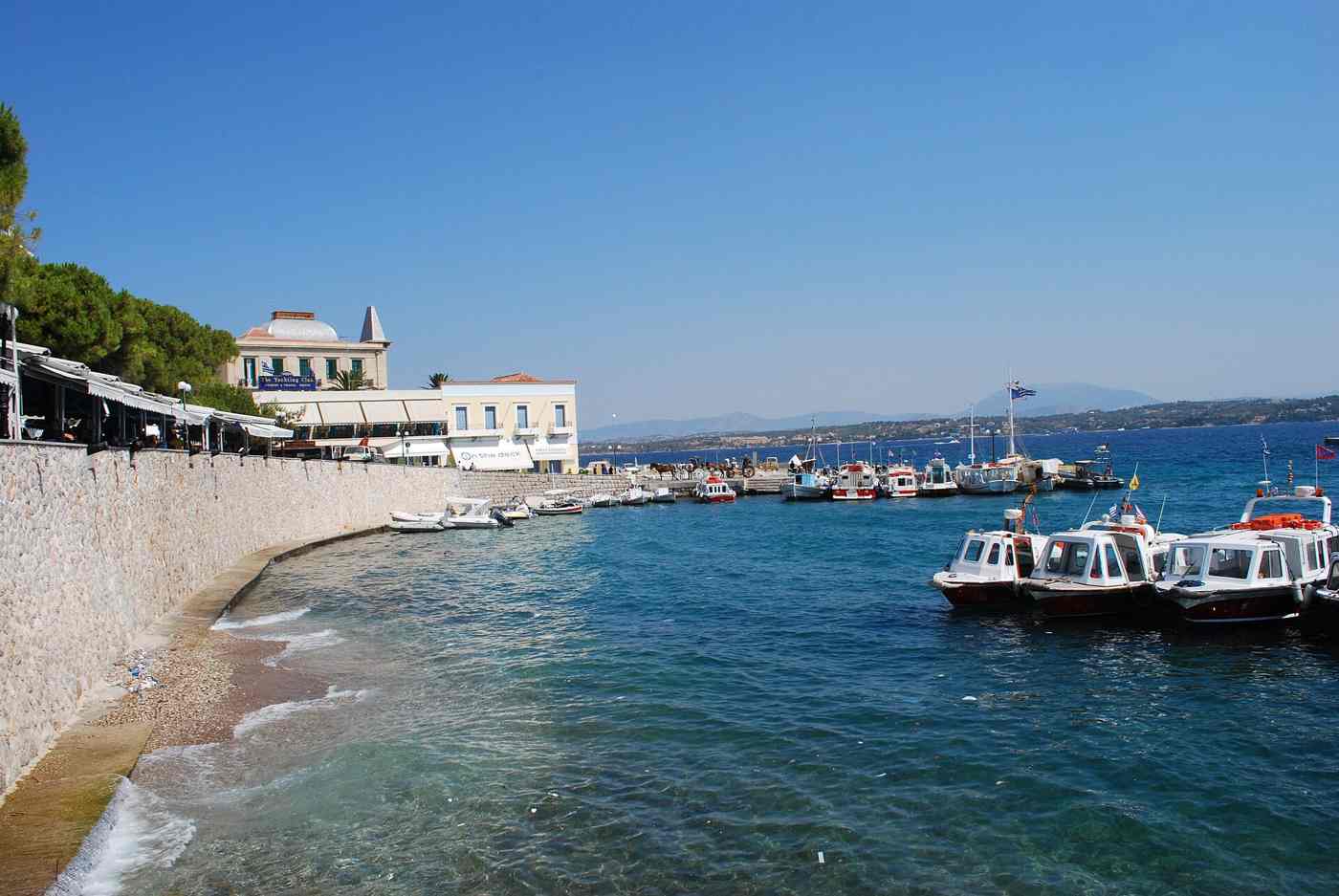
The Bouboulina Museum on Spetses preserves the mansion of Laskarina Bouboulina, the shipowner who became a naval commander in the 1821 Greek War of Independence. Set a short walk behind the Dapia, the town’s main quay, the house is shown on guided tours and holds her weapons, portraits, a ship’s figurehead, and family heirlooms. This My Greece Tours guide explains what the museum contains, why Bouboulina matters, and how a visit fits into a day in Spetses Town.
Few island museums combine a genuine historic interior with so dramatic a biography. The mansion’s carved wooden ceilings, period furniture, and personal relics survive because Bouboulina’s descendants still own and run the house, giving each guided visit a strong family thread. Standing on the waterfront nearby, a bronze statue of the heroine keeps her memory in plain sight, so a stop at the museum sits naturally within any exploration of Spetses and its revolutionary past.
What is the Bouboulina Museum on Spetses?
The Bouboulina Museum is a private museum in Spetses Town, housed in the eighteenth-century mansion of naval heroine Laskarina Bouboulina, a short walk behind the Dapia, and shown to visitors on guided tours run by her descendants.
The Bouboulina Museum occupies the former home of Laskarina Bouboulina, the Spetsiot shipowner who commanded her own armed vessels during the 1821 Greek War of Independence. The mansion stands just behind the Dapia, the fortified main quay where boats from Piraeus tie up. It is easy to reach on foot within minutes of arriving in town. Unlike a state museum with fixed galleries and open wandering, this is a family house preserved much as it was lived in. It is owned and operated by Bouboulina’s own descendants. That continuity gives the place an unusual authenticity, and the guided tour weaves the heroine’s biography together with the story of the building itself.
Few museums anywhere can claim so direct a link between the people who show you round and the historical figure whose life fills the rooms.
The museum ranks among the most rewarding stops on the island and features on most lists of things to do in Spetses. It pairs a real historic interior with the drama of a national heroine’s life, so visitors gain both an architectural experience and a compact lesson in the revolution. The tour moves through rooms furnished with period pieces, and guides point out the objects that connect directly to Bouboulina and her family. Because the visit is structured and relatively short, it suits travellers of all ages and slots neatly between a walk along the waterfront and a meal in the town, without demanding a large block of the day.
For visitors it becomes the historical highlight of their time in the town.
The mansion is a fine surviving example of the archontika, the stone captains’ houses that shipping wealth built across Spetses in the eighteenth and nineteenth centuries. Its scale, carved wooden ceilings, and richly furnished rooms reflect the prosperity that Spetsiot shipowners earned trading across the Mediterranean. Seeing such an interior from the inside makes the town’s grander history tangible, since most of the other captains’ mansions in the lanes remain private homes closed to visitors.
Here the doors open, and you can stand in the very rooms where a wealthy merchant family lived, planned voyages, and, in Bouboulina’s case, helped organise and finance an armed struggle for independence that would reshape the whole of Greece and leave its mark on this quiet corner of the Saronic.
The museum is deliberately intimate rather than sprawling, and the emphasis falls on quality of storytelling over sheer quantity of exhibits. A guide leads each group through the house, explaining the significance of the weapons, portraits, and heirlooms on display and answering questions as the visit unfolds. This format means you learn the context behind each object instead of reading it off a label, which brings the history to life more vividly. Because the descendants themselves are involved in running the museum, the account carries personal detail and pride that a conventional institution rarely matches.
Set against the neoclassical streets outside, the visit helps you picture the merchant society that produced Bouboulina and funded the fleet that fought at sea for the Greek cause.
Who was Laskarina Bouboulina, whose mansion holds the museum?
Laskarina Bouboulina was a wealthy Spetsiot shipowner who became a naval commander and heroine of the 1821 Greek War of Independence, funding and captaining armed ships against Ottoman forces, an exceptional role for a woman of her era.
Laskarina Bouboulina was born in the late eighteenth century into a seafaring world, the daughter of a Hydriot captain, and she married into shipping wealth on Spetses. Twice widowed, she inherited and then expanded a substantial fortune and fleet, taking direct control of her commercial and maritime affairs at a time when few women held such power. She used that wealth to build and arm ships in preparation for the coming revolution, most famously the large corvette named Agamemnon. Her decision to invest her money and her energy in the cause of independence turned a prosperous businesswoman into one of the most remarkable military figures of the age.
It is this life that the mansion museum sets out to preserve and explain.
Bouboulina committed her ships, her sailors, and her own person to the struggle. She sailed at the head of her vessels, took part in naval blockades of Ottoman-held ports, and supported land operations in the Peloponnese with supplies and men. Contemporary accounts describe her presence at key sieges, and her role as a commander rather than merely a benefactor set her apart. That she directed armed men in battle as a woman of standing made her a legend in her own lifetime, celebrated across the fledgling Greek nation.
The museum’s tour returns repeatedly to this active military leadership, since it is the core of why she is remembered so fervently on Spetses and beyond.
Bouboulina’s fame spread well beyond Greece during and after the war. She was reputedly honoured with the rank of admiral by Russia, an extraordinary recognition for a woman of her time. Her story circulated among the European supporters of the Greek cause. On Spetses her memory became woven into the island’s very identity, so that monuments, place names, and celebrations all keep her present. The mansion that now houses the museum was her actual residence, which gives the site a weight that a purpose-built memorial could never carry. Walking its rooms, visitors sense the gap between the polished legend and the practical businesswoman who balanced ledgers, managed a fleet.
Then risked everything she owned on the outcome of a revolution.
Her life ended not in battle but in a violent family dispute on Spetses, a sudden and unheroic close to an epic career. Yet that abrupt end did nothing to diminish her standing; if anything, it deepened the island’s sense of her as a tragic as well as a triumphant figure. Successive generations have honoured her as a symbol of courage and of the contribution Spetses made to Greek freedom. The museum presents her as a rounded person, a mother and merchant as well as a commander, which makes the account more human than a simple catalogue of exploits.
Understanding who she was gives every object in the mansion, from her weapons to her portraits, a clear and moving significance for the visitor.
Where is the Bouboulina Museum located in Spetses Town?
The Bouboulina Museum sits a short walk behind the Dapia, the main quay of Spetses Town, tucked among the neoclassical lanes just inland from the waterfront and easily reached on foot within minutes of the port.
The museum stands close to the heart of Spetses Town, only a brief walk inland from the Dapia where hydrofoils and ferries from Piraeus arrive. Because the island’s centre is car-free, you reach it entirely on foot along the pebble-mosaic and flagstone lanes that thread between the captains’ mansions. The route from the quay is short and well signed, and the mansion’s scale makes it stand out among the surrounding houses. Its position so near the waterfront means the museum slots easily into a walking circuit of the old town, whether you visit first thing after stepping off the boat or fold it into a longer wander.
For orientation and the town’s other landmarks, our guide to Spetses Town and the Dapia sets out the layout in detail.
The mansion’s setting among the archontika is itself part of the appeal. These stone houses, built behind high walls with courtyards and gardens, formed the residential quarter of the shipping families who ran the island in its heyday. Bouboulina’s home sat naturally among them, the residence of one of the wealthiest and most powerful families in the town. Walking to the museum therefore takes you through exactly the streetscape that produced her, past doorways, carved lintels, and bougainvillea-draped walls that have changed little in appearance since her day.
This context enriches the visit, because you arrive already immersed in the world of the merchant elite before you cross the threshold of the house that belonged to its most famous member.
Proximity to the Dapia also links the museum to the wider cluster of Bouboulina landmarks along the waterfront. Her bronze statue stands on the quay itself, gazing seaward, only a short stroll from her former home, so the two can be seen in a single loop. The Spetses Museum, housed in the grand Hatzigiannis Mexis mansion, lies a little further uphill and holds relics associated with her as well, meaning the town’s principal historical sights sit within easy walking distance of one another. This concentration makes Spetses Town rewarding to explore on foot, since a compact circuit from the Dapia can take in the statue, the mansion museum.
The broader island history in the space of a relaxed morning or afternoon.
Reaching the museum requires no transport beyond your own feet, though horse-drawn carriages wait at the Dapia for those who prefer to ride part of the way or arrive with luggage. The lanes near the mansion are quiet and shaded in places, a pleasant contrast to the busy quay, and the walk itself forms part of the experience. Because the centre bans private cars, there is no parking to consider and no traffic to negotiate; you simply follow the signs and the shape of the streets. Comfortable shoes help on the uneven pebble paving, especially where lanes climb the hillside.
Once at the mansion, its imposing frontage confirms you have arrived at the home of one of the island’s foremost families.
What can you see inside the Bouboulina Museum?
Inside the Bouboulina Museum you see the heroine’s weapons, a carved ship’s figurehead, family portraits, period furniture, and personal heirlooms, all displayed within the preserved rooms of her original eighteenth-century Spetsiot mansion.
The collection centres on objects connected directly to Bouboulina, her family, and the revolution she helped lead. Weapons feature prominently, including firearms and edged weapons of the kind carried by the fighters of 1821, which underline her role as a commander rather than a distant patron. Portraits of Bouboulina and her relatives hang in the rooms, putting faces to the names that recur in the island’s history, while personal effects and everyday items evoke the domestic life of a wealthy merchant household. Each piece is explained by the guide as the tour moves through the house, so the objects gain meaning from their context.
The result is a portrait of both a family and a national heroine, assembled from the possessions they actually owned and used.
Among the most striking exhibits is a carved wooden ship’s figurehead, a reminder that Bouboulina’s power rested on her fleet. Figureheads once adorned the prows of sailing vessels. Seeing one at close range connects the mansion’s quiet rooms to the dangerous world of naval warfare in which she made her name. Maritime items of this kind anchor the collection in the seafaring identity of Spetses, an island whose fortunes rose and fell with its ships. The guide uses such pieces to explain how the corvette Agamemnon and the rest of her fleet were built, armed.
Crewed, and how they were deployed in the blockades and battles of the war, giving visitors a vivid sense of the scale of her commitment to the cause.
The furniture and fittings of the mansion are themselves part of the display, since the house is preserved as a lived-in interior rather than emptied into glass cases. Period tables, chairs, chests, and decorative objects fill the rooms, many reflecting the international trade contacts of a shipping family whose vessels reached ports across the Mediterranean. This blend of local island tradition with imported taste gives the interiors an eclectic richness. It shows how the merchant elite of Spetses lived at the height of their prosperity.
You experience the exhibits in the spaces for which they were intended, walking the same floors and passing beneath the same ceilings as the family that owned them, which heightens the sense of stepping into the past.
Family heirlooms round out the collection and reinforce the personal thread that runs through the whole visit. Documents, household treasures, and mementoes passed down through Bouboulina’s descendants give the museum a warmth that a state institution seldom achieves, because the people showing you the house are part of the story it tells. This intimate scale is a deliberate strength: rather than overwhelming visitors with vast galleries, the museum offers a focused encounter with one extraordinary life and the family around it. By the end of the tour you have seen the weapons of a warrior, the trappings of a wealthy home.
The mementoes of a lineage, and the combination leaves a far stronger impression than a larger but more impersonal display ever could.
Why are the carved wooden ceilings of the mansion so notable?
The carved wooden ceilings are notable because they display the craftsmanship and wealth of an eighteenth-century Spetsiot captain’s mansion, and they survive intact within the Bouboulina Museum as a rare, viewable example of such interior decoration.
The carved wooden ceilings rank among the finest features of the mansion and among the reasons the building deserves attention in its own right, quite apart from its famous owner. Skilled woodworkers created these ceilings for the wealthy shipping families of Spetses, and they combine intricate joinery with painted and carved detail. Such decoration was a mark of status, a way for a captain’s household to display the fortune earned at sea and its connections to a wider Mediterranean world of craftsmanship and taste.
The ceilings survive in their original setting, allowing visitors to look up and see exactly the ornamentation that impressed guests two centuries ago in one of the island’s leading homes.
Wooden ceilings of this quality are increasingly rare, since many comparable mansions have been altered, subdivided, or lost over the generations. In most of the captains’ houses that still line the lanes of Spetses Town, the interiors remain private and unseen. Travellers have chances to appreciate this aspect of the island’s heritage. The Bouboulina Museum is a notable exception, opening its doors and its ceilings to guided visitors. The guides draw attention to the woodwork as the tour passes from room to room, explaining how it was made and what it signified.
This makes the ceilings not merely a backdrop but an exhibit in themselves, one that illustrates the artistry that shipping wealth could command at the height of the island’s prosperity.
The ceilings also speak to the international outlook of the Spetsiot elite. As their vessels traded across the Mediterranean, the island’s captains absorbed influences from Italy, the wider Ottoman world. Beyond, and these tastes found expression in the decoration of their homes. The woodwork therefore tells a story that reaches past Spetses itself, linking a small Saronic island to the broader currents of eighteenth and nineteenth-century craft and commerce. Seeing the ceilings in the context of the mansion’s furniture, portraits. Maritime objects allows visitors to read the whole interior as a single expression of a prosperous, outward-looking merchant culture.
It is a culture that produced not only fine houses but also the ships and the leaders, Bouboulina among them, who carried the fight for independence to sea.
For visitors, the ceilings reward a deliberate pause and an upward glance in each room. It is easy to focus on the weapons and portraits at eye level and overlook the decoration overhead. The ceilings are among the most authentic and irreplaceable elements of the house. Photographers in particular appreciate the play of carved detail and, where present, painted colour, though visitors should follow any guidance the museum gives about photography inside. Taken together with the neoclassical facades outside and the pebble-mosaic courtyards of the town, the interior woodwork completes a picture of Spetsiot craftsmanship at its peak.
Appreciating the ceilings deepens the sense that this mansion was a showpiece of its day, a fitting home for one of the island’s wealthiest and most celebrated families.
What role did Bouboulina play in the 1821 Greek War of Independence?
Bouboulina played the role of a naval commander and financier in the 1821 War of Independence, arming her own ships, leading them into blockades and operations against Ottoman forces, and supporting the land campaign in the Peloponnese.
Bouboulina’s contribution to the revolution began before the first shots, in the quiet, expensive work of preparation. Using her shipping fortune, she built and armed vessels for the coming struggle, most famously the corvette Agamemnon, and she stockpiled weapons and supplies. When the uprising broke out in 1821, she was ready to act at once, committing her fleet and her resources to the national cause. This willingness to spend her own wealth on the war set her apart from many who merely lent their names. It made Spetses one of the islands whose ships mattered most at sea.
The museum stresses this financial and logistical role, since it explains how a single determined individual could shape the early course of a national revolution.
Beyond funding the effort, Bouboulina took an active command at sea. She sailed with her ships, directed them in naval blockades of Ottoman-held ports along the coast of the Peloponnese, and coordinated with other captains from Spetses and the neighbouring islands. Her fleet formed part of the wider naval effort that gave the revolutionaries control of vital sea lanes, cutting off enemy garrisons and supporting the fighters on land. That a woman held such a command was remarkable then and remains striking now. It is central to why she is remembered as a heroine rather than simply a patron.
The guided tour uses her weapons and the ship’s figurehead to make this maritime leadership concrete for visitors standing in her former home.
Spetses as a whole threw its considerable maritime strength behind the revolution, and Bouboulina was its most famous embodiment. The island contributed ships, sailors, and money out of all proportion to its size, and its captains fought in many of the key naval actions of the war. Understanding Bouboulina’s role therefore illuminates the wider importance of Spetses in 1821, a theme that runs through the town’s monuments, churches, and museums. The mansion museum, the Spetses Museum in the Hatzigiannis Mexis house, and the memorials along the waterfront together tell this larger story, of which she is the human centre.
Her leadership gives a face and a personality to the island’s collective sacrifice, making the abstract history of the revolution vivid and memorable for those who visit.
Bouboulina’s involvement extended to the land war as well as the sea. She is recorded supporting operations in the Peloponnese, supplying men and materiel to the fighters and lending her presence to important sieges. This combination of naval command and support for the land campaign shows the breadth of her commitment, since she did not confine herself to a single sphere but pressed the struggle wherever her resources could help. The revolution she served would ultimately establish an independent Greek state, and her part in its early, precarious years secured her lasting fame.
For visitors, grasping this role transforms the objects in the museum from curiosities into the tools and mementoes of a genuine war leader who staked her fortune and her life on the freedom of her country.
How was Bouboulina involved in the siege of Nafplio?
Bouboulina was involved in the siege of Nafplio as a naval and financial supporter of the Greek forces, blockading the fortified port from the sea and contributing resources to the long campaign that eventually won the town for the revolution.
Nafplio, a heavily fortified port on the mainland coast facing the Argo-Saronic islands, was one of the most important strongholds the revolutionaries needed to take. Its capture would give the young Greek state a strong seat of government and a secure harbour, so the siege of the town became a prolonged and significant campaign. Bouboulina is remembered for her part in this effort, bringing her ships to bear against the fortress from the sea. A naval blockade was essential to any siege of a coastal stronghold, since it prevented supplies and reinforcements from reaching the defenders.
Her fleet’s presence off Nafplio contributed to the pressure that, over time, wore down the garrison and helped bring the fortified town into revolutionary hands.
The siege of Nafplio was not a swift affair but a drawn-out struggle that tested the resources and resolve of the besiegers. Bouboulina’s contribution reflected the same combination of command and expenditure that marked her whole war effort: she deployed her armed vessels and helped sustain the operation materially. Tradition holds that she was present and active at Nafplio, adding to the roster of engagements associated with her name. For the revolutionaries, holding the sea around such a port was as important as any action on land. The ships of Spetses and the neighbouring islands provided exactly that maritime dominance.
The eventual fall of the town was a major milestone for the cause, and Bouboulina’s association with it deepened her reputation as a leader who saw campaigns through.
The museum’s account of Nafplio helps visitors understand how naval power translated into strategic results on land. A fortress by the sea could hold out against an army almost indefinitely if it could be resupplied by ship, so cutting that lifeline was decisive. By committing her fleet to the blockade, Bouboulina applied her greatest asset, sea power, where it counted most. This connection between her ships and the fate of a mainland stronghold illustrates the wider logic of the war at sea, in which the island fleets shaped events far from their home ports.
Seeing her weapons and the ship’s figurehead in the mansion, visitors can picture the vessels that pressed the siege and grasp why command of the water mattered so greatly to the revolution’s success.
Nafplio’s later role as an early capital of independent Greece lends Bouboulina’s involvement an added significance. Having helped win the town, she was among the figures connected with the fledgling state that briefly centred there, and her fortunes became entangled with its turbulent early politics. The town’s importance in the young nation’s story means that her part in its siege is more than a single military episode. It links her directly to the founding of the Greek state itself. For visitors to the museum, this connection widens the frame beyond Spetses, showing how a Spetsiot commander’s actions helped shape the map of a new country.
It is a reminder that the mansion behind the Dapia was the home of someone whose decisions influenced events of national consequence.
What is the bronze statue of Bouboulina on the Dapia?
The bronze statue of Bouboulina stands on the Dapia waterfront in Spetses Town, depicting the heroine gazing out to sea, and it is one of the island’s most photographed monuments, a short walk from her mansion museum.
The statue of Bouboulina is among the most prominent monuments on the Spetses waterfront, positioned near the Dapia where visitors arrive and gather. Cast in bronze, it shows the heroine looking out over the water toward the sea she once commanded, a fitting pose for a naval leader whose power rested on her fleet. Its position on the busy quay ensures that almost everyone who steps ashore encounters it, and it has become a natural meeting point and photograph stop. The statue anchors the outdoor half of the Bouboulina story, complementing the indoor experience of the mansion museum nearby.
That the two together let visitors honour the heroine both in her private home and in the public heart of the town.
Placing the statue on the waterfront ties Bouboulina permanently to the element that defined her, the sea. From the Dapia the view stretches across the narrow channel toward the wooded islet of Spetsopoula and the mainland beyond, the same waters her ships once sailed. Standing at the monument, visitors can look out over that seascape and imagine the fleet that carried the island’s fighters into the revolution. The statue thus does more than commemorate a person; it fixes her in the landscape of her achievements.
From morning coffee to the evening stroll, the heroine presides over the daily rhythm of Spetses, a constant presence at the centre of island life.
The monument forms one point in a compact circuit of Bouboulina landmarks that visitors can walk in a single outing. From the statue on the Dapia it is only a short stroll to her mansion museum in the lanes behind. A little further to the Spetses Museum, which holds relics associated with her. Linking these sights on foot gives a rounded sense of how deeply she is embedded in the town, in stone and bronze as well as in preserved rooms and objects.
The waterfront setting also makes the statue an ideal starting or finishing point for a broader exploration of the old town, since the Dapia is where most walking routes begin and where the arriving and departing boats keep the quay lively throughout the day.
The statue plays its fullest role during the island’s great annual celebration, when Bouboulina’s memory takes centre stage. Each September the town honours the heroism of its 1821 generation during the Armata festival, and her image on the waterfront becomes a focus of the commemorations. Even outside the festival, the monument is a fixture of the Spetses experience, admired for its setting and its meaning alike. Photographs of the statue against the sea and the anchored boats are among the classic images travellers take home from the island.
Seeing the statue, then visiting the mansion museum, gives visitors both the public symbol on the quay and the private, preserved world of the woman Spetses reveres above all others on the whole of the island.
How do you visit the Bouboulina Museum on a guided tour?
You visit the Bouboulina Museum on a guided tour rather than by wandering freely, joining a scheduled group that a guide leads through the mansion, with tours running seasonally and their times posted at the house on arrival.
The museum operates on a guided-tour system, so instead of exploring at your own pace you join a group that a guide takes through the rooms of the mansion. This format suits the house well, since it is a preserved family home rather than a set of open galleries. It means each object is explained in context as you go. Tours run on a schedule that varies with the season. It is worth checking the day’s tour times when you arrive rather than assuming a fixed timetable. These are posted at the mansion. Because we cannot guarantee specific hours in advance, the practical approach is to walk up to the house, note the next available tour.
Plan the rest of your morning or afternoon around it.
A visit typically lasts under an hour, making it a compact but vivid introduction to Bouboulina’s life and the revolution she served. The relatively short duration means the museum fits easily into a broader day in Spetses Town, whether combined with a waterfront walk, a stop at the Dapia statue, or a visit to the Spetses Museum uphill. The guided format keeps the group moving through the rooms in an orderly way, and guides answer questions as they explain the weapons, portraits, ship’s figurehead, and carved ceilings. Families find the pace and length manageable for children, while history-minded travellers appreciate the depth the guides bring.
The structure ensures you leave with a clear narrative rather than a jumble of unexplained objects.
The museum’s seasonal operation reflects the wider rhythm of Spetses, which is busiest from late spring through early autumn and quieter in winter. During the warm months the island is at its liveliest and most museums and tavernas keep full schedules, whereas the low season brings reduced activity across the town. Planning your visit for the main season improves the chance of convenient tour times and pairs the museum with the town at its most active.
For guidance on how the seasons shape a trip, our overview of the best time to visit Spetses explains what to expect month by month, which helps you time a visit to the mansion alongside the beaches, the festival, and the rest of the island’s attractions.
Reaching the museum is simple once you are in town, since it lies only a short walk behind the Dapia through the car-free lanes. No booking of transport is needed; you arrive on foot, having perhaps first admired the bronze statue on the quay. Given the guided-tour arrangement, a little flexibility helps, as you may wait briefly for the next departure at busy times. Combining the visit with the town’s other historical sights makes for an efficient and satisfying circuit, and the mansion’s central location means little walking is involved. Approached this way, the Bouboulina Museum becomes a natural highlight of a day exploring Spetses Town, connecting the statue on the waterfront, the preserved home behind it.
The wider story of the island’s part in the fight for Greek independence.
Frequently Asked Questions
What is the Bouboulina Museum on Spetses?
The Bouboulina Museum is a private museum in Spetses Town, housed in the eighteenth-century mansion that belonged to the naval heroine Laskarina Bouboulina. It stands a short walk behind the Dapia, the town’s main quay, among the neoclassical captains’ houses of the old centre. The museum is owned and run by Bouboulina’s own descendants, which gives it an unusually personal character. It is shown to visitors on guided tours rather than through free wandering. Inside, the preserved rooms display her weapons, a carved ship’s figurehead, family portraits, period furniture, and personal heirlooms, all set beneath the mansion’s notable carved wooden ceilings.
The visit combines a genuine historic interior with the dramatic biography of a woman who commanded ships in the 1821 Greek War of Independence. Compact and vivid, it ranks among the most rewarding indoor sights on the island and pairs naturally with the bronze statue of Bouboulina on the nearby waterfront.
Who was Laskarina Bouboulina?
Laskarina Bouboulina was a wealthy Spetsiot shipowner who became a naval commander and one of the great heroines of the 1821 Greek War of Independence. Born in the late eighteenth century into a seafaring family and twice widowed, she inherited and expanded a large shipping fortune and took direct control of her fleet, an exceptional position for a woman of her time. She used her wealth to build and arm vessels for the revolution, most famously the corvette Agamemnon. When the uprising began she committed her ships, her sailors, and herself to the cause. She led naval blockades against Ottoman forces, supported the land campaign in the Peloponnese, and was associated with major sieges including that of Nafplio.
Reputedly honoured with a naval rank by Russia, she became a legend in her own lifetime. On Spetses her memory is inseparable from the island’s identity, kept alive by her mansion museum, a waterfront statue, and the annual Armata festival.
What can you see inside the Bouboulina Museum?
Inside the Bouboulina Museum you see objects connected directly to the heroine, her family, and the revolution, displayed within the preserved rooms of her original mansion. Weapons feature prominently, including firearms and edged weapons of the kind carried by the fighters of 1821, underlining her role as a commander. A carved wooden ship’s figurehead recalls the fleet on which her power rested, tying the quiet rooms to the world of naval warfare. Family portraits put faces to the names of the island’s history, while period furniture, chests. Decorative objects show how a wealthy shipping household lived at the height of its prosperity. Personal heirlooms passed down through her descendants add a warm, human thread to the collection.
Overhead, the mansion’s carved wooden ceilings are exhibits in their own right, examples of the craftsmanship that shipping wealth commanded. A guide explains each piece in context as the tour moves through the house, so the objects gain their full meaning.
Do you need a guided tour to visit the Bouboulina Museum?
Yes, the Bouboulina Museum is visited on a guided tour rather than by wandering freely through the rooms. Because the mansion is a preserved family home rather than a set of open galleries, a guide leads each group through the house, explaining the significance of the weapons, portraits, ship’s figurehead. Carved ceilings as the visit unfolds. This structured format means the objects are set in context and questions are answered along the way. You leave with a clear narrative rather than a jumble of unexplained exhibits. Tours run on a schedule that varies with the season.
The day’s times are posted at the mansion, so the practical approach is to walk up to the house and note the next available tour on arrival. The visit typically lasts under an hour, a compact length that suits all ages and fits easily into a broader day exploring Spetses Town on foot.
Where is the Bouboulina Museum and how do you get there?
The Bouboulina Museum stands in Spetses Town, only a short walk behind the Dapia, the main quay where hydrofoils and ferries from Piraeus arrive. Because the island’s centre is car-free, you reach it entirely on foot along the pebble-mosaic and flagstone lanes that thread between the captains’ mansions, following signs and the shape of the streets for minutes from the port. There is no transport to arrange and no parking to consider, though horse-drawn carriages wait at the Dapia for those who prefer to ride part of the way or arrive with luggage. The mansion’s imposing frontage stands out among the surrounding houses, confirming you have reached the home of one of the island’s foremost families.
Its central position places it within an easy walking circuit that also takes in the bronze statue of Bouboulina on the waterfront and the Spetses Museum uphill. The town’s principal historical sights can be seen together in a single relaxed outing.
How does Bouboulina connect to the 1821 War of Independence and Nafplio?
Bouboulina was a naval commander and financier of the 1821 Greek War of Independence, and her fleet took part in the campaign against the fortified port of Nafplio. Using her shipping fortune, she built and armed vessels before the uprising, then committed them to the cause once fighting began, leading blockades against Ottoman-held ports along the Peloponnesian coast. At Nafplio, a heavily fortified town the revolutionaries needed to capture, she brought her ships to bear from the sea, contributing to the naval blockade that prevented supplies and reinforcements from reaching the defenders during a long siege. Cutting that maritime lifeline was decisive, since a coastal fortress could otherwise hold out almost indefinitely.
The eventual fall of Nafplio was a major milestone, and the town later served as an early capital of independent Greece, which gives her involvement national significance. Her weapons and the ship’s figurehead in the museum help visitors picture the vessels that pressed such campaigns.
Is the Bouboulina Museum worth visiting during a day in Spetses Town?
The Bouboulina Museum is well worth including in a day exploring Spetses Town, offering one of the island’s most rewarding indoor experiences. It combines a genuine historic interior, complete with carved wooden ceilings and period furnishings, with the dramatic biography of a national heroine. You gain both an architectural and a historical experience in a single compact visit that usually lasts under an hour. Its central location, a short walk behind the Dapia, means it fits easily into a walking circuit that also takes in the bronze statue on the waterfront and the Spetses Museum uphill.
The account carries personal detail and pride that a conventional institution rarely matches, bringing the story of 1821 down to a human scale. For travellers interested in the island’s role in the Greek War of Independence, or simply in seeing inside one of its grand captains’ mansions, it is an essential stop.