
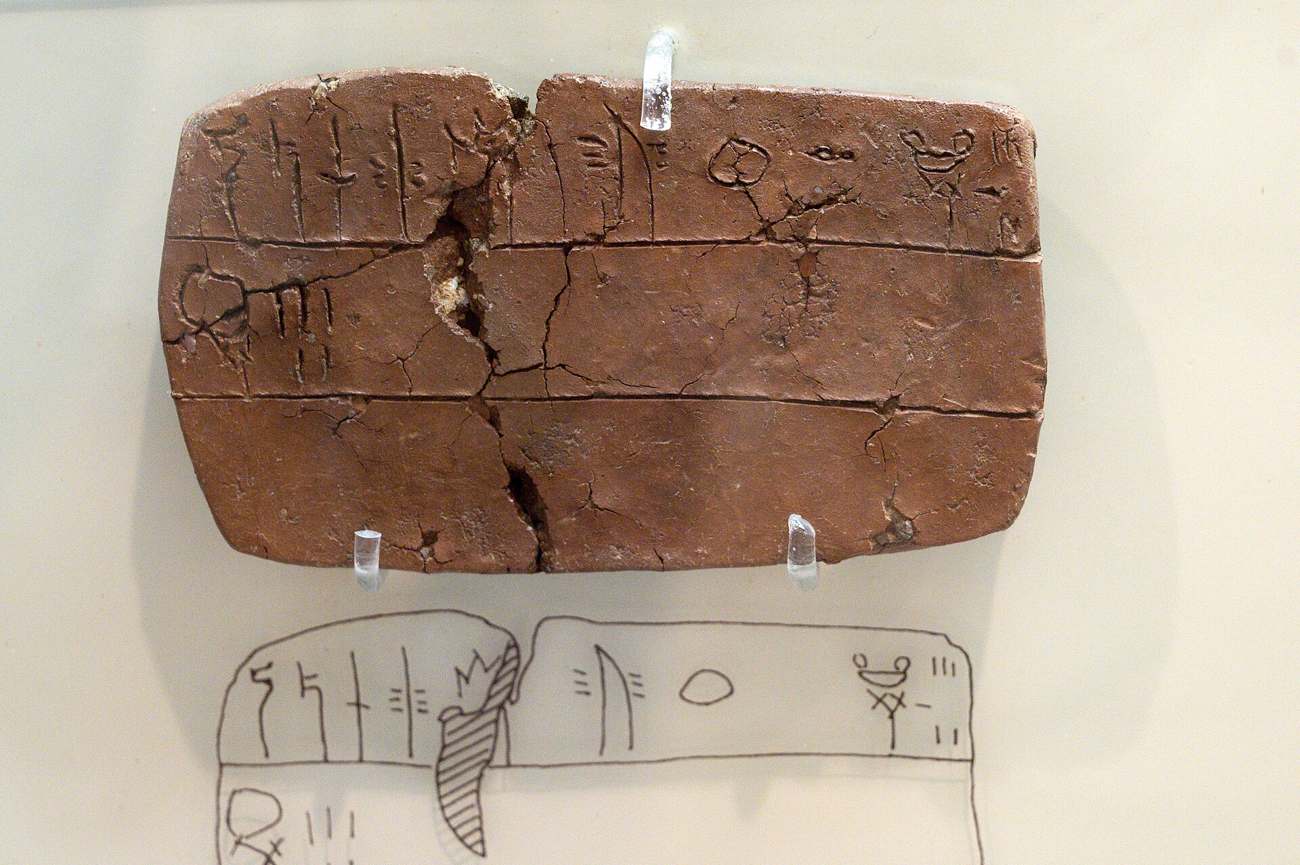
Linear B is the earliest known script used to write the Greek language, the writing system of the Mycenaean palaces in the Late Bronze Age. It survives on clay tablets, baked hard by the very fires that destroyed the palaces they belonged to. Copies of the script have turned up at Mycenae, Pylos, Tiryns, Thebes and Knossos on Crete, tying a scatter of great citadels into one shared administrative world. The tablets record no poetry and tell no story: they list stores, flocks, weapons and offerings, the plain accounts of a working palace. Trace the written voice of the Bronze Age Aegean with My Greece Tours.
Linear B gives the Mycenaean world a rare written record, a direct line into how its palaces counted and controlled their wealth. The script uses signs for syllables alongside pictorial signs and numbers, and it was read only in the twentieth century, long after the tablets were dug up. The sections below cover what the script was, where it was found, how it was deciphered, what it recorded and why it matters, drawing throughout on our Mycenae travel guide for the wider setting of the citadel and its ruined palace.
What is Linear B and how does the Mycenae script work?
Linear B is the earliest known script used to write the Greek language, the writing system of the Mycenaean palaces in the Late Bronze Age. It combines signs for syllables together with pictorial signs and separate signs for numbers.
Linear B is a syllabic script, which means each of its core signs stands for a whole syllable rather than a single sound or letter. Alongside these syllabic signs the system carries pictorial signs, small drawings that represent the things being counted, and a set of number signs for recording quantities. This mixture let a palace scribe note a commodity with a picture, the amount with figures, and any accompanying words with syllables. The result reads less like a sentence and more like a ledger entry.
The script belongs to the Late Bronze Age, the era of the great Mycenaean citadels, and it stands as the earliest written form of the Greek language known to survive anywhere in the record. A trained scribe could set down a whole transaction in one compact line, naming the goods and fixing the amount.
The physical form of Linear B shapes how much of it endures. Scribes pressed the signs into wet clay tablets, small hand-held documents meant to last a single accounting season rather than the ages. Those tablets should have crumbled back to dust, and yet great numbers of them survive precisely because the palaces burned. The heat that destroyed the buildings baked the soft clay hard, fixing the writing in fired form for archaeologists to recover thousands of years later. This accident of fire preserved the daily record of the ruined palace of Mycenae itself and of the other centres where the script was in use, turning a disaster into the very reason the writing reached us at all.
The tablets that endure are the ones a fire happened to catch.
Where was Linear B found, including at Mycenae?
Linear B tablets have been found at Mycenae, Pylos, Tiryns and Thebes on the Greek mainland, and at Knossos on the island of Crete. The shared script ties these separate palace centres into one administrative culture.
The find-spots of Linear B trace the reach of the Mycenaean palace world across the Aegean. On the mainland the script has come to light at Mycenae, at Pylos in the south-west, at Tiryns near the coast below Mycenae, and at Thebes to the north. Across the sea on Crete a large body of tablets was recovered at Knossos, the great palace whose earlier Minoan script had used a related writing system. That the same Linear B script served all these centres shows how far a single administrative habit had spread. Each palace kept its own accounts in the same signs, a mark of shared method rather than a single central archive controlling them all.
The reach from Thebes to Pylos, and across the water to Knossos, shows how widely the habit of writing had settled.
The presence of Linear B at Mycenae ties the citadel firmly into this literate palace network. The tablets found there speak the same clipped accounting language as those from Pylos or Knossos, listing the resources a great household managed. For the visitor standing among the ruins, the tablets add a further layer to the stone: the walls and gates housed not only warriors and kings but scribes keeping careful count. Anyone tracing the history of Mycenae meets in these tablets the closest thing the site offers to a contemporary written record, a voice from inside the working palace rather than a later legend told about it.
The written record and the great walls belong to the same moment, each confirming the reach and wealth of the citadel in its prime.
How was Linear B deciphered?
Linear B was deciphered in the twentieth century by Michael Ventris, working with John Chadwick. Their work showed that the language written in the script was an early form of Greek, not a separate lost tongue.
The decipherment of Linear B stands as one of the landmark achievements of twentieth-century scholarship. For a long stretch after the tablets first came to light, the signs stayed silent, an undeciphered script whose sounds and language nobody could read with confidence. The breakthrough came from Michael Ventris, an architect by training with a gift for patterns and puzzles, who worked out the sound values behind the signs. He then joined forces with John Chadwick, a scholar of the Greek language, whose expertise tested and secured the reading. Together they proved that the words locked inside Linear B belonged to an early form of Greek, pushing the written history of the language back into the Bronze Age.
The partnership paired a puzzle-solver’s eye with a linguist’s rigour, and that balance carried the reading past guesswork into firm proof.
That single conclusion reshaped the study of the Mycenaean past. The proof that Linear B recorded Greek meant the palace scribes of Mycenae, Pylos and Knossos were speaking a tongue continuous with the language of later Greece, a startling reach across the centuries. The reading turned a set of mute clay lists into readable documents, opening a direct window onto how these palaces were run. Travellers exploring the Mycenaean civilization owe much of their factual picture to this decipherment, since so much hard evidence about the economy and society of the age comes from the tablets that Ventris and Chadwick first made legible.
Their reading turned the palace scribes from anonymous mark-makers into witnesses whose words could at last be understood, giving the Mycenaean age a documented inner life.
What do the Linear B tablets record?
The tablets record lists and accounts: stores of grain, oil and wine, flocks of sheep, weapons, chariots, workers and offerings made to the gods. They document the palace administration and economy rather than literature or history.
The content of the Linear B tablets is resolutely practical, the paperwork of a palace at work. The scribes tallied stores of grain, oil and wine held in the palace magazines, and they counted the flocks of sheep whose wool fed a textile economy. Other tablets list weapons and chariots, the hardware of a warrior aristocracy, along with the workers assigned to set tasks around the household. Further records note offerings made to the gods, showing the palace at the centre of religious as well as economic life. Read together, these lists sketch a tightly managed centre that gathered, stored and redistributed goods, keeping written count of nearly everything that passed through its stores.
The picture that emerges is of a palace as accounting house, where wealth was not simply held but measured and tracked.
What the tablets do not contain is just as telling as what they hold. There is no poetry here, no myth, no chronicle of kings or wars, none of the literature that later Greece would be known for. Linear B was a tool of administration, written to run a palace and then discarded, not to be read by later generations. This narrow purpose still delivers a rich reward, since the accounts reveal the inner workings of the palace economy with a directness no later legend can match.
Items and quantities recorded on these tablets have parallels among the finds housed in the Mycenae archaeological museum, where the objects and the written record of the same world stand side by side. A weapon in a case and a weapon logged on a tablet describe the one palace from two angles.
Why does Linear B matter for understanding Mycenae?
Linear B gives the Mycenaean world its only contemporary written voice, revealing the palace economy directly. It confirms an early form of Greek at Mycenae and ties the citadel to the wider Bronze Age Aegean.
The importance of Linear B lies in the kind of evidence it supplies. Stone walls, tombs and grave goods tell an eloquent story, yet they remain mute about names, numbers and daily transactions. The tablets fill that gap with a contemporary written record, produced inside the palace at the height of its power rather than composed centuries later. Through them the workings of the Mycenaean economy and administration come into focus with a precision archaeology alone cannot reach. For the citadel of Mycenae this means a documented palace, one whose stores, flocks and offerings were counted and set down in writing that has since been read and understood.
The stones give the citadel its scale and drama, and the tablets give it its balance sheet, so the two together render a fuller portrait than either could alone.
Linear B also anchors Mycenae within a much larger Aegean world. The same script at Pylos, Tiryns, Thebes and Knossos reveals a shared administrative culture spanning the mainland and Crete, a network of palaces speaking an early form of the Greek language and keeping their accounts in the same signs. The wider entanglements of the era, including the ties and contrasts between the mainland palaces and Crete, run through the Minoan and Mycenaean worlds. The same script recurring from citadel to citadel is itself the proof of that shared world, a written thread binding distant palaces into one culture.
Tracing any of that on the ground begins with the practicalities, and our guide on how to visit Mycenae sets out the citadel where this written record was first kept.
Frequently Asked Questions
Is Linear B the same as the alphabet used in later Greece?
Linear B is not the alphabet familiar from later Greek writing, though it does record an early form of the Greek language. It is a syllabic script, which means its core signs each stand for a whole syllable rather than a single letter. Alongside those syllabic signs it uses pictorial signs for the things being counted and separate signs for numbers. The later Greek alphabet, with its individual letters for single sounds, came into use long afterwards and worked on a wholly different principle. What links the two across the gap of centuries is the language itself.
The decipherment of Linear B in the twentieth century proved that the palace scribes were writing Greek, showing that the tongue behind these Bronze Age clay tablets was an early ancestor of the language later written in the alphabet we know. The two systems sit at opposite ends of a long gap in time, the syllabic script serving the scribes of Mycenae and the alphabet arriving only after that palace world had fallen.
How did clay tablets survive from the Mycenaean age?
The Linear B tablets survive through a grim accident of history. Scribes wrote them on soft clay, meant to serve a palace for a season of accounts and then be discarded or reused, not to endure for thousands of years. Left to themselves, such tablets would have crumbled away. The palaces of Mycenae and the other centres met a violent end in fire, and that fire is the reason the writing reached us. The heat baked the damp clay hard, firing the tablets like pottery and fixing the pressed signs permanently in place. What destroyed the buildings preserved their records. Archaeologists later recovered these baked tablets from the ruins at Mycenae, Pylos, Tiryns, Thebes and Knossos on Crete.
The daily accounts of the palace economy reached the modern world only because the disaster that ended these citadels happened to save the writing kept inside them. The tablets we can read today are the ones a fire caught in time, a preserved fraction of a record never meant to last.
What can Linear B tell us that the ruins cannot?
Linear B supplies a kind of evidence the stones of Mycenae cannot give on their own. Walls, gates and tombs reveal the scale and wealth of the palace world, yet they stay silent about the fine detail of daily life. The tablets speak directly, listing the grain, oil and wine in the stores, the flocks of sheep, the weapons and chariots, the workers and the offerings made to the gods. Through them the palace economy and its administration come into clear focus, counted and recorded by the scribes who ran it. The record is contemporary, set down inside the palace at its height rather than remembered in a legend told long after.
This gives the citadel a documented inner life to set beside its ruined grandeur. The tablets show not just how mighty Mycenae was, but exactly what it held, managed and valued in the closing age of the Bronze Age Aegean.