
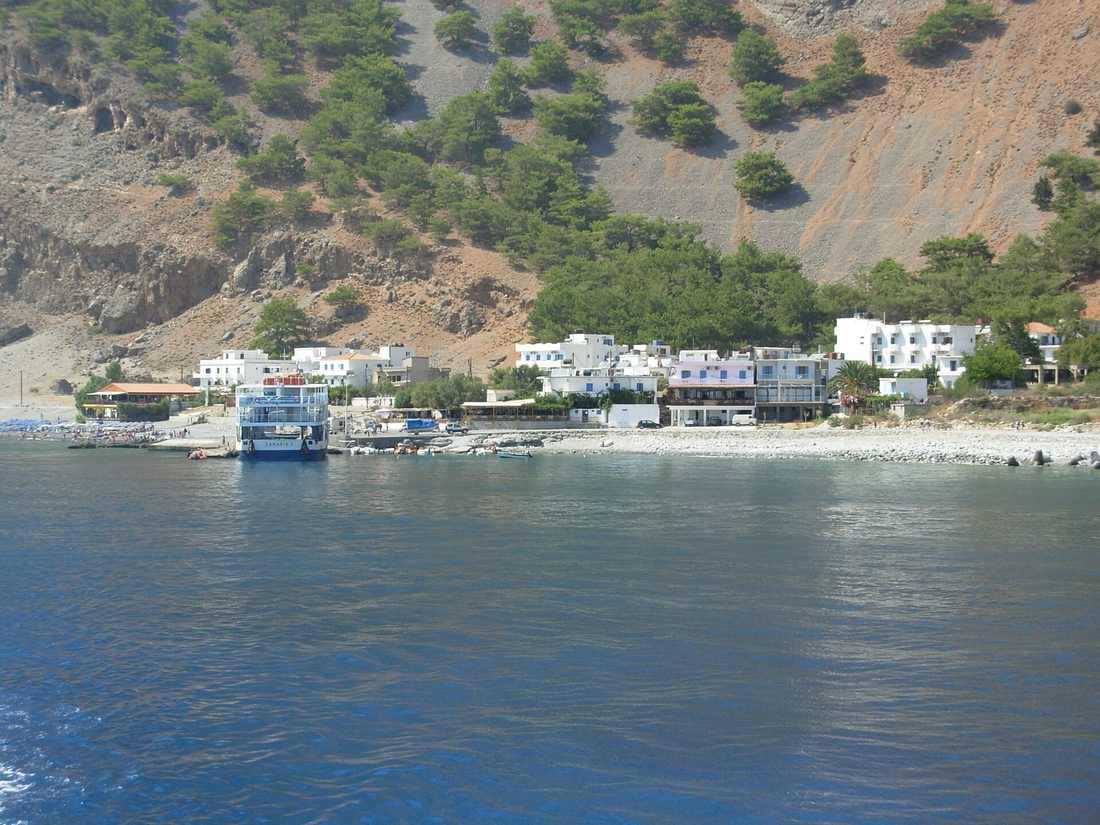
Agia Roumeli is a tiny village on the south-west coast of Crete, in the Chania region, where the Samaria Gorge meets the Libyan Sea. The settlement has no road link to the rest of the island. Travellers reach it on foot after walking down the gorge, or by ferry along the coast from Sougia, Loutro and Chora Sfakion. A long grey-sand and pebble beach, deep clear water and a row of tavernas and rooms serve tired walkers, while the ruins of ancient Tarra and a Turkish fort stand on the hill. Plan the walk, the swim and the boat timetable together with My Greece Tours.
This village works as the end point of the island’s most famous walk rather than a place travellers drive to. The daily rhythm follows the gorge crowds arriving through the afternoon and the ferries that carry them onward. The sections below cover how to arrive without a road, what fills the day between the walk and the boat, the beach and swimming, the ancient ruins on the hill, and how the village fits the wider south coast. For the full regional picture, the Crete travel guide sets Agia Roumeli within the Chania region and the roadless Sfakia coast.
Where is Agia Roumeli in Crete and why has it no road?
Agia Roumeli sits on the south-west coast of Crete, in the Chania region, at the mouth of the Samaria Gorge where the canyon reaches the Libyan Sea. Steep mountain terrain blocks any road, so foot and ferry give the only access.
The village occupies the narrow coastal strip where the Samaria Gorge opens onto the Libyan Sea, on the south-west shore of Crete within the Chania region. The White Mountains fall almost straight to the water here, and the ground rises too sharply for a road to be cut through. That isolation shapes the whole place. No car, bus or motorbike reaches Agia Roumeli, and no through route runs along this stretch of the south coast. The result is a settlement reached only on foot down the canyon or by boat across the water, a rarity on an island crossed by a dense road network of highways and mountain lanes.
This road-free setting is part of what draws walkers to the outdoor things to do in Crete that centre on the wild south-west and its gorges.
The gorge above the village carries the pedestrian route in. Walkers start at the Xyloskalo entrance on the Omalos plateau, high in the mountains, and descend the length of the Samaria Gorge to reach the coast. The full walk runs about sixteen kilometres downhill and ends at the village beach. The other way in is the coastal ferry, which threads between the roadless settlements of this shore. The terrain rules out driving, so every visitor plans around one of these two options rather than a car park. The village depends entirely on the boats for supplies, mail and the movement of its seasonal crowds.
That dependence has shaped its layout, its jetty and its tight cluster of tavernas along the front, all pitched at people arriving without a vehicle of any kind.
How do you get to Agia Roumeli by ferry and on foot?
Reach Agia Roumeli two ways: descend the Samaria Gorge on foot from the Omalos plateau to the coast, or ride the coastal ferry from Sougia, Loutro or Chora Sfakion. Most gorge walkers leave by the afternoon boat.
The foot route runs one direction for most travellers, downhill from the mountains to the sea. Hikers reach the Xyloskalo trailhead by bus or transfer to the Omalos plateau, then walk the gorge to Agia Roumeli, where the trail ends at the beach. The final stretch crosses the wide riverbed of the canyon mouth before the first tavernas appear. Arrival at the village leaves no road onward, so the ferry becomes the exit. Boats run east to Chora Sfakion, the main road-connected port of this coast, and west to Sougia, calling at the roadless hamlet of Loutro along the way.
Timetables cluster in the afternoon to carry the day’s gorge crowd back to a waiting bus, so the last departure sets the pace of the whole visit for walkers.
Ferry-only visits work in reverse for travellers who skip the long walk. A boat from Chora Sfakion or Sougia drops passengers at the jetty for three or four hours on the beach, then collects them later the same day. This suits families and anyone avoiding the sixteen-kilometre descent on steep stone paths. The coastal service links Agia Roumeli into a small network of ports and stops that share no road, so a single ferry chain can join four or five villages in one day. These sailings feed the wider programme of Crete boat trips along the Libyan Sea, taking in sea caves and beaches that no road reaches.
The coast around the village follows the same pattern seen across the rugged southern shore, where water transport does the work of roads.
What does the beach and swimming at Agia Roumeli offer?
The beach at Agia Roumeli is a long strip of grey sand and pebbles fronting deep, clear water. It gives gorge walkers a cooling swim at the end of the descent, with tavernas and rooms along the shore for a longer stay.
The shoreline stretches wide and open where the canyon meets the sea, a mix of coarse grey sand and rounded pebbles washed down by the river over centuries. The water drops away quickly from the shingle, staying clear and cold, and the open aspect onto the Libyan Sea keeps it fresh even at the height of summer. For a walker who has just spent five or six hours descending stone paths in the heat, this swim is the reward that ends the trek. The beach faces south with nothing but open sea toward the African coast, so sunsets fall straight over the water.
A short walk west along the shore leads to quieter stretches of pebble and sand away from the tavernas, the rooms and the ferry jetty where the day crowd gathers.
Facilities stay simple and geared to the two rhythms of the place. A row of tavernas and rooms lines the front, serving cold drinks and food to the afternoon crowd, then quietening once the last boat leaves. Travellers who stay a night find the village nearly empty after dark, with only the resident families and a small group of overnight guests left along the shore. The grey sand and steep drop mark the beach as one reward earned on foot or by boat rather than reached by car.
Shade is limited, so walkers arriving at midday head for the tamarisk trees behind the sand or the covered terraces of the tavernas until the fierce heat of the early afternoon begins to ease off the exposed shingle.
What ancient ruins and history stand near Agia Roumeli?
The ruins of ancient Tarra, a coastal town of antiquity, lie beside the modern village, and a Turkish fort crowns the hill above. Both mark the long human use of this strategic gorge mouth on the south coast.
The classical town of Tarra once stood at this river mouth, a port of the ancient world that traded across the Libyan Sea and held a sanctuary linked to the cult of Apollo. Scattered stones, wall lines and building foundations survive on the flat ground near the shore, marking where the settlement spread before the modern hamlet grew over part of it. The gorge behind gave Tarra its water and its route to the interior, the same corridor that walkers use now. Traces of an early church built over older foundations sit among the remains, showing how the site passed from the classical age into Christian centuries.
The town held this exposed coast for hundreds of years without ever gaining a road to the outside world, a pattern the modern village still repeats today.
Above the beach, the ruins of a Turkish fort look down over the bay and the canyon mouth. Ottoman forces raised it to watch this natural landing point during the centuries of their rule, when the roadless coast made such gorges the only inland routes and worth guarding closely. The climb to the fort takes in a wide view over the village, the grey beach and the sea toward Africa. This layering of classical, Christian and Ottoman remains ties Agia Roumeli into the broader story of the rugged Sfakia district, whose isolation preserved its own long record of revolt and defence along the southern shore.
The stones on the hill and by the river read as a compact timeline of the island’s contested past on this single stretch of coast.
How does Agia Roumeli fit the wider south coast of Crete?
Agia Roumeli anchors the roadless middle of the Sfakia coast, linked by ferry to Loutro, Chora Sfakion and Sougia. It serves as the finish line of the Samaria Gorge and a stop on longer coastal boat journeys.
This village marks the western pivot of the roadless Sfakia shore, a chain of coves and hamlets reachable only by boat or footpath. To the east lie the tiny port of Loutro and the road-connected town of Chora Sfakion; to the west sits Sougia, another gorge-mouth stop on the same ferry line. Boats knit these points into a single travel route, and Agia Roumeli holds the middle of it as the busiest by day thanks to the gorge traffic. The village fills and empties on a daily cycle: quiet at dawn, crowded by early afternoon as walkers arrive, then emptied again by the departing boats at dusk.
Few places on the island run to such a clear, boat-driven rhythm across the long summer season of hikers and day trippers.
For a traveller planning the south-west, Agia Roumeli works best as the payoff of the gorge walk combined with a coastal boat leg rather than a standalone stay. A common plan descends the canyon, swims at the beach, then rides the ferry east to overnight at Loutro or catch a bus at Chora Sfakion the same evening. The whole area rewards slow, boat-based travel and sits among the quieter corners of the island, well suited to walkers and to anyone hunting the hidden gems in Crete beyond the northern resorts.
The village closes one of the island’s signature walks and opens onto a full south-coast circuit of gorges, empty beaches and small harbours strung along the edge of the Libyan Sea, each reached by the same footpaths and ferries that serve this roadless stretch.
Frequently Asked Questions
Can you drive to Agia Roumeli?
No road reaches Agia Roumeli, and no car, bus or motorbike can arrive there. The village sits at the mouth of the Samaria Gorge on the south-west coast, where the White Mountains drop so steeply to the Libyan Sea that no route fits along the shore. Travellers reach it in one of two ways. The first is on foot, descending the gorge from the Omalos plateau to the coast over about sixteen kilometres. The second is by ferry, riding the coastal boat from Chora Sfakion, Loutro or Sougia to the village jetty. Access depends entirely on boats, so the village schedules its life around the ferry timetable, and even supplies and mail arrive by sea.
Anyone driving toward the south coast parks at a road-connected port such as Chora Sfakion, then transfers to the water for the final leg. This car-free isolation preserves the calm, end-of-the-trail character that walkers value along this stretch of the rugged southern coast and the open Libyan Sea beyond the beach.
Do you have to walk the Samaria Gorge to visit?
No, the gorge walk is one option rather than a requirement. Two kinds of visitor reach Agia Roumeli by two separate routes. The first descends the sixteen-kilometre gorge on foot from the Omalos plateau and ends the trek at the village beach for a swim. The second skips the walk entirely and arrives by coastal ferry from Chora Sfakion, Loutro or Sougia, spending three or four hours on the shore before the return boat. The ferry route suits families, older travellers and anyone who wants the swim and the setting without the long downhill hike over stone paths.
Boats run mainly in the afternoon to carry the gorge crowd back to a waiting bus, so a ferry-only day trip fits neatly around the same timetable. Both routes end at the same grey-sand beach below the canyon mouth, and both let travellers pair the visit with other coastal boat legs that call along the roadless southern shore of the island between Sougia and Chora Sfakion.
Is it worth staying overnight in Agia Roumeli?
Staying a night changes the experience of the village completely. Through the afternoon Agia Roumeli fills with hundreds of gorge walkers waiting for the ferry, and the tavernas and jetty grow busy and loud. The last boat leaves at dusk and takes the crowd with it, dropping the village to its resident families and a small number of overnight guests. Travellers who book a room find a quiet beach, clear water for an evening and morning swim, and a sunset falling straight over the Libyan Sea toward the African coast. The rooms along the front stay simple and inexpensive, matched to walkers rather than resort tourists.
An overnight also splits a longer coastal itinerary, letting travellers walk the gorge one day and continue west or east by boat the next morning. The after-dark calm and the empty beach reward the extra effort of reaching a place that has no road at all, and they set this stop apart from the busy northern resorts of the island.