
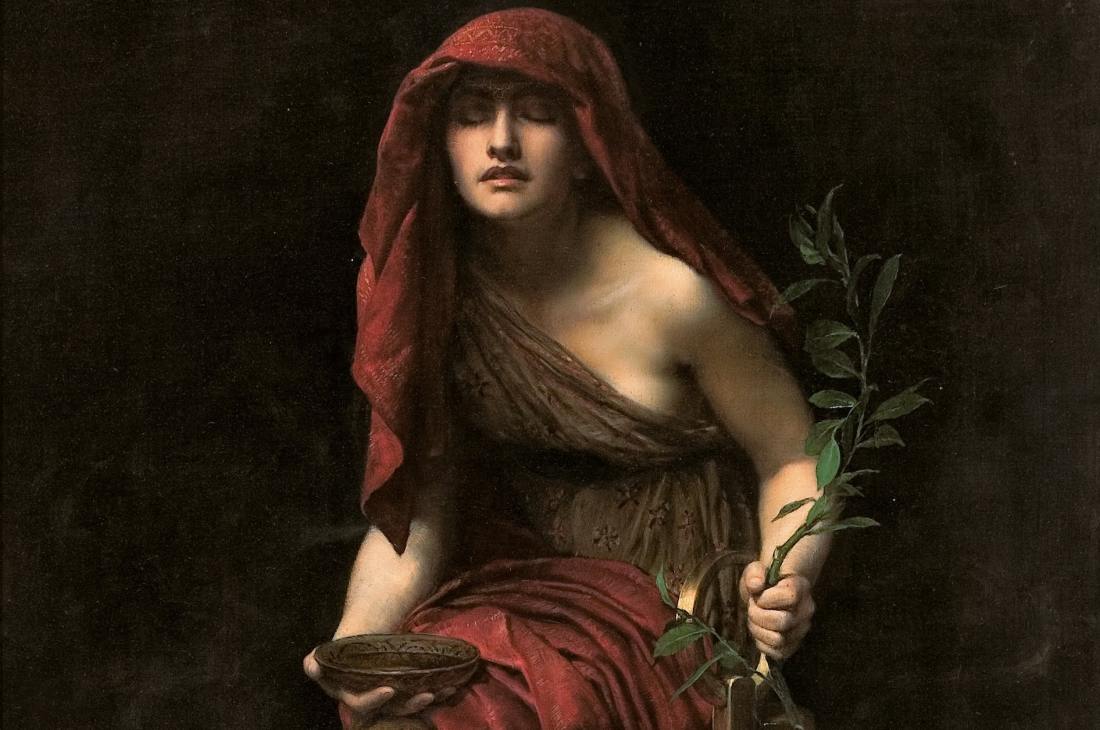
The Oracle of Delphi was the most revered prophetic institution of the ancient Greek world, a place where mortals believed they heard the voice of the god Apollo himself. Set high on the slopes of Mount Parnassus, the sanctuary drew kings, generals, city-states and ordinary pilgrims who travelled great distances to put their questions to the priestess called the Pythia. Her ambiguous, riddling answers shaped wars, colonies and constitutions across the Greek world for centuries, and the site was honoured as the very centre of the earth. Its ruins remain among the most atmospheric in all of Greece, and understanding the oracle transforms any visit to the archaeological site, which you can explore on a guided tour with My Greece Tours. Plan the whole trip with Greece Tours.
This guide explains who the Pythia was, how consultations worked, and why Delphi held such power over the Greek mind. For itineraries, opening details and booking help, see our Delphi travel guide. The sections below cover why Delphi was called the navel of the world, who the Pythia was and how she prophesied, how a consultation actually unfolded, the famous predictions that changed history, and how travellers experience the Temple of Apollo on the ground today.
Why was Delphi called the navel of the world?
The Greeks believed Delphi marked the exact centre of the earth. According to myth, Zeus released two eagles from opposite ends of the world and they met above Delphi, fixing the spot. A sacred carved stone called the omphalos, meaning navel, stood in the sanctuary to mark this cosmic centre.
This idea of Delphi as the omphalos, the navel of the world, gave the sanctuary a spiritual authority that no rival matched. The stone itself was a rounded, beehive-shaped block, often shown draped with a woollen net in ancient art, and it symbolised the meeting point between the human and divine realms. Pilgrims arriving on the slopes of Mount Parnassus understood that they were approaching not merely a shrine but the axis around which the whole cosmos was thought to turn. The dramatic landscape reinforced the feeling, with sheer cliffs, the Castalian spring and the deep valley below all seeming to concentrate the presence of the god Apollo in one extraordinary place.
The sanctuary belonged to Apollo, the god of light, music, healing and prophecy, though older traditions held that the earth goddess Gaia and the serpent Python guarded the site before him. Apollo was said to have slain Python and claimed the oracle, which is why his priestess bore the name Pythia. The layering of these myths gave Delphi a sense of immense antiquity even to the ancient Greeks themselves. To stand at the navel of the world was to touch the deepest roots of Greek religion, and this reputation drew a steady stream of the powerful and the desperate alike.
Who was the Pythia and how did she deliver Apollo’s prophecies?
The Pythia was the high priestess of Apollo who spoke the god’s prophecies at Delphi. Seated on a tripod in the temple’s inner sanctum, the adyton, above a chasm in the rock, she entered a trance said to be induced by rising vapours, and uttered responses that priests then shaped into oracles.
The Pythia was typically an older woman of good character chosen from the local community, who underwent purification before she prophesied. On consultation days she bathed in the Castalian spring, and it is said she descended into the adyton, the restricted inner sanctum of the Temple of Apollo, closed off from the pilgrims who waited outside. There she took her seat on a high tripod, the three-legged bronze stand sacred to the god, positioned over a cleft in the rock. Ancient writers describe her chewing laurel leaves and breathing in vapours that rose from the chasm below, entering an altered state in which Apollo was believed to speak directly through her.
Modern researchers have debated the vapours theory for a long time, with some geologists suggesting that faults beneath the temple released light hydrocarbon gases such as ethylene, capable of producing a trance-like effect. Whatever the physical cause, the ancient understanding was clear: the god possessed the Pythia and spoke through her mouth. Because her utterances came broken or ecstatic, a body of priests attached to the sanctuary interpreted and rendered them into the polished verse or prose that consultants carried home. This interpretive role gave the priesthood real influence, since the framing of an answer steered its meaning as surely as the words themselves.
How did a consultation at the oracle actually work?
Consultations happened only on set days, beginning with sacrifice and purification. Enquirers paid a fee, offered a sacred cake and a sacrificial animal, then submitted their question. The Pythia gave Apollo’s response from the adyton, and priests delivered the interpreted answer, often deliberately ambiguous, back to the waiting consultant.
The oracle was not available on demand. For much of its history it operated on a limited calendar, originally just once a year and later on fixed monthly days during the sailing and travelling season, which meant that queues of enquirers formed. Before a question was asked, a goat was sprinkled with water; only if the animal trembled in the correct way was the day judged favourable and the consultation allowed to proceed. City-states sent official envoys, while individuals came with private concerns about marriage, business, health, or whether to have children. Certain privileged states and benefactors held the right of promanteia, the honour of consulting ahead of others in the line.
Questions ranged from matters of state to personal dilemmas, and were often phrased so that a simple choice was put to the god. The responses that reached the consultant were famous for their ambiguity, a quality that protected the oracle’s reputation whatever the outcome. A carefully balanced answer read as vindication if events turned out one way and as a warning misheard if they turned out another. This studied vagueness, combined with the priests’ deep knowledge of affairs across the Greek world, helped Delphi maintain its standing as an unerring source of divine guidance for generation after generation.
What were the most famous prophecies of the Oracle of Delphi?
The oracle’s fame rested on celebrated responses. It warned King Croesus that attacking Persia destroyed a great empire, told the Athenians their salvation lay behind wooden walls before the battle of Salamis, and inscribed at its temple the maxims know thyself and nothing in excess, which became guiding principles of Greek thought.
The story of Croesus, the fabulously wealthy king of Lydia, is the classic warning about Delphic ambiguity. Told by the oracle that that war on Persia destroyed a great empire, Croesus confidently attacked, only to discover that the empire destroyed was his own. Equally celebrated is the wooden walls prophecy delivered to the Athenians as the Persian army advanced. The Pythia’s grim response spoke of safety in wooden walls, and the statesman Themistocles argued this meant the Athenian fleet rather than a wooden palisade on the Acropolis. His interpretation led to the decisive Greek naval victory at Salamis, an event that helped preserve Greek independence.
Most visitors reach the sanctuary from the capital, and a well-organised excursion such as a Delphi day trip from Athens makes it easy to stand where these prophecies were sought. Carved at the entrance to the Temple of Apollo were short maxims attributed to the Seven Sages, above all gnothi seauton, know thyself, and meden agan, nothing in excess. These phrases distilled a whole ethic of self-knowledge and moderation and were quoted endlessly by later philosophers, so that Delphi shaped Greek thought not only through its predictions but through the wisdom inscribed in its stones.
How do visitors experience the Temple of Apollo and the site today?
Today Delphi is a UNESCO World Heritage archaeological site where visitors walk the Sacred Way up to the ruined Temple of Apollo, the heart of the oracle. The route passes treasuries and monuments to a theatre and stadium above, with the excellent Delphi museum displaying finds nearby.
Modern travellers follow the ancient Sacred Way, the winding paved path that climbs through the sanctuary just as pilgrims once did. Along the route stood the treasuries built by different city-states to house their offerings, of which the reconstructed Treasury of the Athenians is the most striking survivor. Higher up lie the columns of the Temple of Apollo at Delphi, where the Pythia once prophesied in the adyton; although only foundations and a few standing columns remain, the setting on the flank of Mount Parnassus, looking down towards a sea of olive groves, still conveys the awe that the sanctuary inspired. Above the temple, a well-preserved theatre of Delphi and, further up, the athletic Delphi stadium show that Delphi was also a centre for festivals and the Pythian Games.
The nearby Delphi Archaeological Museum holds the treasures recovered from the site, including the famous bronze Charioteer, the twin statues known as Kleobis and Biton, and a marble omphalos stone that echoes the sanctuary’s role as navel of the world. Allowing time for both the site and the museum turns a visit into a full encounter with the oracle’s world. Comfortable footwear helps on the sloping paths, and an early start rewards travellers with cooler air and quieter ruins. Plan your visit and tours through our Delphi travel guide.
Was the Pythia intoxicated by gases from a chasm?
The Pythia inhaled a rising vapour the Greeks named the pneuma, and modern geology identifies it as light hydrocarbon gas seeping through fractured limestone beneath the temple, so the ancient account and the fault evidence converge on a natural cause.
Plutarch supplies the earliest detailed testimony. He served as a senior priest at Delphi in the first and second centuries AD, and in his dialogue On the Obsolescence of Oracles he records that a sweet-smelling exhalation rose from the adyton, the inner chamber, and that its strength waxed and waned. Plutarch reports that the vapour weakened in his own service and that one Pythia, forced to prophesy on an unfavourable day, collapsed and died within days, a case he attributes to a foul rather than a benign pneuma.
The geologists Jelle de Boer and John Hale reopened the question in the late twentieth century. De Boer, a geologist, mapped two intersecting faults under the sanctuary: the Delphic fault runs east to west along the mountain, and the Kerna fault crosses it beneath the Temple of Apollo. Hale, an archaeologist, joined the survey, and the toxicologist Diane Van Rossum and the chemist Jeffrey Chanton completed the team. Their analysis of the spring water and travertine deposits detected the light hydrocarbons ethylene, ethane and methane rising along the fault intersection through the bituminous limestone of Mount Parnassus.
Ethylene formed the centre of the de Boer and Hale argument. In low concentration it produces a floating, disembodied euphoria; in higher concentration it causes delirium and loss of consciousness, matching both Plutarch’s trance and his account of the Pythia who died. The classicist Joseph Fontenrose had earlier rejected any vapour, since the French excavators of the sanctuary found no open chasm under the temple floor. De Boer answered that a chasm was never required, because gas travels through rock fractures without a visible cleft, and Hale’s fieldwork placed the faults exactly where the ancient sources set the tripod. The debate continues between the geological reading and scholars such as Fontenrose, yet the intersecting faults, the hydrocarbon traces and Plutarch’s firsthand description of the pneuma stand as the recorded evidence. The Temple of Apollo at Delphi sits directly above that fault crossing.
How were the oracle’s responses framed and interpreted?
The Pythia spoke while attendant priests called the prophetai received her words and rendered them for the enquirer, some responses cast in dactylic hexameter verse and others in plain prose, and the framing carried a reputation for double meaning that shifted interpretation onto the questioner.
The division of labour separated the voice from the wording. The Pythia occupied the tripod in the adyton and delivered the utterance; the prophetai and the hosioi, a college of sanctioned interpreters, stood as intermediaries and formed the answer that reached the client. Plutarch notes that in his own era the responses came in prose, whereas the archaic and classical oracles carried the prestige of verse, and he explains that earlier Pythias, or the poets attached to the shrine, shaped the pronouncements into metre.
Dactylic hexameter, the metre of Homer and Hesiod, gave the verse oracles their authority. The line paired the god of poetry with the god of prophecy, since Apollo governed both, and the hexameter form let the response echo epic diction. Herodotus preserves many such oracles in verse within his Histories, and their compression forced the enquirer to weigh every word, a demand that opened the path to ambiguity.
The reputation for double meaning rests on named cases that the ancient historians transmit:
- Croesus of Lydia — Herodotus records the oracle that a great empire fell when Croesus crossed the Halys river; the empire that fell was his own.
- The wooden wall — before the Persian invasion the Athenians received the counsel that a wooden wall alone stayed unconquered; Themistocles interpreted the wall as the fleet, and the ships won at Salamis.
- Pyrrhus of Epirus — the line reported by later sources reversed victor and vanquished depending on where the reader placed the sense, leaving the outcome to the campaign.
Interpretation therefore remained the enquirer’s burden. The oracle framed a proposition; the client decided its reference, and the record of the decision determined success or ruin. This structure protected the shrine and pushed responsibility onto the human reading, which is why Heraclitus wrote that the lord whose oracle is at Delphi neither speaks nor conceals, but gives a sign.
What was the ritual calendar of the oracle — when did it speak?
The oracle spoke on the seventh day of each month during the nine warm months when Apollo resided at Delphi, opened its year in the sacred month Bysios, rested through the three winter months of Dionysus, and required a preliminary sacrifice, the goat-and-cold-water omen, and the pelanos fee before any consultation.
The seventh of the month carried Apollo’s number. Tradition set the god’s birthday on the seventh, so the Pythia mounted the tripod on that day, and the restriction limited each consulting season to a fixed set of dates. Enquirers travelled from across the Greek world and beyond to reach the sanctuary on the appointed day, and the queue was ordered by the promanteia, the right of precedence that certain cities and benefactors held.
Bysios marked the annual opening. This Delphic month fell near the start of spring and celebrated Apollo’s return from the northern land of the Hyperboreans, where the god was held to winter. From Bysios onward the oracle operated through the nine warm months that belonged to Apollo, while the three winter months passed under Dionysus, whose tomb the Delphians located within the Temple of Apollo. During the Dionysiac season the Pythia did not prophesy, and the Thyiads conducted their own rites on Parnassus in the god’s honour.
The preliminary rite tested the day itself. Before a consultation the priests sprinkled cold water over a goat and watched the animal; only when the goat shivered through its whole body did the omen declare the day fit for Apollo, and a failed shiver closed the oracle. The Pythia who died in Plutarch’s account was compelled to descend when this omen had refused the day, which he cites as the cause of her collapse. After a favourable omen the enquirer paid the pelanos, a fixed offering that funded the sacrifice, and presented the sacred cake at the altar. The client then submitted the question, the Pythia gave the response, and the prophetai delivered the wording, completing a sequence bound at every step to the calendar of Apollo and the winter interval of Dionysus.
What were the Delphic maxims and the Seven Sages?
The Delphic maxims were short moral commands carved in the forecourt of the Temple of Apollo at Delphi. The three principal maxims read gnothi seauton (Know thyself), meden agan (Nothing in excess), and engya para d’ata (Surety brings ruin).
Greek tradition credited these commands to the Seven Sages, the statesmen and lawgivers of the 7th and 6th centuries BC whom later writers grouped together as the founders of practical wisdom. Plato names the seven in his dialogue Protagoras and reports that they dedicated the first-fruits of their wisdom to Apollo, inscribing “Know thyself” and “Nothing in excess” on the temple wall. Pausanias, walking the sanctuary in the 2nd century AD, recorded the same two maxims above the temple entrance.
The seven men fixed in the canonical list each governed or advised a city of the Greek world:
- Thales of Miletus, natural philosopher and geometer.
- Solon of Athens, the archon who reformed Athenian law.
- Chilon of Sparta, the ephor.
- Pittacus of Mytilene, ruler of Lesbos.
- Bias of Priene, the judge and advocate.
- Cleobulus of Lindos on Rhodes.
- Periander of Corinth, the tyrant.
Beyond the three principal commands, a wider tradition recorded 147 maxims and attached them to the sages, distributing single sayings among the names. Stobaeus, the anthologist of the 5th century AD, preserved the full sequence, and a 3rd-century-BC inscription at Ai-Khanoum in Bactria carries the same maxims carried east by the successors of Alexander. A separate riddle stood at the temple as well: the letter E, dedicated in wood, then bronze, then gold. Plutarch, who served as a priest at Delphi, devoted the essay “On the E at Delphi” to the sign and set out the readings advanced for it, from the number five to the verb “thou art” addressed to the god.
How did the Oracle of Delphi shape Greek colonization and politics?
The Oracle of Delphi directed the founding of Greek colonies and sanctioned the constitutions of city-states. Founders consulted the Pythia before sailing, and the oracle named the site, appointed the leader, and pronounced the settlement legitimate under Apollo’s authority.
Herodotus records that Battus of Thera founded Cyrene in Libya on the instruction of the Pythia in the 7th century BC. When Battus first hesitated and the colony faltered, the Therans returned to Delphi, and the oracle repeated the command to settle Libya. The western Greek settlements of Sicily and southern Italy followed the same procedure: Archias of Corinth received the sanction of Delphi before founding Syracuse, and the oracle assigned the sites of Croton and Rhegion. No mother-city dispatched a colonial expedition without the god’s word directing it.
The oracle also arbitrated between states and sanctioned law at home. Herodotus reports that Lycurgus, the lawgiver of Sparta, received the framework of the Spartan constitution from the Pythia, and the founding document known as the Great Rhetra was presented as an oracle from Delphi. Athens turned to the sanctuary during the reforms of Cleisthenes, and the Pythia selected the ten heroes after whom the new Athenian tribes were named. The sanctuary held political weight across the Greek world through the Amphictyonic League, the council of neighbouring peoples that administered Delphi and its Pythian Games.
The authority reached into war and crisis. Before the Persian invasion, Herodotus records that the Athenians received the “wooden wall” response, which Themistocles read as the fleet that fought at Salamis. The sanctuary at Delphi collected the dedications of cities that prospered after consulting it, and the treasuries that lined the Sacred Way, among them the Athenian Treasury and the Siphnian Treasury, stood as the record of that traffic between the city-states and the god.
Who were the Sibyl and the prophetic powers before Apollo?
The Sibyl was a prophetess who chanted oracles at Delphi before the shrine’s classical order, and the oracle itself belonged to earlier powers. Gaia the Earth held it first, then passed it through Themis and Phoebe to Apollo, who took the site by slaying the serpent Python.
Pausanias records the Sibyl named Herophile, who prophesied at Delphi and stood on a rock in the sanctuary. The Rock of the Sibyl lies beside the Sacred Way below the temple terrace, and Pausanias reports that she delivered her verses from that stone. The Sibyl chanted her prophecies unbidden, in contrast to the Pythia, who answered the questions of consultants seated on the tripod within the temple.
The transfer of the oracle across generations of gods opens the Eumenides of Aeschylus. In the prologue the Pythia names the succession: Gaia held the seat of prophecy first, then gave it to her daughter Themis, who yielded it to the Titaness Phoebe, and Phoebe granted it to Apollo as a birth-gift. Apollo carried the name Phoebus from that inheritance. The sequence set the god’s claim to Delphi on the older authority of the Earth rather than on conquest alone.
The serpent Python guarded the earlier oracle of Gaia. The Homeric Hymn to Apollo records that the god came to the site, killed the serpent with his arrows, and took possession of the shrine. From the rotting of the serpent’s body the place drew the name Pytho, and the priestess who spoke for Apollo carried the title Pythia from the same root. The quadrennial games at the sanctuary took the name Pythian Games in memory of the god’s victory over Python.
How did the Oracle of Delphi rise to Panhellenic authority?
The Oracle of Delphi rose to Panhellenic authority from the eighth century BC, when a modest hillside shrine to Apollo grew into the shared religious center of the Greek world, its verdicts trusted by rival cities because Delphi belonged to none of them and answered to all.
The sanctuary sat on the slopes of Mount Parnassus in the territory of Phocis, deliberately outside the control of Athens, Sparta, Corinth or Thebes. The Amphictyonic League, a council of neighboring peoples, administered the site and guaranteed its independence, and that shared custody made Delphi a neutral ground where enemies presented questions to the same god. Cities that fought each other on the battlefield accepted the same Pythia’s word on colonies, laws and cult, and each accepted verdict added to the oracle’s standing.
Credibility compounded through the record. When a Delphic response proved right, the story traveled the trade routes and returned as reputation; when a city founded a successful colony on Apollo’s instruction, the colonists sent thanks back to Parnassus. The stream of gratitude took physical form along the Sacred Way at Delphi, which filled with treasuries built by individual states to house their offerings. The Athenians, the Siphnians and the Sikyonians each raised a treasury; bronze tripods, golden statues and marble sculpture crowded the terraces, turning the sanctuary into a museum of Greek wealth and gratitude.
The network of enquirers reached far past the Greek mainland. Foreign kings courted Delphi to buy legitimacy among the Greeks and to test the god themselves. Midas of Phrygia dedicated his royal throne. Croesus of Lydia sent the most lavish gifts of all, melting down gold to cast ingots and a lion, before he received the answer of a great empire’s fall if he attacked Persia; he marched east and destroyed his own. Envoys arrived from Ionia, Magna Graecia, Cyrene and beyond, and every embassy that climbed to the temple confirmed that the oracle spoke for the whole Hellenic world rather than a single city.
Why did the Oracle of Delphi decline and fall silent?
The Oracle of Delphi declined through Roman plunder, Christian ascendancy and imperial closure: generals stripped its treasures, the new faith drained its authority, and a final response to a pagan emperor announced the god’s departure before the sanctuary shut for good.
The wealth that signaled Delphi’s prestige also marked it for looting. In the first century BC the Roman general Sulla seized the sanctuary’s treasures to pay his armies during his campaigns in Greece. A century later the emperor Nero carried off hundreds of bronze statues from the site to Rome, gutting the sculptural collection that generations of Greek cities had assembled. Each stripping left the terraces emptier and the oracle poorer, and the plunder announced that Delphi no longer commanded the fear its dedications once expressed.
The deeper cause was religious. As Christianity spread through the eastern Mediterranean, the pagan cults lost their worshippers, their revenues and their reason to consult Apollo. The temple’s income fell, the flow of enquirers thinned, and the priesthood that had interpreted the god’s words for a thousand years faced a world that no longer asked.
The decline produced its own epitaph. In the fourth century AD the emperor Julian, who set out to revive the old gods, sent an embassy to Delphi to reopen the oracle. The response it carried back reported that the god had gone:
- the fair-wrought hall had fallen to the ground;
- Apollo no longer had a house, nor a prophetic laurel;
- the speaking spring had dried, and the water that once inspired the Pythia was silent.
Julian’s revival died with him, and under the emperor Theodosius, who outlawed pagan worship across the empire, the sanctuary closed. The Pythia gave no further answers, the sacred fire went out, and the site that had guided the Greek world for centuries passed into ruin and then under a village that grew over the temple foundations.
How have modern scholars and science studied the oracle?
Modern scholars recovered Delphi by excavation, textual reappraisal and geological fieldwork: French archaeologists uncovered the buried sanctuary, historians reread Plutarch’s firsthand account, and earth scientists mapped the faults beneath the temple, while the oracle’s phrases and its priestess kept a hold on the wider culture.
The physical recovery came from the French School at Athens. To reach the temple the excavators first removed the village of Kastri, which sat directly over the ruins, relocating its inhabitants before digging out the terraces, the treasuries, the theater and the stadium. Their work in what became known as the Great Excavation exposed the Sacred Way and its dedications, and their finds fill the Delphi Archaeological Museum, where the bronze Charioteer, the Naxian Sphinx and the twin kouroi of Kleobis and Biton stand as the surviving evidence of the sanctuary’s wealth.
Alongside the spade came a rereading of the ancient testimony. Plutarch, who served as a priest at Delphi and wrote essays on the oracle, described a sweet-smelling vapor rising in the inner chamber and discussed why the prophetic power had waned. Earlier scholars had dismissed his report of an intoxicating exhalation as fable, but in recent decades researchers returned to his words and treated them as the observations of a man who worked at the site.
That reappraisal opened the ground to science. The geologist Jelle de Boer and the archaeologist John Hale carried out fieldwork on Parnassus and identified intersecting faults running beneath the temple, along with hydrocarbon gases in the local limestone and spring water, giving a physical basis to Plutarch’s vapor without settling every question the ancient accounts raise. Their study reframed the Pythia’s chamber as a place where geology and cult met.
The oracle’s cultural legacy outlasted its stones. The maxim “know thyself,” inscribed at the sanctuary and reported by ancient visitors, entered philosophy through Socrates and remains a byword for self-examination. The image of the Pythia on her tripod, veiled in vapor and speaking for a god, recurs in painting, literature and film, so that Delphi still names the idea of prophecy in the modern imagination centuries after its last response.
Frequently Asked Questions
Was the Oracle of Delphi always right?
The oracle’s reputation for accuracy owed as much to the wording of its responses as to any genuine foresight. Many answers were deliberately ambiguous, capable of being read in more than one way, so that whatever happened the oracle was said to have spoken truly. The tale of Croesus, who destroyed his own empire after being told that war destroyed a great empire, is the classic example of a consultant misreading a technically correct reply. Beyond this cleverness of phrasing, the priests who framed the Pythia’s utterances possessed unusually good information about politics and affairs across the Greek world, gathered from the constant flow of envoys who came to consult. This knowledge allowed them to offer shrewd, well-judged advice that often proved sound. The oracle was therefore less a machine for predicting the future than a respected source of guidance whose careful ambiguity and political insight preserved its authority across many centuries of Greek history.
How did the oracle influence Greek colonisation and politics?
Delphi wielded enormous practical influence over the Greek world well beyond individual prophecies. When a city planned to found a colony overseas, it was normal to consult the oracle first, and Apollo’s blessing gave the venture legitimacy and confidence. Because envoys from many cities passed through the sanctuary, its priests accumulated a remarkable store of geographical and political knowledge, allowing them to steer prospective settlers towards viable sites around the Mediterranean and the Black Sea. In this way the oracle helped shape the map of the Greek world during the great age of colonisation. Delphi also intervened in domestic politics, sanctioning new law codes and lending authority to reformers and lawgivers, so that a constitution endorsed by Apollo carried extra weight. Its role in interstate disputes, festivals and the sacred truce surrounding the Pythian Games further reinforced its standing as a shared institution that united otherwise rival Greek states around a common religious centre.
Can you still visit Delphi and how long does it take?
Yes, Delphi is one of Greece’s most rewarding archaeological sites and is fully open to visitors. It lies in central Greece on the slopes of Mount Parnassus, a scenic drive of roughly three hours from the capital, which is why so many travellers see it on a day trip from Athens or as part of a longer central Greece itinerary. A thorough visit combines the archaeological site, where you walk the Sacred Way past the treasuries to the Temple of Apollo, the theatre and the stadium, with the nearby Delphi Archaeological Museum and its celebrated bronze Charioteer. Allowing around three to four hours lets you take in both at an unhurried pace, though enthusiasts easily spend longer. The pretty modern village of Delphi and the sanctuary of Athena Pronaia with its graceful circular tholos are close by and well worth adding. Comfortable shoes and, in summer, an early start make the sloping terrain far more pleasant.