
No Greek island suits every wine lover, so the best Greek island for wine is the one that pours your glass. Santorini suits Assyrtiko drinkers, Crete drinkers who want choice, Kefalonia Robola fans and Rhodes lovers of Athiri and Amorgiano.
Santorini shows the highest review count for a wine-tasting listing at 3,738, and Crete follows with 2,894. Both are day trips that add a tasting, so the verdicts weigh grapes and terrain first. Wine lovers who have not picked an island yet can compare every region on the Greece Tours homepage.
Which island is the best Greek island for wine?
No island wins for every wine lover. Santorini wins for a flagship white grape, Crete for choice, Kefalonia for Robola and Rhodes for Athiri and Amorgiano. Your best Greek island for wine depends on the glass you want.
This page ranks each island on five checks, explained in the next section. The facts come from Wikipedia, a booking site’s island comparison and the listing frames on GetYourGuide. Where two sources differ, the text says so. That is the method behind every pick for the best Greek island for wine.
On GetYourGuide, the highest review count for a listing with a wine tasting is 3,738, on Santorini. Crete follows with 2,894. Mykonos shows 555, Kos 423, Rhodes 401 and Kefalonia 386.
The top Santorini and Crete listings are day trips that add a tasting to a wider day out. These counts show demand, not wine quality. The verdicts for the best Greek island for wine rest on grapes and terrain first.
When two islands tie, the order of the checks decides. Grape comes first, then designation, then terrain, then tasting format. Review depth comes last. That order ties the best Greek island for wine to the glass, not to the crowd.
Wikipedia’s list of Greek appellations names five Aegean islands, four Cretan areas and four Ionian islands. Each group grows different grapes, so each group wins a different wine lover. One crown for the best Greek island for wine hides that.
Santorini and Crete top the review counts, yet they answer different questions. Wikipedia puts the land under vine on Santorini at about 1,200 hectares. It calls Assyrtiko the island’s flagship grape. Santorini wins on focus, and Crete wins on spread. Both are strong picks for the best Greek island for wine.
Crete wins on choice because Wikipedia names four grapes there: the reds Liatiko, Kotsifali and Romeiko, and the white Vidiano. It adds that Vidiano grows on a small scale, chiefly around Rethymno and Heraklion.
Kefalonia and Rhodes win on grapes, not on volume. Wikipedia places Robola mainly in the mountain vineyards of Cephalonia. It lists Athiri and Mandilaria, also called Amorgiano, among the grapes of Rhodes. Both islands show far fewer reviews than Santorini. Both stay in the race for the best Greek island for wine.
A high review count can hide a thin wine story. Mykonos shows 555 reviews, yet Wikipedia’s appellation list names no Mykonos area. The same list leaves out Kos, Naxos and Milos. That gap matters when you look for the best Greek island for wine.
- Santorini: the wine lover who wants one flagship grape, Assyrtiko, grown in volcanic ash soil.
- Crete: the wine lover who wants choice, with four named wine areas and grapes such as Vidiano and Liatiko.
- Kefalonia: the grape hunter, because Robola grows mainly in its mountain vineyards.
- Rhodes: the red and white drinker, because Athiri and Amorgiano both grow on the island.
- Samos: the sweet wine fan, because a booking site’s comparison pairs the island with sweet Muscat.
Wikipedia’s appellation list also names mainland areas such as Naoussa and Nemea. Our guide to Greek wine regions covers those. This page stays on the islands.
What makes a Greek island the best Greek island for wine?
Five checks you can verify separate the best Greek island for wine from an island that only sells tastings. Each check rests on a named fact. The list at the end turns them into five questions for any island.
Age does not separate the islands. Wikipedia dates the earliest evidence of Greek wine to 6,500 years ago. What separates them is what grows there today. That is the first check for the best Greek island for wine.
Start with the grape. Wikipedia’s Greek wine article says Greece has about 200 vine varieties. It calls Assyrtiko native to Santorini, Vidiano indigenous to Crete and Limnio indigenous to the Aegean island of Lemnos. It places Robola mainly in the mountain vineyards of Cephalonia.
Next, read the designation. A protected designation of origin (PDO) marks a product produced, processed and developed in one area by local producers. Wikipedia says its traits link to its terroir, meaning the growing area. Use of the European PDO logo is compulsory.
Wikipedia’s Greek wine article sorts Greek wines into PDO, PGI and table wine. It ranks PDO as the Appellation of Origin of Superior Quality and PGI as Quality wines of Origin. Read the tier on the label when you compare candidates for the best Greek island for wine.
Its appellation list names Lemnos, Paros, Rhodes, Samos and Santorini among the Aegean islands. It adds Archanes, Dafnes, Peza and Sitia on Crete. Kefalonia, Corfu, Zakynthos and Lefkada follow in the Ionian group. For the best Greek island for wine, start from this list.
Wikipedia gives no designation count per island. A booking site’s island comparison does. It lists one for Santorini, three for Kefalonia and seven for Crete. It lists none for Naxos, which uses a regional PGI. The two sources count Crete differently, since Wikipedia names four areas.
You can test any designation yourself. Wikipedia says the European Commission keeps a register of protected names, and that anyone can search its online database.
Then read the terrain. Wikipedia’s Santorini article calls the vineyard soils very poor, made of volcanic ash and rocks. It records low rainfall and strong winds, so growers train vines low to the ground. Porous calcareous subsoils release moisture to the vines at night.
Cliffs run right to the sea on Santorini, the same article notes. Cephalonia offers a mountain slope instead. Wikipedia describes Assyrtiko as a grape that keeps its acidity as it ripens. It gives Robola a smoky, mineral and lemony character. Terrain is check three for the best Greek island for wine.
Then read the tasting format. We read four listing frames on GetYourGuide. Their lengths run from 50 minutes to 4.5 hours. One lists 12 wines at three wineries, and one a private session with a sommelier. Our guide to Greece food and wine tours sorts these formats, from winery visits to cooking classes.
One frame lists a guided walk through the vineyards before a food and wine tasting. Another lists vineyards, olive groves and villages, then a light lunch. Two frames offer a private format, and one is a small-group tour.
Two of the four frames list pickup, and they are the two longest, at 4 and 4.5 hours. The 2-hour vineyard walk and the 50-minute session list no transfer. Read the meeting point in the frame before you book a tasting on the best Greek island for wine.
All four frames list free cancellation. The booking cut-off runs from 1 hour to 10 hours before the start. Check that line for the day you plan to taste.
Last, read review depth. The four frames show ratings from 4.9 to 5, yet review counts from 12 to 768. A 5 from 12 travellers tells you less than a 4.9 from 768. Read the count next to the rating before you name the best Greek island for wine.
- Native grape: does a source call a variety indigenous to the island?
- Designation: the number of PDOs a source lists for the island.
- Terrain: volcanic ash, mountain slope or windy coast.
- Tasting format: length, number of wines and pickup.
- Review depth: the review count next to the rating.
Is Santorini the best Greek island for wine?
Santorini wins for the traveller who wants one distinct grape on one volcanic island. It is the best Greek island for wine if you value Assyrtiko, ungrafted vines and a short tasting day.
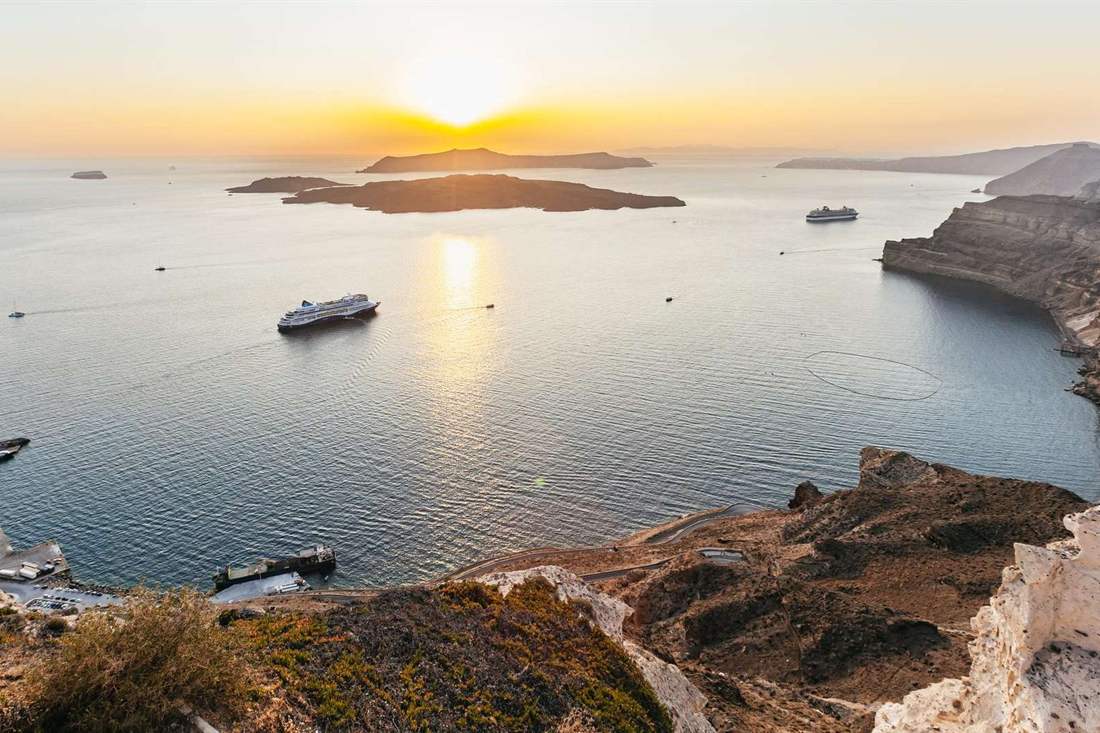
Soil is the first test for the best Greek island for wine. Wikipedia’s article on Santorini wine describes very poor vineyard soils made of volcanic ash and rock.
Rainfall is low, humidity in the growing season is high, and strong winds hit the island. Porous calcareous subsoils hold humidity and release it as moisture at night.
Vines grow low in a basket shape called kouloura, with the grapes inside the ring. Wikipedia says the leaves shield the fruit from wind and sun. A study it cites found kouloura vines kept a less stressed water status in heatwaves. That training is one reason Santorini scores high as the best Greek island for wine on terrain.
Wikipedia says the volcanic soils hold none of the clay that the pest phylloxera needs. Vines grow on their own roots, and the roots found on the island’s vines are centuries old. A tour operator’s guide, citing the national wine body, says vines sit on roots around 300 years old.
Native grapes shape the choice of the best Greek island for wine. Assyrtiko is Santorini’s flagship. Wikipedia calls it a high-acid grape with citrus and mineral notes. It keeps its acidity even when very ripe. Athiri and Aidani are the other white grapes. Aidani brings a floral aroma and blends with Athiri in dry wines.
Wikipedia, quoting a wine magazine, calls Santorini examples low-yielding and concentrated, with briny freshness and sharp acidity. It adds that Assyrtiko is called a white grape in red’s clothing for its full body. Mandilaria and Mavrotragano are the red grapes the article names.
Wikipedia lists three classified wines. Santorini needs at least 75% Assyrtiko, with Athiri or Aidani for the rest, and it is bone-dry. Nykteri also needs at least 75% Assyrtiko, and it ages at least three months in oak. Nykteri was traditionally picked at night to avoid the heat.
That rulebook helps a first taster. A tour operator’s guide notes that the label tells you what is in the bottle. For comparing one grape in its home terroir, Santorini is the best Greek island for wine.
Sweet wine matters when you rank the best Greek island for wine, and Vinsanto is Santorini’s. It comes from grapes dried in the sun for 12 to 14 days. It needs at least 51% Assyrtiko and ages at least 24 months in oak.
An EU rule gave Santorini the exclusive use of the Vinsanto name for its sweet wines. Italy keeps vin santo as a style name for its own method.
The island is small. About 1,200 hectares are under vine, and Wikipedia says tourism puts that number at risk. Sources disagree on winery counts. An island directory lists 13 wineries. A tour operator’s guide says fewer than twenty cellars take visiting groups.
The same guide adds that Santorini is small enough for one tour to reach three cellars in an afternoon. That suits a short trip to the best Greek island for wine. A hosted day needs no rental car.
The wine listing with the highest review count for Santorini on GetYourGuide shows 3,738 reviews. It is a 9-hour guided day trip rated 4.7. Wine is one stop on that day, beside Oia and a black sand beach. It adds a tasting and a talk on the island’s pruning technique.
For a pure answer to the best Greek island for wine, the next listing fits better. It is built around wine. Its frame shows a small-group tour of 4 to 4.5 hours.
That tour visits 3 wineries and pours 12 wines, among them Assyrtiko, Nykteri and Vinsanto. Guests explore a wine field, see the cellars and finish at sunset. It holds a 4.9 rating from 937 reviews.
Four tasting formats appear in the frames and sources.
- Small-group sunset tour: 3 wineries, 12 wines, 4 to 4.5 hours.
- Full-day island trip: 9 hours with one wine stop.
- Private tour: both Santorini frames list a private option.
- One-winery tasting flight: the guide says a hosted day reaches three cellars in one afternoon instead.
Crete is the contrast: a large limestone island with seven designations to Santorini’s one, says the same guide. For the cellars themselves, read our guide to Santorini wineries.
Why do wine lovers also look to Crete?
Choice is the reason. A tour operator’s guide counts seven designations on Crete against one on Santorini. It adds more than 30 member wineries in a Crete wine network. For a week of tastings, Crete is the best Greek island for wine.
Wikipedia’s article on Cretan wine says the Minoans were certainly making wine in the Bronze Age. In the second century, the Roman Empire knew Crete for a sweet wine called protropos, which went to Italy. In the late Middle Ages, sweet Candia wines, named for Heraklion, were valued in western and northern Europe.
Terrain is where the best Greek island for wine debate splits Santorini from Crete. Santorini has ash and rock. Wikipedia describes Cretan calcisol soils in the mountain ranges and limestone land from dense clay to sandy loam. Summers are hot and sunny, winters are mild and rainy, and the Aegean sends cooling breezes from the north.
Crete’s grapes widen the best Greek island for wine debate. Vidiano, a white grape indigenous to Crete, carries aromas of peach, apricot, melon and honey. Wikipedia says it is hard to grow and planted on a small scale, mainly around Rethymno and then Heraklion. Vilana, another white, makes delicate wines rarely seen outside Greece.
Reds count for the best Greek island for wine too, and Crete supplies them. Kotsifali, a red grape of Crete, grows mainly in the Heraklion regional unit. Blended with Mandilaria, it gives a ruby dry wine that needs little ageing.
Liatiko is an old red with a pale colour and moderate acidity. Historically it was blended with Mandilaria and Kotsifali to make Malvasia, a strong sweet red that Venetian traders exported.
Sources differ on the number of designations. Wikipedia names Peza, Archanes, Dafnes and Sitia among the Cretan appellations. A tour operator’s guide, citing the national register, lists seven and adds Handakas-Candia and two Malvasia wines. By that count, Crete wins on range.
Each grape has a home area. Kotsifali sits around Heraklion, Vidiano around Rethymno, and Wikipedia ties Romeiko to the Chania region. For Kotsifali, book a Heraklion wine tasting. The guide describes one winery in the Dafnes area south of Heraklion. Its tasting pours six wines in about 90 minutes.
Crete is large, so the best Greek island for wine for a long stay still needs one base. The guide says to pick one region and build the wine days there. It names Heraklion with Archanes, or Chania. Read our guide to Crete wineries before you choose.
The wine listing with the highest review count for Crete on GetYourGuide shows 2,894 reviews. Its frame shows a Chania day trip of 8 to 11 hours with a 4.7 rating. It has 4 hours of free time at Elafonissi beach, then Elos village and a Cretan wine tasting.
The second listing has 1,788 reviews and a 4.6 rating. It runs 10 hours by coach with pickup. Guests taste Cretan honey and local wine before the beach, then spend 4 hours there.
Both top Crete listings are beach trips with a wine stop. Santorini’s second listing is a winery tour. That gap matters if you rank the best Greek island for wine by winery-led tastings.
Santorini suits a wine day, and Crete suits a wine week, as the guide puts it. Pick Santorini as the best Greek island for wine for depth in one grape. Pick Crete for variety and beach days around the tastings.
What do Naxos and Paros offer wine lovers?
Between these two, Paros fits the best Greek island for wine question better. It holds a protected designation of origin and a red blend that adds a white grape. Naxos grows wine grapes too, but it holds no designation of its own.
Does Naxos farm well enough to rank as a best Greek island for wine pick? Wikipedia ranks it first in the Cyclades for size and for fertile land. Mount Zeus rises 1,001 metres, tends to trap clouds and brings greater rainfall. Wikipedia names the island’s cheese, potatoes, a lemon spirit and thyme honey. Wine is not on that list.
A Naxos travel guide agrees. It says wine is not among the products the island shows off, though visitors can find locally made bottles. So is Naxos the best Greek island for wine on the sources? No. The island wins on food first.
Sources differ on the number of wineries on Naxos, a key point in any best Greek island for wine verdict. A travel blog on Cyclades wine tasting says Naxos has no commercial winery. It adds that families make wine for their own use. A travel guide lists three wineries by village, with guided tours and tastings.
The blog says Naxian winemakers work with local and international grapes. It names Fokiano, an indigenous grape used for rosé. Wikipedia’s article on Greek wine lists five Aegean island appellations: Lemnos, Paros, Rhodes, Samos and Santorini. Naxos is not one of them.
A tasting operator’s guide gives the reason: Naxos has no PDO, so its wine carries the PGI Cyclades label. The listings tell the same story. The two top-reviewed Naxos listings in this set are food tastings, not winery visits.
One is a two-hour olive oil tasting with hands-on baking and a full meal, for small groups. It holds a rating of 5 from 101 reviews. The other is a 45-minute olive oil and honey tasting with local bites, rated 5 from 19 reviews.
Naxos wins the traveller who puts food first and wants local wine beside it. Naxos trails Paros on designation and grape rules in any best Greek island for wine ranking. Our Naxos wine tasting page lists the formats the island does offer.
Paros argues its best Greek island for wine claim with land and law. It lies 8 kilometres west of Naxos. Wikipedia describes one 724-metre mountain that slopes evenly down to a coastal plain. A Greek gastronomy guide says Paros earned its PDO for wines from two grapes, Monemvasia and Mandilaria.
The red PDO wine needs at least 35% Mandilaria, blended with Monemvasia. A tasting operator’s guide, quoting the register, says it is the only Greek PDO whose composition includes a white grape. A second PDO, Malvasia Paros, covers a sweet white wine from high-sugar grapes.
Mandilaria gives strong colour and firm tannin, the gastronomy guide says. Monemvasia, grown with care, gives white wine with its own aromas. That pairing is the Paros pitch in any best Greek island for wine debate: a blend, not one star grape.
The old vines on Paros grew low. The guide says they had no trunk. The branches crawled along the ground to shelter the grapes from strong wind. It calls that method nearly gone, with vines in straight lines now the norm. It counts four wineries today.
A travel blog on the Cyclades says one Paros winery opens its tasting room from twelve to four. It offers a range of flights. The same blog lists 75 ml pours or a do-it-yourself tasting at one Paros stop.
If the best Greek island for wine means a winery visit, the Paros listings fall short. The two top-reviewed ones that name wine skip the winery. One is a 3.5-hour cooking class with a meal and wine, rated 4.9 from 83 reviews. The other is a two-hour sunset boat trip with local wine, rated 4.6 from 46 reviews.
Side by side, the two islands differ on five points.
- Designation: Paros holds a PDO. Naxos holds none and uses the PGI Cyclades label.
- Grapes: Paros blends Mandilaria and Monemvasia. Naxos names the indigenous Fokiano.
- Terrain: Paros has one 724-metre mountain. Naxos has Mount Zeus at 1,001 metres and more rain.
- Wineries: Paros has four, per a gastronomy guide. Naxos has none or three, depending on the source.
- Listings: Paros offers a cooking class and a boat trip with wine. Naxos offers olive oil and honey tastings.
Paros wins the wine lover who wants a named designation, a red-and-white blend and a short list of producers. On this evidence, Paros takes the pair in a best Greek island for wine contest. Our Paros wineries page covers the visits in detail.
Does Rhodes or Kos suit wine lovers?
Rhodes suits wine lovers better than Kos. It has named protected grapes, a wine village on Mount Attavyros and a sommelier-led tasting. In a best Greek island for wine comparison across the Dodecanese, Rhodes leads. Kos holds an older story and one large tour.
Both islands enter the best Greek island for wine race from the Dodecanese, in the south-eastern Aegean. Rhodes is the largest island of the group. Kos is the third largest, after Rhodes and Karpathos, and it measures 42 by 11 kilometres.
Rhodes has a mountainous interior of pine and cypress forest, Wikipedia says. The shores are rocky, but strips of arable land grow citrus, wine grapes, vegetables and olives. Embonas sits halfway up Mount Attavyros, a grey peak 1,215 metres high. Wikipedia calls it the centre of the wine industry on Rhodes.
The Greek tourism board’s wine page credits a microclimate. Long sunshine and winter rain ripen the grapes. From late spring to early autumn, sea breezes and the meltemi wind cool the vines. The page says that cooling gives the wines acidity and aroma.
The same page lists four PDO varieties worth checking when you judge a best Greek island for wine.
- Athiri: the flagship white, with citrus and fruit aromas.
- Mandilaria, also called Amorgiano: the red, with deep colour and strong tannins.
- White Muscat and Trani Muscat: grapes for sweet, aromatic wines.
- Assyrtiko: adapted to the island’s soil, with minerality.
Wikipedia adds that Athiri ties so closely to Rhodes that wine labels can print Rhodes as its synonym. On Mandilaria, sources describe the wine in different terms. Wikipedia’s grape article calls it light bodied. Its Greek wine article and the tourism page call it tannic.
A tasting operator’s guide gives Rhodes a second point in the best Greek island for wine tally. It quotes Wines of Greece saying Rhodes has long led Greek bottle-fermented sparkling wine. The guide adds that a number of popular bottlings are tank fermented.
The top-reviewed wine listing for Rhodes on GetYourGuide shows 401 reviews and a rating of 4.9. It is a 50-minute private tasting for beginners, led by a sommelier, with Greek grape varieties and local food. It runs in English and Greek. The frame marks it wheelchair accessible.
The second Rhodes listing is a nine-hour small-group tour by minibus. It visits Lindos, Prasonisi and Monolithos Castle, with wine, olive oil and honey tastings in the day. It shows 265 reviews and a rating of 4.5, and pickup is available. That is a sightseeing day with a tasting, not a winery day.
On history alone, Kos has a case in the best Greek island for wine argument. Wikipedia’s Coan wine article says the style was invented on Kos in classical antiquity and was known for its saltiness. Pliny says a slave made it by accident, adding sea water to the must.
Makers on Rhodes copied the salty style, the article adds. From about the fourth century BC, Coan wine was exported in large quantities. Wikipedia also lists grapes among the main crops of Kos today. Kos is missing from the appellation list named earlier, and the sources read here name no modern Kos designation.
The top-reviewed wine listing for Kos on GetYourGuide shows 423 reviews and a rating of 4.5. It is a three-hour tour of two Dodecanese wineries, with guided winemaking talks, a vineyard stroll and wine pairing. Transport is part of the listing, and the frame marks it wheelchair accessible.
The second Kos listing is a 4.5-hour tuk tuk tour from Pyli. It combines olive oil, an aloe vera farm and a vineyard walk with wine tasting. It shows a rating of 4.8 from five reviews, in English. Today, the case for Kos as the best Greek island for wine rests on the first tour.
Rhodes wins the wine lover who wants named grapes, a wine village and a sommelier-led tasting. Kos wins the traveller who wants one clear winery tour on a compact island. Rhodes edges this pair on a best Greek island for wine count. Our Rhodes wine tasting page and Kos wine tasting page cover each island in full.
Is Kefalonia the best Greek island for wine across the Ionian Sea?
For a traveller who follows one grape, Kefalonia is the best Greek island for wine. Robola, a dry white with a lemon note, grows mainly here. A tour-operator guide counts three protected designations of origin on the island.
Wikipedia’s article on Robola calls it a white grape grown primarily on Cephalonia. The vine ripens early and makes high-acid wine. The wines are dry and medium bodied with a clear lemon note. Wikipedia’s article on Greek wine adds a smoky, mineral side and pairs the wine with seafood.
Terrain backs Kefalonia’s claim to be the best Greek island for wine. Wikipedia says plains cover under 15 percent of Cephalonia, and the island is largely rugged and mountainous. Robola vines can grow ungrafted, on their own roots, in its limestone soils.
Sources differ on where the Robola vines sit. Wikipedia’s map marks the south eastern parts of the island. A wine-tour operator’s guide puts a 180-hectare Robola zone on the western slopes of Mount Ainos. It gives the height as 175 to 800 metres. Plan any drive from the winery’s own address.
The same guide names three designations for Kefalonia. That is the largest count among the Ionian islands in this section.
- Robola of Kefalonia: the dry white described above.
- Mavrodaphne of Cephalonia: Wikipedia says the grape is native to Achaea in the Peloponnese and also names Kefalonia as an important growing area. The wine was sweet and fortified in the past, and producers now also make dry reds.
- Muscat of Cephalonia: named by the guide. The sources checked for this page give no style details.
Wikipedia traces a puzzle in Robola’s past. The grape was once thought to match Friuli’s Ribolla. Venetian merchants were thought to have carried it to Italy in the thirteenth century. DNA profiling cast doubt on that idea. The Vitis International Variety Catalogue now lists Robola as a separate variety.
Scale matters when you weigh the best Greek island for wine. A wine magazine’s travel feature calls the island’s largest producer a cooperative that buys grapes from 300 growers. Its total production is half a million bottles. The same feature says one artisanal winery makes no more than 25,000 bottles.
Two routes let a visitor test the best Greek island for wine in person. The longer one climbs from Argostoli to the Omala plateau, at the heart of the Robola vineyards. The shorter one tours Paliki, near Lixouri. The feature names solid Robola, Mavrodaphne and Muscat from two Paliki producers.
The listing frames test the claim of the best Greek island for wine against what visitors book. The Kefalonia listing with the highest review count on GetYourGuide is a nine-hour guided tour. It has 386 reviews and 4.8 stars. Its frame names Melissani Lake, Drogarati Cave, Fiscardo, Myrtos Beach and a Robola tasting, with pickup available.
A second listing, an eight-hour guided tour with 23 reviews, adds a Robola winery and Agios Gerasimos Monastery. Both frames offer pickup and free cancellation. The frames do not state the number of wines poured.
Verdict: Kefalonia wins the title of best Greek island for wine among these three, for a grape-led traveller. It is not the pick for a short, wine-only day, because both listings checked fill a whole day. Our Kefalonia wine tasting guide names the wineries that take visitors.
Do Corfu and Zakynthos make good wine islands?
Yes, but neither tops Kefalonia as the best Greek island for wine. Corfu grows native Kakotrygis and Petrokoritho, and its top listings sell food. Zakynthos is tied to Verdea, a high-acid white, and sells short winery visits.
Corfu enters any talk of the best Greek island for wine through tradition. Wikipedia’s article on Corfu says the island is largely olive groves and vineyards. It has made olive oil and wine since antiquity. A source cited there counted 1,800 hectares of vines, led by white Kakotrygis and red Petrokoritho.
Both lead grapes come in red and white versions, the source says. Wikipedia names five main grapes on the island:
- Kakotrygis: the indigenous white.
- Petrokoritho: the indigenous red.
- Robola: the white grape of Cephalonia.
- Moschato: the Aegean white muscat.
- Mavrodaphne: the grape of Achaea.
Two ranges split Corfu into three districts: mountainous north, undulating centre and low south. Mount Pantokrator reaches 906 metres. Wikipedia calls the winters very rainy and much wetter than on other Greek islands.
Designations are the gap. Wikipedia’s article on Greek wine lists Corfu as an Ionian wine region. No source checked for this page names a protected designation of origin for Corfu wine. A wine lover who judges the best Greek island for wine by labels will rank Kefalonia higher.
Listings show where Corfu fits in the best Greek island for wine contest. Of the food and drink listings checked, the two with the highest review counts are not wine tastings. One is a three-hour food walk in Corfu Town with 427 reviews and 4.9 stars.
Its frame lists a seated lunch, food stops and a small group. The other is a 40-minute private olive oil tasting with 182 reviews and 5 stars. Neither frame mentions wine.
Corfu wins for a food-led day with a native grape on the table. Our Corfu wine tasting guide covers the estates that welcome visitors.
Zakynthos joins the search for the best Greek island for wine with one wine. A wine-search site’s regional page calls Verdea the island’s main wine by a wide margin. It is a white with high acidity, traditionally aged in oak, and it suits local seafood.
The page names four grapes behind Verdea: Robola, Skiadopoulo, Katsakoulis and Pavlos. The name comes from verde, the Latin word for green, and points to picking the grapes slightly unripe. Greek wine law lists Verdea as an Appellation by Tradition, the category retsina also holds.
The island’s west holds mountains up to 760 metres, and the east holds fertile lowlands. The same page places the bulk of the vineyards in the east, with small family producers. A poem from the early seventeenth century lists grape varieties still grown there.
History weighs on the best Greek island for wine question here. Under Venetian rule, a large number of vines gave way to currants. By the eighteenth century the island and Cephalonia ranked among the world’s largest currant exporters. Vineyards have grown in area again since the early nineteenth century.
Verdea is by far the main wine, but the page also lists red wines from Avgoustiatis and Xynomavro. A sweet white called Lianoroidi has declined sharply in the past century.
One Zakynthos listing is a one-hour winery and vineyard tour with 66 reviews and 4.4 stars. Its frame names a family-owned winery and a meeting with the winemaker. It asks for booking at least 24 hours ahead. A two-hour private organic farm tour with olive oil and wine tasting has only 2 reviews.
Verdict: Zakynthos wins for a one-hour winery visit and a taste of Verdea. It trails Kefalonia in the search for the best Greek island for wine by designation count. Our Zakynthos wine guide covers Verdea in more depth.
Robola links the three contenders for the best Greek island for wine. Wikipedia places it primarily on Cephalonia and lists it among Corfu’s grapes. The wine-search page lists it among the grapes behind Verdea. A traveller who likes high-acid whites can follow one grape across all three islands.
Which smaller islands pour good wine too?
Five smaller islands also make a claim to the best Greek island for wine: Tinos, Samos, Milos, Mykonos and Syros. Tinos grows grapes among granite boulders, and Samos presses sweet Muscat. The other three have one or two small producers each.
Wikipedia’s article on Tinos describes giant boulders around the village of Volax and hills terraced with stone walls. A Greek wine magazine says one winery farms granite soil at 400 metres. The same magazine says geologists date the boulders there to 15 to 25 million years ago. Our guide to Tinos wineries goes deeper.
Wikipedia’s article on the Mavrotragano grape says its cultivation has spread beyond Santorini to Tinos and Crete. A Greek food guide says the flagship winery planted its four estates at 10,000 vines per hectare. It adds that the greater part of the production is exported, mainly to France.
We found no Tinos wine listing on GetYourGuide, so a visit means contacting a winery yourself. Without a bookable tour, Tinos still earns a seat in the argument over the best Greek island for wine.
A great portion of Samos is covered with vineyards, says Wikipedia’s article on the island. A booking site says PDO Samos is made entirely from Muscat Blanc. Our guide to Samos wine covers the island in more detail.
Wikipedia’s article on Samos adds that the island was renowned for its wines in classical antiquity. Its article on the Muscat grape says emerging independent producers now lean toward dry or even sparkling styles.
The only Samos wine listing we found is a one-hour winery tour with 4 wines and local bites. It shows 18 reviews and runs in English. For sweet wine, the best Greek island for wine claim belongs to Samos.
Wikipedia’s article on the Cyclades names Milos and Santorini as the two volcanic islands of the group. A Greek wine magazine lists one Milos winery, near the fishing village of Pollonia. It makes about 5,000 bottles a year, all sold on the island. Read more in our guide to Milos wine.
The sources differ on the number of wines that winery pours. The magazine names three wines, while a travel blog describes a flight of six. The only Milos listing we found is a five-hour yacht cruise with 140 reviews. Its open bar lists wine among the drinks.
With one winery and no winery-visit listing, Milos is a stop on a wider trip. It does not compete as the best Greek island for wine.
The top-reviewed Mykonos wine listing on GetYourGuide shows 555 reviews. It is a two-hour guided vineyard walk with food and wine tasting, offered in English and Greek. No other smaller island here shows more than 140 reviews. That count favours Mykonos when the best Greek island for wine is judged on bookable choice.
The sources differ on the producer. A travel blog calls one organic farm the island’s only commercial winery. A Greek wine magazine says the same farm has no winery of its own, so its wine is made elsewhere. Our guide to Mykonos wine follows the farm.
The same blog says Mykonos bar lists lean toward Bordeaux over Greek grapes. It advises going to the farm for local wine. Mykonos wins on listings, not on vineyards. Anyone who ranks islands by bookable tastings can start here.
A Greek wine magazine says Syros hosts two wineries. One makes a white from Assyrtiko, a white from Monemvasia and Kountoura, and a red from Mandilaria. The other makes two wines, from Serifiotiko and Assyrtiko. The first winery’s wines sit in shops on Syros and Tinos.
Syros fits a traveller who wants native Cyclades grapes in a small setting. It is not the best Greek island for wine on grape count. It does add names the larger islands do not feature.
Lemnos belongs on the list for its grape story. Wikipedia’s article on the Limnio grape says the grape is indigenous to Lemnos. The island’s appellation wine, it adds, comes from Muscat of Alexandria. A booking site lists two PDOs for Lemnos, Limnos and Muscat of Limnos.
We found no Lemnos wine listing. So Lemnos cannot claim the best Greek island for wine on bookable tastings.
Each of the five main islands has one more fact that helps a choice. Weigh these before you settle on the best Greek island for wine:
- Tinos – a Greek wine magazine lists four grapes on the 40-hectare flagship estate: Assyrtiko, Malagousia, Avgoustiatis and Mavrotragano.
- Samos – Wikipedia’s article on the Muscat grape lists a Vin Doux Naturel, aromatic dry whites and a straw wine, with the high-quality vineyards between 500 and 1,000 metres.
- Milos – a travel blog describes a self-guided walk through the vineyard and the cave cellar before the tasting.
- Mykonos – the magazine lists a white from Assyrtiko and Athiri, a red from Mandilaria and Agiannitis, and a sweet wine from sun-dried grapes.
- Syros – a ferry-booking site says the number of wineries has grown in recent years, but it gives no new count.
The five smaller islands split the work. Tinos and Samos win on the wine itself. Mykonos wins on bookable tastings. Milos and Syros fit a short stop. Your own test, grapes or tours, picks the best Greek island for wine from these five.
Is the best Greek island for wine different for each kind of wine lover?
Yes. The best Greek island for wine changes with the tasting. Santorini suits a sunset, Crete a winery lunch, Mykonos a small group and Rhodes olive oil. Syros suits cheese, and Corfu suits a tasting room or a farm walk.
Each line below rests on one GetYourGuide listing. The hours, the review count and the group type come from the listing frame, not from a ranking. Read each line as one short answer. Which pick is the best Greek island for wine for that kind of lover?
- Sunset seeker – Santorini: a five-hour tour visits 2 wineries, pours about 8 samples and ends with the sunset in Oia; the listing shows 226 reviews.
- Lunch lover – Crete: a six-hour small-group tour joins Knossos, a winery with wine and olive oil tastings, and Cretan dishes; the listing shows 130 reviews.
- Small-group fan – Mykonos: a farm tasting with a dish is booked as a small group, with pickup available; the listing shows 116 reviews.
- Private-tour buyer – Santorini: a 4.5-hour private tour visits 3 wineries and pours 12 wine varieties with local snacks; the listing shows 44 reviews.
- Olive oil fan – Rhodes: olive oil, olives and wine come in one tasting of 1.5 to 3 hours at a local winery; the listing shows 89 reviews.
- Tasting-room visitor – Corfu: a one-hour small-group tasting in the only dedicated tasting room of Corfu Old Town, led by a certified sommelier; 122 reviews.
- Food pairer – Syros: local cheeses and homemade bread come with the wine in a mansion in Ermoupolis; the listing shows 1 review.
- Farm walker – Corfu: a one-hour farm walk among old vines and olive trees ends with a tasting of wine, olive oil and honey; the listing shows 5 reviews at a 5.0 rating.
Two islands can tie on a kind. Then compare four facts from the listings: length, number of wines, languages and review count. The Mykonos farm tasting runs 3 hours, pours 4 wines and offers English only. The Syros mansion tasting runs 1.5 hours, pours 5 wines and offers Dutch, French, English and Greek.
Thin review counts need care. The Syros line shows 1 review and the Corfu farm walk shows 5. Each rests on a very small sample. The Santorini lines rest on 226 and 44 reviews, which is a firmer base for a pick.
Santorini and Corfu take two of the eight kinds each. Crete, Mykonos, Rhodes and Syros take one each. Eight kinds spread over six islands show this. No single island leads every format, so the best Greek island for wine splits by kind.
The frames do not state the grape list or the vineyard area, so these lines compare formats, not wine quality. That limit turns the best Greek island for wine into a matter of format.
The kind decides more than the island does. Name the tasting you want first, and the best Greek island for wine follows from the listing facts above.
When is the best time to visit the best Greek island for wine?
Whichever you pick as the best Greek island for wine, check the calendar first. Six of the eleven booking calendars I read list tastings only between April and October. Five list dates in every month.
The calendars differ even on one island. A Naxos 50-minute tasting lists dates from July to October. A Naxos vineyard walk lists late spring to October. A Naxos private winery tour lists dates in every month. The best Greek island for wine in autumn depends on the listing, not only on the island.
Other frames follow the same split. A Santorini winery tour with a meal lists April to October. A Kos one-hour tasting lists dates from late spring to October. A Kefalonia three-winery tour lists four or five dates a month, from late spring to September. A Rhodes winemaker tour lists April to October.
A visitor who wants the best Greek island for wine in winter finds five listings with dates in every month. Two are on Corfu, one is on Paros, one is on Naxos and one is in Athens. A calendar shows open dates, not the opening hours of the winery itself.
A directory page lists Santorini wineries as open from April to October. It lists Paros and Rhodes as late spring to October, when estates run tours. It gives 11 am to 7 pm as the standard tasting hours. It says July and August need booking 24 hours ahead.
The best Greek island for wine at harvest depends on the grape. The directory page puts the Santorini harvest in late July to August and the Crete harvest in August to September. It puts the Muscat harvest on Samos and Limnos in August.
Wikipedia’s article on Greek wine gives no harvest dates. No source I read compares spring and autumn tastings for the best Greek island for wine. One travel blog reports a small winery that was open in harvest season with nobody free to pour. That is one account, not a rule.
Wikipedia’s article on Santorini wine says Nykteri wine was traditionally harvested at night to avoid the hot temperatures. It adds that a number of producers still pick at night. The directory page tells visitors to go in the late afternoon, when vineyards are cooler. Heat sets the hour, whichever island you call the best Greek island for wine.
Opening hours decide which day works when you visit the best Greek island for wine. A booking-site comparison lists one cooperative on Kefalonia as open Monday to Saturday from 9 am to 8 pm. On Sunday it closes at 3 pm. It lists one small winery on Thirassia as open from April to October and closed on Tuesdays.
The same comparison says opening hours change and tells readers to confirm them on the winery’s own page. A Cyclades travel blog reports one winery that took walk-ins. It found a small farmhouse winery closed on two visits. The blog advises asking ahead for a tasting time.
How do wine tastings on the Greek islands run, and how do you book one?
Choose the format first on the best Greek island for wine. The island frames I read run from 50 minutes to 8 hours and pour from 5 wines to 18 tastings. Five include pickup, and every one carries the label Free cancellation.
- Short cellar-style tasting: a Naxos Town listing runs 50 minutes and pours five native Naxian wines with fish charcuterie.
- Vineyard walk: a Naxos estate listing runs 2 hours, walks a vineyard, then tastes wines with foods made on the estate.
- Multi-winery day with transfer: a Kefalonia listing runs 6.5 hours, visits three wineries and names 18 tastings in its title.
- Private tour: a Paros listing runs 4 hours for a private group, visits two wineries and pairs the wines with meze.
- Pairing without the trip: an Athens listing serves six Kefalonia wines with food pairing, so the best Greek island for wine can reach you in the capital.
Group type sits in the frame. A Kefalonia tour of 4.5 hours is a small group with pickup and a light lunch. A Santorini tour of 4 to 5 hours is a small group with pickup, a sommelier and a full meal. A Naxos private winery tour runs 1.5 hours with local cheeses.
Two formats add an activity. A Corfu e-bike tour runs 4 hours, rides through olive groves and visits one local winery for a guided tasting. A Rhodes tour with the winemaker runs 4 hours. It adds a Greek cooking session and ends with meze and a tsipouro tasting.
Wine counts sit in titles and summaries. A Heraklion tour pours 15 Cretan wines for no more than six guests, then moves to a restaurant for lunch. A Corfu one-hour tasting pours five native grape varieties. Its summary also lists wines from Naousa, Crete and Santorini.
Language and group size sit in the booking form. The Corfu e-bike frame offers English, Greek and French. The Naxos vineyard frame offers English and Greek, with two guests as the minimum and fifteen as the maximum. The Athens frame offers French, Greek, Spanish and English. Check the language list before you pick the best Greek island for wine.
The booking steps look the same on the best Greek island for wine and on a smaller island. You pick a date, the guests and a language. The cut-off differs. The Naxos vineyard frame needs 30 minutes, and the Rhodes winemaker frame needs 9 hours.
All thirteen frames I read carry the label Free cancellation. None gives the hour at which free cancellation ends, so read the full listing. Nine of the thirteen set a booking cut-off of 10 hours.
Ratings and review counts help you choose between listings on the best Greek island for wine. The Santorini tour with a meal shows 5 stars on 384 reviews. The Kos one-hour tasting shows 4.7 stars on 4 reviews. The Paros private tour carries the label New activity and shows no stars, so no review backs it yet.
What do travellers ask about wine on the Greek islands?
Travellers ask about transport, wine counts, food, vine age, season, non-drinkers, grapes and children. Each answer on the best Greek island for wine comes from a frame, Wikipedia or a named type of source. Where no source gives a number, the answer says so.
Two frames carry the label Wheelchair accessible: the Athens pairing and the Corfu one-hour tasting. Readers who plan around age and mobility can also read how we rank the best Greek island for over 50s.
Can you taste wine on a Greek island without a car?
Yes, on listings with pickup, on the best Greek island for wine and elsewhere. Five frames I read carry the label Pickup available, on Kefalonia, Paros, Santorini and Crete. A booking-site comparison says a large number of Santorini three-winery tours add hotel pickup and drop-off.
What number of wines does a tasting pour?
The wine count poured on the best Greek island for wine sits in each listing. The frames give five wines on Naxos and six Kefalonia wines in Athens. They give 15 Cretan wines near Heraklion and 18 tastings across three Kefalonia wineries.
Do wine tastings on the Greek islands include food?
Yes, on listings that name it. Frames name fish charcuterie on Naxos and meze on Paros. They name a light lunch on Kefalonia, a gourmet lunch near Heraklion and a full meal on Santorini. The Corfu one-hour tasting names no food.
Which Greek island grows the oldest vines?
No source I read names one island with the oldest vines. Wikipedia’s article on Santorini wine says a large number of vine roots there are centuries old. It links this to volcanic soil without clay.
Is the best Greek island for wine the same in spring and autumn?
No source ranks islands by month. A directory page puts the Crete harvest in August to September. Frames show a Kos tasting from late spring to October and a Kefalonia tour whose calendar ends in late September.
Can you join a tasting as a non-drinker?
No frame I read states a rule for guests who skip alcohol. None lists an alcohol-free pour, on the best Greek island for wine or elsewhere. Ask the operator through the listing before you book.
Which grape is native to Santorini?
Assyrtiko. Wikipedia’s article on the grape calls it indigenous to Santorini. The same article says the grape also grows on Paros and in Chalkidiki.
Can children join a winery visit?
Three frames list a child category. A Kefalonia tour sets it at ages 15 and under. A Kos tasting sets it at ages up to 17. A Heraklion tour sets it at ages 2 to 12. The frames do not say what children are served.