
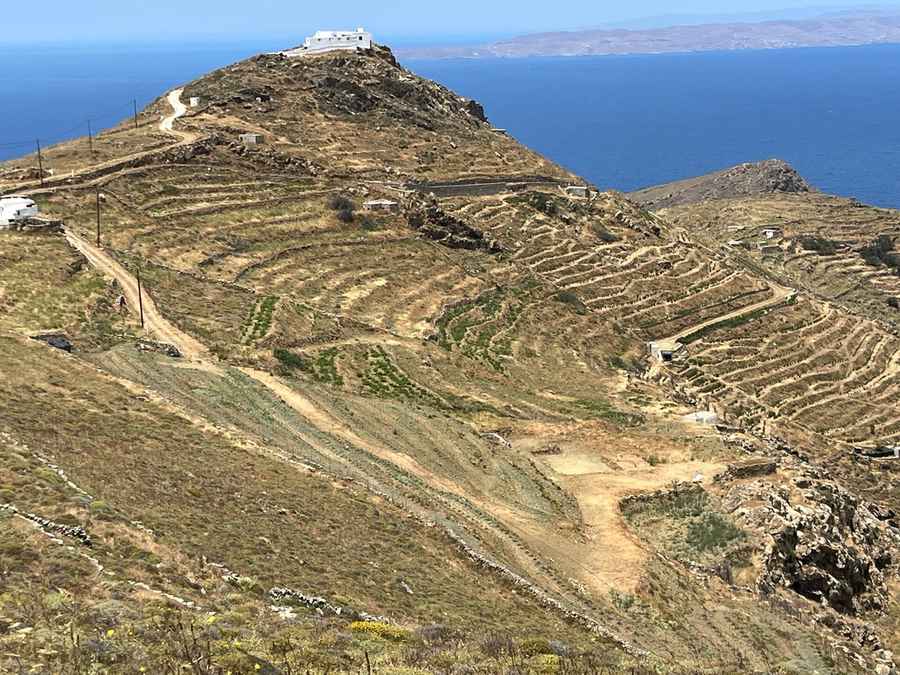
Tinos wineries grow assyrtiko and the rare mavrotragano grape among the island’s giant granite boulders, producing mineral whites and structured reds that reach fine-dining lists across Greece. Led by T-Oinos, Volacus and Domaine de Kalathas, the island’s revived wine scene has turned a once-abandoned tradition into one of the most exciting in the Cyclades. This guide covers the Tinos wineries, their wines and how to visit. Plan the whole trip with Greece Tours.
The vineyards cluster on the central plateau around Falatados and Steni, where granite, wind and altitude shape the fruit. Wine has become a serious draw alongside the island’s other food traditions, detailed in the guide to the food and wine of Tinos. The sections below cover the main producers, the grapes and the tasting experience.
What are the wineries of Tinos?
The wineries of Tinos are led by T-Oinos, Volacus Wine and Domaine de Kalathas, all on the central plateau. They grow native Cycladic grapes among granite boulders and have revived an island wine tradition nearly lost in the last century.
The Tinos wineries form a small but acclaimed group. T-Oinos is the flagship estate, Volacus a boutique producer near Falatados, and Domaine de Kalathas a champion of natural wine and old native varieties. Each works the difficult, boulder-strewn terrain of the central plateau, often organically. Together they have rebuilt a wine culture that had nearly vanished, drawing critics and wine lovers to the island. Their success rests on the island’s unusual terroir. The grapes they grow define the style.
What wine does Tinos produce?
Tinos produces mineral white wines from assyrtiko and structured reds from the rare mavrotragano grape, alongside native varieties such as potamisi, koumariano and rozaki. The granite soil and sea wind give the wines freshness, minerality and depth.
The island’s wines reflect its land and its grapes. Assyrtiko, the great white grape of the Cyclades, yields crisp, mineral whites with citrus and saline notes. Mavrotragano, a rare red revived from near extinction, produces deep, structured reds with dark fruit and spice. Older native varieties, including potamisi, koumariano and rozaki, add character to blends and single-varietal bottlings. The wines lean fresh, mineral and food-friendly, suiting the island’s cuisine. The flagship estate set the standard.
What is T-Oinos winery?
T-Oinos is the flagship winery of Tinos, founded by sommelier Gerard Margeon on a rocky outcrop near Falatados. Its organic vineyards grow assyrtiko and mavrotragano among granite boulders, producing acclaimed whites and reds in limited quantities.
T-Oinos put the island on the wine map. The estate began when a sommelier recognised the potential of the mineral-rich, boulder-strewn ground on the central plateau, planting vines in the pockets of soil between the rocks. The organic vineyards yield assyrtiko for mineral whites and mavrotragano for structured reds, the whites making up the larger share of a limited annual production. The wines now appear on fine-dining lists in Greece and abroad. The boulder vineyards are among the most striking and most photographed on the island. The estate also helped prove that mavrotragano, once almost extinct, could produce world-class red wine, encouraging others to plant it. Its cellar and tasting space sit amid the dramatic landscape that gives the wines their identity. A smaller estate matches it for character.
What is Volacus Wine?
Volacus Wine is a boutique Tinos winery near Falatados, named after the round granite rocks, the volakes, among which its vines grow. Its first harvest won national acclaim, and it welcomes visitors for tastings in a courtyard shaded by a plane tree.
Volacus is the island’s celebrated small producer. Founded by a local winemaker and named for the volakes, the round granite boulders that fill the plateau, the vineyard lies a few kilometres from Falatados. Its early vintages drew national praise and quickly reached Greek restaurants and wine shops. Visitors can taste at the estate by appointment in the warmer months, when a table is set with local treats and wine in the vineyard courtyard beneath a plane tree. The intimate setting makes it a highlight for visiting wine lovers. The personal welcome from the winemaker, the shade of the plane tree and the plates of local cheese and louza turn a tasting into a relaxed afternoon. Reservations are required, since the estate is small and opens only on set evenings in summer. A third estate champions natural wine.
What is Domaine de Kalathas?
Domaine de Kalathas is a natural-wine estate on Tinos that revives old, ungrafted vines and rare native grape varieties. Its low-intervention wines, made with minimal additives, have earned a cult following among natural-wine enthusiasts.
Domaine de Kalathas takes a different path among the Tinos wineries. The estate focuses on old, ungrafted vines and forgotten native varieties, farming organically and making wine with minimal intervention and few or no additives. The results are distinctive, characterful natural wines that have built a devoted following in Greece and abroad. The project doubles as a rescue of the island’s vinous heritage, preserving grapes that had nearly disappeared. It rounds out a small but diverse wine scene. The land itself explains the quality.
Why are the Tinos vineyards unique?
The Tinos vineyards are unique because the vines grow in pockets of soil between giant granite boulders, sheltered from the meltemi wind. The granite, the altitude and the sea air concentrate the fruit and give the wines their mineral character.
The terroir sets the island apart. Across the central plateau, vines grow low and bush-trained in the gaps between the volakes, the great rounded granite rocks that shelter them from the relentless meltemi wind. The mineral-rich granite soil, the altitude and the constant sea air stress the vines and concentrate their fruit, producing wines of notable freshness and minerality. The boulder vineyards are as scenic as they are productive, making a visit memorable. This dramatic landscape is the signature of the island’s wine country. The granite also stores and radiates heat, helping the grapes ripen despite the cooling wind, while excellent drainage keeps the vines healthy. Yields are naturally low, which concentrates flavour but limits production, so the wines are made in small, sought-after quantities. Visiting for a tasting is straightforward.
Can you visit Tinos wineries for a tasting?
Yes, you can visit Tinos wineries for tastings, usually by appointment in the warmer months. Estates such as Volacus open to visitors in summer, offering guided tastings of their wines paired with local treats among the vines.
Wine tourism has grown alongside the wines. Several of the Tinos wineries welcome visitors for tastings, generally by prior arrangement and mostly from late spring to early autumn. A typical visit includes a walk through the boulder vineyards, an explanation of the grapes and the granite terroir, and a guided tasting paired with local cheese and charcuterie. Booking ahead is essential, since the estates are small and hours are limited. A wine tasting combines easily with a marble-village or food tour, as the guide to Tinos tours and guided experiences shows. Reaching the vineyards is simple.
How do you get to the Tinos wineries?
You get to the Tinos wineries by car or scooter to the central plateau around Falatados, about 25 minutes from Tinos Town. The estates cluster near the village, which also makes a good base for a wine and food day.
Access to the vineyards is easy by island standards. A rental car or scooter reaches the plateau around Falatados in about 25 minutes from Tinos Town, with the estates a short distance from the village. Falatados and nearby Steni offer tavernas for a meal between tastings, pairing the wine with local raki, cheese and meze. A designated driver or a guided wine tour is wise given the tastings. The villages and vineyards combine into a rewarding half-day, set among the villages of Tinos. The questions below cover the points travellers ask most.
Frequently Asked Questions
What wineries can you visit in Tinos?
You can visit Tinos wineries including Volacus near Falatados, with T-Oinos and Domaine de Kalathas also producing on the central plateau. Tastings are usually by appointment in the warmer months, set among the boulder vineyards.
What wine is Tinos known for?
Tinos is known for mineral assyrtiko whites and structured reds from the rare mavrotragano grape, grown among granite boulders. The wines of estates like T-Oinos and Volacus reach fine-dining lists across Greece and abroad.
Why is Tinos wine special?
Tinos wine is special because the vines grow in soil pockets between giant granite boulders, sheltered from the meltemi wind. The granite, altitude and sea air concentrate the fruit, giving the wines a distinctive freshness and minerality.
Can you do a wine tour in Tinos?
You can do a wine tour in Tinos that visits the vineyards near Falatados for guided tastings, often combined with a food or marble-village experience. Booking ahead is essential, as the estates are small with limited opening hours.