
Daylight at Meteora lasts 14 hours 59 minutes on 21 June and 13 hours 31 minutes on 21 August. Wikipedia’s Trikala climate box puts the average July high at 33.5°C, and the Meteora Tours guide lists 34°C for the same month. A holiday here is built around those two numbers: how much light you get and how hot midday runs.
Wikipedia counts six working monasteries among the rock pillars, with Kalambaka and Kastraki at their base. If you also want sea days on the same trip, the Greece Tours homepage points to the islands and coasts we cover.
What do Meteora summer holidays look like?
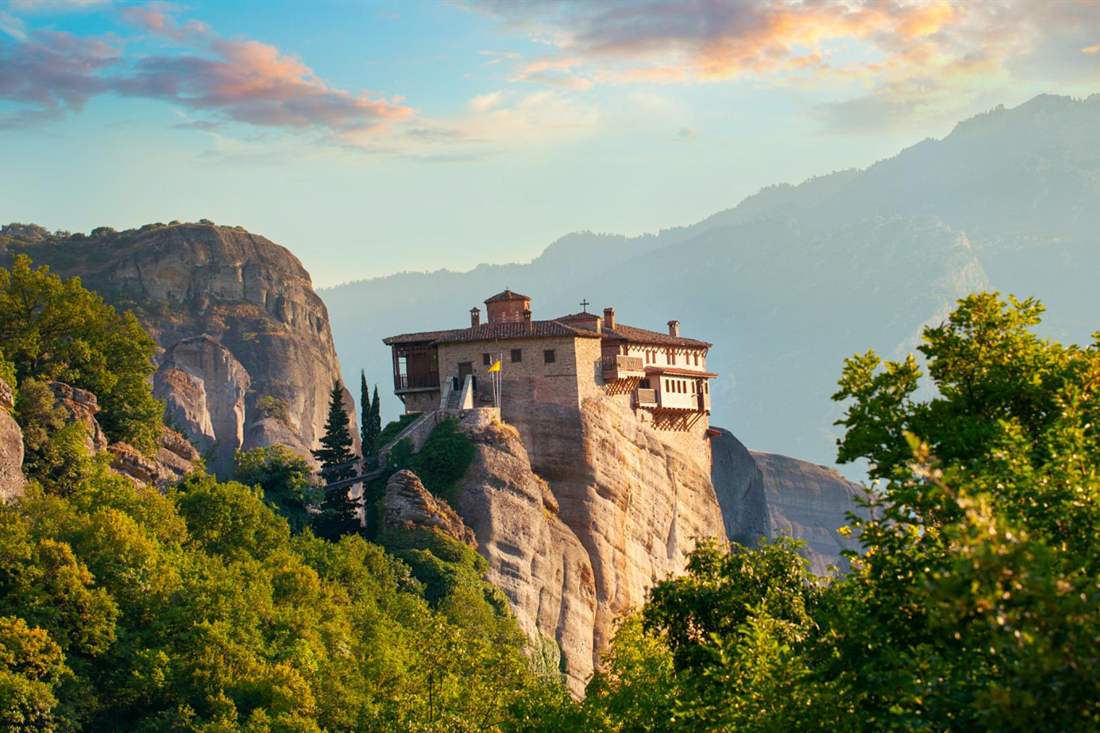
Meteora summer holidays revolve around sandstone and conglomerate pillars in Thessaly. Wikipedia says twenty-four monasteries were founded on them. It counts six that still function, four of men and two of women.
Wikipedia dates those foundations mainly to the second half of the 14th century. Each of the six working monasteries houses fewer than ten people, it adds. The name Meteora means lofty or elevated.
The sources do not agree on every count. The Cultural Foodies blog says there were 25 monasteries at first and names the same six survivors. Wikipedia’s own lead is less sure. It lists four monasteries as occupied and two as no longer active as monasteries.
Two places sit at the base of the rocks behind Meteora summer holidays, the Maman Voyage blog says. Kalambaka is the town. Wikipedia spells it Kalabaka and says the whole Meteora massif belongs to one municipal unit of that name. Kastraki is the village. Wikipedia says the rocks surround it and border the north side of Kalabaka.
Our Meteora travel guide covers the monasteries and the rocks in full.
The guides describe three kinds of day inside Meteora summer holidays:
- A monastery morning: the Maman Voyage blog puts the walk to each monastery entrance at 10 minutes at the longest. Its writer saw four monasteries, says all six were possible, and went in October.
- An evening on the rocks: Visit Meteora lists sunset viewpoints among its summer experiences and says the rocks glow copper.
- A day on foot: Cultural Foodies gave one day to three monasteries and lookouts, then a second day to the hiking trails.
The same Maman Voyage writer only imagines that the walk feels completely different in the heat of summer. Original Travel, a holiday seller, says its Meteora holidays are about views as much as monasteries. It also mentions an hour’s hike up to the Great Meteoron.
Wikipedia says Meteora lies close to the Pineios river and the Pindus range. Of the guides read for this section, none describes a water day from Kalambaka.
Two guides say what sets Meteora summer holidays apart. The Meteora Tours guide calls summer the hardest season to manage well. It also says the landscape begins to dry toward summer gold by late spring and is baked dry in August.
The same guide says a July trip fixed by work and school holidays is absolutely worth doing. Visit Meteora lists travellers who want long days and the classic summer feel among those the season suits.
Wikipedia’s Meteora article gives no summer rule or timetable. Every tip about Meteora summer holidays here comes from a named guide.
How hot do Meteora summer holidays get in Kalambaka and Trikala?
Meteora summer holidays run hot. Wikipedia calls summers at Trikala very hot, with climate-box highs above 32°C from June to August. Trikala lies close to Meteora, and Kalabaka has no climate box, so Trikala stands in.
The box gives these figures for the three summer months:
- June: average high 32.8°C, average low 18.5°C, rainfall 33.8 mm.
- July: average high 33.5°C, average low 20.3°C, rainfall 17.0 mm.
- August: average high 34.5°C, average low 19.9°C, rainfall 18.3 mm.
The box is labelled Trikala Castle and cites a Trikala weather station. It names three years for temperatures and a longer run for rainfall. Every number about Meteora summer holidays in this section rests on that short sample.
Wikipedia files Trikala under a Mediterranean climate and notes a significant gap between day and night. The high sits 14.3°C over the low in June, 13.2°C in July and 14.6°C in August.
In Fahrenheit, Meteora summer holidays face highs of 91.0, 92.3 and 94.1. Rain is thin. The three months add up to 69.1 mm. July is the driest month in the whole box, and February is the wettest at 80.2 mm.
Visit Meteora describes the climate behind these holidays as hot, dry summers and cooler, wetter winters. It calls that pattern typical of inland northern Greece.
A second source gives a table for Meteora itself. The Meteora Tours guide lists a June high of 30°C and low of 17°C. July reads 34°C and 20°C. August reads 34°C and 19°C. Every month sits within three degrees of the Trikala box.
The two sources split on the driest month. The Meteora Tours table lists about 3 rain days in July and about 2 in August. It calls August the driest. Wikipedia’s box has July drier by 1.3 mm. Neither source lists a record high, so this page gives none.
The guides also describe heat on the rock paths. The Meteora Tours guide says the monastery staircases and exposed viewpoints amplify the heat significantly. Its July entry adds that exposed stone steps and paths radiate heat by midday. In August it says the rocks shimmer in the heat by midday.
Visit Meteora writes that July and August can push into high heat by midday, especially on exposed trails. It adds that temperatures can shift fast between sun and shade on the rocks.
These numbers describe weather, not a ranking of months. The guide to the time to visit Meteora holds the month-by-month order. Meteora summer holidays stay with June, July and August here.
How much daylight do Meteora summer holidays get?
On 21 June the sun is up for 14 hours 59 minutes at Meteora. It rises at 06:06 and sets at 21:05, local summer time. By 21 August the day has shrunk to 13 hours 31 minutes.
These numbers for Meteora summer holidays come from the Sunrise-Sunset.org service, set to the coordinates of Meteora. It answers in UTC. Wikipedia says Greek daylight saving time moves one hour ahead, to UTC+03:00. It runs from the last Sunday in March to the last Sunday in October.
So local summer time is the service’s answer plus three hours, rounded to the minute. All three dates fall inside the daylight saving stretch. The times use the 24-hour clock, which Wikipedia says Greeks also use in writing. Here is the result for the 21st of June, July and August.
- 21 June: sunrise 06:06, sunset 21:05, day length 14 hours 59 minutes.
- 21 July: sunrise 06:23, sunset 20:57, day length 14 hours 34 minutes.
- 21 August: sunrise 06:51, sunset 20:22, day length 13 hours 31 minutes.
The day does not shrink at an even pace. From 21 June to 21 July it loses 25 minutes. From 21 July to 21 August it loses 1 hour 3 minutes. In all, Meteora summer holidays on 21 August get 1 hour 28 minutes less daylight than those on 21 June.
The loss lands at both ends of the day. Between 21 June and 21 August, sunrise moves 45 minutes later. Sunset moves 43 minutes earlier. Plan the trip with that shift in mind, because the evening shrinks as fast as the morning grows later.
On Meteora summer holidays the light outlasts the sunset. The service also lists dusk. Its documentation says dawn and dusk mark when it is bright enough to be outdoors without artificial light. Dusk follows sunset by 31 minutes on 21 July and by 28 minutes on 21 August.
Dawn comes at 05:33 on 21 June, 05:52 on 21 July and 06:23 on 21 August. From dawn to dusk, that makes 16 hours 4 minutes of outdoor light on 21 June. It is 15 hours 36 minutes on 21 July and 14 hours 27 minutes on 21 August.
At midday the sun climbs high. At solar noon the service puts it 74 degrees above the horizon on 21 June. That falls to 71 degrees on 21 July and 62 degrees on 21 August. Solar noon itself comes at 13:35, 13:40 and 13:37.
After solar noon, Meteora summer holidays have 7 hours 30 minutes of daylight left on 21 June. That is 7 hours 17 minutes on 21 July and 6 hours 45 minutes on 21 August.
The Meteora Tours guide writes of long summer days with 14+ hours of daylight. The service agrees for 21 June and 21 July. For 21 August it gives 13 hours 31 minutes, just under that mark.
The same guide says long days give you real options to visit early or late. That way you miss the midday crush. It adds that this takes discipline. The daylight is there for it on Meteora summer holidays, as the list above shows.
How do you plan mornings and evenings on Meteora summer holidays?
Use three blocks on Meteora summer holidays. Visit in the morning, rest in Kalambaka or Kastraki from 12:00 to 15:00, then go back out until sunset. The Meteora Tours guide sets that rest for lunch and shade. It also says summer needs sun protection and water above all else.
No guide fetched here gives an exact hour for the hottest stretch. The sun’s high point falls inside the 12:00 to 15:00 rest on all three dates above.
- Leave early. For June, the guide suggests a weekday visit with an 08:30 departure from your hotel.
- Reach the first monastery before 09:30, as the guide says for July.
- Carry water and sun cover. The guide lists high-SPF sunscreen, a hat, sunglasses and 1 litre or more of water from the hotel. VisitMeteora.travel adds electrolytes and a sun hoodie.
- Rest in Kalambaka or Kastraki from 12:00 to 15:00, a break of 3 hours.
- Go back out after 15:00 and stay until sunset.
Now count a day of your Meteora summer holidays on each date. The morning visit runs from 09:30 to 12:00, which is 2 hours 30 minutes. The late block runs from 15:00 to sunset.
- 21 June: 3 hours 24 minutes of light before 09:30. The late block lasts 6 hours 5 minutes, so 8 hours 35 minutes of visiting in all.
- 21 July: 3 hours 7 minutes of light before 09:30. The late block lasts 5 hours 57 minutes, so 8 hours 27 minutes in all.
- 21 August: 2 hours 39 minutes of light before 09:30. The late block lasts 5 hours 22 minutes, so 7 hours 52 minutes in all.
The guide also adds a note on its four-hour early-morning outing. It says that in spring and summer, starting early is the simplest way to walk the staircases in cooler air.
The Meteora Tours guide backs the early start for Meteora summer holidays with a table of its own. It says the table draws on more than 14,400 guided visits. For summer, one “wish I’d known” issue leads the table: starting too late and missing the quiet morning. The table puts it at about 51 percent.
This plan for Meteora summer holidays names no gate time. The Meteora monasteries opening hours page holds them, so check it before you fix your day.
How busy do the monasteries get in July and August?
Busy means 10:00 to 14:00, according to the Meteora Tours guide, when Athens day-tour coaches are on site. The same guide names the hours before 09:30 and after 15:30 as the quiet ones. Meteora summer holidays work when your monastery visits sit in those windows.
Wikipedia lists hikers, trail runners, mountain bikers and climbers among the site’s visitors. It says they come particularly in summer. It gives no visitor count. The numbers on Meteora summer holidays below come from two guides instead.
The Meteora Tours guide says coach groups from Athens peak between June and August. It says they fill Great Meteoron and Varlaam between 10:00 and 14:00. The same guide says July, August and September take about 58 percent of its annual bookings.
Month by month, Meteora Tours calls July the busiest month and says August is equally crowded. Its season table rates summer crowds very high at midday. The verdict it gives Meteora summer holidays is manageable with early starts.
The two guides disagree on when the rush starts. Meteora Tours calls early June the last window before peak summer, with groups but not the constant queue of August. Visit Meteora rates summer crowds as high, especially from mid-June to late August.
Both guides call late afternoon the calmer time on Meteora summer holidays. Visit Meteora says day-trippers thin out after 15:30. It lists monastery hopping at sunrise, before the tour buses roll in, as a summer experience. It adds that trails and viewpoints are nearly empty between 6:30 and 8:30.
- Start with Saint Nicholas Anapausas and Holy Trinity. Meteora Tours says they get fewer coach groups, and August mornings before 09:30 there can still feel quiet.
- Keep Great Meteoron and Varlaam for outside 10:00 to 14:00, the window when Meteora Tours finds them full.
- Walk the trails and viewpoints between 6:30 and 8:30 (Visit Meteora).
- Return to the monasteries after 15:30, when both guides say the crowd thins.
- Skip the mid-August public holiday, which Visit Meteora calls a peak-summer exodus weekend with roads and buses packed.
All five moves dodge the same midday window. No source gives a daily visitor count for Meteora summer holidays, so none appears here. What the guides give is hours.
Which base suits Meteora summer holidays: Kalambaka, Kastraki or a night elsewhere?
Two settlements sit at the foot of the rocks: Kalambaka, the larger, and Kastraki, much smaller. One travel blog calls both very practical. A night in Athens or Thessaloniki adds a long drive to Meteora summer holidays.
Wikipedia says Meteora lies between Kalambaka, a town, and Kastraki, a village. It sits on the northwest rim of the Thessaly plain. Those two names cover the basic choice for Meteora summer holidays. A third choice is a bed in a bigger city, which adds a drive.
- Kalambaka: Wikipedia gives the town proper 8,573 people at its latest census. The Maman Voyage blog finds more restaurants there than in Kastraki, plus a wide choice of bakeries. Visit Meteora says KTEL runs the main bus routes from Athens and Thessaloniki to the town.
- Kastraki: Wikipedia gives the village 1,023 people and a height of 275 metres. It says hotels and tavernas serve international tourists, and Kalambaka is a 20-minute walk away on the main road.
- A night elsewhere: the Maman Voyage blog allows 3.5 hours by car from Athens, so a 09:30 arrival means leaving by 06:00. From Thessaloniki airport it needed 3 hours, so the same arrival means leaving by 06:30.
Wikipedia puts Kalambaka at the foot of the massif on its southwest side. Kalabaka, in Wikipedia’s spelling, is the seat of the Meteora municipality. The whole municipal unit has 11,492 people.
Kastraki sits on the southwest side of the massif, where a small valley opens up. Precipices ring it on every side but the west, says Wikipedia. The same article adds a central plaza and church. It also says a trail network links the village to the rocks and monasteries.
The Maman Voyage blog names two walks. From Kastraki, a path goes up to Great Meteoron and Varlaam. From Kalambaka, one goes up to Holy Trinity. Each base therefore picks a first walk on Meteora summer holidays.
The blog says a two-night stay is for walking more, not for visiting more monasteries. Its Kastraki guesthouse gave a view of the Meteora formations from the balcony. No guide fetched here rates one village above the other.
Meteora Tours says Meteora summer holidays come with the widest hotel availability of the year. Visit Meteora says to book June to August stays three to five months ahead. It gives 10 to 14 weeks for the spring and autumn months. It singles out a balcony view in Kastraki.
For the choice between both villages in more depth, read where to stay in Meteora.
Wikipedia names Meteora and Kalambaka among the daily-trip destinations near Trikala. A night there is a night within reach of Meteora summer holidays. Wikipedia counts 62,064 inhabitants in Trikala and says KTEL buses link it with Athens and Thessaloniki.
Wikipedia also says the city’s tourism sector is supported by its proximity to Meteora. None of the guides fetched here says anything about sleeping in Ioannina or Volos, so this page leaves both out.
Which Athens day tours suit Meteora summer holidays?
Six Athens listings cover the trip, and each one lasts 14 hours. Four of them add a sunset or a sunset dinner, which puts an evening stop into Meteora summer holidays. The other two show no sunset in their listing text.
The Meteora Tours guide says summer has more bus departures from Athens and more guided tour options than other seasons. That helps Meteora summer holidays that start in the capital.
Visit Meteora, a travel guide, names three ways to go from Athens. They are a direct organised day trip by coach, an intercity bus and a private transfer. The six listings below belong to the day-trip group.
- The listing built around a 9 AM start runs 14 hours in 12 languages. It leaves Athens by bus with A/C, WiFi and USB. It enters 3 monasteries, sees all 6 and visits the hermit caves. A Greek lunch, a dinner and the sunset are on the programme.
- “Athens: Meteora Monasteries Tour, Live Guide, Lunch & Seasonal Sunset” runs 14 hours in 8 languages. It explores all the monasteries and steps inside 3 of them. The listing adds the hermit caves, an optional lunch at a local restaurant and a visit to the town of Kalambaka. The title names a seasonal sunset, but the listing gives no sunset time.
- “Meteora Day Trip with Sunset, Caves, Beachfront Stop & Lunch” runs 14 hours in 13 languages, Greek included. It leaves at 08:00, which the listing says beats the morning traffic in Athens. It visits 3 monasteries and the hermit caves, and adds seaside stops for brunch and dinner. One highlight line names a winter sunset, so check the sunset claim for your date.
- “Athens: Meteora Day Trip with Central Pickup & Audio Guide” runs 14 hours in 8 languages. The bus collects guests at 4 central points in Athens. An audio guide is optional. The listing names the rock formations and the UNESCO monasteries.
- “Athens to Meteora, Day Trip with Local Guide, up to 9 people” runs 14 hours. It is a small group, in English only, and the listing marks it as skip the line. It centres on the rock formations of Meteora with a local guide.
- “Athens: Meteora Monasteries, Hermit Caves & Hotel Pick-Up” runs 14 hours in 11 languages, with pickup available. The listing names the cliffside monasteries, the hermit caves and optional meals, including lunch in Kastraki, a seaside brunch and a sunset dinner by the sea.
Only two listings give a start time. One leaves Athens at 9 AM and the other at 08:00. The other four list no departure time. Check the booking page before you plan the morning.
Language is the second filter on Meteora summer holidays. One listing offers 13 languages. The small-group listing offers English only. The other four offer 12, 11, 8 and 8 languages.
A 14-hour day on Meteora summer holidays has to fit the road. One blogger at Maman Voyage counts 3.5 hours by car for the 350 kilometres from Athens. The route, the rail option and the history sit on our Meteora day trips from Athens page.
How long are Thessaloniki day trips on Meteora summer holidays?
Five Thessaloniki listings for Meteora summer holidays run from 9 to 13 hours. The 9-hour one takes up to 6 guests. The 13-hour one lists monasteries, hermit caves, local history and panoramic views. Two of the five add Greek to English.
Meteora summer holidays from Thessaloniki have three reliable options, says Visit Meteora, a travel guide. They are intercity bus services, organised excursions and private transfers. One blogger at Maman Voyage picked up a hire car at Thessaloniki airport. The drive took 3 hours for 240 kilometres.
The 9-hour listing is the shortest option for Meteora summer holidays out of Thessaloniki. It is a small group of up to 6 guests, in English, with pickup available. Its text says you visit Great Meteoron and a second monastery of your choice.
“Thessaloniki: Full-Day Bus Trip to Meteora” lasts 11 hours and runs in English. It visits 2 of the 6 monasteries and has lunch in a village taverna in Kastraki. Its highlights also point to the preserved old rope-net system at Varlaam, used to scale the cliff.
The listing with the 09:00 start also lasts 11 hours. It runs in Greek and English. It names two monasteries, Saint Stephen and Varlaam. You get free time in Kalambaka for lunch and a coffee break in the city of Trikala.
“From Thessaloniki: Small-Group Meteora Day Trip for Up to 8” lasts 12 hours, in English and Greek, with pickup available. It visits 2 monasteries and makes panoramic stops. Free time in Kastraki or Trikala is set aside for a traditional Greek lunch.
“Thessaloniki: Full-Day Meteora Monasteries Tour” is the longest at 13 hours. It runs in English, Spanish, French and Italian. The listing names monasteries, ancient hermit caves, local history and panoramic views. An optional audio guide and skip-the-line entry are on the listing too.
The shortest and the longest differ by 4 hours, since 13 minus 9 is 4. The 9-hour trip names two monasteries. The 13-hour trip gives no monastery count but adds the caves and the local history. On Meteora summer holidays that gap decides how much of the day stays free for other plans.
The route, the monastery choice and the season sit on our Meteora day trip from Thessaloniki page. Read it before you book a 9-hour or a 13-hour day.
Which sunset and evening tours fit Meteora summer holidays?
Seven GetYourGuide listings add a sunset or an evening to Meteora summer holidays. Three last 4 hours, one lasts 4.5 hours, two last 3 hours, and one is a 1.5-hour horseback ride. They differ in language, pickup and pace.
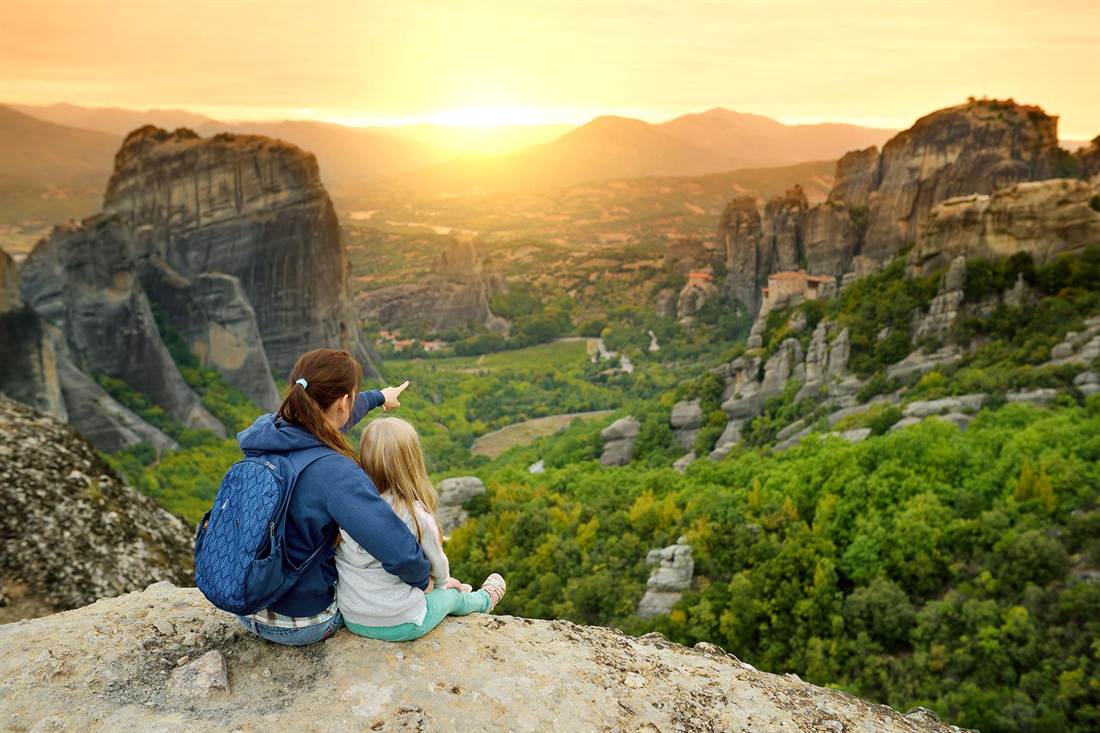
Two guides point the same way for a summer trip. The Visit Meteora guide calls early mornings and sunsets the comfort windows of June, July and August. The Meteora Tours guide says its four-hour late-afternoon loop suits June through September. The useful hours in those months, it says, are early and late.
For the viewpoints themselves, read our Meteora sunset page. For Meteora summer holidays the choice is between seven listings. They differ in ways you can check before you book.
- Guided sunset tour with monasteries and caves: 4 hours, eight languages. The listing offers hotel pickup from Kalabaka or Kastraki and an optional audio guide. It views the monasteries, hikes to hermit caves and watches the sunset.
- Sunset tour with a local guide: 4 hours, 12 languages, small group. It explores the monasteries, visits the Byzantine Church of Virgin Mary and finds the caves. The sunset comes from a panoramic viewpoint. Pickup is available.
- Small-size sunset tour: 4.5 hours, 12 languages. Its stops are monasteries, hermit caves and what the listing calls the oldest church. Pickup and drop-off cover Kalabaka, and a multilingual smart guide app comes with it.
- Sunset hike to secret caves: 4 hours, English only, pickup available. It views hermit caves, walks trails, visits the ancient monks’ prison and watches the sunset.
- Sunset e-bike tour: 3 hours, small group, English and Greek. The listing says you watch the sunset over the cliffs of Meteora.
- Sunset and night hike: 3 hours, English and Greek. It walks through the rock pillars to a sunset viewpoint above Kalambaka, then returns under the stars.
- Sunset horseback ride from Kastraki: 1.5 hours, small group, English and Greek. The listing shows Meteora in the warm colours of the setting sun.
Language is the first filter for a mixed group on Meteora summer holidays. Only three of the seven list more than two languages: the guided, local-guide and small-size tours. Four listings offer pickup. The e-bike, night-hike and horse listings show no pickup. No summary names an exact meeting point, so read the booking page before you plan the way there.
The listings set different booking cut-offs. The e-bike tour closes 15 minutes before the start and the small-size tour 30 minutes before. The night hike closes 2 hours before, the horseback ride 3 hours, and the other three listings 10 hours. That makes the e-bike tour the last-minute pick on Meteora summer holidays. All seven show free cancellation.
The Meteora Tours page for its own sunset route notes that sunset visibility depends on weather. A short cut-off lets you check the sky first, which helps on Meteora summer holidays with one evening free.
The sunset hike names the ancient monks’ prison. Wikipedia says the Monks’ Prison is perched on a rock cliff on the Agion Pneuma Rock.
Caves appear in four of the seven listings, and none names a cave in its summary. Wikipedia lists the Pyxari and Ambaria rocks at the southwestern edge of the complex. It says they hold cave hermitages formerly inhabited by ascetics. Ask the operator which caves the tour visits.
Which adventure tours can you add to Meteora summer holidays?
Six listings add an active day to Meteora summer holidays. They are two buggy rides, two horseback rides, an e-bike ride and a private hike. Durations run from 1 hour to 4 hours. Wikipedia calls Meteora popular with climbers, hikers, trail runners and mountain bikers from around the world, particularly during the summer.
Two listings hand you the wheel of a buggy. Each lists a small group, 12 languages and an optional audio guide. The morning ride lasts 2 to 4 hours, and the sunset ride lasts 4 hours. Our Meteora buggy tour page covers the vehicles and the route.
The morning listing says you drive your own buggy through the Meteora UNESCO Global Geopark. It follows dirt tracks, streams and cave monasteries. The sunset listing follows remote dirt roads to a secluded panoramic viewpoint, away from crowds.
Both horseback listings include a 20-minute training session. They list English and Greek, a small group and photos. The age range on both starts at 6. One ride lasts 1.5 hours. The other lasts 1 hour, rides through Kastraki and adds cold water and fruit.
For Meteora summer holidays with little spare time, the one-hour ride is the shortest of the six. The 1.5-hour ride is the next step up.
The morning e-bike listing lasts 3 to 4 hours. It runs as a small group with a guide, a snack and water, and the languages are English and Greek. The title says morning, which matches the early-start advice guides give for Meteora summer holidays. Read our Meteora e-bike tour page for the route and the bikes.
The private hike follows a circular 6 km trail to the Ypapanti monastery. It lasts 4 hours, runs for a private group and lists English and Greek. The adult age range runs from 18 to 85. Booking closes 8 hours before the start.
Wikipedia lists Ypapantis Monastery as inactive and rarely visited, though the building has been restored. Its link to Meteora Trails says the mapped network now counts 14 interconnected trails. The Visit Meteora guide tells hikers on Meteora summer holidays to start early. Midday is for shade or village breaks.
Only two titles say morning: the buggy ride and the e-bike ride. The sunset buggy ride says sunset in its title. The two horseback rides and the private hike state no start time, so check the time slots when you book. None of the six names a season, so check the dates of your Meteora summer holidays too.
How do you split three, five or seven days on Meteora summer holidays?
Two nights cover all six monasteries and the hikes on Meteora summer holidays, and three to five days suit hikers. The one seven-day plan in the sources adds Epirus. The listings below cover the shorter stays.
The Cultural Foodies blog spent two nights and three days in Meteora and found that a bit short for hikers. It says two days is fine if the monasteries are your only goal. For climbers and hikers it recommends 3 to 5 days.
The Visit Meteora guide counts in nights. One night is the minimum for both sunset and sunrise. Two nights suit hikes and all the monasteries without rushing. Three nights fit photography sessions and deeper trails. Use that ladder to size Meteora summer holidays.
- Three days: the two Athens listings below.
- Five days: the Solos Holidays walking trip spends three nights in Kalambaka, with a guided hike on each of those days. No source lists a five-day sightseeing plan.
- Seven days: the Original Travel page sells a week across Epirus and Meteora. It names no day-by-day plan.
For Meteora summer holidays of three days, two listings start in Athens. “From Athens: 3-Days Meteora with small size local tours” lasts three days and two nights. It runs as a small group. An audio guide is optional, and the listing offers 11 languages. Its summary names the UNESCO monasteries and the geology.
“From Athens: 3 Days in Meteora & Delphi with Tours & Hotel” adds Delphi. Its summary lists a Meteora sunset and a choice of a hike or a half-day exploration. It then names a transfer to Delphi with a stop at the Thermopylae battlefield.
Four more listings turn Meteora summer holidays into stays of two days. Two go by rail. “From Athens: Meteora Train Trip with Overnight Stay” is a small group in English. “Meteora: 2-Days Train Tour from Thessaloniki – Local Agency” is a small group in English and Greek. It runs one Meteora tour on each day.
The other two include a hotel. “Athens: 2 Days in Meteora with 2 Guided Tours and Hotel Stay” lists a sunset tour on the Meteora rocks. It also lists an air-conditioned coach from Athens. It offers skip the line entry and 13 languages, Greek among them.
“2-Day Delphi & Meteora with Official Guide, Tickets and Hotel Pickup” adds the Delphi site, in English only. Its summary lists a four-star hotel with dinner and breakfast. Pickup is available.
Rail ties Meteora summer holidays to the cities. On Wikipedia, the old Thessaly Railways end in the northwest at Kalabaka. The Visit Meteora guide says a train or bus to Kalambaka plus a local tour works from Athens. It calls Thessaloniki easy by train too.
Two days is the shortest stay in the listings above. The Meteora 2 day itinerary on this site shows how two days hold all six monasteries. Use it to set the order for your own Meteora summer holidays.
Which regions can you add to Meteora summer holidays?
Epirus is the region the holiday sellers in the sources pair with Meteora. Corfu and Halkidiki come up as add-ons. Five areas get one fact each below, with a distance only where a source gives it.
Meteora summer holidays that stay in Thessaly have three neighbours to pick from: Pelion, Mount Olympus and Lake Plastiras. Wikipedia ties each one to Thessaly. The other two pairs lie in Epirus and in Macedonia.
- Pelion and Volos. Wikipedia places Pelion in southeastern Thessaly, where hiking trails and stone paths reach springs, coves and beaches. Volos lies about 170 km north of Athens and 140 km south of Thessaloniki. It has ferry and hydrofoil links to Skiathos, Skopelos and Alonissos.
- Zagori and Ioannina. Zagori holds 46 villages and is a designated UNESCO World Heritage Site. Ioannina, the capital of Epirus, stands on the western shore of Lake Pamvotis, 80 km east of the port of Igoumenitsa.
- Olympus and the Pieria coast. Mount Olympus rises on the border of Thessaly and Macedonia. Litochoro, the usual starting point for hikers, lies about 100 km from Thessaloniki. Pieria combines plains, mountains and sandy beaches.
- Thessaloniki and Halkidiki. Wikipedia calls Chalkidiki a popular summer tourist destination, with three fingers named Kassandra, Sithonia and Athos. Athos is a special polity within Greece, known for its monasteries.
- Lake Plastiras. Wikipedia says the lake is named after general Nikolaos Plastiras, who was the first to picture an artificial lake in the area.
Original Travel sells a seven-day trip across Epirus and Meteora. Its page says the Epirus coast faces Corfu, so a Corfu and Epirus pairing is doable. It names Halkidiki and a villa stay in Corfu as the other combination for Meteora summer holidays.
The same page describes the Epirus stops. It counts 92 stone arched bridges in Zagori. Wikipedia says more than 160 arched bridges were built in the wider area. Original Travel adds that the Vikos Gorge holds the Guinness World Record as the deepest gorge relative to its width.
Solos Holidays sells a ten-day walking trip with four bases: Corfu, Kalambaka, Monodendri and Corfu again. Its coach takes three hours from Kalambaka to the Oxia viewpoint over the Vikos Gorge, with Monodendri on the way. Add that transfer to Meteora summer holidays that reach Zagori. The ferry from Corfu to Igoumenitsa takes 90 minutes.
Meteora summer holidays that start in Volos or Ioannina have sister pages. The Meteora day trip from Volos begins in Thessaly, and the Meteora day trip from Ioannina begins in Epirus.
Where can you cool off near Meteora in summer?
Six stops in the sources hold water, rock cover or height. They are the Pineios and Lithaios rivers, Theopetra Cave, the hermit caves, Lake Plastiras and Vikos Gorge. Each has a source line below, and the notes say what that source leaves out on Meteora summer holidays.
No source gives a temperature for these places. None says one is cooler than the rocks. None names a swimming spot. Read the list as places with water, rock cover or height for Meteora summer holidays, and nothing more.
- Pineios river: Wikipedia lists Malakasi, Kalampaka, Megarchi and Larissa among the places along it. Shiny Greece suggests a leisurely stroll along the banks and says lush plants surround the river.
- Lithaios river: Wikipedia says it runs through the centre of Trikala and counts its lush banks among the city’s landmarks.
- Theopetra Cave: Wikipedia places it 4 km from Kalambaka. The chamber covers 500 square metres, and the Lithaios river flows in front of it.
- Hermit caves: Wikipedia says monks occupied the caverns of Meteora as early as the 11th century. The Cultural Foodies blog describes a cave on a forest path.
- Lake Plastiras: Wikipedia puts it at 792 metres above sea level and ties its tourist appeal to that altitude.
- Vikos Gorge: the Solos Holidays itinerary stops at the Panagia Springs, an hour or so into the walk, to refill bottles with cool, fresh mineral water.
Wikipedia says the Pineios rises in the Pindus mountains, near the village of Malakasi, east of Metsovo. It crosses the Thessalian plain and empties into the Aegean Sea near Stomio.
Wikipedia puts Kalabaka on the left bank of the Pineios, where the river runs north to south. The Shiny Greece guide names the brown trout, the kingfisher and the otter among its wildlife. It names no swimming spot, so do not build Meteora summer holidays around a river dip.
Two sources disagree on the distance to Theopetra Cave. Wikipedia says 4 km from Kalambaka. VisitMeteora says 5 km from Kalabaka and 15 minutes away. It also calls the cave only 4 km from Meteora.
Wikipedia gives the cave entrance as 17 metres wide and 3 metres high. It names no summer temperature inside, and neither does VisitMeteora. Take 4 to 5 km as the range for a Theopetra stop on Meteora summer holidays. Check the drive yourself.
The Cultural Foodies blog reaches its cave along a cobblestone path that turns back into the forest. It reports bats but no mosquitoes. The Solos Holidays itinerary also leads through dense forest to caves where hermits once lived.
Wikipedia adds that people lived in the caves near Meteora from 50,000 to 5,000 years ago. No source compares the air inside a cave with the air on the rock paths of Meteora summer holidays.
Wikipedia names the bridge with the statue of Asclepius as a point along the Lithaios. It says the city centre was pedestrianised and the river revitalised in the 21st century. If Trikala joins your Meteora summer holidays, our Trikala tours page covers the city itself.
Wikipedia also calls Lake Plastiras the Tavropos Reservoir. It says the lake serves irrigation and a hydroelectric plant. It is also the main water source for the city of Karditsa.
The Solos Holidays itinerary walks Vikos Gorge along the Voidomatis stream. It describes the stream in spring and in autumn but gives no summer description. It also mentions bright green ferns and large trees in the gorge.
The same itinerary serves a picnic at the Krini Source, halfway along a 13 km walk to Monodendri. It gives no air temperature for the gorge floor.
Put the stops side by side. The Pineios runs beside Kalabaka, and Theopetra Cave lies 4 to 5 km from the town. Trikala and Lake Plastiras come with no travel time from Kalambaka in the sources used here. Check the road before you add either to Meteora summer holidays.
What do travellers ask about Meteora summer holidays?
How long does the light last after sunset on 21 June?
On Meteora summer holidays in late June, the sunrise-sunset.org API gives last light at 23:07 Greek summer time. That is 2 hours 2 minutes after sunset. The API says the night is fully dark after last light.
How deep is Vikos Gorge?
Wikipedia gives a length of about 32 km and a depth from 120 to 1,350 metres. It says the Guinness Book of Records lists the gorge as the deepest in the world relative to its width.
How long is the Pineios river?
Wikipedia gives a total length of 205 km and a drainage basin of 9,500 square kilometres. Shiny Greece gives a length of 185 km. The two sources differ by 20 km.
How big is Lake Plastiras?
Wikipedia lists the lake at 12 km long and 4 km wide, with an area of 24 square kilometres. Its greatest depth is 60 metres. Weigh those figures before you add a lake day to Meteora summer holidays.
How old is the stone wall at Theopetra Cave?
Wikipedia dates the wall to 23,000 years ago. It calls it the oldest known example of a built structure. The wall blocked two-thirds of the cave entrance.
Is Theopetra Cave open to visitors on Meteora summer holidays?
Wikipedia says the cave is open to the public after restoration. VisitMeteora warns that access has changed in the past. It tells visitors to confirm the opening status before setting out. A cave stop can sit inside a longer day, and our one day in Meteora plan shows how a single day fits together.