
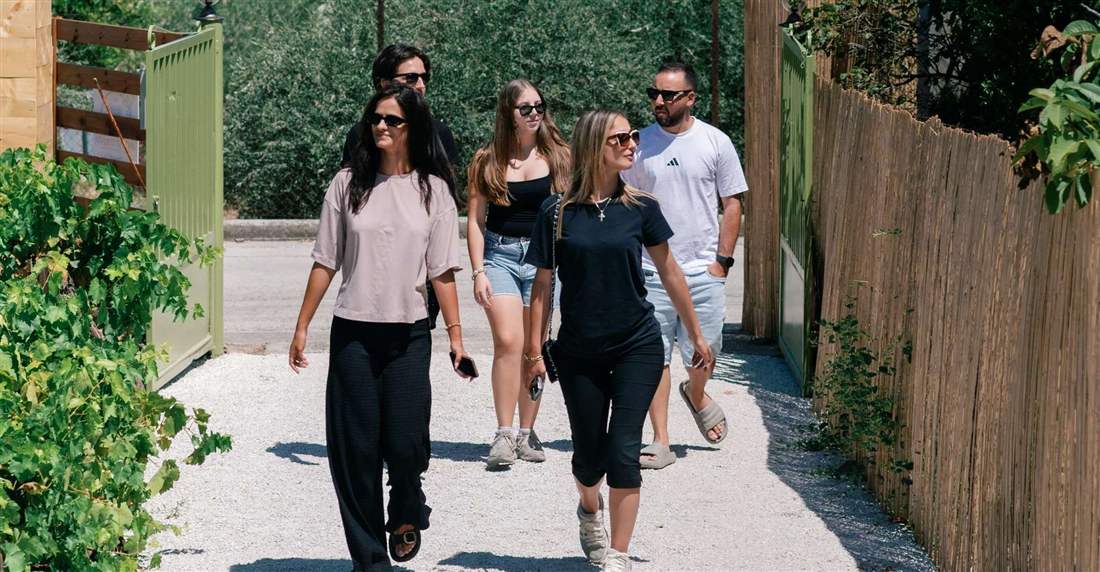
A Corinth cooking class takes you to a farmhouse at Ancient Corinth to cook Greek food by hand and share it with local wine. More food days across the country sit on Greece Tours.
Below you find the classes on offer, the setting, the steps, the wine, the sights close by, the route from Athens, the season and answers to common questions.
What is a Corinth cooking class?
A Corinth cooking class is a practical lesson held in a farmhouse in Corinth. You learn to make traditional Greek dishes by hand from fresh ingredients. The class follows a farm-to-table approach. It ends with a shared meal and local wine.
The setting is a farmhouse, and the listing title calls it a cooking class in Corinth. Guests learn to make the dishes themselves, and the listing describes the food as handmade. This Corinth cooking class is a working session, so every guest takes part in the cooking rather than only tasting.
The listing bills the class as a farm-to-table experience. It names fresh ingredients and handmade food as the heart of the lesson. That farm-to-table idea ties the Corinth cooking class to the farmhouse where it takes place.
The class closes with a meal of the food you made. You enjoy it with local wines, and the class title promises unlimited wine. The listing sets that meal under the sky of Ancient Corinth. So a Corinth cooking class is three things in one booking: a lesson, a meal and local wine.
Which Corinth cooking class can you book?
You can book four options that link Greek cooking or local food with Corinth and the Peloponnese. One is the farmhouse Corinth cooking class with unlimited wine. The other three cover Greek hospitality, a sightseeing tour with olive tasting, and a private tour with food.
Two options put cooking first, and two put the ancient sites first with food added. The list starts with the farmhouse class, the main Corinth cooking class on this page.
- Corinth: Cooking Class in Farm House with Unlimited Wine: a hands-on Corinth cooking class in a farmhouse. You make traditional Greek dishes by hand and share the meal with local wines.
- Private Apostle Paul Tour of Ancient Corinth: a private tour of the ancient city with a traditional local food option.
- The Art of Greek Hospitality: Cooking in the Heart of Peloponnese: a cooking session built on Greek hospitality.
- Ancient Corinth, Akrokorinthos, Canal & Cooking Class, Olive Tasting: a combined tour of the three sights in its title. It adds a cooking class and an olive tasting.
The farmhouse class stands apart because its title names no ancient site at all. It names a farmhouse, a cooking class and unlimited wine. The two sightseeing options lead with Ancient Corinth, and food is one part of the tour. The farmhouse Corinth cooking class is also the only option here with wine in its title.
The hospitality option also centres on cooking. Its title names the Peloponnese rather than Corinth. So for a Corinth cooking class tied by name to the town, the farmhouse class is the direct match.


Where does a Corinth cooking class take place?
A Corinth cooking class takes place in a farmhouse, as the title on the booking card states. The card lists the class under Acrocorinth. Its summary says guests enjoy their meal under the Ancient Corinth sky.
The card’s web address goes further and calls the class “Ancient Corinth cooking in farm house”. Its summary labels the session a farm-to-table experience. The card also pins the activity on the map at 37.9031 N, 22.8796 E. Enter those numbers into a map app to see where the Corinth cooking class sits.
The rock of Acrocorinth sits at 37.8906 N, 22.8725 E. The ancient city sits at 37.9053 N, 22.8802 E. On the map, the farmhouse pin falls between these two points, closer to the ancient city.
The old city rests on two large terraces. Arable plains and natural springs lie along their southern edge. Seasonal rivers from the Ayios Vasilios valley and Mount Ziria add to that water supply. Natural drainage has carved a broad valley that lets people move between the terraces.
Ancient Corinth lies on the Isthmus of Corinth, the thin neck of land between the Peloponnese and the rest of the Greek mainland. The ancient site and the modern city share a name. Check which one a map search for a Corinth cooking class shows.
How does a Corinth cooking class run from start to finish?
A Corinth cooking class follows the order set out in the booking card’s summary. Guests join the class and learn to make traditional Greek dishes. They work with fresh ingredients, make the food by hand and then enjoy a meal.
The cooking stages take place in the farmhouse, as the card’s title states. The steps below follow the summary’s wording for a Corinth cooking class, in the order it gives them.
- Arrive at the farmhouse and join the class in Corinth.
- Learn to make traditional Greek dishes.
- Work with the fresh ingredients that the farm-to-table label promises.
- Make the food by hand, as the card’s summary describes.
- Enjoy a meal under the Ancient Corinth sky, the last stage the summary names.
The card’s words point to a hands-on Corinth cooking class. Its summary invites guests to “learn to make” the dishes. It also describes the food as “handmade”, without saying whose hands make each part. So ask the hosts on the day which tasks are yours and which are theirs.
Readers who want more local food after a Corinth cooking class can read about the Corinth food tour.
Which dishes do you cook at a Corinth cooking class?
A Corinth cooking class teaches you to make traditional Greek dishes by hand in a farm house. The tour listing describes the menu as traditional Greek food and handmade food. It does not name the single dishes on the menu.
- Traditional Greek dishes: you learn to make traditional Greek dishes during the session.
- Handmade food: the food at the Corinth cooking class is made by hand.
- A meal: the session includes a meal for you to enjoy.
Traditional Greek dishes belong to Greek cuisine, the cuisine of Greece and the Greek diaspora. Greek cuisine uses vegetables, olive oil, grains, fish and meat. Its meats include pork, poultry, veal, beef, lamb, rabbit and goat. These facts describe Greek cooking as a whole, not the menu of one Corinth cooking class.
Other key ingredients in Greek cuisine are pasta, cheeses, herbs, lemon juice, olives and yoghurt. The cuisine continues traditions from Ancient Greek and Byzantine cooking. It also takes in Middle Eastern, Balkan and Italian influences.
The listing for the Corinth cooking class names no dessert, bread, salad or side dish. Across Greek cuisine, bread made of wheat is found everywhere. Common Greek dessert ingredients include nuts, honey, fruits, sesame and filo pastry.
Which fresh ingredients go into a Corinth cooking class?
A Corinth cooking class uses fresh ingredients, according to the tour listing. The class runs as a farm-to-table experience in a farm house. The listing does not name each ingredient, herb, cheese or oil that goes into the food.
Farm-to-table is a social movement that promotes serving local food. It favours buying food directly from the producer. Routes include direct sales, a farmers’ market, a local distributor, or a kitchen that raises its own food.
Farm-to-table can also include food traceability. Under this idea, diners learn where their food comes from. The tour listing calls the Corinth cooking class a farm-to-table experience.
At the Corinth cooking class, fresh ingredients go together with handmade food. The listing does not say whether the ingredients come from the farm itself, a garden or other local producers.
Olive oil and wheat are two of the founding staples of Greek cuisine. For the oil on its own, see our Corinth olive oil tasting page.
How does Greek home cooking shape a Corinth cooking class?
A Corinth cooking class teaches traditional Greek dishes, made by hand from fresh ingredients in a farm house. Those dishes come from a home-cooking tradition with its own herbs, methods and regional recipes. The card calls the session a farm-to-table experience.
Herbs set Greek food apart from other Mediterranean cooking. Dill, mint and oregano stand out, with garlic, onion, cumin and bay leaves beside them. Basil, thyme and fennel seed are other common herbs and spices. These flavourings run through the traditional Greek food that a Corinth cooking class sets out to teach.
Home-cooked Greek meals include seasonal vegetables stewed with herbs and tomato sauce. Another method braises meat or pasta in tomato sauce. A third bakes food in a roasting tin in the oven, with tomatoes and herbs. Cooks also wrap food items in filo pastry, as bite-size triangles or large sheets.
Beside the dishes found throughout Greece, there are regional dishes too. Northern recipes in particular pair meat with sweet spices, such as cinnamon, allspice and cloves in stews. Peloponnesian cooking counts among the regional cuisines of Greece. Corinthia, home to a Corinth cooking class, is a region of the Peloponnese.
In Greek cuisine, salads also count as appetisers. So do spreads and dips, which also belong to Greek sauces. Dining out is common in Greece. The taverna and the estiatorio are widespread and serve home cooking to locals and tourists.
Which wine comes with a Corinth cooking class?
A Corinth cooking class includes unlimited wine, as the title of its booking card states. Guests drink local wines with the meal, which is served under the open sky of Ancient Corinth. Unlimited means the card sets no cap on the wine at that meal.
The card speaks of local wines, in the plural, rather than a single label. It does not name a grape, a wine zone or a producer. At a Corinth cooking class, the wine comes with the meal of handmade food. Wine and olive oil have long stood at the centre of Greek cuisine.
Greece has about 200 vine varieties, and Agiorgitiko is one of them. It is a red Greek wine grape. Its name means St George’s grape. Grape scientists believe it is native to Greece. In Nemea, its wine carries the nickname Blood of Hercules, from a legend about the hero and the Nemean lion.
The Nemea area lies in the regional unit of Corinthia. Agiorgitiko has traditionally been grown in the Nemea region of the Peloponnese. It is the only variety permitted in Nemea’s designated wine region, a system similar to the French AOC. In Nemea, the grape goes only into red wine, and rosé from it is prohibited.
Those facts describe the wider wine country of Corinthia, not the glass at a Corinth cooking class. For a visit built around wine itself, see our Corinth wine tasting page.
Which Corinth cooking class adds sightseeing?
Two options pair food with sightseeing. One Corinth cooking class tour lists Ancient Corinth, Akrokorinthos, the canal, a cooking class and an olive tasting. The other is a private tour of Ancient Corinth that includes traditional local food.
The first option is described from its title alone. That title names Ancient Corinth, Akrokorinthos and the Corinth Canal. It adds a cooking class and an olive tasting. This places the Corinth cooking class inside a sightseeing tour. Three sights and two food activities sit in one product. The title gives no further detail, so this page adds none.
The second option has the Apostle Paul in its title. It is a private tour of the ancient city of Corinth. The listing names two stops: the Temple of Apollo and the Bema. Tradition holds that the Apostle Paul faced trial at the Bema. The card names no other site.
The tour lasts six hours and runs for a private group. Guests enjoy traditional local food as part of the day. Food and history share the same six-hour day. Unlike a Corinth cooking class, the listing mentions no hands-on lesson.
A stand-alone farmhouse Corinth cooking class centres on the food itself. The two options above add sights to the meal. The first adds Akrokorinthos, the canal and an olive tasting to its class. The second adds the temple and the Bema to its local food. Both include Ancient Corinth.
Which sights lie near a Corinth cooking class?
Three sights lie close to a Corinth cooking class. They are the ruins of Ancient Corinth with the Temple of Apollo, and the Acrocorinth rock with its fortress. The third is the Corinth Canal, dug across the isthmus.
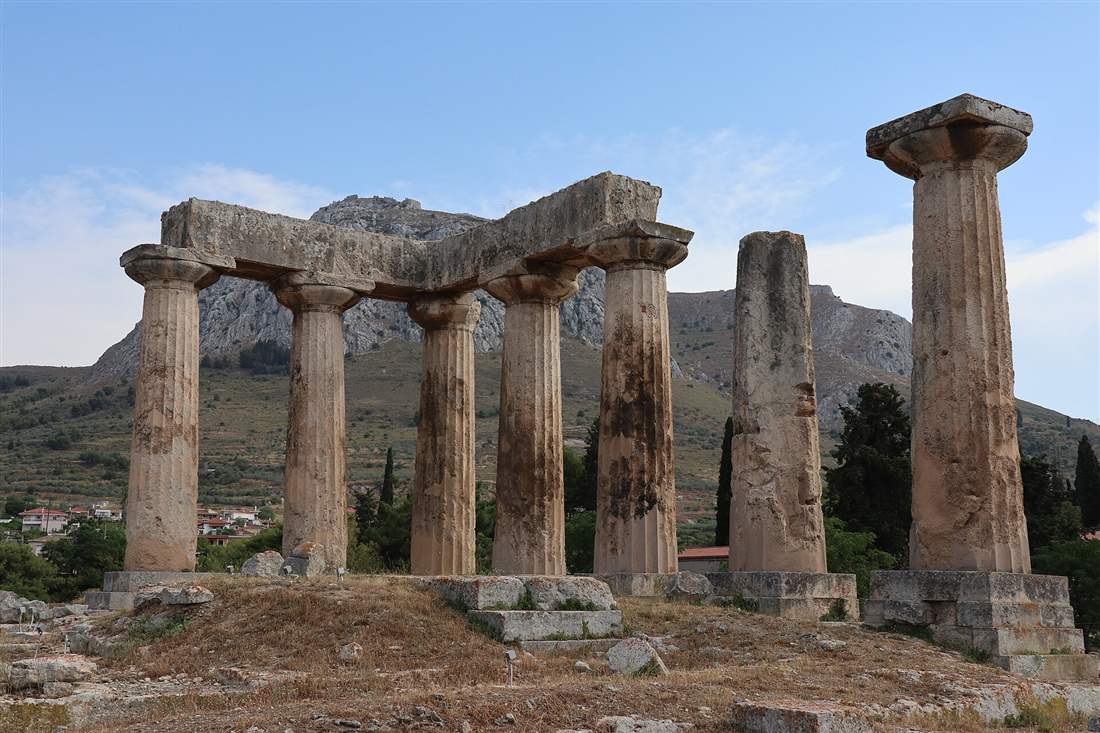
The ruins appear in both tour listings above. Akrokorinthos and the canal join them only in the title of the first Corinth cooking class tour. Akrokorinthos is the Greek form of the name Acrocorinth, which means Upper Corinth. Each sight below gets two facts.
- Ancient Corinth and the Temple of Apollo: The Temple of Apollo went up in the mid-6th century BC. It is one of the only parts of the ancient site that has stayed in view since antiquity.
- Acrocorinth and its fortress: Acrocorinth is a monolithic rock that overlooks the ancient city of Corinth. Three circuit walls formed the man-made defence of the hill.
- Corinth Canal: The canal links the Gulf of Corinth, in the Ionian Sea, to the Saronic Gulf in the Aegean. It runs for 6.4 kilometres from one gulf to the other.
The modern city of Corinth lies about 5 kilometres northeast of the ancient ruins. A modern village, also named Ancient Corinth, sits directly over the old city. Our page on Ancient Corinth tickets covers entry to the site. The canal has its own page of Corinth Canal tours.
How do you reach a Corinth cooking class from Athens?
To reach a Corinth cooking class from Athens, travel about 78 kilometres west to Corinth by rail or by road. The village of Ancient Corinth lies to the southwest of the modern city. The booking card lists the class under Acrocorinth.
Rail travellers bound for a Corinth cooking class take Line A4 of the Athens suburban railway. This line runs between Piraeus and Kiato and calls at Corinth railway station. The station stands on the outskirts of the city, near Examilia, 2.9 kilometres from the town centre. The journey time from Athens to Corinth is about 55 minutes.
At the station entrance, guests heading to a Corinth cooking class find a booking office, toilets and a cafe. At platform level, they find sheltered seating and an air-conditioned indoor shelter. The forecourt holds a local bus stop, a taxi rank and a large car park. The station is five minutes by car from the city centre.
Do not confuse the current station with the old Corinth station inside the city. That station is now closed and lies closer to the coast of the Corinthian Gulf.
Drivers bound for a Corinth cooking class take the A8/E94 toll motorway from Athens. Corinth railway station also sits near the A8 motorway between Athens and Patras. Travellers who plan an Ancient Corinth day trip from Athens follow the same route west.
The card title places the class in a farm house. The booking card lists no pick-up among its features. Read the meeting point on the card before you leave Athens.
Who suits a Corinth cooking class?
A Corinth cooking class suits adults who book alone or together, and families with younger guests on an adult’s booking. The booking card marks the class as wheelchair accessible, so guests who use a wheelchair can take part.
Only adults can hold a booking of their own. Younger guests join a Corinth cooking class only when an adult books a place with them. This makes the class a fit for parents and other adults travelling with young people.
Wheelchair users travelling to a Corinth cooking class by rail find a ramp into the raised station. A lift then links the station subway with the platform level.
Solo travellers can book a single adult place, since the card sets the minimum at one guest. Couples and groups of friends can book up to 15 adults together for a Corinth cooking class.
When is the season for a Corinth cooking class?
A Corinth cooking class runs all year, with open dates in every month of its booking calendar. Classes run from Monday to Saturday, and no Sunday dates appear. Each session ends with a meal under the open sky.
The booking card lists dates but names no start time. It shows no separate morning, midday or evening slot. For a Corinth cooking class, the calendar opens more than a year ahead.
No month is closed on the Corinth cooking class calendar. December, January and February all show open dates in winter. June, July and August show open dates in summer. Spring and autumn follow the same six-day pattern.
Corinth has a hot-summer Mediterranean climate. Summers are hot and dry, and winters are cool and rainy. The warmest month is July, averaging 28.7 °C, while January is the coolest. The average yearly temperature is 18.1 °C, and the city receives about 463 mm of rain each year.
That pattern matters for a meal served outdoors on a farm. A summer Corinth cooking class meets dry weather and the peak heat of the year. A winter class meets cooler air during the rainy season. For an open-air table, rain is a winter concern rather than a summer one.
How does a Corinth cooking class differ from other Peloponnese cooking classes?
A Corinth cooking class lasts 2.5 hours, which is shorter than classes in Nafplio and Kalamata. Nafplio sessions run three to five hours, and Kalamata classes list three hours. Olympia adds olive-grove classes near its ancient site.
Our Nafplio cooking class page covers kitchens in three settings around the Argolid town. Guests cook in old town houses, on farms across the plain or in beach kitchens at Karathona. About half of the hosts there open the session with a market walk.
A Kalamata cooking class is held in Messinia, whose capital is Kalamata. One venue is a farm in the village of Arfara, about 25 minutes from the city by car. Another sits in a family olive grove towards Pylos. The featured classes there each run for three hours, and a meal comes with every one.
In Elis, our Olympia cooking class page lists five classes in the farmland around the ancient sanctuary. Three of them cook outdoors in an olive grove. Four begin at the port of Katakolo, for cruise passengers with a single day ashore. As in a Corinth cooking class, each one ends at the table with a meal.
What sets the Corinth cooking class apart is its farmhouse setting at Ancient Corinth. The booking card calls it a farm-to-table experience built on handmade food. The meal takes place under the Ancient Corinth sky, and the card lists the class as a new activity.
How do you book a Corinth cooking class?
You reserve a Corinth cooking class online on its booking card. Choose a date, add your guests and read the cut-off and refund rules. Then pay, keep the confirmation and look for the meeting point before the day.
- Pick the Corinth cooking class card that suits your plans, then choose a date from its calendar.
- Set the number of guests. The farmhouse class card sorts them as adult (18 to 99), youth (10 to 17) or child (9 and younger). Children of 9 and younger must still be added to the booking.
- Add any dietary needs or allergies in a note to the operator before you pay.
- Read the cut-off time and the refund rules. The farmhouse class card asks you to book at least 10 hours in advance. The private tour card with a food option asks for at least 6 hours.
- Pay on the booking page, or reserve if the page offers that choice.
- Save the confirmation and check it for the meeting point.
Both cards state free cancellation, so the two match on that point. Neither card gives a deadline for cancelling, so read the terms shown at checkout. Neither card states a reserve now and pay later option. Look at the payment choices before you confirm your Corinth cooking class.
Planning a second class in the capital? Use the same six steps to compare the cut-off and cancellation terms of an Athens cooking class.
What do travellers ask about a Corinth cooking class?
How long does a Corinth cooking class last?
The Corinth cooking class on the farmhouse card lasts 2.5 hours. The card gives this length as a single figure, not a range. It states no extra time for arrival or for leaving. Confirm the start time with the operator when you book. Then plan the rest of your day around the class.
Which languages does the Corinth cooking class host speak?
The farmhouse class card lists two languages for the Corinth cooking class: English and Greek. English is the default language the card shows. The card names no third language. If you need help in another language, message the operator from the booking page first. Keep a copy of the reply with your confirmation.
Can vegetarians join a Corinth cooking class?
The farmhouse class card states nothing about vegetarian meals or other diets. It lists no dietary notes at all. Do not assume a meat-free option exists. Before you book a Corinth cooking class, message the operator from the booking page. Name your diet and any allergies, then wait for a clear written answer.
Do you take the recipes home after a Corinth cooking class?
The farmhouse class card does not say whether guests receive the recipes. It lists no printed or emailed recipe pack among its details. Message the operator from the booking page if the recipes matter to you. You can also take your own notes during the Corinth cooking class, with the host’s permission.