
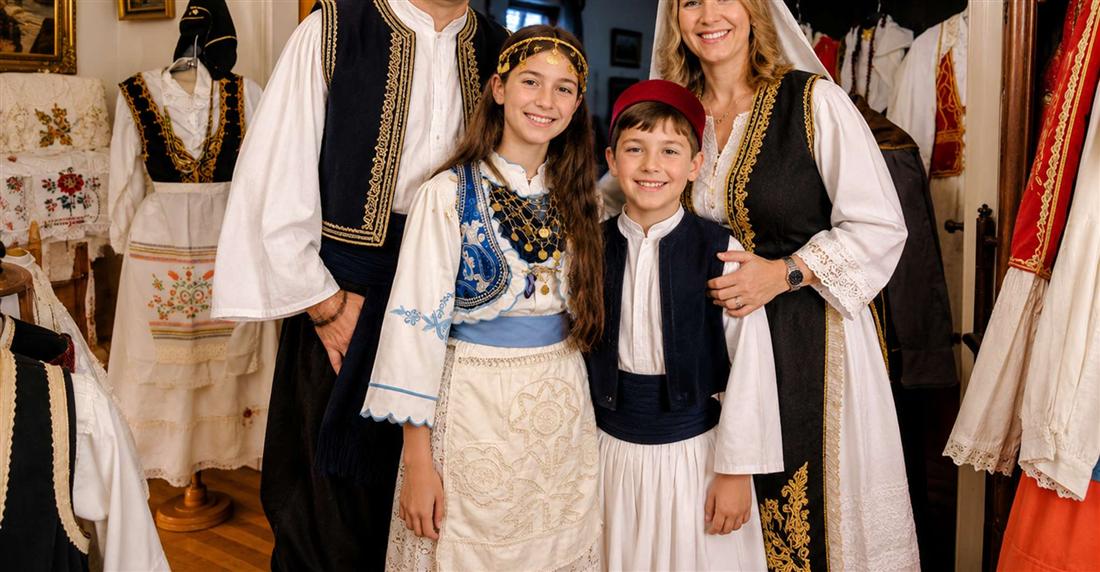
A Corinth photoshoot can mean a costume session in a village studio or a day of your own shots at the canal and the ruins. More ideas for trips across the country wait on Greece Tours.
This page covers the sessions you can book, the spots to frame, the light and the season, the rules for cameras and drones, and the booking steps.
What is a Corinth photoshoot?
A Corinth photoshoot is a photo session held in and around Corinth. You can book one with a local photographer or a host. You can also plan your own shots at the canal, the ancient sites and the coast.
The first way is a booked Corinth photoshoot. A host or a photographer runs it. One option is a traditional costume experience in Vrachati that includes a photo session. Another option is a private photo session with a local photographer in Corinth. In both sessions, you stand in front of the camera and someone else frames each shot.
The second way is a self-planned Corinth photoshoot. You bring your own camera or phone and pick the spots yourself. No photographer is needed. The canal, the ancient sites and the coast give you three different backdrops. You also set the order of the stops and the time you spend at each one.
Both kinds of Corinth photoshoot cover the same area. The main difference is who holds the camera. In a booked session, the photographer or the host takes the pictures of you. On a self-planned day, you or a travel companion take every shot.
Which Corinth photoshoot can you book?
You can book two Corinth photoshoot sessions: a costume experience with photos in Vrachati and a private local photographer. Two sightseeing trips, a glass-bottom boat crossing and a day trip, add photo chances without a photographer.
Four bookable options fit a Corinth photoshoot plan. Two are photo sessions, and two are sightseeing trips. Each one is set out below with what its listing states.
- Greek traditional costume experience with photos in Vrachati: a one-hour experience in costume, with photos in a designed traditional setting.
- Private photo session with a local photographer in Corinth: a private session in Corinth, led by a local photographer.
- Corinth Canal crossing by glass-bottom boat: a crossing of the canal on a glass-bottom boat, lasting 1.5 hours.
- Ancient Corinth day trip with a VR guide: a six-hour trip to the canal and the ruins of Ancient Corinth. A virtual reality and audio guide comes with it.
The two photo sessions and the two sightseeing trips serve different aims. On a booked Corinth photoshoot, a host or a photographer takes the pictures of you. The boat crossing and the day trip give you photo chances at the canal and the ruins. Neither trip includes a photographer, so you take the photos yourself.
A session suits travellers who want to appear in the pictures. A trip suits travellers who want to see the sights and take their own photos along the way.


How does the Vrachati costume photoshoot work?
The Vrachati session is a Greek traditional costume experience with photos. It lasts one hour and runs in English or Greek. It turns a Corinth photoshoot into a short heritage session, with the costume and the traditional set in one booking.
The card describes the hour as a way to discover the cultural heritage of Greece through traditional costume. The photo session takes place in a carefully designed traditional setting. The card lists no step-by-step plan, so this Corinth photoshoot rests on two parts: costume and photos.
The card tags the session as both a private group and a small group. Its one ticket type, Adult, covers ages 99 and younger. Each booking takes one to five participants for a Corinth photoshoot.
English is the default language on the card, and Greek is the second language on offer. The whole experience fits into one hour, so a Corinth photoshoot here takes a short slot in a day plan.
The card lists free cancellation for this session. Its booking cut-off is two hours, so a Corinth photoshoot must be booked at least two hours before it starts. The card text names no meeting point and does not list the costume pieces.
Which traditional Greek costumes suit a Corinth photoshoot?
Three Greek costumes suit a Corinth photoshoot: the fustanella for men, the Amalia dress for women and the vraka breeches. The fustanella and the Amalia dress both became national costumes after Greek independence. Islanders wore the vraka in the Ottoman period, when each area had its own style.
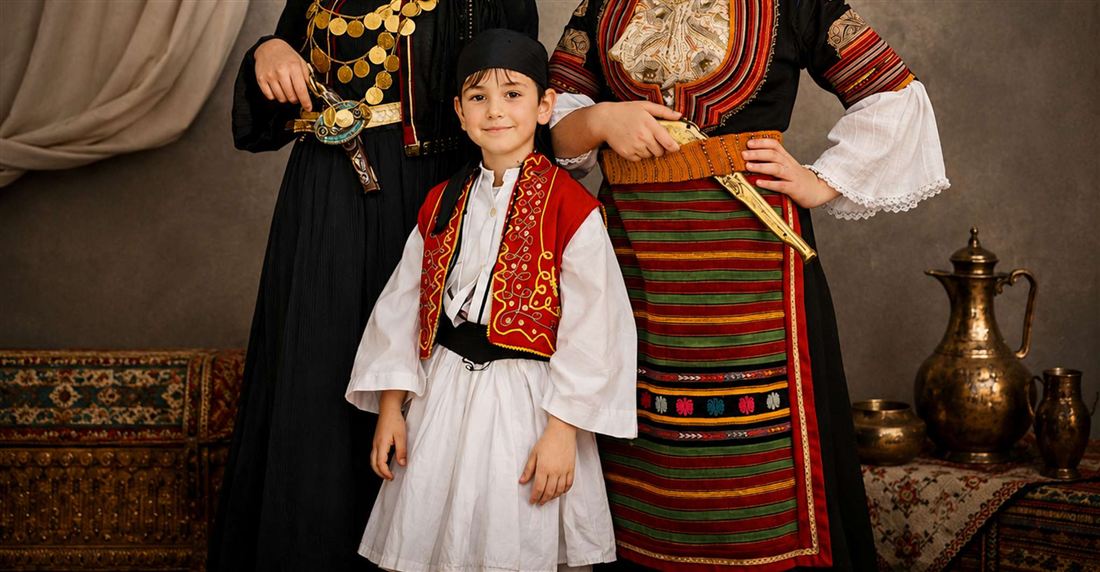
The fustanella is a pleated, kilt-like garment worn by men in the Balkans. Revolutionary fighters wore it in the Greek War of Independence. King Otto later made it the official court costume, and it became the Greek national dress. The ceremonial Presidential Guard still wears it.
Anyone planning a Corinth photoshoot in costume can spot the fustanella by its pleats. The Greek version has more pleats than the Albanian one. The skirt is worn with a bolero, waistcoat, sleeveless coat and a leather belt embroidered in gold or silver.
The Amalia dress takes its name from Queen Amalia, who shared King Otto’s interest in fashion. She created a folk-style court dress that became a national Greek costume. It pairs a loose white shirt of cotton or silk with an embroidered velvet jacket or vest. The ankle-length skirt is pleated silk.
The headwear of the Amalia dress showed marital status, a detail to know before a Corinth photoshoot. Married women wore a soft cap or fez with one long golden silk tassel. Unmarried women wore the kalpaki, a type of toque. The dress spread to Christian townswomen across the Balkans, as far north as Belgrade.
The vraka offers a third choice for a Corinth photoshoot. It is a type of traditional breeches, worn from the Ionian Islands in the west to Cyprus in the east.
Where is Vrachati, the village of the costume Corinth photoshoot?
Vrachati is a seaside town on the Gulf of Corinth, about 12 km west of Corinth. It belongs to the Velo-Vocha municipality in the Corinthia regional unit. A traditional costume Corinth photoshoot is bookable in the town.
Within that municipality, Vrachati is one of the communities of the municipal unit of Vocha. The other communities of the unit are Bolati, Chalkeio, Evangelistria, Soulinari, Vochaiko and Zevgolateio. Zevgolateio is also the seat of the whole municipality.
Velo-Vocha came from the merger of two former municipalities, Velo and Vocha. Both became municipal units of the new body. The municipality covers about 165 square kilometres. Corinthia, in turn, forms part of the Peloponnese region of Greece.
Vrachati’s beach has received the Blue Flag award from the European Union. Its seashore on the gulf gives a Corinth photoshoot a setting right beside the water. The local economy rests on two activities: tourism and citrus fruit production. The census counted more than three and a half thousand residents.
East of Vrachati, around Corinth, lie further coastal settings for a Corinth photoshoot. They include two ancient ports and the sanctuary of Poseidon at Isthmia.
Which coastal spots near Corinth suit a photoshoot?
Four coastal spots near Corinth suit a Corinth photoshoot: Lechaion, Kechries, Isthmia and the harbour of modern Corinth. Lechaion and Kechries were the two ancient ports of the city. Isthmia held a sanctuary of Poseidon, the god of the sea.
- Lechaion: this was the main port of the ancient city on the Corinthian Gulf. A road of 2.3 km, running between the Long Walls, linked it to the city. Excavations there revealed a Christian basilica with five aisles.
- Kechries (Cenchreae): the modern village takes its name from the ancient port of Kenchreai, which stood on the same site. That port served eastern trade across the Saronic Gulf. Digs at its Roman harbour uncovered warehouses, fish tanks and mosaics.
- Isthmia: this ancient sanctuary of Poseidon lay between the ports of Lechaion and Cenchreae. The games held there ranked second only to those at Olympia. Its Early Stadium keeps a well-preserved starting line.
- Corinth harbour: the modern city lies on the gulf shore. Its artificial harbour lies north of the city centre. A reinforced mole shields anchored vessels there from strong northern winds.
For a Corinth photoshoot, Lechaion and Kechries pair open water with excavated ancient remains. Isthmia swaps the shoreline for ruins, with a theatre on a slope near the Temple of Poseidon. The modern harbour offers anchored boats and open views across the gulf.
At Kechries, seismic activity has lowered the coastline moderately since ancient times. A Corinth photoshoot there frames a shore that sits lower than it did in antiquity. Finds from the Kechries digs now rest in the Archaeological Museum of Isthmia.
Which Corinth Canal viewpoints suit a Corinth photoshoot?
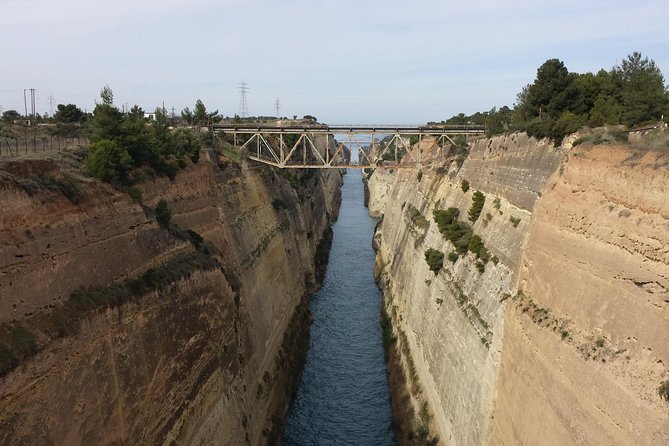
Bridges cross the canal at about 45 metres and give a Corinth photoshoot a high view from land. Low bridges at sea level sit at each end. The Diolkos ship road at the western end adds a third setting.
The canal cuts through the Isthmus of Corinth, between the Peloponnese and the mainland. Its walls of rock climb to 90 metres, cut at 80 degrees from the horizontal. The waterway runs 6.4 kilometres, and at the water line it is 24.6 metres across. For a Corinth photoshoot, those walls close in on both sides of the frame.
Guided trips to the cutting appear on our Corinth Canal tours page. From land, these three viewpoints give a Corinth photoshoot different backdrops:
- The high bridges: a railway, a road and a motorway cross about 45 metres above the water.
- The submersible bridges: installed at sea level at each end, they give road traffic two extra crossings.
- The Diolkos path: a footpath runs beside the ancient ship road, east of the lowering bridge at the western end. Digs uncovered a nearly continuous stretch of 800 metres.
The Diolkos was a paved trackway for moving boats overland across the isthmus. Boats crossed on it from about 600 BC to the mid-first century AD. Its hard limestone surface carries parallel grooves set about 1.60 metres apart. Those grooves add an ancient detail to a Corinth photoshoot beside the modern cutting.
Can you take Corinth photoshoot pictures from a boat in the canal?
Yes. Two glass-bottom boat trips sail through the canal itself. A 1.5-hour trip covers the passage. A 4.5-hour cruise runs between the two gulfs, with a swim stop. A Corinth photoshoot on board shows the walls from water level.
The shorter trip takes 1.5 hours and sails the whole cutting in a boat with a glass floor. Pickup is available. It keeps a Corinth photoshoot focused on the cutting alone.
The longer trip is a 4.5-hour Corinth Canal cruise between the Corinthian and Saronic Gulfs. A swim stop off Siderona beach breaks the trip. The glass bottom shows marine life below. Pickup is available on this trip as well. That route adds a beach scene to a Corinth photoshoot.
From a bridge, the canal lies far below. From a boat, the near-vertical walls rise on both sides and the bridges pass overhead. The cutting then fills the frame from inside, which no bridge view gives. That is the main gain for a Corinth photoshoot on the water.
The canal was dug at sea level and has no locks. It is used mainly by tourist ships, about 40 a day on average. Traffic moves in single convoys, in one direction at a time. The channel saves passing vessels a 700-kilometre trip around the Peloponnese.
How do you plan a Corinth photoshoot at Ancient Corinth?
Plan a Corinth photoshoot at Ancient Corinth around six backdrops inside the archaeological site. Start with the Temple of Apollo and the Fountain of Peirene. Then add the Lechaion Road, the agora, the Bema and the site museum.
Each stop below gives a Corinth photoshoot its own ancient setting and its own story.
- Temple of Apollo: it was built in the Doric order in the mid-sixth century BC. Of its 38 columns, seven remain upright.
- Fountain of Peirene: Pausanias described the spring as decorated with white marble. He wrote that its water ran from cave-like chambers into an open-air well.
- Lechaion Road: a building known as the Great Bath stood along this ancient road. The bath has its own volume in the Corinth excavation series.
- Agora: a published study covers the monuments of the Lower Agora. Current digs centre on the Panayia Field, southeast of the forum.
- Bema: this monument later became the Church of the Apostle Paul. The New Testament links Corinth with the mission of Paul the Apostle.
- Site museum: the Archaeological Museum of Ancient Corinth stands inside the site. Its Atrium holds statues, sculptures and inscriptions in Greek and Latin.
The modern village of Ancient Corinth sits on top of the ancient city, which limits digging. Excavation has centred on the ground around the Temple of Apollo. The temple has stayed in view since antiquity. That gives a Corinth photoshoot a fixed point to plan the other frames around.
Pausanias traced a route out of the market-place along the Lechaion Road. He passed a gateway and then reached the entrance to Peirene. Acrocorinth, the acropolis of the ancient city, overlooks these ruins. Check entry to the site on our Ancient Corinth tickets page before a Corinth photoshoot.
Is Acrocorinth a good backdrop for a Corinth photoshoot?
Yes, Acrocorinth gives a Corinth photoshoot a fortified backdrop overlooking the ancient city. This monolithic rock served as the acropolis of Corinth. Its walls, gates, spring and summit temple site each add a separate frame for the camera.
The rock was lived on continuously from archaic times to the early nineteenth century. Builders ringed the hill with three circuit walls as its man-made defence. Its walled gates show Venetian rebuilding. One of them is the inner, second western gate. Each wall and gate adds a layer of stone to a Corinth photoshoot on the rock.
The highest peak held a temple to Aphrodite. Later builders turned that temple into a church and then into a mosque. The Upper Peirene spring lies inside the encircling walls. Pausanias wrote that the spring sits behind the temple. He recorded a story that Asopus gave the spring to Sisyphus.
The fortress commanded the Isthmus of Corinth and kept enemies from entering the Peloponnese by land. Its secure water supply made it the last line of defence in southern Greece. Macedonian garrisons later held it as one of the Fetters of Greece. That record of garrisons and defence gives a Corinth photoshoot on the summit a clear story.
Can vineyards near Nemea frame a Corinth photoshoot?
Yes. Nemea lies in Corinthia, in the north-eastern Peloponnese, and its vineyards grow the red Agiorgitiko grape. A Corinth photoshoot here pairs those vineyards with ancient ruins. The site keeps standing temple columns and a stadium built in a natural hollow.
The town of Nemea sits at about 300 metres, in a fairly flat basin. Mountains rising to about 750 metres surround it. Nemea is the biggest vineyard area in the Balkans. This basin gives a Corinth photoshoot a broad vineyard setting with high ground on every side.
Agiorgitiko is a red Greek wine grape. In Nemea, growers use it only for red wine. Its skins give the wine a deep, dark colour. A Nemea day trip from Corinth takes in this wine country. A Corinth wine tasting turns the focus from the vines to the wine.
The ancient site of Nemea was a sanctuary of Zeus. Its Temple of Zeus had 32 limestone columns around the outside. Three of them have stood since the temple was built, and more have been reconstructed. Greek myth made Nemea the home of the Nemean Lion, which Heracles killed.
The ancient stadium was built in a natural hollow between two ridges. The banks around it served as seating. The stadium and the temple columns add an ancient backdrop to a Corinth photoshoot.
Which lakes and villages of Corinthia suit a Corinth photoshoot?
Lake Stymphalia, the seaside town of Xylokastro and the mountain village of Stymfalia suit a Corinth photoshoot. Together they offer a wetland lake and a long pebble beach on the Gulf of Corinth. Stymfalia adds a high valley under Mount Kyllene.
All three lie in Corinthia, in the Peloponnese. Each one adds a different setting to a Corinth photoshoot, from wetland to coast to mountain valley.
- Lake Stymphalia: The lake lies in a closed karst basin with a wetland area and farmland. It is a key stopover for migratory birds. In Greek myth, the Stymphalian birds infested the woods near the lake. Heracles’ sixth labour was to wipe them out.
- Xylokastro: This seaside town sits on the Corinthian Gulf shore, 30 km north-west of Corinth. It has a long white pebble beach, 2 km in length, and semi-arid forest on varied ground. The beach gives a Corinth photoshoot a seaside setting.
- Stymfalia: This village sits in a mountain valley with an average altitude of 600 metres. Mount Kyllene dominates the valley to the north-west. The Stymfalia area also holds the remains of the medieval Cistercian monastery of Zaraka.
These three places give a Corinth photoshoot a mix of water, hills and woodland. The lake and its wetland bring inland water, and Xylokastro adds the sea. Stymfalia’s mountain valley and Mount Kyllene add height. Xylokastro’s semi-arid forest adds the woodland.
When is the light right for a Corinth photoshoot?
The light is right for a Corinth photoshoot in the golden hour, shortly after sunrise or before sunset. Photographers also use the blue hour, in the twilight just after sunset or just before sunrise. Midday brings harsh overhead light.
In the golden hour, daylight is redder and softer than when the sun is higher. More blue light is scattered, so the sun’s light appears more reddish. The low sun casts longer shadows. Shadows are less dark, and highlights face a lower risk of overexposure. The hour has no fixed length and changes with season and latitude.
A Corinth photoshoot at midday meets a lighting problem. The bright overhead sun creates strong highlights and dark shadows. This harsh lighting is a particular problem in portrait photography. Portrait photographers turn to the golden hour when they want diffuse, warm light.
The blue hour comes when the sun sits at a significant depth below the horizon. The remaining sunlight then takes on a mainly blue shade. Ozone causes this through Chappuis absorption, which lets blue wavelengths dominate. Artists value the period for its soft light. Photographers use it for the tranquil mood it sets.
For an outdoor Corinth photoshoot by the gulf, plan the shoot for the golden hour or the blue hour. The Gulf of Corinth separates the Peloponnese from western mainland Greece. Corinthia borders it on the south-east and south. The golden hour’s length changes with the season, so check the sun times for the shoot date.
Which season suits a Corinth photoshoot?
Summer suits a Corinth photoshoot that needs dry skies, with one to two rainy days a month. Winter has the highest count of rainy days. Late spring and early autumn fall between, with lower humidity than winter.
Corinth has a hot-summer Mediterranean climate, Köppen Csa. Its summers bring heat and little rain, while its winters are cool and wet. The climate figures come from a weather station at Velo, near Corinth, run by the Hellenic National Meteorological Service.
The Velo records count the rainy days in each month. December has the highest count, and July the lowest. These counts help plan an outdoor Corinth photoshoot.
- Summer: June has 2.0 rainy days, July 1.1 and August 1.7.
- Autumn: September has 4.1, October 5.8 and November 8.0.
- Winter: December has 10.3, January 7.7 and February 9.0.
- Spring: March has 8.3 and April 6.0, falling to 4.1 in late spring.
Relative humidity follows the same pattern. August has the lowest figure, at 55.7%. January has the highest, at 70.6%. April sits at 65.8% and September at 59.8%. A Corinth photoshoot in late summer meets the year’s lowest humidity.
The booking calendar for the costume session lists open dates in every month of the year. Each week, it shows Monday to Saturday as open. Sundays carry no open dates. A Corinth photoshoot built around the session can take place in any season, on any day but Sunday.
What photography rules apply to a Corinth photoshoot at the ancient sites?
The Greek Ministry of Culture publishes a permit request form for photography at museums, monuments and archaeological sites. Read that form first when you plan a Corinth photoshoot at a state site. Separate forms cover filming and other uses of images.
The Ministry’s services page lists four request forms that matter for a Corinth photoshoot. Each form covers one use:
- Photography in museums, at monuments and on archaeological sites.
- Filming or video recording in the same places.
- Use of images with archaeological content on the internet.
- Reproduction of such images in an electronic publication or on a digital disc.
The Ministry treats web use and electronic publication as separate requests. Note how every frame from the Corinth photoshoot will be used before you apply. Then pick each form that matches that use.
A Corinth photoshoot that adds video falls under the filming form. For filming at one monument, site or museum, email the completed form to the responsible Ephorate of Antiquities. Applications for the Central Archaeological Council must arrive at least one month before filming.
Sort the paperwork before you fix a shoot date. Keep a printed or digital copy of any permit with you on the day. For framing and camera kit ideas on a Corinth photoshoot, see our photography tips for Greece tours.
Can you fly a drone for a Corinth photoshoot?
Yes, within limits. The Hellenic Civil Aviation Authority allows open category flights without special approval outside yellow and magenta zones. Those zones include archaeological sites, where a Corinth photoshoot flight needs prior authorisation from the authority.
Registration comes before any Corinth photoshoot flight. An operator not registered in another EASA member state must register in Greece before flying. An operator registered in another EASA state needs no extra registration. EASA requires registration for class C1 to C4 drones. A camera drone under 250 grams with no class label needs registration unless it is a toy.
The EASA open category limits for a Corinth photoshoot depend on the drone class:
- Classes C0 to C4 stay below 120 metres above ground level.
- No open category drone flies over assemblies of people.
- A C2 drone must not overfly uninvolved people and keeps 30 metres from them, or 5 metres in low-speed mode.
- C3 and C4 drones keep 150 metres from uninvolved people and urban areas.
For a Corinth photoshoot over an archaeological site, submit an authorisation request to the HCAA before flying. Send the Drone Flight Notification Form at least 5 working days ahead. The HCAA assesses the request first. It then forwards it to the Hellenic Aviation Service Provider and the Hellenic Air Force for evaluation.
Before each Corinth photoshoot flight, check airspace restrictions on the Drone Aware Greece (DAGR) platform. The HCAA makes this check mandatory.
Which Corinth tours give photo stops without a photographer?
Four day tours from Athens reach Corinth’s main spots without a photographer. All four stop at the Corinth Canal. Three add Ancient Corinth, and one adds the fortress on Acrocorinth. Each one works as a do-it-yourself Corinth photoshoot with your own camera.
Each tour below starts from Athens. Each line lists the stops its card names, plus its length. Match those stops to your Corinth photoshoot list. For one site in depth, read our Ancient Corinth day trip from Athens page. For the waterway on its own, see the Corinth Canal day trip from Athens page.
- Ancient Corinth day trip with a VR guide: stops at the Corinth Canal and the ruins of Ancient Corinth. A virtual reality and audio guide helps you explore the ruins. It lasts 6 hours from Athens, with pickup available.
- Corinth Canal, Mycenae and Nafplio guided tour: stops at the Corinth Canal, then Ancient Mycenae and Nafplio. It lasts 10 hours from Athens, with a licensed guide.
- Ancient Corinth tour with a licensed guide and tickets: it stops above the Corinth Canal. It then visits Apollo’s sanctuary and the Agora. It lasts 6 hours from Athens, with pickup available.
- Canal cruise, Ancient Corinth and Acrocorinth tour: it covers the canal, the ancient city and the fortress. A traditional Greek lunch is included. It runs as a private tour from Athens for 6 to 8 hours. Its fortress stop adds Acrocorinth to a Corinth photoshoot.
None of the four cards names a photographer or a set time for photos. Each card does name the places you reach. Use the tour as your route between those places, and take your own frames at each stop. That turns any of the four into a Corinth photoshoot you run yourself.
In which order can you shoot Corinth’s spots in one day?
Start at the Corinth Canal, then move to Isthmia on the east side of the isthmus. Go on to Ancient Corinth, then up to Acrocorinth above it. Finish at Lechaion on the Corinthian Gulf. This order builds a one-day Corinth photoshoot.
The order follows where each spot sits, from the canal on the isthmus to the port on the gulf. The first two stops belong to the isthmus. The last three belong to the ancient city: its ruins, its rock and its port. Plan your Corinth photoshoot in that sequence.
- Corinth Canal: the canal cuts through the narrow Isthmus of Corinth. It runs from the Corinthian Gulf in the west to the Saronic Gulf in the east. It opens the Corinth photoshoot route.
- Isthmia: the ancient sanctuary sits on the east side of the Isthmus of Corinth. The canal’s eastern end lies by the harbour of Isthmia.
- Ancient Corinth: the old city stood on the Isthmus of Corinth, on two large terraces. The modern city lies about 5 kilometres north-east of the ruins.
- Acrocorinth: this monolithic rock overlooks the ancient city and served as its acropolis.
- Lechaion: the main port of ancient Corinth lay to the west, on the Corinthian Gulf.
The site of Lechaion lies near the modern village of Lechaio. Your Corinth photoshoot ends there, on the coast of the gulf.
Who books a Corinth photoshoot?
A Corinth photoshoot on the costume card suits solo travellers, couples and small parties of up to five. The card lists one ticket type for ages 99 and younger. A second listing offers a private session with a local photographer.
The costume card sells a single ticket type, called Adult, for anyone aged 99 and younger. One booking takes from one to five people. The card labels the session a private group, so it runs for your party alone. This Corinth photoshoot fits a solo traveller, a couple, friends or a family of up to five.
The second listing’s title names a private photo session with a local photographer in Corinth. The word private means the photographer works with your party alone. This Corinth photoshoot fits travellers who want a photographer from the area behind the camera. The title states no group size and no age rule, so check both on the listing first.
Travellers who prefer to plan alone can run their own Corinth photoshoot at the sights. One person in the party holds the camera or phone. That person is then missing from the shots they take.
A booked session puts a photographer behind the lens, so the whole party appears in the pictures. A self-planned Corinth photoshoot, by contrast, needs no booking and runs at your own pace.
How does a Corinth photoshoot differ from photoshoots in Nafplio and Athens?
A Corinth photoshoot centres on a traditional costume session and a private session with a local photographer. Our Nafplio page covers a walk through the streets of the old town. Our Athens page covers lanes and hills around the Acropolis.
On our Nafplio photoshoot page, the walking session takes up to two people. The route passes neoclassical streets and opens onto views of the sea. Nafplio was the first official capital of the modern Greek state. A Corinth photoshoot in costume takes up to five people per booking.
An Athens photoshoot moves through Plaka and the whitewashed Anafiotika quarter beneath the Acropolis. Our Athens page also names Philopappos Hill, where the city skyline spreads out with the Acropolis in view. Its list of session types includes ancient Greek costume shoots. The same page also lists indoor sessions, set in an apartment or a hotel room.
A Corinth photoshoot on the costume card puts you in traditional Greek dress. The card title calls it a costume experience with photos. The card presents the experience as a way to discover the cultural heritage of Greece. Your photo session then takes place in a traditional setting that was carefully designed.
Like the Nafplio walk, the second Corinth listing is private and run by a local photographer. Neither city page above centres on traditional Greek folk dress. That folk-dress focus sets a Corinth photoshoot apart from sessions in Nafplio and Athens.
How do you book a Corinth photoshoot?
You book a Corinth photoshoot online through its booking card. Pick the session and date, add your group, and read the cut-off and cancellation terms. Then pay, save the confirmation and send the host your photo plans before the day.
- Pick a session or tour, such as the costume session with photos, and choose a date.
- Select the number of people. The boat passage card lists adult, youth, child and infant tickets.
- Read the cut-off time and the free cancellation line on the card before you continue.
- Pay at checkout, as none of the three cards states a reserve-now, pay-later option.
- Keep the confirmation, with the meeting point or pickup details.
- Message the host with your Corinth photoshoot plans, such as your group size and the shots you want.
The boat and day-trip cards set different cut-offs. The canal boat passage must be booked at least 2 hours in advance. The Ancient Corinth day trip must be booked at least 5 minutes in advance. Both cards list free cancellation and available pickup. Neither card states the cancellation deadline, so read the full terms on the booking page.
The private session with a local photographer is listed here by its title only. Ask its host about length, cut-off and cancellation before you book that Corinth photoshoot. You can add a Corinth cooking class as a separate booking on the same trip.
What do travellers ask about a Corinth photoshoot?
Can you plan a Corinth photoshoot without a photographer?
Yes. You can book the canal boat passage or the Ancient Corinth day trip and take your own photos. Neither card lists a photographer. The boat passage lasts 1.5 hours, and the day trip lasts 6 hours. The day trip also offers an optional audio guide for the ruins.
Do you need an entry ticket for a Corinth photoshoot at the ruins?
The day-trip card does not state whether an entry ticket is included. It says you explore the ruins at Ancient Corinth with a virtual reality and audio guide. Send the operator a question on the booking page before paying. Digs led by an American archaeological school in Athens have uncovered large parts of the ancient city.
Does a Corinth photoshoot come with a set number of photos?
The listings state no number. The costume card describes a photo session, and the private session title names a local photographer. Neither gives a photo count or a delivery method. Before your Corinth photoshoot, ask the operator on the booking page for the count and the delivery date.
Which Corinth photoshoot suits a short visit?
For a short Corinth photoshoot, pick the costume session with photos, as its card lists 1 hour. The canal boat passage lasts 1.5 hours. The Ancient Corinth day trip takes 6 hours. The private session title states no length, so ask the operator on the booking page.