
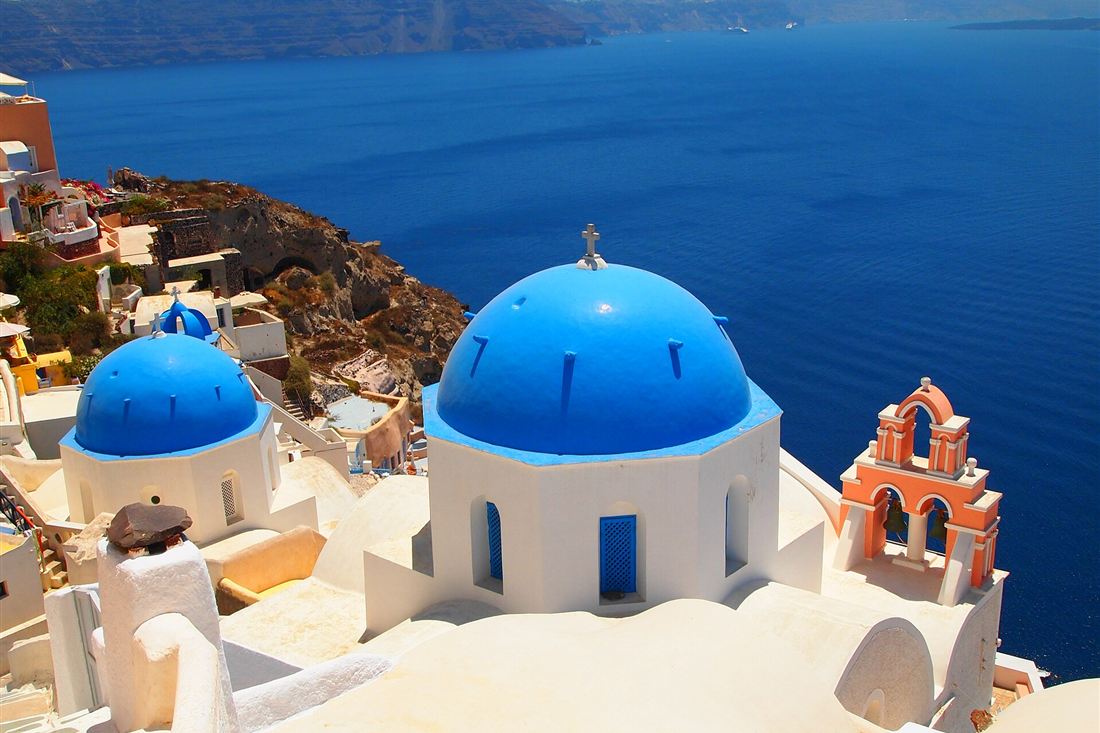
The 2-day trip to Santorini from Athens includes a night on the island, the cobblestone lanes, the Oia castle and the sunset over the Aegean. Tours across the rest of the country are listed on Greece Tours.
The sections below cover what the trip to Santorini from Athens includes, how the two days fit, earthquakes, Oia’s sea captains, pumice, dry-farmed tomatoes, Venetian castles, water, the Catholic quarter, season and booking, with links into the Santorini pages. The tours shown are checked on GetYourGuide and Viator.
What is the 2-day trip to Santorini from Athens with accommodation?
This 2-day trip to Santorini from Athens is GetYourGuide tour 270247, and accommodation is part of it. The tour starts in Athens. Its listing summary mentions cobblestone streets, the Oia castle and a sunset over the Aegean Sea.
Santorini lies at the southern end of the Cyclades, about 200 km southeast of Piraeus by sea. Its official name is Thira, and the municipality counts 15,480 residents. The main island covers about 73 km², a size that suits a 2-day trip to Santorini from Athens.
The island curves around a flooded caldera about 12 km by 7 km. Cliffs up to 300 m high wall it on three sides. The water inside the ring reaches 385 m deep. The smaller islands of Therasia and Aspronisi close its western side. Sea channels between these islands open the caldera to the Aegean.
The caldera took its present shape in the Minoan eruption of the 17th century BC. The same eruption buried the Bronze Age town of Akrotiri under ash. Two dark volcanic islets, Nea Kameni and Palea Kameni, rise near its centre. Both stay in view from the cliff-top lanes during a 2-day trip to Santorini from Athens.
Fira, the island capital, sits high on the caldera edge. A cable car links it with the old port. The white Orthodox Cathedral of Ypapanti stands near its centre. The Archaeological Museum of Thera lies 30 m east of the cable car entrance. The Museum of Prehistoric Thera stands at the cathedral’s southeast corner.
The village of Oia lines the northwest caldera edge, 70 to 100 m above the sea. Its houses fill niches carved into the cliff on the seaward side. Its municipal unit also covers the whole island of Therasia. Oia holds the castle named in the listing for the 2-day trip to Santorini from Athens.
What does the 2-day Santorini trip include?
The 2-day trip to Santorini from Athens includes accommodation and a start in Athens, per its listing. Transport, meals, the nightly hotel fee and site tickets are not named. Each of these needs its own line in the trip budget.
Accommodation is the one service the listing names as included on the 2-day trip to Santorini from Athens. The listing gives no hotel name, room type or meal plan. Meals on both days belong in the separate budget until the hotel states otherwise.
- Included: accommodation, as named in the listing
- Included: a start in Athens
- Listed highlight: a stroll on the cobblestone streets
- Listed highlight: the Oia castle
- Listed highlight: the sunset over the Aegean
- Separate budget: transport between Athens and Santorini, unless the listing page names it
- Separate budget: breakfast, lunch and dinner on both days
- Separate budget: the Greek climate resilience fee for each hotel night
- Separate budget: entry tickets for Akrotiri, Ancient Thera and the island museums
- Separate budget: KTEL bus, taxi or cable car fares on the island
- Separate budget: drinks and snacks at the Oia sunset viewpoints
The listing names no transport mode for the 2-day trip to Santorini from Athens. Athens links to the island by ferry from Piraeus or by air to Santorini (Thira) International Airport. Ferries dock at Athinios, the main port of the island. Unless the listing page names it, the fare for that leg is a separate cost.
Greece charges a climate resilience fee for each room and each night of a hotel stay. The fee rises with the hotel’s star class. The listing for the 2-day trip to Santorini from Athens does not mention it. The fee replaced the older overnight stay tax.
Entry tickets are not named on the 2-day trip to Santorini from Athens. Akrotiri, on the island’s southwest peninsula, has its own ticket. Ancient Thera stands on Mesa Vouno at 396 m and charges separate entry. The Museum of Prehistoric Thera also sells its own tickets.
On the island, public KTEL buses leave the Fira bus station for Oia, Kamari, Perissa and Akrotiri. Taxis and rental cars use the same roads. The listing names neither, so these fares join meals and tickets on the separate budget.
How do the two days on Santorini fit together?
The listing gives no day order for this 2-day trip to Santorini from Athens. A simple split puts the arrival, a town walk and the Oia castle sunset on day one. The rim walk and the return to Athens fill day two.
Day one starts with the arrival and the check-in at the included accommodation. The afternoon then suits a stroll on Fira’s cobblestone lanes along the caldera edge. That stroll covers the first named highlight of the 2-day trip to Santorini from Athens.
- Day one, arrival: travel from Athens and check in at the included accommodation.
- Day one, afternoon: stroll the cobblestone lanes of Fira.
- Day one, sunset: watch from the ruined castle at the top of Oia.
- Day two, morning: walk the 10 km caldera-rim path from Fira to Oia.
- Day two, afternoon: return to Athens.
Sunset at the Oia castle closes day one of the 2-day trip to Santorini from Athens. The ruined castle stands at the top of the village and gives a 360-degree view. It looks west across the channel to Therasia. Crowds gather there every evening to watch the Santorini sunset over the Aegean.
Day two of the 2-day trip to Santorini from Athens starts with the walk along the caldera rim. The path from Fira to Oia passes the villages of Firostefani and Imerovigli. The Monastery of Saint Nikolaos stands on the stretch between Fira and Imerovigli.
The return to Athens closes day two, so the rim walk fits the morning hours. Below Oia, 300 steps lead down to the port at Amoudi Bay.

How does a 2-day trip compare with a same-day visit and a 3-day stay?
A 2-day trip to Santorini from Athens adds one hotel night to the visit. A same-day visit has no night and ends on a late return flight. A 3-day stay holds two nights and a third day.
A same-day visit leaves Athens by plane and returns on a late flight the same night. Unlike a 2-day trip to Santorini from Athens, it holds no night on the island. The page on flights and ferries from Athens to Santorini also covers that one-day plan by plane.
The 2-day format includes accommodation, so one night falls on Santorini itself. This 2-day trip to Santorini from Athens lists two sights. They are the Oia castle and the sunset over the Aegean. Oia sits on the northern tip of the island, about 11 km from Fira.
A 3-day stay adds a second night and a full third day. The Santorini 3-day itinerary sets out a plan for each of those three days. Next to a 2-day trip to Santorini from Athens, it adds one hotel night and more island hours.
The evening is where the formats split. On a 2-day trip to Santorini from Athens, a hotel bed follows the sunset over the Aegean. On a same-day visit, the Oia sunset fits only when the return flight leaves after dark.
Pick the same-day visit when the calendar holds a single free day. Pick a 2-day trip to Santorini from Athens when one night away fits the plan. Pick the 3-day stay when two nights away fit the calendar.
- Same-day visit: no nights, no hotel, island hours between two flights, Oia sunset only with a late return
- 2-day trip: one night, accommodation included, the Oia castle and the sunset over the Aegean on the plan
- 3-day stay: two nights, a hotel for both, two evenings for an Oia sunset, three island days

How have earthquakes shaped Oia and Santorini?
A 2-day trip to Santorini from Athens visits an island reshaped by two seismic crises. The Amorgos earthquake of the mid-20th century wrecked Oia and Fira. A swarm of tremors in the 21st century sent over half the residents away for weeks.
The Amorgos earthquake struck early on a July morning in the mid-20th century. Its epicentre lay south of Amorgos, at a depth of about 20 km. It measured 7.7, the strongest quake in Greece in the 20th century. A second shock of 7.2 hit near Santorini 13 minutes later.
On Santorini the shaking killed 53 people and injured about 100. It destroyed 529 houses and badly damaged 1,482 more. Oia, home of a castle on the 2-day trip to Santorini from Athens, took the worst damage. Homeless families from across the island moved into camps outside Fira.
Families left for Athens after the quake, and Oia shrank to 306 residents two decades later. From that period, the Greek National Tourism Organisation restored the village as a protected traditional settlement. Architect Aris Konstantinidis led the work for about 15 years.
Seamen’s cave houses became guest houses, hotels and restaurants under the programme. Oia’s restored lanes, seen on a 2-day trip to Santorini from Athens, date from this work. Today the community works with geologists and limits building on unstable ground.
The 21st-century swarm began in late January, with over 200 undersea tremors on one February weekend. Its epicentres clustered around the empty islet of Anydros, between Santorini and Amorgos. The strongest shock measured 5.3. About 9,000 of the island’s 15,500 residents left by ferry and plane. Aegean Airlines doubled its Athens to Santorini flights for two days.
- Mid-20th century: about 35% of Santorini’s houses collapsed in the quake
- Same morning: a tsunami with a run-up of up to 30 m on nearby coasts
- Late 20th century: a Europa Nostra prize for the restoration of Oia
- The swarm: schools closed on Santorini, Amorgos, Ios and Anafi
- The swarm: a state of emergency on Santorini, lifted after about four weeks
- Later studies: the swarm linked to a 30 km volcanic dyke under the seabed
Who were the sea captains of Oia?
Oia grew rich in the 19th century on a merchant fleet of sailing ships. Its captains built mansions on the upper ridge, seen on a 2-day trip to Santorini from Athens. The Naval Maritime Museum of Oia keeps their records.
In the late 19th century, Oia had about 2,500 residents and roughly 130 sailing ships. The fleet traded across the Eastern Mediterranean. Its main route ran between Alexandria in Egypt and the ports of Russia.
Wealthy captains built two-storey neoclassical mansions, the kapetanospita, on the village’s highest ground. Crews lived lower down, in cave houses cut into niches of the caldera wall. The rock kept those rooms warm in winter and cool in summer. Both house types frame the lanes of Oia on a 2-day trip to Santorini from Athens.
Steamships replaced sail in the early 20th century, and shipping moved to Piraeus. Oia’s seaborne trade collapsed, and families left for Piraeus and Laurium. Earlier eras, from Bronze Age Akrotiri to Ottoman rule, appear in the history of Santorini.
The Naval Maritime Museum stands one block from the cliff top in Oia. Its Oia address puts it within reach on a 2-day trip to Santorini from Athens. The building is a restored 19th-century captain’s mansion.
Its rooms hold figureheads, nautical charts, ship models and historic photographs. The displays trace the role of Santorini’s shipowners and captains in Greek maritime history. The museum closes on Tuesdays, a detail for timing a 2-day trip to Santorini from Athens.
- Founder: Captain Antonios Dakoronias, from his own collection, in the mid-20th century
- First home: his grandfather’s mansion, closed after the mid-century quake
- Present house: donated by Dina Manolessou-Birbili in the late 20th century
- Rebuilders: shipowners Nikolaos and Dimitrios Nomikos
- Reopening: the late 20th century, as a public benefit foundation
- Latest renovation: the 21st century, with a new exhibition
How did pumice mining shape Santorini’s caldera coast?
Pumice mining cut deep quarries into the white ash layers that cap the caldera cliffs. Ships carried this ash abroad as cement for harbours and the Suez Canal. A 2-day trip to Santorini from Athens shows the pale quarry scars along the inner coast.
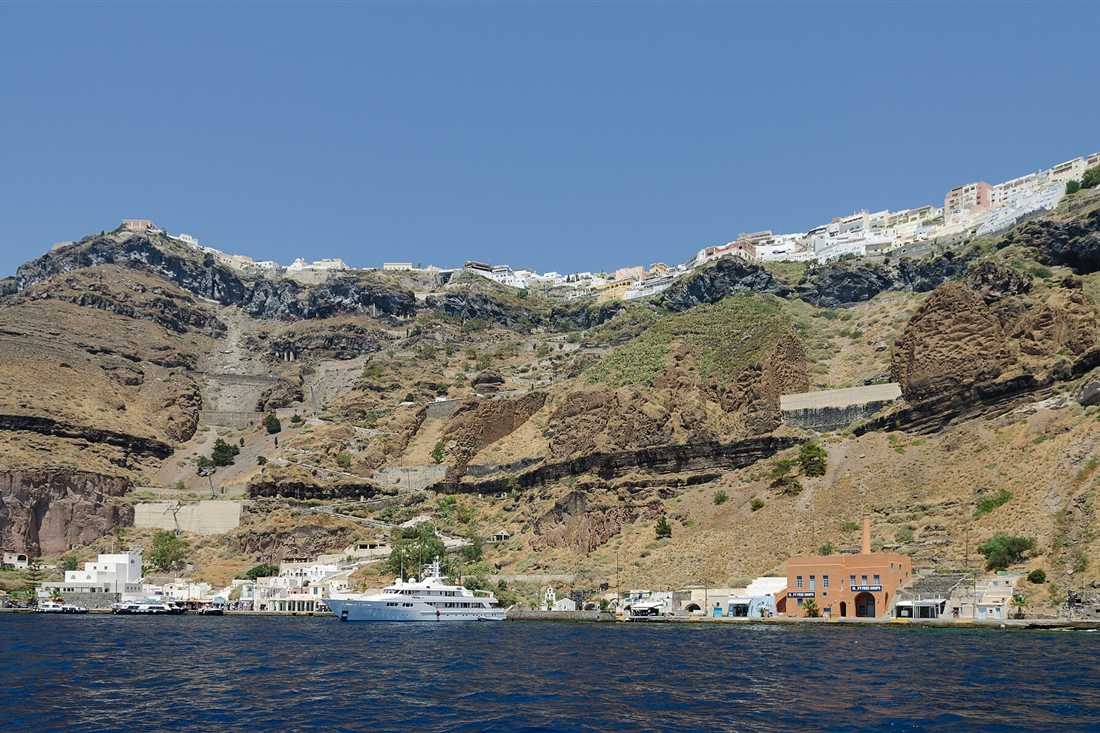
The Late Bronze Age eruption spread white pumice and ash up to 60 metres thick. This pale band caps the caldera cliffs, which rise up to 300 metres above the sea. Every caldera view on a 2-day trip to Santorini from Athens shows that white cap.
Quarries opened along the inner caldera coast, where the white ash lay exposed in the cliff face. Miners also dug tunnels straight into the cliff sides. Their dark openings stay in view from the rim on a 2-day trip to Santorini from Athens.
Builders abroad knew the fine ash as Santorin earth. Mixed with lime, it sets hard even under seawater. That made it a natural cement for piers, moles and harbour walls. Masons in the Eastern Mediterranean used it from the 5th century BC. In the 19th century, the Suez Canal works sent demand soaring.
Quarrying also exposed buried ruins. Workers at the Alafouzos quarries found Bronze Age walls under the ash in the 19th century. The French geologist Ferdinand Fouqué then excavated on Therasia and on Santorini. Those walls predate the Oia castle on a 2-day trip to Santorini from Athens by about three millennia.
The pumice quarries closed in the late 20th century to protect the caldera landscape. Cargo ships once moored below the cliffs inside the Santorini caldera to load the ash. Look for the old loading platforms at the cliff foot on a 2-day trip to Santorini from Athens.
- Tephra: the geological term for the loose pumice and ash in the cliffs
- Theraic earth: the Greek name for the ash, after Thera, the island’s ancient name
- Pozzolana: the cement family named after Pozzuoli near Naples
- Lower cliff bands: red and black lava from older eruptions
- Therasia: the second island quarried for ash, across the caldera bay
Why does Santorini grow tomatoes and fava without irrigation?
Santorini’s porous volcanic soil traps night humidity from the sea and waters the roots without irrigation. This dry farming yields the protected cherry tomato and Santorini fava. Both crops grow across the island visited on a 2-day trip to Santorini from Athens.
Santorini lies in a rain shadow, and summer brings almost no rain. Farmers plant without hoses, pumps or channels, a method called dry farming. Every field seen on a 2-day trip to Santorini from Athens relies on stored winter rain.
The volcanic soil works like a sponge. Early-morning fog from the Aegean condenses on the ground as dew. The porous ash holds that moisture near the roots. Plants under this water stress grow small fruit with firm skin and a high sugar content.
The Santorini cherry tomato, tomataki Santorinis, holds Protected Designation of Origin status in the European Union. Its small, slightly flattened fruit ripens in about 80 to 90 days. Look for tomatokeftedes, the island’s tomato fritters, on taverna menus during a 2-day trip to Santorini from Athens.
Santorini fava comes from Lathyrus clymenum, a vetchling native to the Mediterranean, not from broad beans. In a good year, a hectare yields about 800 kilograms of seeds. Cooks blend the boiled seeds with chopped onion into a yellow purée, a staple of Santorini food. Order it during a 2-day trip to Santorini from Athens.
The Tomato Industrial Museum at Vlychada fills a former canning factory of the Nomikos family. Its restored machinery traces tomato paste production from seed to can. The factory closed in the late 20th century as tourism replaced farming. Check the museum’s opening hours before a 2-day trip to Santorini from Athens.
- Santorini fava: also holds Protected Designation of Origin status
- White aubergine: a pale, sweet variety grown in the same dry fields
- Capers: wild bushes on rocky slopes, with pickled buds and leaves
- Tomato paste: the main product of the island’s 20th-century canneries
Which Venetian castles guarded Santorini’s villages?
Five fortified villages called kastelia guarded Santorini under the Venetian Duchy of the Archipelago. They stood at Skaros, Oia, Pyrgos, Emporio and Akrotiri. Their towers and walls still mark the island on a 2-day trip to Santorini from Athens.
Marco Sanudo founded the Duchy of the Archipelago in the early 13th century, with its capital on Naxos. Venetian lords from the Barozzi and Sanudo families held Santorini in the 13th and 14th centuries. The Ottomans annexed the duchy in the late 16th century.
Pirate raids forced islanders to live behind walls. In a kasteli, the outer houses stood side by side and formed the wall itself. Their outer faces had only small openings, and narrow gates led inside. The cobblestone streets on a 2-day trip to Santorini from Athens follow the same tight, bending plan.
Inside or beside each kasteli stood the goulas, a tall, square stone tower. Families climbed into it as a last refuge during raids. The name goulas comes from the Turkish word for tower. Each kasteli also had a church inside its walls.
Skaros emptied in the 18th century, as residents moved to Fira and Imerovigli. By the early 19th century, only weathered ruins stood on its rock. Fira grew into the island’s main town after this move. In Pyrgos village, lived-in houses still fill the walled core around the hilltop.
Spot a kasteli by two clues: a ring of blank house walls and a tower at its core. At the Oia castle on a 2-day trip to Santorini from Athens, tower and wall fragments survive.
- Skaros: the Venetian capital, with over 200 homes in the 14th century
- Agios Nikolaos, Oia: seat of the Argyri family under Venetian rule
- Pyrgos: later the administrative centre of the island
- Emporio: its Goulas tower still rises over the old fortified quarter
- Akrotiri: remains of the Goulas tower crown the hill above the village

How does Santorini get its drinking water?
Santorini turns seawater into tap water at desalination plants, but that water is not for drinking. Drinking water comes from small treatment units and sealed bottles. Guests on a 2-day trip to Santorini from Athens drink bottled water.
The island lies in a rain shadow, so little rain reaches it. Its small size and volcanic ash soil allow no rivers to form. The only spring is Zoodochos Pigi, the Life-giving Spring. No stream crosses the hillsides seen on a 2-day trip to Santorini from Athens.
Islanders once diverted rain from roofs and courtyards into underground cisterns. In the 20th century, extra water arrived by sea from other parts of Greece. Homes along the cobblestone streets on a 2-day trip to Santorini from Athens still hide old cisterns. A large share has fallen into disrepair.
Demand from visitors, such as guests on a 2-day trip to Santorini from Athens, outgrew rain harvesting. The first desalination plant opened in Oia late in the 20th century, after a private donation. Today these plants deliver running water to the majority of homes on the island. Each plant below serves its own area.
- Oia: the first plant, with six units and 2,800 cubic metres a day
- Agia Paraskevi: 5,000 cubic metres a day for Kamari, Messaria, Monolithos and four other villages
- Exo Gialos: two units and 2,000 cubic metres a day for Fira, Imerovigli and Pyrgos
- Fira: 1,200 cubic metres a day
- Akrotiri: two units and 650 cubic metres a day
- Therasia: two units and 350 cubic metres a day
DEYA Thiras, the municipal water and sewerage company, runs the system on Santorini and Therasia. Its work covers the desalination plants, irrigation, drainage, sewers and treatment plants. The Loulas and Evangelos Nomikos Foundation has funded upgrades to both the water and sewage networks.
Desalinated tap water serves showers, washing and cleaning, but not drinking. Small autonomous units at Kamari, Emporio, Messaria and Therasia produce drinking water. Each unit makes 6 cubic metres a day. Carrying a sealed bottle in a day bag covers thirst on a 2-day trip to Santorini from Athens.
Saving water takes three simple steps on a 2-day trip to Santorini from Athens. Short showers come first. Taps stay closed while brushing teeth or shaving. Towels get reused instead of washed daily. Each step lowers the load on the island’s desalination plants and sewage network.
Why does Fira have a Catholic quarter?
Fira has a Catholic quarter because Venetian rule left Santorini with a sizable Catholic community. That community still worships in its own cathedral and churches. The quarter lies in Fira, open to anyone on a 2-day trip to Santorini from Athens.
After the Fourth Crusade, Santorini passed to the Duchy of Naxos, a Latin state in the Cyclades. From the 15th century on, the island recognised Venice as its overlord. A sizable Catholic community grew under this Latin rule. Visitors on a 2-day trip to Santorini from Athens meet this Latin heritage in Fira’s Catholic quarter.
The Catholic Cathedral of Saint John the Baptist was completed in the early 19th century. Its Baroque Revival walls in blue-grey and cream set it apart from the Orthodox churches of Santorini. A dome and a decorated bell tower crown the building. That bell tower makes the cathedral easy to spot on a 2-day trip to Santorini from Athens.
Dominican nuns first settled on the island in the late 16th century and later moved to Fira. The sisters live a cloistered life, so the convent rooms stay closed to the public. Only the convent church admits outside visitors, such as guests on a 2-day trip to Santorini from Athens.
Frangika, the old Catholic quarter, stretches along the northern edge of Fira. Its name comes from Frangos, the Greek word for a Frank or Western Catholic. Its lanes lead past the cathedral and the convent to the village of Firostefani. A walk through Frangika adds Latin history to a 2-day trip to Santorini from Athens.
- Cathedral of Saint John the Baptist: the seat of the Bishop of Santorini
- Dominican convent: a yellow building beside the cathedral
- Church of Our Lady of the Rosary: the convent church, with Baroque features
- Catholic Church of the Dormition: the Three Bells of Fira, with a feast day on 15 August
Two cave churches were cut into the cliff at the Three Bells site in the mid-17th century. Both vanished as the cliff edge receded, and an infirmary took their place. Jesuits later lived on the site until the land passed to the Catholic diocese. The present church dates from the 18th century and follows the Greek Byzantine rite.
The Catholic Diocese of Santorini began in the early 13th century as the Diocese of Thera. It follows the Latin rite within the church province of Naxos, Andros, Tinos and Mykonos. Fira also holds the Orthodox Metropolitan Cathedral of Ypapanti, a short distance away. A single walk through Fira on a 2-day trip to Santorini from Athens passes both cathedrals.
Which season suits the 2-day trip to Santorini from Athens?
Late spring and September suit a 2-day trip to Santorini from Athens. Both bring dry days, warm sea and late sunsets over the caldera. July and August add heat and the meltemi wind, while winter brings the year’s heaviest rain.
Santorini has a dry, warm climate with about 271 mm of rain a year. Rain falls mainly from November to March. July records close to zero, at 0.03 mm. April marks the switch, as rain drops from about 45 mm in March to 12 mm. The year-round mean daily high sits close to 22°C.
- Late spring: highs near 23°C, about 8 mm of rain, sea near 19°C, sunset close to 20:30.
- Summer, June to August: highs of 28°C to 30°C, dry skies, sea near 25°C, sunset close to 20:40.
- Autumn, September to mid-October: highs fall from 27°C to 23°C. Rain reaches 15 mm, and sunset moves from 19:50 to 18:30.
- Winter, December to February: highs of 14°C to 16°C. Rain reaches 40 mm to 55 mm a month, and sunset falls close to 17:05.
The meltemi is a dry north wind over the Aegean Sea. It blows hardest in July and August and can reach force 7 or 8 on the Beaufort scale. Strong meltemi days can delay or cancel ferries. That risk applies to any ferry leg of a 2-day trip to Santorini from Athens.
The Oia sunset on a 2-day trip to Santorini from Athens moves by over three hours between seasons. The clock change on the last Sunday of October pulls it an hour earlier overnight. A month-by-month look at Santorini weather lists rain, heat and sea conditions across the year.

How do you book and cancel the trip to Santorini from Athens?
Booking the 2-day trip to Santorini from Athens runs through the GetYourGuide booking page. Pick a date, set the group size, read the cancellation terms and pay. Free cancellation, where the listing shows that label, runs up to 24 hours before the start.
The GetYourGuide page for this tour shows open dates on a calendar. It also lists the inclusions of the 2-day trip to Santorini from Athens. These cover accommodation, a start in Athens, cobblestone streets, the Oia castle and the sunset over the Aegean.
- Choose a travel date on the availability calendar.
- Set the number of travellers in the group.
- Read the cancellation terms shown on the booking page.
- Enter the lead traveller’s name, email and phone number.
- Pay online and keep the mobile voucher sent by email.
On GetYourGuide, listings with the free cancellation label refund in full up to 24 hours before the start. The booking page states whether the 2-day trip to Santorini from Athens carries that label. A cancellation inside the 24-hour window earns no refund. Cancel through the account page or the GetYourGuide app.
Greek hotels charge a climate crisis resilience fee per room per night. The rate depends on the hotel’s star class and the season, with higher rates from April to October. Hotels collect it from guests at the property. For extra nights after the tour, compare the areas listed under where to stay in Santorini.
Frequently Asked Questions
How long does the Santorini tour from Athens last?
The tour lasts 2 days from its start in Athens. The 2-day trip to Santorini from Athens includes accommodation for the overnight stay. That leaves time for the lanes of Oia and the sunset without a same-day return. The booking page shows the start time for each date.
Is a hotel included in the 2-day Santorini trip?
Yes. Accommodation is part of the 2-day trip to Santorini from Athens. The listing summary names no hotel, star class or room type. Ask the operator for the hotel name through the GetYourGuide booking. The same message can ask about its distance from Oia and Fira.
Does the listing name the transport from Athens?
No. The listing summary does not name the transport mode. Ferries from Piraeus and Rafina and flights from Athens International Airport both serve Santorini. Before packing, confirm the mode used on the 2-day trip to Santorini from Athens with the operator. Flights carry stricter luggage limits than ferries.
What time is the Oia sunset in summer and winter?
In summer, the sun sets over the Aegean near Oia close to 20:40 local time. In winter, sunset falls close to 17:05. The Oia castle walls fill well before sunset from late spring to September. Arriving an hour early secures a clear view west.
How far is Oia from Fira?
Oia lies about 10 km north of Fira along the island’s main road. The drive takes around 25 minutes in light traffic. KTEL buses link the two villages through the day, and taxis wait at the Fira taxi rank. A cliff-top trail also joins them on foot.
Are meals included in the tour?
The listing summary names no meal plan. Treat meals on the 2-day trip to Santorini from Athens as extra unless the confirmation lists them. Ask the operator through the booking whether breakfast comes with the room. Plan for lunch and dinner on both days until that answer arrives.
Which shoes and clothes suit the cobblestone lanes?
Flat shoes with grip suit the smooth cobblestones and steps of Oia. On a 2-day trip to Santorini from Athens in summer, pack a hat, sunglasses and light cotton layers. A windproof jacket helps after sunset, when the caldera rim turns cool and breezy.
What happens if bad weather stops the ferries?
The Greek coast guard halts sailings when gale-force winds hit the Aegean. Ferry companies move stranded passengers to the next departure. Under a ban, contact the operator of the 2-day trip to Santorini from Athens through the booking. Ask for a new date or a refund.