
Getting from Athens to Santorini means choosing between a 45-minute flight and a scenic ferry from Piraeus of 4 to 10 hours. Flying is fastest, the ferry is cheaper and more scenic and better for luggage. This guide covers the ferry and flight options, the costs, the ports and which to choose.
This is the most common route to the island, a key part of the wider Santorini travel guide. Santorini sits in the southern Cyclades. The sections below cover the journey.
Should you fly or take the ferry?
Fly from Athens to Santorini for speed, in 45 minutes, or take the ferry for a scenic journey of 4 to 10 hours from Piraeus. Flying suits travellers short on time; the ferry suits island-hoppers, those with luggage and anyone who enjoys the sea.
The choice between plane and ferry shapes the trip. Flying is by far the quickest way, a domestic hop of around 45 minutes that is ideal if you are short on time or already heading to Athens airport, and flights now often cost less than the ferry. The ferry, leaving from the port of Piraeus, is slower at four to ten hours but more scenic, more comfortable for luggage and the natural choice for island-hopping around the Cyclades, with the open-deck crossing past other islands part of the holiday. The decision comes down to time, budget and how much you value the sea journey, set within the wider how to get to Santorini. The flight is the fast route.
How do you fly from Athens to Santorini?
Flights link Athens International Airport with Santorini (JTR) in about 45 minutes, on Aegean, Olympic, Sky Express and Ryanair, daily in summer. Athens airport is reached by metro line 3 or airport buses; Santorini airport sits 6 kilometres from Fira.
Flying is simple and quick. Frequent domestic flights link Athens International Airport with Santorini National Airport, code JTR, taking roughly 45 minutes, operated by airlines including Aegean Airlines, Olympic Air, Sky Express and Ryanair, with many a day in summer and fares that are often very reasonable when booked ahead. To reach Athens airport from the city, take the metro Line 3, the blue line, to the airport stop, or the X95 airport bus from Syntagma Square. On arrival, Santorini airport lies about 6 kilometres from Fira, reached by local bus, taxi or a pre-booked transfer, set out alongside the guide to the Santorini airport. The ferry is the scenic alternative.
How does the ferry from Athens work?
Ferries to Santorini leave from Piraeus, 12 kilometres south-west of central Athens and 25 minutes by metro. The trip takes 4 to 5 hours by high-speed boat or 8 to 10 by conventional ferry, from around 48 euros, arriving at Athinios port.
The ferry is a scenic, good-value way to reach the island. Boats leave from the port of Piraeus, roughly 12 kilometres south-west of central Athens and easily reached in about 25 minutes by metro from Monastiraki. The crossing time depends on the vessel: fast catamarans take around four to five hours, while the larger conventional car ferries, such as Blue Star, take about eight to ten hours but are cheaper, steadier and run year-round. Standard fares start from around 48 euros, rising for high-speed and premium seats. The ferry docks at Athinios, Santorini’s main port, set out alongside the guide to where to stay in Santorini. The ports are worth knowing.
What about the ports and getting to your hotel?
The ferry arrives at Athinios port, 8 kilometres below Fira and not walkable to the towns. Buses meet each ferry, and taxis and pre-booked transfers are available. From the airport, Fira is 6 kilometres, served by bus, taxi or transfer.
Knowing the arrival points helps you plan the last leg. The ferry docks at Athinios, a small, busy port at the foot of the cliffs on the west coast, around 8 kilometres below Fira and not within walking distance of Fira, Oia or the beach towns. You will need onward transport from the quay.
Public buses wait at Athinios after each ferry arrival and run up to Fira, from where you connect onward, while taxis and pre-booked transfers offer a quicker, door-to-door option. From the airport on the east coast, Fira is 6 kilometres away, similarly reached by bus, taxi or transfer. A pre-booked transfer is the smoothest choice after a long journey, set out alongside the guide to Fira. The ports of departure differ, too.
Which port do ferries leave from, Piraeus or Rafina?
Ferries to Santorini leave mainly from Piraeus, the largest port in Greece, 12 kilometres from central Athens. A smaller number of high-speed boats depart from Rafina, near the airport on the east coast, a shorter transfer for arriving air passengers.
Piraeus is the main gateway to the Cyclades and handles the widest choice of departures to Santorini, from both conventional car ferries and high-speed catamarans. The port lies at the end of metro Line 1, the green line, 25 minutes from Monastiraki in central Athens, which makes it the natural choice for travellers staying in the city centre.
Rafina sits on the east coast, closer to Athens International Airport at 20 minutes by taxi or the KTEL bus, and suits passengers who land and want to sail the same day without crossing the city. Rafina runs fewer Santorini services and mostly high-speed boats, so departure times are more limited. The port you choose depends on where you stay in Athens and whether you value airport proximity over frequency.
What is the difference between high-speed and conventional ferries?
High-speed catamarans reach Santorini in 4 to 5 hours with airline-style seating and no open deck. Conventional car ferries such as Blue Star take 8 to 10 hours, cost less, ride steadier in wind and carry vehicles and open deck space.
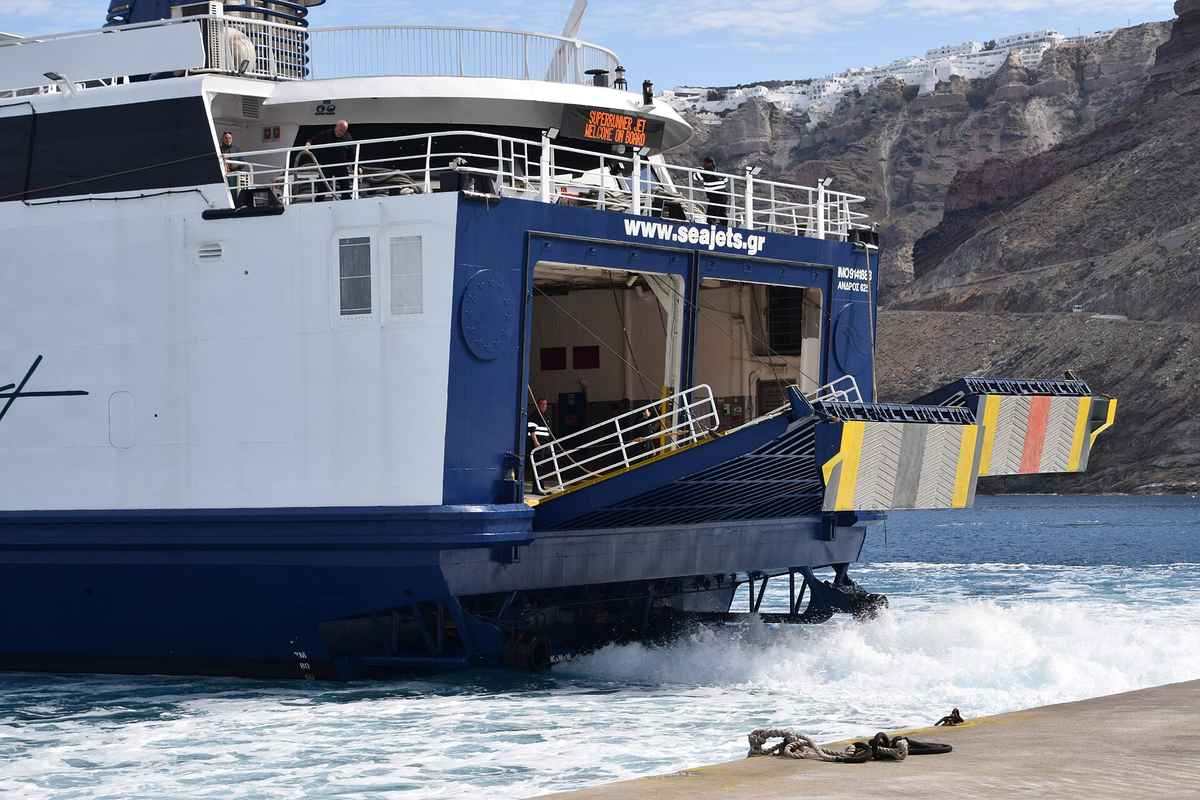
The high-speed boats, run by operators such as SeaJets, are the fastest way across by sea and cut the crossing to roughly half the time of a big ferry. Seating is enclosed and assigned, luggage sits in a shared rack, and the ride can feel bouncier when the wind picks up. Fares run higher than the conventional boats and sell out quickly in peak season.
Conventional ferries, led by Blue Star Ferries, are larger, steadier and cheaper, with sun decks, cafeterias and cabins on the longer sailings. They carry cars and motorbikes, which matters if you plan to bring a rental vehicle to the island. The trade-off is time: a conventional crossing runs 8 to 10 hours against 4 to 5 on a catamaran, so the choice weighs comfort and price against speed.
How do you buy tickets and how far ahead should you book?
Buy Athens to Santorini ferry and flight tickets online in advance, well ahead in July and August when both sell out. Ferry tickets come from operator sites or agents; flights from the airlines direct. Bring the paper or e-ticket for boarding at the port.
Summer is the busiest travel window in Greece, and the popular Athens to Santorini route fills fast from June through September. Booking two to four weeks ahead in peak season secures a seat and the better fares, since prices climb as departures fill. Shoulder months such as May and October give more flexibility and lower prices.
Ferry tickets are sold through the operators and through booking agents that list every company on one screen, which helps you compare crossing times and fares side by side. For conventional ferries you collect or print a boarding ticket; high-speed boats often accept an e-ticket. Flights are booked direct with Aegean, Olympic, Sky Express or Ryanair. Arrive at Athinios or the airport 45 to 60 minutes before departure to allow for boarding.
Does the Meltemi wind affect the crossing, and can you return the same way?
The Meltemi, a strong summer north wind, can slow or cancel high-speed ferries in July and August, while larger conventional ferries sail through most conditions. Return ferries and flights run daily from Santorini back to Athens on the same routes.
The Meltemi is a dry northerly wind that blows across the Aegean in high summer and builds through the afternoon. Fast catamarans sit lighter on the water and feel the swell more, so operators sometimes delay or cancel high-speed sailings on the windiest days. The heavy conventional ferries handle rough seas far better and rarely stop, which is one reason island-hoppers keep a big-ferry option in mind during August.
The route works in both directions with the same frequency. Daily ferries sail from Athinios back to Piraeus and Rafina, and flights return from Santorini airport to Athens in 45 minutes, so planning the trip home mirrors the outbound leg. Booking the return early matters as much as the outbound in peak season, since Santorini departures fill quickly.
How do luggage and cost compare between flight and ferry?
Ferries carry luggage free with no weight limit and easy access on board, while budget flights charge for hold bags. On price, ferries and flights now sit close, with early-booked flights sometimes cheaper than a high-speed ferry seat in peak season.
Luggage is one of the clearest advantages of the ferry. Boats let you bring cases and bags aboard at no extra charge and with no weight limit, and on conventional ferries you keep them near your seat or in an open rack. That freedom suits travellers moving between several islands with heavy bags or sports gear such as diving kit.
Flights follow airline rules, so a budget carrier such as Ryanair charges for hold luggage and caps cabin bags, which adds to the headline fare. Aegean and Olympic include a checked bag on most tickets. The old assumption that the ferry is always the cheaper option no longer holds: early-booked flights on the 45-minute hop sometimes undercut a high-speed ferry seat, so it pays to compare both on your dates before deciding.
Which route suits your trip best?
Choose the flight for the fastest door-to-door trip and a same-day arrival. Choose the ferry for island-hopping, a rental car, heavy luggage or the caldera views on approach. Match the route to your priorities of time, budget and scenery.
The flight wins on speed and simplicity for travellers arriving into Athens airport with limited days, since the 45-minute hop leaves the whole holiday for the island itself. It also avoids the transfer from the city to a port and the long crossing at either end of the trip.
The ferry earns its place for anyone chaining Santorini with Naxos, Paros or Milos, bringing a car, or travelling with bags that would cost extra to fly. The slow approach into the caldera, with the cliffs and whitewashed towns rising above the sea, is a highlight in its own right and a fitting start to the visit. Weigh time against budget and scenery, and the right route follows.
Frequently Asked Questions
How long does it take to get from Athens to Santorini?
Flying from Athens to Santorini takes about 45 minutes, while the ferry from Piraeus takes around 4 to 5 hours by high-speed boat or up to 8 to 10 hours by conventional ferry. Flying is fastest; the ferry is more scenic and better for luggage.
Is it better to fly or take the ferry to Santorini?
Flying is better if you are short on time or already at Athens airport, and is often cheaper, taking just 45 minutes. The ferry is better for island-hopping, luggage and enjoying the scenery, though it takes much longer. The choice depends on time, budget and preference.
Where does the Athens ferry arrive in Santorini?
The Athens ferry arrives at Athinios port on Santorini’s west coast, about 8 kilometres below Fira and not walkable to the towns. Buses meet each ferry up to Fira, while taxis and pre-booked transfers offer a quicker, door-to-door way to reach your hotel.
What is the fastest ferry from Athens to Santorini?
The fastest ferries are the high-speed catamarans run by operators such as SeaJets, which reach Santorini from Piraeus in about 4 to 5 hours. The conventional car ferries take 8 to 10 hours. Only a flight, at 45 minutes, is quicker than the fast boat.
Should you book Athens to Santorini tickets in advance?
Yes, book two to four weeks ahead for travel in July and August, when both ferries and flights on this popular route sell out and prices climb. In the shoulder months of May and October there is more availability and lower fares, so shorter notice works.