
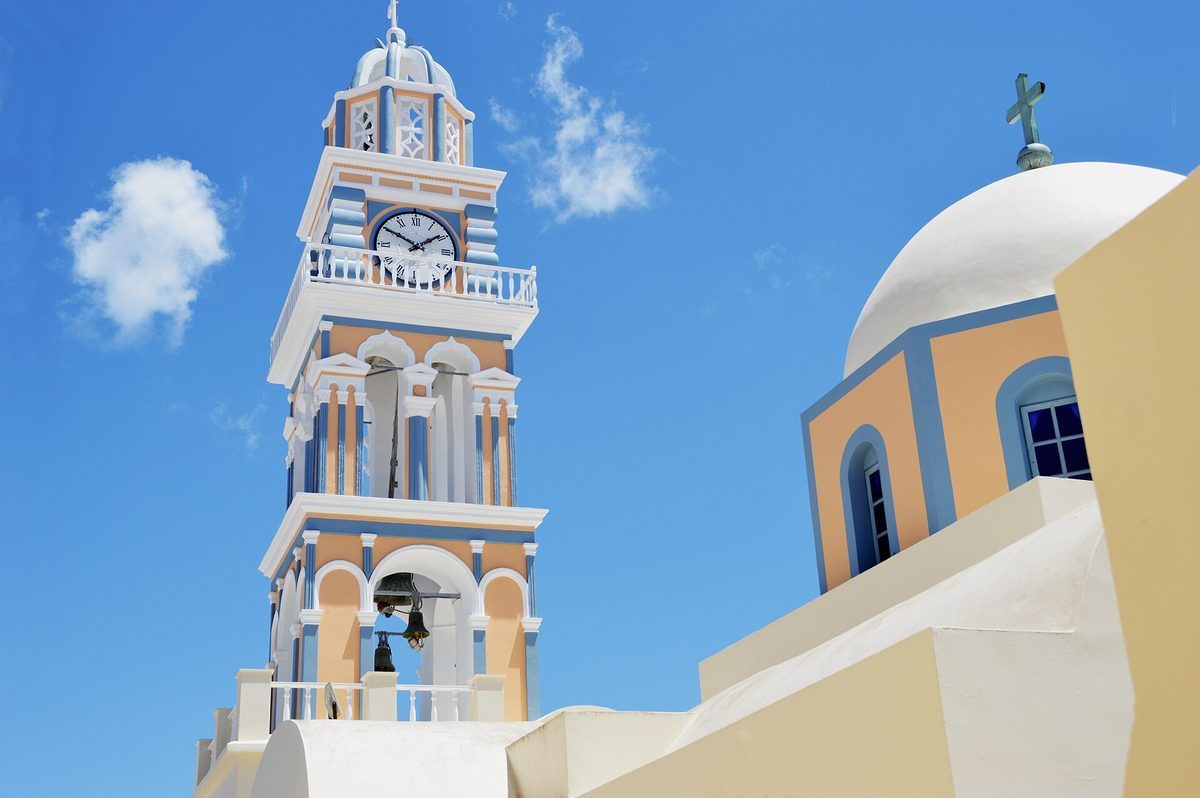
Santorini has hundreds of churches, from the famous blue domes of Oia to the Orthodox and Catholic cathedrals of Fira, the hilltop Profitis Ilias monastery and the ancient Panagia Episkopi. This guide covers the cathedrals, the blue-domed churches, the monasteries and the historic churches worth visiting. Plan the whole trip with Greece Tours.
Churches are everywhere in the wider Santorini travel guide. They shape the island’s look and its faith. The sections below cover the churches district by district.
How many churches are on Santorini?
Santorini holds more than 600 churches and chapels across the island, both Greek Orthodox and Catholic. They range from tiny private chapels to grand cathedrals, and their whitewashed walls and blue domes define the island’s look.
Churches are woven into the fabric of Santorini. The island counts more than 600 of them, far outnumbering what its small population would seem to need. The range runs from family chapels tucked into the lanes and clifftops to imposing cathedrals on the caldera rim. Unusual for Greece, the island keeps a sizeable Catholic community beside the Greek Orthodox majority, a legacy of Venetian rule. You therefore find both faiths represented in stone and paint.
The buildings blend Byzantine cross and basilica forms with the plain, whitewashed Cycladic style. Their blue domes and white bell towers against the sea rank among the island’s most photographed sights. That vernacular look belongs to the wider Santorini blue domes, and it repeats in every clifftop village. Fira, the capital, holds the two cathedrals that anchor the island’s religious map.
What are the cathedrals in Fira?
Fira has two cathedrals. The Orthodox Metropolitan Cathedral, the Candlemas of the Holy Virgin, sits on the caldera edge with arched facades and volcano views. The baroque Catholic Cathedral of Saint John the Baptist stands nearby in the Catholic Quarter.
The capital holds the island’s two grandest churches. The Orthodox Metropolitan Cathedral, dedicated to the Candlemas of the Holy Virgin, stands on the caldera edge in Fira and shows a handsome arched facade with sweeping views over the volcano. It was rebuilt to its present form after a mid-20th-century earthquake damaged the earlier structure. Its bright interior, painted arcades and marble floor draw a steady stream of visitors alongside worshippers.
A short walk away, in the historic Catholic Quarter, the Catholic Cathedral of Saint John the Baptist shows a baroque style in soft tones of pale blue, grey and beige. It reflects the island’s Venetian Catholic heritage and was likewise restored after the same earthquake. Together the two cathedrals make Fira a rewarding place to see the two traditions side by side, set out alongside the guide to Fira. The monasteries crown the heights above the town.
What are the main monasteries?
The main monastery is Profitis Ilias, on the island’s highest peak above Pyrgos, with panoramic views and a museum of icons and relics. The convent of Agios Nikolaos, between Firostefani and Imerovigli, is the island’s only Greek Orthodox convent.
Santorini’s monasteries occupy its most commanding positions. The greatest is the monastery of Profitis Ilias, on the summit of the island’s highest mountain at 565 metres above the village of Pyrgos. The fortress-like complex commands unrivalled panoramas over the whole island. Its museum holds important icons, manuscripts, old books and displays of traditional crafts, and the monks once ran a school here during Ottoman times.
Between Firostefani and Imerovigli stands the convent of Agios Nikolaos, the only Greek Orthodox convent on Santorini. The community began at Skaros, the medieval fortress rock, and moved to its present spot after rockfalls threatened the old site. These religious houses combine spiritual weight with history and superb light, set out alongside the guides to the Profitis Ilias monastery and Pyrgos. Older churches lower down reward the effort of seeking them out.
Which is the oldest church on Santorini?
The oldest church is the Panagia Episkopi, near Exo Gonia in the island’s centre-east. This Byzantine church dates from the medieval era and has survived earthquakes, fires and lootings, making it the island’s most important historic religious landmark.
The Panagia Episkopi ranks as the island’s foremost Byzantine survivor. It stands near Exo Gonia in the centre-east and was raised during the medieval Byzantine era, long before the whitewashed cliff villages took their present form. Centuries of earthquakes, fires and raids failed to destroy it, and it keeps its cross-domed plan, carved marble screen and fragments of old wall painting. The building served both Orthodox and Catholic congregations at different points in its long history.
The medieval hilltop village of Pyrgos holds more than 40 churches threaded through its lanes, including the church of the Holy Trinity with a small museum of Byzantine icons and ecclesiastical robes. The blue-domed churches of Oia, Firostefani and Imerovigli remain the island’s photographic icons. Church-hopping therefore becomes a rewarding way to explore, set out alongside the guides to Exo Gonia and Oia.
Which are the most famous churches in Santorini?
The most famous churches are the blue-domed chapels of Oia, Imerovigli and Firostefani. The Anastaseos church in Oia and the Three Bells of Fira in Firostefani frame the caldera and the sunset, making them the island’s signature photographic subjects.
Fame on Santorini follows the caldera rim. The blue-domed chapels of Oia draw the largest crowds, with the Anastaseos church and its cluster of cobalt cupolas set against the sea and the sunset. Photographers gather along the walkways of Oia through the late afternoon to catch the domes as the light turns gold. The single most reproduced view frames three domes stacked above the blue water.
Firostefani, just north of Fira, holds the Three Bells of Fira, a white bell-gable with a blue dome that faces west over the caldera. Imerovigli adds the church of Panagia Malteza and a scatter of clifftop chapels above the old Skaros rock. These small churches carry no grand history, yet their placement on the cliff edge gives them the island’s most recognisable silhouettes and the best light of the whole caldera.
Why are Santorini’s churches blue and white?
Santorini’s churches are blue and white because whitewashed lime walls reflect summer heat and once disinfected surfaces, while blue domes echo the sea and sky. The colours form the traditional Cycladic vernacular used across the island’s chapels.
The colour scheme grew from practical roots. Whitewash made from slaked lime coated walls across the Cyclades because it reflected the fierce summer sun and acted as a mild disinfectant against damp and disease. Islanders repainted their houses and chapels each year before major feasts, so the villages kept their bright, clean face. The custom hardened into a shared architectural identity across the island group.
Blue arrived on domes, doors and window frames as the natural partner to all that white. The pigment echoed the sea and sky that surround every viewpoint, and cheap laundry blueing once tinted the paint on many chapels. The rounded domes themselves follow Byzantine church design, so the blue-and-white dome became the meeting point of faith and Cycladic craft. The palette now reads as the visual shorthand for the whole island.
Where are the Catholic churches on Santorini?
The Catholic churches cluster in the Catholic Quarter of Fira, around the Cathedral of Saint John the Baptist. The Dominican convent and the church of the Dormition sit nearby, a legacy of the Venetian and Latin rule of the island.
Santorini keeps one of the largest Catholic communities in the Aegean, rooted in the centuries of Venetian and Latin control after the fall of Byzantine power. The heart of that community sits in the Catholic Quarter of upper Fira, a knot of vaulted lanes around the baroque Cathedral of Saint John the Baptist. The Dominican convent stands close by and still runs a chapel and workshops within its walls.
The quarter also holds the Catholic church of the Dormition of Mary and several smaller chapels dedicated to Latin-rite saints. Street names, coats of arms and the pale baroque facades set the district apart from the Orthodox lanes below. A short walk links the Catholic and Orthodox cathedrals, so travellers can trace both traditions within one afternoon in the capital.
Can you visit the churches inside?
You can enter most Santorini churches during opening hours, and entry is generally free. They are working places of worship, so dress modestly, cover shoulders and knees, keep quiet during services and ask before photographing interiors or icons.
Access varies with the building. The cathedrals of Fira, the Profitis Ilias monastery and the Panagia Episkopi welcome respectful visitors outside service times, and the monastery museum charges a small fee for its collection. Blue-domed clifftop chapels stay locked outside their annual feast days, so travellers usually admire them from the outside and photograph the domes rather than the interiors.
Modest dress is the firm rule at every active church. Cover shoulders and knees, remove hats indoors, silence phones and step aside for worshippers. Many chapels sit on private terraces or narrow walkways, so keep off private property and follow marked paths. These simple courtesies keep the churches open and welcoming, and they matter most during the busy feast days of the Orthodox calendar.
Which churches suit different visitors?
Photographers head to Oia and Imerovigli for blue domes, history lovers to the Panagia Episkopi and Pyrgos, and pilgrims to the Profitis Ilias monastery. The table below matches each type of visitor to the churches that suit them best.
| Visitor | Church or area | Why it suits |
|---|---|---|
| Photographers | Oia, Firostefani, Imerovigli | Blue domes and bell-gables framing the caldera and sunset |
| History lovers | Panagia Episkopi, Pyrgos | Byzantine architecture, old icons and a small church museum |
| Pilgrims | Profitis Ilias monastery | Working monastery with relics, icons and panoramic quiet |
| Culture seekers | Catholic Quarter, Fira | Baroque cathedral and convent from Venetian rule |
The island rewards mixing these threads in one visit. A morning at the Panagia Episkopi and Pyrgos pairs Byzantine history with hilltop views, while a late afternoon in Oia and Imerovigli catches the blue domes at their best light. A drive up to the Profitis Ilias monastery adds the widest panorama on the island and a quiet contrast to the crowded caldera villages.
Frequently Asked Questions
How many churches are on Santorini?
Santorini holds more than 600 churches and chapels across the island, both Greek Orthodox and Catholic. They range from tiny private chapels to grand cathedrals, and the whitewashed walls and blue domes of the Cycladic style define the island’s look. The count far outstrips what the small resident population would seem to need.
What are the main churches in Fira?
Fira holds two cathedrals. The Orthodox Metropolitan Cathedral, the Candlemas of the Holy Virgin, stands on the caldera edge with arched facades and volcano views. The baroque Catholic Cathedral of Saint John the Baptist rises nearby in the Catholic Quarter, in soft pale blue, grey and beige. A short walk links the two traditions.
Which is the oldest church on Santorini?
The oldest church is the Panagia Episkopi, near Exo Gonia in the island’s centre-east, dedicated to the Virgin Mary. This Byzantine church dates from the medieval era and has survived earthquakes, fires and lootings across the centuries. Its cross-domed plan, carved marble screen and old wall painting make it the island’s major historic religious landmark.
Are Santorini’s churches free to visit?
Entry to most Santorini churches is free during opening hours, and only the Profitis Ilias monastery museum charges a small fee for its collection. The churches remain working places of worship, so dress modestly, cover shoulders and knees, and ask before photographing interiors or icons. Clifftop chapels often stay locked outside their annual feast days.
Where are the best blue domes?
The best blue domes cluster along the caldera rim in Oia, Firostefani and Imerovigli. The Anastaseos church in Oia and the Three Bells of Fira in Firostefani frame the water and the sunset, giving the island its signature views. Late afternoon light turns the white walls gold and deepens the blue of the domes.