
The 4-day Athens city break joins a 3-star hotel in the centre with the Acropolis, the Acropolis Museum, the Herakleidon Museum and a 2-day hop-on hop-off bus ticket. Tours across the rest of the country are listed on Greece Tours.
The sections below cover what the Athens city break includes, hotel ratings, the bus ticket, the Acropolis restoration, the museum excavation, kiosks, summer cinemas, the metro finds, the Olympic legacy, refugee districts, holidays, season and booking, with links into the Athens pages. The tours shown are checked on GetYourGuide and Viator.
What is the 4-day Athens city break with the Acropolis and a city tour?
This package spans four days in Athens, the capital of Greece. The 4-day Athens city break joins a 2-day hop-on hop-off bus ticket with a central hotel stay. Visits cover the Acropolis, the Acropolis Museum and the Herakleidon Museum.
GetYourGuide lists the package as tour 1372126, a new listing for the city. Athens has a recorded history of more than 3,400 years. The city takes its name from Athena, its patron goddess in myth. This 4-day Athens city break keeps every named sight within the old centre around the Acropolis.
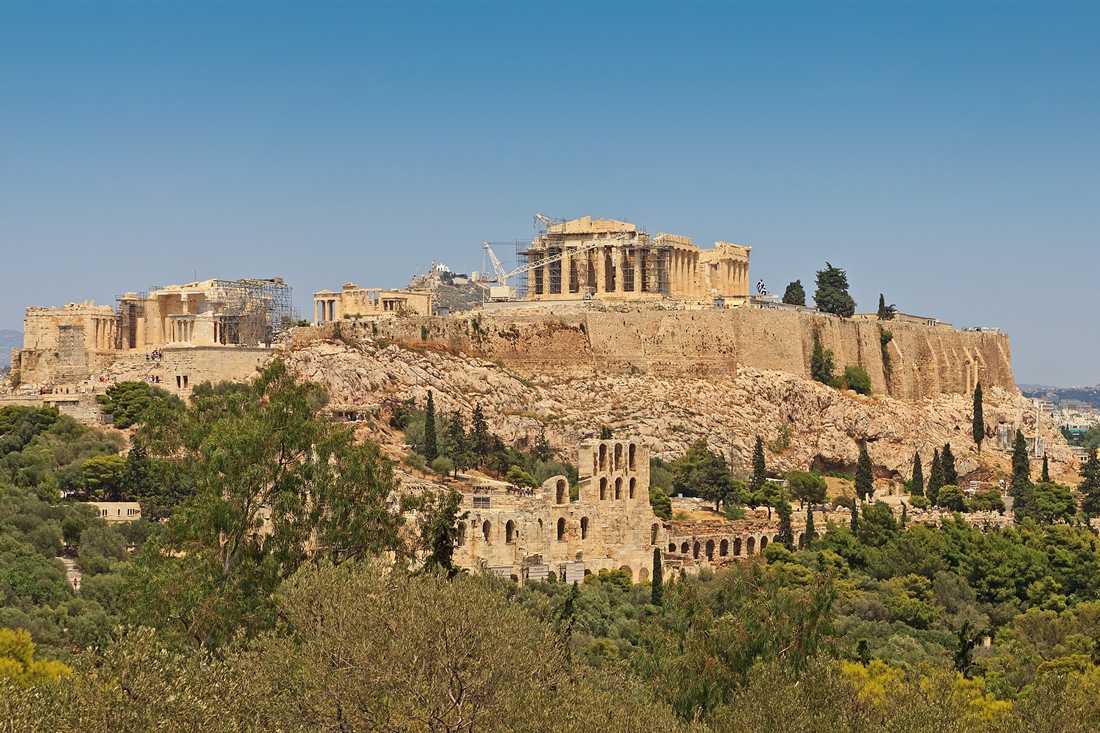
The Acropolis is a flat-topped rock that rises about 150 m above sea level in central Athens. Its Parthenon was built in the 5th century BC under Pericles as a temple to Athena. Around it stand the Erechtheion, the Propylaia gateway and the Temple of Athena Nike. The 4-day Athens city break includes a visit to this hilltop citadel.
Below the south slope, in the Makrygianni district, stands the Acropolis Museum. Swiss-French architect Bernard Tschumi designed it with over 14,000 square metres of exhibition space. Its top-floor Parthenon Gallery faces the temple through glass walls. The Acropolis Museum highlights page lists the key rooms for this stop on the 4-day Athens city break.
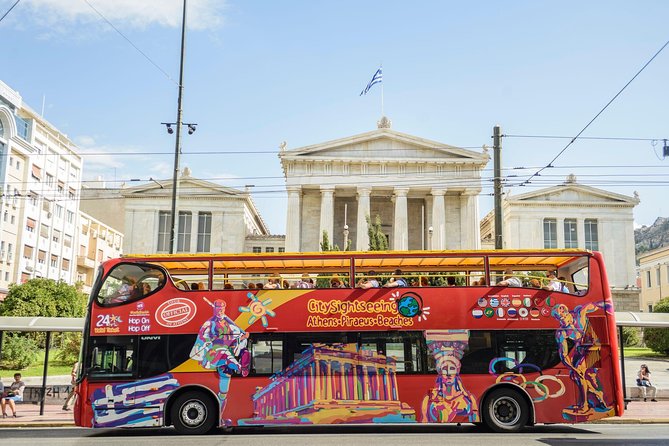
The city tour part of the 4-day Athens city break comes from the 2-day hop-on hop-off bus ticket. Riders step off at a stop and rejoin a later bus from any stop on the route. This format turns the ticket into a self-paced tour of the city over two days.
The third named sight is the Herakleidon Museum, set in a neoclassical building in Thissio. It holds works by the Dutch graphic artist M. C. Escher and the painter Victor Vasarely. Its exhibitions also explain ancient Greek mathematics and technology. More on the collections sits on the Herakleidon Museum in Athens page.
What does the Athens city break include?
Five parts make up the 4-day Athens city break. They are a 2-day hop-on hop-off bus ticket, three sight visits and a central hotel stay. Flights, the airport transfer, meals and the city tax need a separate budget.
The listing gives no hotel name, room type or meal plan for the 4-day Athens city break. Breakfast is therefore not assumed in the package. The split below separates the named parts from the costs travellers carry themselves.
- Included: a 2-day hop-on hop-off bus ticket
- Included: a visit to the Acropolis
- Included: a visit to the Acropolis Museum
- Included: a visit to the Herakleidon Museum
- Included: a stay in a 3-star hotel in the city centre
- Budget separately: return flights to Athens International Airport
- Budget separately: the airport transfer on arrival and departure
- Budget separately: breakfasts, lunches and dinners
- Budget separately: the per-night city tax charged by the hotel
Athens International Airport Eleftherios Venizelos lies about 20 km east of central Athens, near Spata. The 4-day Athens city break listing names no transfer between the airport and the hotel. Both arrival and departure days need a separate ride by taxi or private transfer. The drive follows the Attiki Odos motorway into the city.
Greece charges a climate crisis resilience fee, known as the city tax, per room and per night. The hotel collects it directly, so it sits outside the package. Plaka and Monastiraki, beside the Acropolis, hold dense rows of tavernas for lunch and dinner. The Varvakios central market on Athinas Street sells fresh food for picnic lunches.
The Athens city pass joins the Acropolis, museums and the hop-on hop-off bus without a hotel. It suits travellers who have already booked a room elsewhere in Athens. The 4-day Athens city break differs by placing the hotel stay inside the same package.
Sights beyond the three named visits sit outside the listing as well. The Temple of Olympian Zeus, the Roman Agora and the National Archaeological Museum each need separate entry. The National Archaeological Museum, on Patission Street, holds the Mask of Agamemnon from Mycenae.
How do the four days of the city break fit together?
Each traveller sets the day order of the 4-day Athens city break, since the listing fixes none. A workable split keeps day one for arrival and day four for departure. The two middle days hold the three sights and the bus ticket.
- Day 1, arrival: airport transfer, hotel check-in in the centre and an evening walk
- Day 2, Acropolis day: the Acropolis in the morning, then the Acropolis Museum
- Day 3, bus and Herakleidon day: the hop-on hop-off bus, then the Herakleidon Museum in Thissio
- Day 4, departure: hotel checkout, a last morning walk and the airport transfer
On arrival day of the 4-day Athens city break, the hotel check-in comes first. No named sight falls on day one, which leaves room for a late flight. The Areopagus, a bare rock northwest of the Acropolis, gives a close view of the Propylaia. Its summit has no gate or ticket, so it suits a short evening walk.
Day two pairs two sites about 300 m apart: the Acropolis and the Acropolis Museum. The pedestrian street Dionysiou Areopagitou links the south slope of the rock to the museum entrance. The short distance keeps day two of the 4-day Athens city break on foot. Seeing the rock first gives context for the Parthenon frieze on the top floor.
Day three uses the bus to circle central Athens before an afternoon in Thissio. The Herakleidon Museum lies about 1.5 km on foot from the Acropolis Museum. The walk follows the car-free Apostolou Pavlou street along the west side of the rock. The Temple of Hephaestus, from the 5th century BC, stands in the Ancient Agora beside Thissio.
The 2-day bus ticket’s second day fits day two or the morning of day four. Day four of the 4-day Athens city break closes with the hotel checkout and the airport transfer. An afternoon flight frees the morning for the hourly Evzones guard change at Syntagma Square.
How does the city break compare with the Athens 4-day itinerary?
The 4-day Athens city break bundles a central 3-star hotel, a 2-day bus ticket and three sights. The self-planned itinerary covers the same four days. There, each traveller arranges the hotel, transport and every ticket alone.
A self-planned Athens 4-day itinerary sets out every day in order, morning to night. The 4-day Athens city break removes that planning step for the bed, the bus and the main sights. Everything outside those three parts stays self-planned under both options.
- Hotel: the package fixes a central 3-star hotel; a self-planned trip chooses its own.
- Transport: the package adds a 2-day hop-on hop-off ticket; a self-planned trip walks or pays per ride.
- Sights: the package names the Acropolis and two museums; a self-planned trip sets its own list.
- Meals: the package listing names none; the itinerary page suggests food stops day by day.
- Nightlife and packing: the package covers neither; the itinerary page adds tips for both.
- Planning time: the package needs one decision; a self-planned trip needs separate hotel, bus and sight choices.
The self-planned route wins on freedom. Its traveller picks any neighbourhood and any hotel class. It can even split the stay between Plaka and Koukaki, which lies directly south of the rock. Inside the 4-day Athens city break, one central 3-star hotel serves the whole stay.
Weather favours the looser plan. A self-planned trip has no fixed points, so a rainy day swaps places with a dry one. In the 4-day Athens city break, the bus ticket runs on a clock once it starts. The Acropolis Museum and the Herakleidon Museum sit indoors, out of the rain.
A first visit suits the 4-day Athens city break, with hotel and sights fixed before landing. A return visit suits the self-planned route, since the central districts are already familiar. Groups with set interests, such as street food or rebetiko music, also lean toward self-planning.
What does a 3-star hotel rating mean in Greece?
A 3-star rating in Greece marks a mid-range hotel graded after an official on-site inspection. The 4-day Athens city break uses this class. It means a staffed reception, a private bathroom and daily cleaning of every room.
Greece grades hotels on a fixed scale from 1 to 5 stars, with 5 at the top. The Ministry of Tourism sets the rules in a ministerial decision. The Hellenic Chamber of Hotels, based at 24 Stadiou Street in Athens, issues each star certificate. One star marks the basic end of the scale.
Accredited inspection bodies visit each hotel and send a technical report to the Chamber. The certificate then stays valid for five years, and renewal needs a fresh inspection. Every licensed hotel in Greece must hold a star grade. Stars replaced the older letter classes, such as A, B and C, in the 21st century.
The grade rests on a points system. Inspectors score the building, the rooms and the services against a fixed checklist. Room size, reception hours, breakfast service and a lift all count toward the total. The hotel in the 4-day Athens city break reached the 3-star band on that checklist.
- A reception staffed 10 hours a day, or 8 hours plus 24-hour self check-in
- Phone or digital contact with the hotel around the clock
- Front-desk staff who speak two languages
- A breakfast buffet or an equal breakfast menu
- A private shower or bath with WC in each room
- A desk with a lamp, a luggage rack, a mirror and a hairdryer
- A drinks offer in the room and a laundry and ironing service
- Free Wi-Fi, daily cleaning and a central safe at reception
A 4-star grade adds a 14-hour reception service with staff on site 24 hours a day. It also adds a lobby bar or lounge and a minibar or in-room drinks service. A 2-star grade does not require the breakfast buffet, the desk or the hairdryer.
Stars grade facilities, not the street outside the front door. Noise, views and walking distance to the Acropolis sit outside the checklist. Area choice is compared on the page about where to stay in Athens. That page helps when adding extra nights to the 4-day Athens city break.
How does the 2-day bus ticket fit around the Acropolis visit?
The 2-day bus ticket runs for 48 hours from its first use, not from purchase. Within the 4-day Athens city break, visiting the Acropolis on foot first saves bus hours. Three stops sit close to the rock: Acropolis Museum, Plaka and Monastiraki.
The 48-hour clock starts at the first boarding. A first ride at 11:00 on one day keeps the ticket valid until 11:00 two days later. That window covers parts of three calendar days inside the 4-day Athens city break.
From 1 April to 31 August, the Acropolis opens 08:00 to 20:00. Closing time moves earlier through September and October as daylight shortens. From 1 November to 31 March, the hours run 08:00 to 17:00. An 08:00 entry on the 4-day Athens city break avoids the strongest midday sun.
The Acropolis Museum stop serves the south-east slope, where the museum stands about 280 metres from the Parthenon. Plaka covers the northern and eastern slopes. Monastiraki lies to the north-west, under 1 kilometre from the Herakleidon Museum in Thissio. All three named sights of the 4-day Athens city break sit within walking range of these stops.
- Enter the Acropolis first, while the bus ticket is still unused.
- Walk downhill from the rock to the Acropolis Museum.
- Board the bus for the first time after the museum, and note the time.
- Count 48 hours from that boarding to find the last valid ride.
- Ride to the Monastiraki stop for the walk to the Herakleidon Museum.
- Keep the ticket or its phone code ready at every boarding.
The full line map and stop list sit on the page about the Athens hop-on hop-off bus. On the 4-day Athens city break, the bus covers the longer stretches between districts. The walk from the Acropolis Museum to Thissio follows the pedestrian Dionysiou Areopagitou and Apostolou Pavlou streets.
What has the Acropolis restoration project rebuilt?
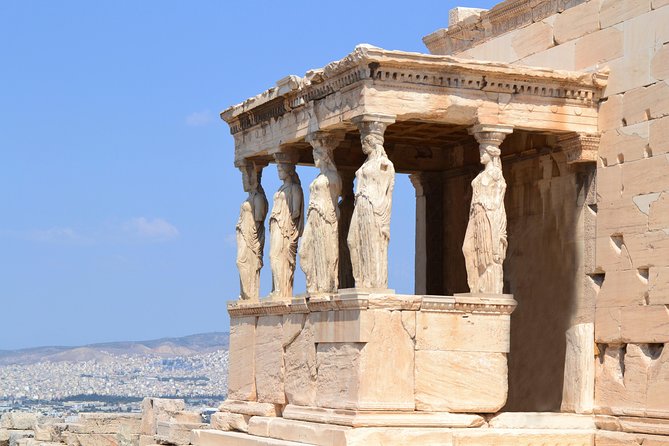
Crews have rebuilt large parts of the Parthenon, Erechtheion, Propylaia and Temple of Athena Nike. Since the nineteen-seventies, titanium has replaced rusted iron, and new Pentelic marble has replaced old cement. A 4-day Athens city break with an Acropolis visit shows the results.
The Greek state created the Committee for the Conservation of the Acropolis Monuments to lead the programme. It joins architects, civil engineers and archaeologists in one panel. The Acropolis Restoration Service, or YSMA, runs the worksites seen on a 4-day Athens city break. Each repair stays reversible, so later experts can undo it.
The programme corrects an earlier restoration led by engineer Nikolaos Balanos in the early twentieth century. He joined blocks with poor-quality iron clamps and filled gaps with cement. The iron rusted, swelled and broke the marble from inside. On a 4-day Athens city break, pale new marble on the columns marks the repairs.
Crews gathered and logged every loose fragment on the summit and slopes. Each stone returns to its ancient spot, a method called anastylosis. In all, 686 stones were rebuilt from original fragments. Titanium joints stand in for iron because titanium does not rust.
New marble comes from Mount Pentelicus, north-east of Athens, the source the ancient builders used. By the early twenty-tens, crews had used 530 cubic metres of it. Of all restored parts, 186 were cut wholly from new marble, and 905 stones received marble patches. The restored members weigh 2,675 tons in total.
- Erechtheion: 720 members reset in the nineteen-eighties, with copies of the six Caryatids
- Parthenon: eight north columns dismantled in the early twenty-first century, plus 117 west-side blocks reset since the twenty-tens
- Propylaia: 90 members of the central building’s north wall and east colonnade reset in the early twenty-first century
- Temple of Athena Nike: all 319 members taken down and reassembled in the early twenty-first century
Scaffolding on the Parthenon’s west front came down after fifteen years of work. The temple’s ancient builders shaped every block for one exact slot, so a misplaced stone shows. The Parthenon’s history and design make each repair easier to read on a 4-day Athens city break.
Which ancient neighbourhood lies under the Acropolis Museum?
The Acropolis Museum stands over an excavated neighbourhood in Makrygianni, 280 metres from the Parthenon. Its houses, streets, baths and workshops span the Classical to Byzantine eras. A 4-day Athens city break that visits the museum passes directly above its ruins.
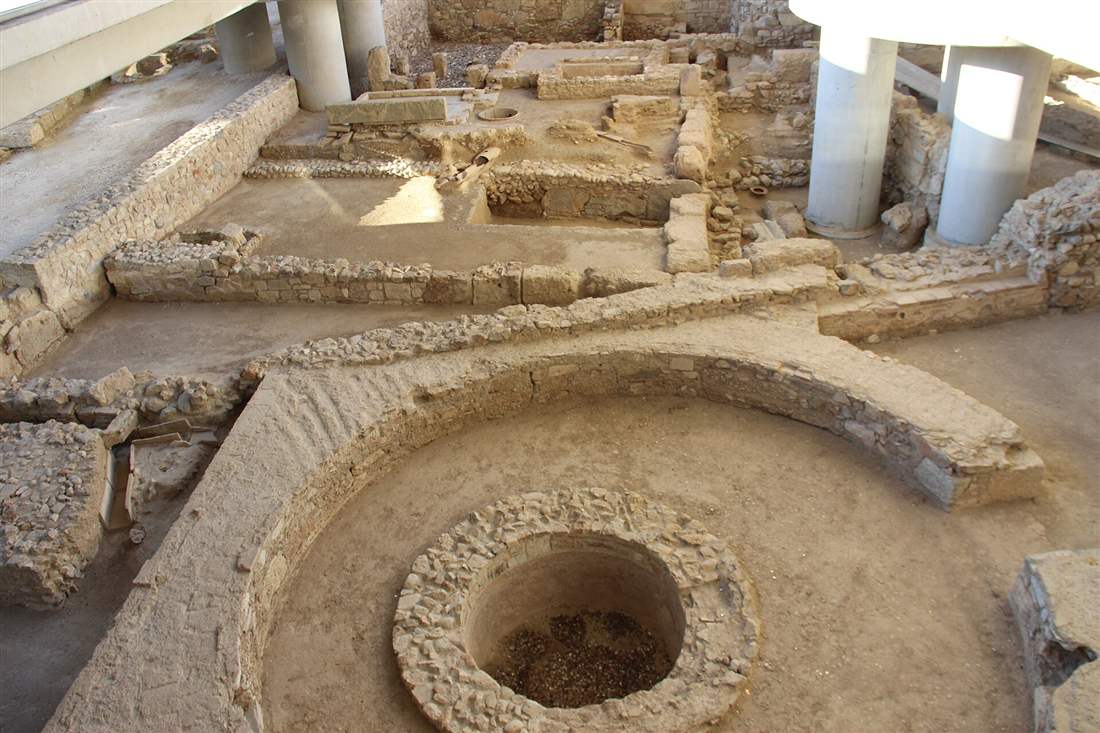
Digging for the museum’s foundations in the nineteen-nineties exposed the ruins and halted the project. The design changed, and the building rose on pillars set between the ancient walls. Each pillar reaches bedrock and sits on roller bearings built for a magnitude 10 earthquake.
Glass floors in the forecourt and inside the galleries look straight down onto the ruins. Balconies at the edge of the dig give a second view from above. On a 4-day Athens city break, the first ruins appear underfoot outside the entrance.
Human activity here began in the fourth millennium BC, and homes appeared in the eighth century BC. The quarter came inside the city walls at the end of the fifth century BC. Troops of the Roman general Sulla wrecked it in the first century BC. Herulian raiders destroyed it again in the third century AD.
- houses with inner courtyards and their own wells
- workshops fitted with water cisterns
- ancient streets running between the house blocks
- second-century AD homes with colonnaded courtyards, frescoes and mosaic floors
- private baths and latrines in the wealthiest homes
- Building Z, a fifth-century AD mansion
- an early sixth-century AD wing added to Building E
The site emptied for good in the early thirteenth century. The Weiler Building, the first military hospital in Athens, rose over Building Z in the early nineteenth century. Today it holds the museum’s offices. A visit on a 4-day Athens city break spans over five thousand years on a single plot.
The open excavation level welcomed walkers at the end of the twenty-tens. Paths now run along the ancient streets between the house walls. A Museum of the Excavation opened at its southern edge in the mid-twenty-twenties. On a 4-day Athens city break, a tour of the Acropolis Museum can start at this level.

Why does Athens have a kiosk on every corner?
Greece’s street kiosks, called periptera, began in the early twentieth century as state licences for disabled war veterans. Each booth sells newspapers, drinks, snacks and small daily needs. Travellers on a 4-day Athens city break find one at busy corners and squares.
The first licences went to men disabled in the Balkan Wars and the wars that followed. A booth gave each veteran a steady income without heavy physical work. Later laws extended licences to war widows and to people with disabilities. The kiosks on a 4-day Athens city break descend from that scheme.
The word periptero comes from peripteros, the ancient Greek term for a temple ringed by columns. The Parthenon is one, with eight columns at each end and seventeen along each side. A 4-day Athens city break thus meets the word twice: on the Acropolis and at the street corner.
Kiosks stand at the main squares and street corners around a 3-star hotel in the city centre. In the old lanes of Plaka, they sit beside tavernas and souvenir shops below the Acropolis. On a 4-day Athens city break, one is the quickest stop for a cold drink before the climb.
- Greek and foreign newspapers and magazines
- bottled water, soft drinks and beer
- ice cream from a freezer chest by the counter
- crisps, chocolate bars and chewing gum
- cigarettes, tobacco and lighters
- mobile phone top-up cards
- batteries and phone charging cables
Central Athens kiosks open early and close late, and the busiest corners keep one open around the clock. Late returns to the hotel on a 4-day Athens city break still find one lit and open. Pointing at an item across the counter works with no Greek needed.
Why do Athenians watch films in open-air summer cinemas?
Athenians watch films outdoors because summer nights stay warm and the open air beats a hot indoor hall. The therina cinemas run from late spring to September. One evening of a 4-day Athens city break fits a screening under the night sky.
Outdoor film shows in Athens began around the turn of the 20th century, at cafés on Syntagma Square. The Greek word therinos means “of the summer”, so locals call these venues therina. At their peak, in the decades after the Second World War, Athens counted over 600 open-air cinemas.
July afternoons in Athens pass 30 °C, and older indoor halls had no air conditioning. A garden screen catches the evening breeze instead. Rows of canvas or metal chairs face the screen, with small tables for drinks. After a sightseeing day on a 4-day Athens city break, the first show starts around 9 pm.
Cine Thisio has screened films for more than 90 years. It stands in the same district as the Herakleidon Museum, a stop on the 4-day Athens city break. Cine Paris works from a rooftop in Plaka, about 1.5 km away on foot.
Films play in their original language with Greek subtitles, and dubbing is kept for children’s films. English-language releases suit an Athens city break with no Greek needed. A second show starts near 11 pm. Late shows in residential streets run with lower sound for the neighbours.
- Cine Thisio: Apostolou Pavlou Street, Thisio
- Cine Paris: Kydathineon Street, Plaka
- Cine Aigli: the Zappeion gardens
- Cine Dexameni: Dexameni Square, Kolonaki
- Cine Riviera: Valtetsiou Street, Exarchia
Which antiquities line the Athens metro stations?
Metro digging in the late 20th century uncovered more than 50,000 ancient finds across Athens. Syntagma, Acropolis, Monastiraki and Panepistimio stations display finds, replicas and preserved ruins to passengers. Travellers on a 4-day Athens city break see them between trains.
Attiko Metro funded excavations over 69,000 square metres, the largest dig programme ever run in Athens. More than twenty digs took place at stations and ventilation shafts. Archaeologists worked ahead of the engineers, then beside them, for six years. The tunnels run about 15 metres deep, below the layers that hold antiquities.
The Syntagma dig exposed a Classical sculpture foundry, Roman baths, an ancient road and burials. Part of the finds moved to a 2,000 square metre open-air display on the Zografou campus. Lines 2 and 3 meet here, so a 4-day Athens city break crosses it on both lines. Its exits face the Evzones guard change at Syntagma Square.
The Acropolis station dig covered 2,500 square metres, with traces from the 3rd millennium BC to Byzantine times. Copies of sculptures of Dionysus, Demeter and Persephone stand on its concourse. The exit lies a short walk from the Acropolis Museum, another stop of the 4-day Athens city break.
Digs at Monastiraki found homes from the 8th century BC up to the 19th century. A walkway leads from the northbound Line 1 platform to a room of antiquities. Lines 1 and 3 meet here, and the exits open onto Monastiraki square and its flea market.
Panepistimio station lies under Panepistimiou Street, beside the University of Athens and the National Library. Digging there exposed part of an ancient cemetery. Evangelismos, one stop east on Line 3, revealed a walled cemetery, a water channel and a road. The Athens metro lines and ticket types page maps every station of a 4-day Athens city break.
- Syntagma: a soil cross-section behind glass, with finds in showcases
- Acropolis: a Parthenon frieze copy and pottery from the dig
- Monastiraki: the covered bed of the Eridanos river behind the platform
- Panepistimio: excavation finds in glass cases
- Evangelismos: finds re-placed inside the station hall
What did the Athens Olympic Games of the 21st century leave behind?
The Games of the early 21st century left Athens a roofed stadium and new coastal venues. They also left a modern tram and a new airport at Spata. Visitors on a 4-day Athens city break meet these legacies from arrival day.
The Athens Olympic Sports Complex, known as OAKA, lies in Marousi, a northern suburb. Spanish architect Santiago Calatrava redesigned it for the Games. His stadium roof hangs from two steel arcs with a total span of 304 metres. The arcs rise to 72 metres and carry 5,000 polycarbonate panels.
Builders assembled the west arc 72 metres from its final spot, then slid it into place. The roof weighs 18,700 tonnes and covers 25,000 square metres. Irini station on Line 1 stands beside the complex, 12 stops north of Monastiraki. OAKA also holds an indoor hall, an aquatic centre, a velodrome and a tennis centre.
On the Faliro seafront, the Peace and Friendship Stadium hosted Olympic volleyball after a renovation. It now seats 14,940 and serves as the home court of Olympiacos basketball. The nearby Faliro Sports Pavilion Arena held taekwondo and handball. Its own tram stop, SEF, puts it within reach of a 4-day Athens city break.
Hellinikon, a southern suburb, hosted baseball, softball, hockey, fencing and canoe slalom on the old airport grounds. Until the Spata airport opened, an Athens city break by air began on these grounds. The indoor arena, the fencing hall and the baseball centre have since been demolished. Their ground is turning into the Hellinikon Metropolitan Park.
The modern tram began service one month before the Games opened. The network links Syntagma with the coast at Palaio Faliro, Glyfada and Voula. The old network had closed after 52 years of electric service. A beach afternoon on a 4-day Athens city break starts with a tram ride south from Syntagma.
Athens International Airport Eleftherios Venizelos opened at Spata three years before the Games. It lies about 20 km east of the centre. Metro Line 3 runs to Syntagma, the first ride of a 4-day Athens city break by air.
- OAKA in Marousi, under the Calatrava stadium roof
- The Peace and Friendship Stadium at Faliro, now a basketball arena
- The Hellinikon venues, partly cleared for a metropolitan park
- The coastal tram from the city centre to Voula
- The Spata airport and its Metro Line 3 link
Which Athens districts grew from Asia Minor refugee settlements?
Nea Smyrni, Nea Ionia, Kaisariani, Vyronas and Nea Filadelfeia grew from refugee camps after the Asia Minor Catastrophe. Four of them carry the names of lost Anatolian homelands. Their streets add a 20th-century chapter to a 4-day Athens city break.
The Asia Minor Catastrophe ended the Greco-Turkish War with a Greek defeat and the burning of Smyrna. A convention signed at Lausanne in Switzerland then ordered a compulsory exchange of populations. Religion, not language, decided who had to leave.
About 1.2 million Orthodox Christians moved from Turkey to Greece, and about 400,000 Muslims moved the other way. The Refugee Settlement Commission of the League of Nations funded new housing. At the next census, refugees made up 19% of the Athens population.
- Nea Smyrni: named after Smyrna, today’s İzmir, and home to Panionios, a sports club founded in Smyrna.
- Nea Ionia: first called Nea Pisidia, it grew on the carpet-weaving skills of its refugee families.
- Kaisariani: named after Caesarea in Cappadocia, it began as a refugee camp at the foot of Mount Hymettus.
- Vyronas: named after Lord Byron, it stages the Vyronas Festival each summer at Theatro Vrachon.
- Nea Filadelfeia: named after Filadelfeia, now Alaşehir, it hosts the Agia Sophia Stadium of AEK Athens.
Nea Smyrni grew from 210 residents to 6,500 in five years. Today 72,853 people live on its 3.5 square kilometres. Nea Smyrni Square and its 5-hectare park show suburban daily life on a 4-day Athens city break.
Kaisariani holds a memorial at its old rifle range. German occupation forces executed 200 Greek communists there on Labour Day during World War II. Above the district, Kaisariani Monastery on Mount Hymettus dates from the late 11th or early 12th century. The monastery and the memorial fill one morning of a 4-day Athens city break.
Nea Filadelfeia sits about 6 km north of central Athens, at the geographic centre of Attica. Its Alsos park covers 0.48 square kilometres and once held a zoo. The Agia Sophia Stadium stands where the Nikos Goumas Stadium served AEK for 73 years.
How do public holidays and strikes change sightseeing in Athens?
Greece marks 12 national holidays, and state sites like the Acropolis close on five. They also shut on Orthodox Easter Sunday and open shorter hours on the other seven. Strikes are announced in advance, so a 4-day Athens city break can work around them.
The Acropolis and other state archaeological sites follow the holiday calendar below. On shorter-hour days, their gates open at 8:30 and close at 15:00.
- 1 January, New Year’s Day: closed.
- 6 January, Epiphany: shorter hours.
- Clean Monday, first day of Orthodox Lent: shorter hours.
- 25 March, Independence Day: closed.
- Orthodox Easter: shorter hours on Good Friday and Easter Monday, closed on Easter Sunday.
- Labour Day: closed.
- Whit Monday, 50 days after Orthodox Easter: shorter hours.
- 15 August, Dormition of the Mother of God: shorter hours.
- 28 October, Ohi Day: shorter hours and free entry.
- 25 and 26 December, Christmas: closed.
The Acropolis Museum closes on 1 January, Labour Day, Orthodox Easter Sunday, 25 December and 26 December. A 4-day Athens city break over Orthodox Easter loses both the Acropolis and the museum on the Sunday.
State sites open free on 6 March, in memory of Melina Mercouri, and on 18 April. Entry is also free on 28 October and the last weekend of September. First Sundays from November to March are free as well. Pair those dates with other free things to do in Athens during a 4-day Athens city break.
Greek law requires unions in public utilities to give at least 4 days’ notice before a strike. Ferry, rail and taxi unions publish the dates and hours ahead of time. Acropolis guards also hold work stoppages that shut the site for set hours. Check the strike notices each evening of a 4-day Athens city break.
Greek law treats every Sunday as a public holiday. On Sundays, antique dealers fill Avissinias Square, the core of the Athens flea market in Monastiraki. The 2-day hop-on hop-off bus ticket covers two days of a 4-day Athens city break. Set those two days away from closures and announced strikes.
Which season suits the 4-day Athens city break?
Spring and autumn suit a 4-day Athens city break. Downtown highs reach 21°C in April and 24°C in October, while July and August hit 34°C. Winter highs sit at 13°C to 14°C, and December brings 76 mm of rain.
Downtown Athens averages 433 mm of rain a year and a mean temperature of 19.2°C. Coastal Elliniko logs about 96 rainy days a year, 1.6 of them in August. Snow is uncommon in the centre. Fog is rare downtown and forms more near Mount Hymettus to the east.
- Winter, December to February: highs of 13°C to 14°C and 44 to 76 mm of rain a month.
- Spring, March to late spring: highs climb from 17°C to 27°C, rain falls from 46 to 21 mm.
- Summer, June to August: highs of 32°C to 34°C, under 12 mm of rain monthly, sea near 26°C.
- Autumn, September to November: highs fall from 30°C to 19°C, and November rain climbs to 71 mm.
July logs 363 hours of sunshine at Elliniko against 127 hours in December. Athens was the first European city to appoint a chief heat officer. During heatwaves, the Ministry of Culture closes the Acropolis through the midday hours. A summer 4-day Athens city break works with 8:00 starts at the gates.
From 1 April to 31 October, the Acropolis keeps summer hours from 8:00 until as late as 20:00. From 1 November to 31 March, winter hours run from 8:00 to 17:00. Last entry is 30 minutes before closing, at 16:30 on a winter 4-day Athens city break.
The Saronic Gulf off the Athens coast reaches about 26°C in August and stays above 20°C into October. In January the water drops to about 16°C. An autumn 4-day Athens city break pairs ancient sites with sea swims on the Athens Riviera.
What do travellers pack for four days in Athens?
Packing for a 4-day Athens city break covers flat shoes, a sun hat, water and a light jacket. Add a plug adapter for Type C and F sockets and photo ID for museum entry. A small day bag clears the bag rules at the Acropolis.
- Flat shoes with rubber soles for the smooth marble paths of the Acropolis
- A sun hat, sunscreen and drinking water for the open, shadeless hilltop
- A light jacket or cardigan for evenings out in the city
- A plug adapter for the 230 V Type C and Type F sockets
- A passport or national ID card for museum entry and reduced-ticket checks
- A reusable bottle for refills at the city’s public drinking fountains
Heeled shoes are banned at Greek archaeological sites, because thin heels dent and scratch ancient stone. The marble steps at the Propylaia, the gateway to the Acropolis, are worn smooth by foot traffic. Rubber-soled trainers grip that polished surface and the uneven rock on the summit. Sandals with open backs slip off on the steep path from the ticket gate.
Large bags, suitcases and bulky backpacks are not allowed through the Acropolis entrance. Bottled water passes the gate, but food stays off the rock. Eating among the monuments is forbidden, so meals wait for the tavernas of Plaka below. A slim day bag suits the Acropolis visit on the 4-day Athens city break.
Greek state archaeological sites give free or reduced entry to young visitors and students. Staff grant it only on sight of a passport, ID card or student card. The ticket desk checks the document before it issues a reduced ticket. Ticket types and hours appear in this rundown of Acropolis Museum tickets and skip-the-line entry.
Greek mains power runs at 230 volts and 50 hertz. Phone, laptop and camera chargers accept that range, so a plain plug adapter does the job. Hair dryers built only for 110 to 120 volts need a voltage converter as well. UK three-pin plugs also need an adapter to fit Greek sockets.
Athens tap water comes from the EYDAP network and meets EU drinking-water standards. The supply draws on the Mornos, Evinos and Marathon reservoirs. Refilling a bottle at public fountains and hotel taps cuts plastic waste across the 4-day Athens city break. Bottled water also sells at every kiosk, or periptero, along the main streets.
On arrival day, the hotel room opens only from the set check-in hour. Reception desks hold bags on request, freeing the first hours of the Athens city break for a walk. This overview of getting from Athens airport to the city centre lists each transfer option. A cabin-size case rolls over the narrow, uneven pavements of Plaka with less effort.
On departure day, the room goes back to the hotel at its check-out hour. Bags left at reception free the last afternoon of the 4-day Athens city break. Private luggage-storage shops near Syntagma and Monastiraki also take bags for the day. A claim ticket from the desk speeds up collection before the airport transfer.
How do you book and cancel the Athens city break?
Booking the 4-day Athens city break runs through GetYourGuide listing 1372126. Pick a start date and the number of travellers, then confirm the order. Cancellation terms appear on the booking page before payment, so the rules are clear in advance.
The listing bundles four days in Athens with a 3-star hotel in the city centre. A 2-day hop-on hop-off bus ticket is part of the package. So are visits to the Acropolis, the Acropolis Museum and the Herakleidon Museum. The Herakleidon sits in the Thissio district, a short walk west of the Acropolis.
- Open listing 1372126 on GetYourGuide and pick a start date
- Enter the number of travellers for the booking
- Read the inclusions and the cancellation terms on the booking page
- Fill in the lead traveller’s name, email address and mobile number
- Complete payment and save the confirmation email and voucher
- Keep the voucher on a phone or on paper for the whole trip
Checkout on GetYourGuide takes credit and debit cards, PayPal, Apple Pay and Google Pay. The voucher arrives by email once payment clears. It also sits in the GetYourGuide app under Bookings, ready to show offline. A booking made in the app and on the website lands in the same account.
The voucher carries the booking reference and the local supplier’s contact details. Checking names and dates on booking day leaves time to fix errors before the trip starts. GetYourGuide customer service handles changes through the app chat or by phone. Support runs around the clock. Names on the order need to match the passports shown at the hotel desk.
At hotel check-in, reception asks for a passport or national ID card for each guest. Hotels in the Schengen Area record the identity details of foreign guests by law. Late arrivals message the hotel ahead to keep the room held for the first night. The booking reference from the voucher speeds up the desk check.
Greek hotels charge a climate crisis resilience fee per room per night. Reception collects it at check-in or check-out, separate from the online booking. The amount rises with the hotel’s star category. The fee applies to stays in every Greek town and island. Setting it aside before the 4-day Athens city break avoids a surprise at the desk.
The listing for the 4-day Athens city break shows its own cancellation terms on the booking page. On GetYourGuide, free cancellation runs up to 24 hours before the start on listings that show that label. Terms on multi-day packages can differ from day tours, so the booking page has the final word.
The cutoff counts back from the start time printed on the voucher. A cancellation inside that 24-hour window brings no refund on those listings. Cancelling happens in the GetYourGuide app or website, under the 4-day Athens city break booking in the account. Refunds for eligible cancellations return to the original payment method. The cancellation confirmation arrives by email.

Frequently Asked Questions
How long is the city break?
The tour lasts 4 days, all of them in Athens. A 4-day Athens city break leaves time for the Acropolis, two museums and two days on the bus. The listing sets no day order, so plan each day around site opening hours and the weather forecast.
Which sights are included?
Three visits come with the 4-day Athens city break: the Acropolis, the Acropolis Museum and the Herakleidon Museum. The Acropolis holds the Parthenon, the Erechtheion and the Propylaia. The Acropolis Museum shows the Parthenon Gallery and five original Caryatids. The Herakleidon Museum hosts art and science exhibitions.
Is a guide included at the Acropolis?
Visits to the Acropolis come with the 4-day Athens city break, but the listing names no guide service. Plan the visit as a self-guided walk, or book a licensed guide separately. The main entrance sits on the west side of the rock, below the Propylaia.
How long does the bus ticket last?
The hop-on hop-off ticket lasts 2 days within the 4-day Athens city break. Athens routes stop at Syntagma Square, the Panathenaic Stadium and the Acropolis. Riders step off at any stop and board a later bus. Use the bus days for sights far from the hotel.
Where is the hotel?
A 3-star hotel in the city centre is included, but the listing gives no name. Central Athens covers Syntagma, Plaka, Monastiraki and Omonia. Metro Lines 1, 2 and 3 all cross this area. Check the address on the booking confirmation before the 4-day Athens city break starts.
Are flights included?
Flights are not among the listed items of the 4-day Athens city break. The listing names a hotel, a bus ticket and three sight visits. Book flights to Athens International Airport separately. The airport stands at Spata, about 20 km east of the city centre.
Is the airport transfer included?
The listing names no airport transfer, so plan the ride separately. Metro Line 3 runs from the airport to Syntagma in about 40 minutes. The X95 express bus also links the airport with Syntagma Square. Licensed yellow taxis wait outside the arrivals hall around the clock.
Are meals included?
No meals appear in the listing for the 4-day Athens city break. Check the hotel terms for breakfast before booking. Tavernas fill Plaka, Monastiraki and Psyrri, within a short walk of the Acropolis. The Acropolis Museum also runs a restaurant with a view of the hill.
Does the Acropolis Museum need a separate ticket time?
The Acropolis site and the Acropolis Museum are separate venues with separate entrances. The site runs timed entry windows to spread crowds. The museum stands about 300 metres south of the rock, near Akropoli metro station. Read the booking confirmation for the entry details of each venue.
How far is the Herakleidon Museum from the Acropolis?
The Herakleidon Museum stands in Thissio, about 1 km from the Acropolis. The walk takes around 15 minutes along Apostolou Pavlou, a pedestrian street below the hill. Thissio metro station on Line 1 sits a short walk away. Pair both visits on the same day.
Can children join?
The Acropolis and both museums welcome children. Check the traveller rules and room setup before booking the 4-day Athens city break. Marble paths on the rock are steep and slippery, so hold small children by the hand. A baby carrier works better than a stroller.
Is the Acropolis accessible for wheelchair users?
A lift on the north slope carries wheelchair users and visitors with limited mobility up to the summit. Paved paths on the summit link the main monuments. The lift stops running in strong wind or heavy rain. The Acropolis Museum has lifts to every floor.
What happens if a strike or holiday closes a site?
Greek archaeological sites close on holidays such as Christmas Day, Easter Sunday and Labour Day. Staff strikes can shut a site for a day. The listing shows its cancellation terms, so read them before booking the 4-day Athens city break. Check site notices the day before each visit.