
The Herakleidon Museum in Thissio explores the meeting of science, art and technology, with the EUREKA exhibition of working ancient Greek inventions, the Antikythera Mechanism, automata and a famous M.C. Escher collection. See it alongside the ancient sites with skip-the-line tickets and tours from My Greece Tours for a fascinating, family-friendly visit. Plan the whole trip with Greece Tours.
This original, family-friendly museum is a rewarding stop in the Athens travel guide. The sections below cover what it is, the EUREKA exhibition, the ancient inventions, the automata and Escher, who will enjoy it, practical details and how to get there.
What is the Herakleidon Museum?
The Herakleidon Museum is a non-profit museum founded in the historic Thissio district of Athens, exploring the common ground between science, art, technology and mathematics. Housed in restored neoclassical buildings next to the Ancient Agora, it presents the EUREKA exhibition of working ancient Greek inventions and has long been known for major exhibitions, including one of the world’s largest M.C. Escher collections.
One of the most original and thought-provoking museums in Athens, the Herakleidon Museum sets out to explore the creative dialogue between science, art, technology and mathematics, fields that the ancient Greeks themselves saw as deeply connected. Founded as a non-profit cultural organisation, it occupies beautifully restored neoclassical buildings in the historic and atmospheric district of Thissio, right beside the great ancient sites of the Acropolis, the Ancient Agora and the Temple of Hephaestus, making it easy to combine with classical sightseeing. The museum’s mission is to encourage visitors to see the links between these disciplines and to spark curiosity, and it has always taken an imaginative, interdisciplinary approach.
Over the years it has earned a strong reputation for ambitious exhibitions, including one of the world’s largest collections of works by the famous Dutch graphic artist M.C. Escher, whose mind-bending, mathematically inspired prints fit the museum’s themes perfectly. Today its permanent focus is a fascinating exhibition on the science and technology of the ancient Greeks. Compact, engaging and intellectually stimulating, the Herakleidon offers a refreshing change from conventional museums. It sits beside the ruins in the Thissio guide. Its main exhibition is a marvel.
What is the EUREKA exhibition?
EUREKA: Science, Art and Technology of the Ancient Greeks is the museum’s permanent exhibition, presented since in collaboration with the Association for the Study of Ancient Greek and Byzantine Technology. It showcases working reconstructions of ancient Greek inventions and devices, revealing the surprising scientific and engineering brilliance of the ancient Greeks through interactive, hands-on models.
The heart of the Herakleidon Museum today is its remarkable permanent exhibition, “EUREKA: Science, Art and Technology of the Ancient Greeks”, which has been on display since and was created in collaboration with the Association for the Study of Ancient Greek and Byzantine Technology, a body of specialists devoted to reconstructing the lost machines of antiquity. The exhibition reveals a side of ancient Greece that surprises and delights most visitors: not the familiar world of philosophy, temples and sculpture, but the extraordinary achievements of the Greeks in science, mathematics and engineering. Through a collection of carefully researched, working reconstructions of ancient inventions and devices, EUREKA demonstrates how the ancient Greeks designed and built sophisticated machines for measuring, calculating, lifting, moving and even entertaining, centuries ahead of their time.
The exhibition is designed to be interactive and hands-on, allowing visitors, especially children, to see and understand how these ingenious devices actually worked, turning abstract history into vivid, tangible discovery. By presenting science and technology as part of the ancient Greek genius, EUREKA broadens and deepens our appreciation of the civilisation. It is both educational and genuinely fun. The individual inventions are fascinating. The exhibits reward close inspection.
What ancient inventions can you see?
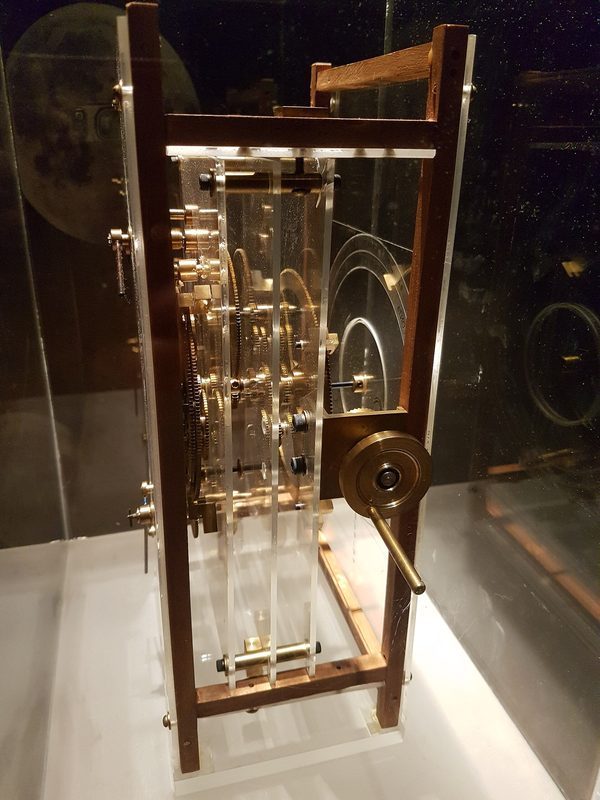
Highlights of the EUREKA exhibition include a large, fully working acrylic model of the Antikythera Mechanism, the ancient “first computer”, and reconstructions of devices designed by Archimedes, Hero of Alexandria and Philo of Byzantium, such as machines, pumps, measuring instruments and automated devices. These working models reveal the engineering genius of the ancient Greek world.
The EUREKA exhibition is filled with fascinating working reconstructions that showcase the inventiveness of the great ancient Greek scientists and engineers. The undoubted star is a large, fully working acrylic-glass model of the Antikythera Mechanism so that its intricate workings are visible; this astonishing geared device, recovered from an ancient shipwreck, was used to calculate and predict astronomical positions and eclipses, and is widely regarded as among the oldest computers ever made, so seeing it rebuilt and operating is a genuine highlight. Around it, the exhibition presents reconstructions of devices designed by the most brilliant inventors of antiquity, including Archimedes, the legendary mathematician and engineer of Syracuse, Hero (or Heron) of Alexandria, famous for his automata and steam-powered devices, and Philo of Byzantium, a pioneer of mechanics.
These working models cover an impressive range, from lifting machines, pumps and measuring and surveying instruments to clever automated and self-operating devices, each demonstrating principles of physics, mechanics and mathematics. Together they reveal that the ancient Greeks were not only philosophers and artists but also gifted engineers and inventors. The exhibits are absorbing for all ages. The most magical of all are the automata. The robots and art bring extra wonder.
What are the automata and the Escher collection?
The museum features ancient automata, early “robots” such as a reconstruction of a moving servant girl that could pour drinks, showing the Greeks’ mastery of automation. The Herakleidon is also celebrated for having held one of the world’s largest collections of M.C. Escher’s mathematically inspired graphic art, reflecting the museum’s mission to connect science, art and mathematics.
Two of the most captivating aspects of the Herakleidon Museum bring together its themes of ancient ingenuity and the meeting of art and science. The first is its collection of ancient automata, the self-operating mechanical devices that represent an early form of robotics, in which the ancient Greeks were surprisingly advanced. The exhibition includes a reconstruction of a famous automated servant figure, a type of robot, sometimes a moving servant girl, designed to perform tasks such as automatically pouring wine and water for guests, an extraordinary feat of mechanical engineering that astonishes modern visitors and delights children. These automata reveal the Greeks’ mastery of mechanics, hydraulics and pneumatics.
The second is the museum’s celebrated association with the art of M.C. Escher: the Herakleidon long held one of the largest collections in the world of works by the famous Dutch graphic artist, whose impossible structures, tessellations and optical illusions are deeply rooted in mathematics and geometry. Featuring Escher’s art alongside ancient inventions perfectly embodies the museum’s founding mission to explore the common ground between science, art, technology and mathematics. This blend of the ancient and the artistic makes the museum unusually rich and stimulating. It rewards curious minds of every age. The museum suits a wide audience.
Who will enjoy the Herakleidon Museum?
The Herakleidon Museum appeals to families with children and teenagers, who love the interactive working models, and to anyone interested in science, engineering, mathematics, history or art. With educational programmes and hands-on exhibits, it is especially good for curious kids and STEM-minded visitors, and as a compact indoor museum it makes a great change of pace from the open-air ancient sites.
The Herakleidon Museum has a broad and somewhat unexpected appeal, making it a rewarding stop for many kinds of visitor. Families with children and teenagers find it especially engaging, since the interactive, working nature of the exhibits, with models that move, operate and can often be tried, captures young imaginations far more effectively than static displays, turning learning into play and discovery. Science, engineering and mathematics enthusiasts of all ages are fascinated by the ingenuity of the ancient devices and the clever reconstructions, while those interested in history gain a fresh, eye-opening perspective on the ancient Greeks as inventors and engineers. Art lovers, meanwhile, appreciate the museum’s long connection with the work of M.C.
Escher and its imaginative bridging of art and science. The museum runs educational programmes in fields such as mathematics, science, archaeology and even artificial intelligence, underlining its learning-focused mission. Practically, as a compact, well-presented indoor museum, it offers a welcome air-conditioned break from the open-air archaeological sites on a hot day, and its location in Thissio makes it easy to combine with the Acropolis and Agora. For curious, STEM-minded and family visitors, it is a hidden gem. More family ideas appear in the Athens with kids guide. Planning a visit is simple.
How do you visit the Herakleidon Museum?
The Herakleidon Museum is at 16 Herakleidon Street in Thissio, a short walk from Thissio metro station on line 1, along the Apostolou Pavlou promenade. It opens on most days with modest admission and reductions for children, students and seniors. Allow about an hour to an hour and a half, and combine it easily with the Acropolis, Ancient Agora and the Thissio cafés nearby.
A visit to the Herakleidon Museum is easy to arrange and slots neatly into a day exploring ancient Athens, thanks to its excellent location in the heart of the historic Thissio district. The museum is found at 16 Herakleidon Street, just off the pedestrianised Apostolou Pavlou promenade that runs beneath the Acropolis, and it is only a short walk from Thissio station on metro line 1, the green line: from the station you follow the promenade and turn onto Herakleidon Street near the cafés. The museum is generally open on most days of the week, though it is wise to check the current opening hours before visiting, as schedules can vary by season. Admission is modest, with reduced rates for children and young people, students, teachers and pensioners, and free entry for young children, making it good value, especially for families.
To explore the EUREKA exhibition and the museum at a relaxed pace, allow around one to one and a half hours. Because of its prime position, the museum combines perfectly with visits to the nearby Acropolis, the Ancient Agora and the Temple of Hephaestus, and with a relaxed coffee or meal in the lively cafés of Thissio. For an engaging, original museum experience, it is well worth including. The wider routes appear in the getting around Athens guide. The questions below cover the points visitors ask most.
Frequently Asked Questions
What is the Herakleidon Museum known for?
The Herakleidon Museum in Thissio is known for exploring the links between science, art, technology and mathematics. Its permanent EUREKA exhibition presents working reconstructions of ancient Greek inventions, including the Antikythera Mechanism and automata, and the museum is also famous for having held one of the world’s largest M.C. Escher art collections.
Is the Herakleidon Museum good for kids?
Yes, the Herakleidon Museum is excellent for children and teenagers, as its interactive, working models of ancient Greek inventions, including early robots and the Antikythera Mechanism, are far more engaging than static displays. Hands-on and educational, with STEM-focused programmes, it is a great family-friendly and air-conditioned indoor activity in Athens.
Where is the Herakleidon Museum in Athens?
The Herakleidon Museum is at 16 Herakleidon Street in the Thissio district of central Athens, just off the Apostolou Pavlou promenade beneath the Acropolis. It is a short walk from Thissio metro station on line 1 and combines easily with the Acropolis, the Ancient Agora and the Thissio cafés nearby.