
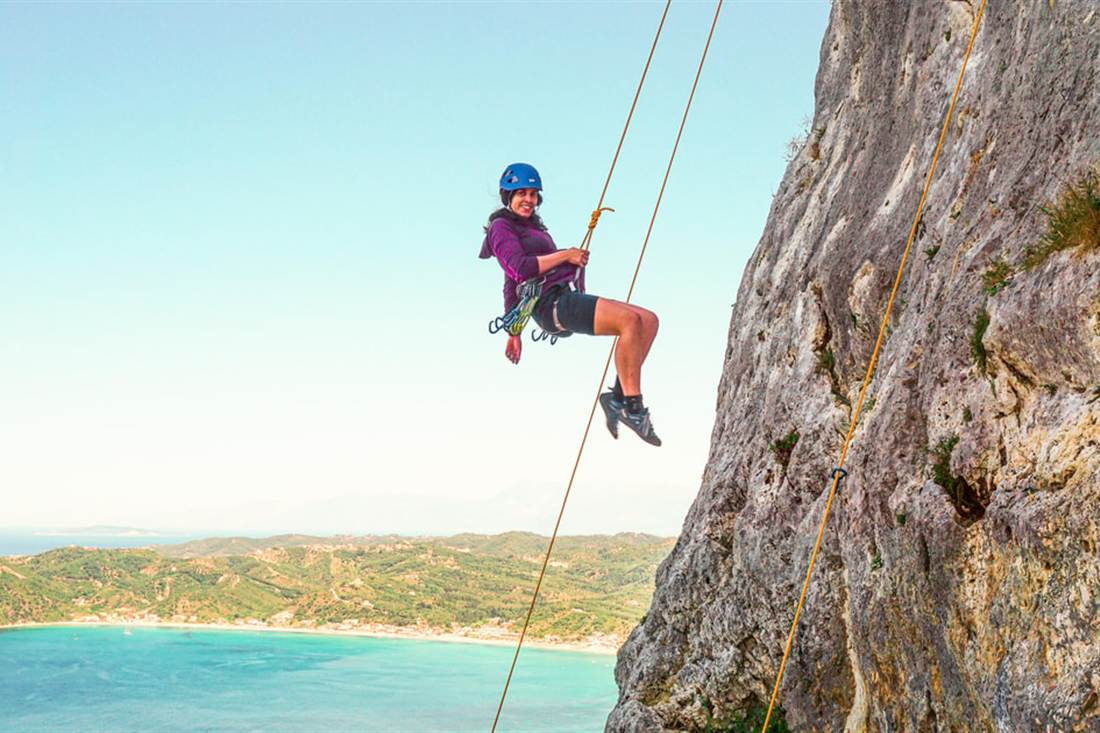
Corfu rock climbing is sport climbing on the limestone cliffs of Corfu’s west coast, above Paleokastritsa and the hill villages around it. Beginners climb with a guide on top-rope, and experienced climbers lead the bolted routes. Tours across the rest of the country are listed on Greece Tours.
The sections below cover the courses, the crags, the rock, routes and grades, the beginner session, gear and bolting. They also cover the season, guidebooks, who it suits, safety, access, where to stay and booking, with links into the Corfu pages. The course shown is checked on GetYourGuide and Viator.
What is Corfu rock climbing?
Corfu rock climbing is sport climbing on limestone cliffs near the Ionian Sea. Bolts are fixed in the rock to hold your rope. The routes are single-pitch, meaning one rope length from the ground to the top.
- Sport climbing: bolted single-pitch routes up to 32 metres long.
- Top-rope courses: beginner sessions with the rope anchored above you.
- Deep water solo: climbing sea cliffs with no rope, above deep water.
- Bouldering: short, ropeless climbs on natural rock around the island.
The scene is young, and a handful of routes went up over ten years ago. Serious bolting of the Corfu rock climbing crags began only in recent years. Local guides and climbers led the work, helped by climbers from Ioannina.
About 20 to 30 active climbers live on the island. They meet up on Sundays when the weather is good. There are no climbing shops on Corfu, so gear comes from home or from a guide.
Corfu rock climbing is far quieter than the busy crags of mainland Greece. Visitors can have a whole wall to themselves. The bolted sectors sit mainly in the north and west, above olive groves or the sea.
Which Corfu rock climbing courses and guides can you book?
Three outfits run Corfu rock climbing: Rock & Climb Corfu, Climbing Corfu and Corfu Extreme Sports. Rock & Climb Corfu sells its two-hour beginner course on GetYourGuide and Viator. Each runs guided sessions on the island’s crags for beginners and experienced climbers.
- GetYourGuide tour 457497: the Rock & Climb Corfu beginner course, 2 hours, 6 people maximum.
- Viator product 359902P1: the same course and crag, about 2 hours, mobile ticket.
- Rock & Climb Corfu: founded by Jakovos Mouzakitis, based at the Makrades crag above Lakones.
- Climbing Corfu: run by Pavlos Tipos, who bolted the Stavros crag above Benitses.
- Corfu Extreme Sports: half-day Corfu rock climbing plans at Makrades, Doukades, Barbati and Stavros.
On GetYourGuide the course is called Corfu: Rock Climbing for Beginners, listed under Paleokastritsa. On Viator it is Rock Climbing in Corfu for Beginners. The GetYourGuide listing offers guides in English, German, Greek and Spanish.
The course uses the top-rope method on Corfu rock climbing routes at Makrades. Top-rope means the rope runs through an anchor above you.
All equipment is included, down to the climbing shoes. Transfers, bottled water and snacks are not included. Bring your own water, a snack and a pair of socks.

Where are the main Corfu rock climbing areas?
Corfu rock climbing centres on four bolted crags. Makrades and Doukades lie in the west, near Paleokastritsa. Barbati is in the northeast and Stavros in the southeast. A new crag at Agios Symeon is being bolted now.
- Makrades: slab and vertical rock above Lakones, facing northwest to the Diapontian Islands.
- Doukades: the largest crag, a limestone amphitheatre above the forest near Paleokastritsa.
- Barbati: an older, remote crag above olive groves, with views to Albania.
- Stavros: a small south-facing slab beneath the summit cross, above Benitses.
- Agios Symeon: the newest crag, now being bolted by Jakovos Mouzakitis and Christopher Payan.
- Paleokastritsa and Agni: sea cliffs for deep water solo, reached by paddleboard or boat.
The Corfu Trail climbs from Paleokastritsa to Lakones on cobbled paths. It then follows old donkey paths to Makrades. The Makrades crag parking sits at the start of the donkey path.
A cobbled donkey path runs north from Makrades towards the fortress of Angelokastro. A morning of Corfu rock climbing pairs well with an afternoon castle walk.
Stavros sits further south on the same trail, in the hills above Benitses. One trail stage runs on from Stavros to Pelekas. The Stavros crag is the gentlest Corfu rock climbing venue, a very short walk from the road.
What is the rock like for Corfu rock climbing?
Corfu rock climbing takes place on limestone that is largely solid. The walls run from slabs to vertical faces and gentle overhangs. The rock is full of pockets, and Doukades has the odd tufa as well.
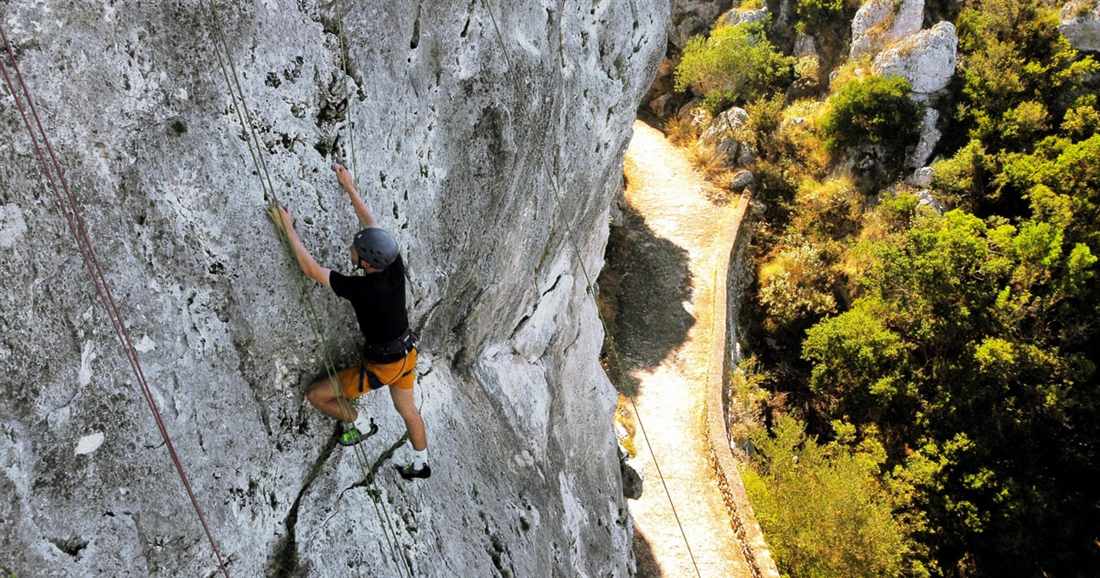
- Pockets: small holes in the rock that take one or more fingers.
- Slabs: walls that lean back, where balance matters more than strength.
- Tufas: ribs of rock built up by dripping, mineral-rich water.
- Overhangs: walls that lean out past vertical, as on parts of Doukades.
Makrades and Stavros are mainly slab and vertical rock. Doukades is steeper, from vertical to slightly overhanging, with technical walls. The Makrades rock is sharp and full of pockets.
The holds in Corfu rock climbing are largely positive, meaning edges you can grip well. New routes get cleaner and firmer each season as climbers use them.
The coast at Paleokastritsa is limestone too, cut into sea caves and arches by the waves.
What routes and grades does Corfu rock climbing offer?
Corfu rock climbing is small in scale. The database theCrag lists 25 sport routes, with 15 at Doukades and 10 at Makrades. Mountain Project lists 23. Grades run from 4a to 7c, and the core sits between 5b and 6c.
Grades use the French scale, where higher numbers and letters mean harder climbing. The two databases list only Makrades and Doukades so far. Barbati, Stavros and Agios Symeon add more Corfu rock climbing routes on top.
- Makrades: about 10 routes from 4c to 6b+, up to 16 metres long.
- Doukades: the largest count, with longer lines and grades up to 7a+.
- Barbati: routes from 5c to 7a+, plus a 7c project still unclimbed.
- Stavros: easy routes from 4a to 5c on a 10 to 15 metre slab.
- Corfu Extreme Sports sectors: routes from 5b to 7b+ across the island.
A project is a bolted route that nobody has climbed yet. Doukades has a 40-metre project with 21 bolts, given a provisional 7a+. Its standout finished line is Zaman Fu, a 6c of 32 metres.
Recommended routes at Makrades include To Vasiloni at 6a and Daizy at 6a+. Mountain Project names Violence, a 6a+, and Donkey Path, a 6c, as classics there.
What does Paleokastritsa offer for Corfu rock climbing?
Paleokastritsa is the hub of Corfu rock climbing. Doukades crag sits in a forest close to the resort. Makrades crag lies on the hill above. The sea cliffs below hold traverses and deep water lines.
Doukades is the largest crag in Corfu rock climbing. It holds 15 or more routes, graded 5c to 7b+. Walls reach 40 metres on technical limestone. The rock offers slabs, vertical faces and overhangs.
The approach takes 10 to 20 minutes up a steep forest trail. Fixed ropes help on the steepest parts. The face turns shady after 3pm, which suits summer Corfu rock climbing. Alekos Koskinas and friends from Ioannina bolted the walls.
Below the resort, a sea-level traverse, a sideways climb, runs from the Grotto to a large cave. It goes at around 6a+, with your feet just above the waves. The monastery hill on the peninsula has no listed routes.
Which other crags complete Corfu rock climbing?
Corfu rock climbing spreads beyond Doukades to three more bolted crags. Makrades sits above Lakones, Barbati overlooks the northeast coast and Stavros serves beginners in the southeast. Mount Pantokrator has big buttresses on its east side.
- Makrades, above Lakones: about 10 routes up to 16 metres, graded 4c to 6b+.
- Barbati, northeast coast: a remote crag with routes from 5c to 7a+.
- Stavros, southeast: a south-facing teaching crag graded 4a to 5c.
- Mount Pantokrator: the island’s highest peak, with a paved road to the top.
Makrades faces northwest toward the Diapontian Islands. It stays shady until about 12:30pm and glows at sunset. The parking is only 90 metres away. Its routes include To Vasiloni and Daizy, a 6a+. Fani Koutsipetkou bolted the crag.
Barbati is one of the oldest Corfu rock climbing crags. It needs a 15-minute uphill walk through olive groves. Its routes are well bolted. The crag looks across the sea toward Albania. A striking 7c project there still waits for a first ascent.
Stavros sits below the summit cross above Stavros village. Its views run from Corfu Town to the hills above Lefkimmi. Pavlos Tipos of Climbing Corfu bolted it for Corfu rock climbing lessons. Its grades are the lowest of the bolted crags.
Is there deep water soloing or multi-pitch Corfu rock climbing?
Corfu rock climbing has deep water soloing but no recorded multi-pitch routes. Deep water soloing means climbing sea cliffs without a rope and dropping into the water. The databases list only single-pitch routes on land.
The longest recorded line in Corfu rock climbing is a 40-metre route at Doukades. It carries 21 bolts and is still marked as a project.
Climbing Corfu runs deep water solo trips lasting 4 to 6 hours. You reach the cliffs on foot, by paddleboard, kayak or motorboat. Climbers must be at least 10 years old. Corfu Extreme Sports pairs paddleboarding with deep water Corfu rock climbing.
One recorded wall near Paleokastritsa rises about 15 metres above water at least 3 metres deep. Its lines carry the grade S0. The S scale runs from 0 to 3 and rates how safe the water landing is.
- Big Dimples: 6a to 6a+, a pitted face that tires the arms near the top.
- Crack Open a Nice Rest: 5c, following the crack on the left.
- Bugs and Jugs: 5b, with big holds from a small cove past an overhang.
- Access: by boat only, unless you swim with wet shoes.
What happens on a beginner Corfu rock climbing session?
A beginner Corfu rock climbing session with Rock and Climb Corfu lasts about two hours at Makrades. A guide gives a safety briefing and fits your gear. You learn the basics, then climb on top-rope four or five times.
- Meet the guide at the crag, a short walk from the Makrades parking.
- Hear the safety briefing and put on harness, helmet and shoes.
- Learn to tie in with a knot and practise belay commands.
- Climb your first route on top-rope while the guide holds the rope.
- Lower to the ground, rest, then try a new line.
Belaying means holding the rope so a falling climber stops at once. On top-rope, a slip drops you only a short way. Your instructor demonstrates each step first. The course moves from simpler walls to harder ones.
Corfu rock climbing groups with this outfit hold no more than six people. Morning sessions run between 9am and 12pm in the shade. Evening sessions catch the sunset light.
Corfu Extreme Sports runs longer Corfu rock climbing sessions of 3 to 4 hours. Beginners there climb 5b to 6a routes on top-rope. The outfit says beginners complete 3 to 6 routes per session. It meets you in Corfu Town, at your hotel or at the crag.
What gear does Corfu rock climbing need?
Guided Corfu rock climbing includes all technical gear, with climbing shoes too. Independent climbers bring a rope, quickdraws, harness, helmet and shoes. The island has no climbing shops, so pack the full kit before you fly.
- Rope: twice the route length, so 80 metres for a 40-metre Doukades line.
- Quickdraws: pairs of clips joined by a sling, one for each bolt.
- Helmet: young crags still shed small loose rocks.
- Harness: courses supply small sizes for children aged 7 and up.
- Shoes: every beginner course listed includes them.
The Rock and Climb Corfu course supplies everything, shoes included. You bring water, a snack and socks. Climbing Corfu includes shoes and a helmet on its 4 to 6 hour tours, with a certified instructor.
Corfu Extreme Sports makes helmets compulsory for every climber. Its kit meets UIAA standards, the safety rules of the international climbing federation. Instructors hold wilderness first aid training. Guides check the rock before each session and move crags if it looks unsafe.
Deep water Corfu rock climbing needs no harness or rope. Climbing Corfu asks you to bring water, snacks, suitable clothing, a hat and sunscreen. Guides on Corfu Extreme Sports trips carry helmets and first aid kits. Further south, Glyfada beach and Myrtiotissa beach suit a calmer swim.
How are the routes bolted for Corfu rock climbing?
Corfu rock climbing routes use fixed bolts. A bolt is a metal ring fixed into the rock. You clip your rope into each bolt as you climb. At the top, a lower-off anchor lets your partner lower you down.
The bolts on Corfu rock climbing routes are 316L marine-grade stainless steel. This steel stands up to salty sea air. Each route ends at a double carabiner anchor. That means two strong metal clips share the load at the top.
Serious bolting started only in recent years. A handful of older routes went up over a decade ago, in remote spots. The first official crags were Stavros in the south and Makrades in the northwest. Both were picked for easy access and gentle lines.
Bolt counts on theCrag show how close the bolts sit. Prokyma, a 14-metre route at Makrades, has 10 bolts. Nahame na legame, a 22-metre line at Doukades, has 12. A small team equipped the Corfu rock climbing crags:
- Fani Kousipetkou, a certified climbing guide from Alpikos Rythmos in Florina, bolted Makrades.
- Pavlos Tipos, who runs Climbing Corfu, bolted the beginner routes at Stavros.
- Jakovos Mouzakitis, founder of Rock and Climb Corfu, helps open new sectors.
- Christopher Payan, an American climber living on Corfu, is developing Agios Symeon with Jakovos.
Which grades suit beginners in Corfu rock climbing?
Corfu rock climbing uses the French grade scale. A number from 4 upwards shows how hard a route is. A letter from a to c splits each number into smaller steps. The easiest routes on the island are graded 4a to 5a.
A plus sign adds a small step, so 5c+ is harder than 5c. On Corfu rock climbing crags, the 5b to 6c band suits beginners and improvers.
Makrades holds gentle Corfu rock climbing lines for first-timers. Its routes are short, at up to 16 metres. The walk from the car takes about two minutes. The starter routes listed on theCrag are these:
- Iptameno Tsekouri (Flying Axe), 4a, 8 metres with 5 bolts
- Alogaki tis Panagias, 4c, 10 metres with 7 bolts
- Bonsai, 5a, 12 metres with 8 bolts
- Archi (Beginning), 5a, 16 metres with 10 bolts
- Nefeli (Cloud), 5b+, 14 metres with 9 bolts
Prokyma, at 5c+, is the next step up. Climbing Corfu lists routes from 4c up to 7c across its crags. Strong climbers chasing longer routes can add climbing on Kalymnos to the trip.
When is the season for Corfu rock climbing?
Corfu rock climbing runs all year. Spring and autumn bring the prime conditions. In those weeks the limestone is dry and grippy, so your shoes stick well. The air is mild, and the trails and villages are quiet.
Summer heat pushes Corfu rock climbing into early mornings and late afternoons. Shade matters because late-summer highs reach about 34°C. Makrades, Doukades and Barbati fall into shade after 3 pm.
Corfu Extreme Sports guides climb on the island in every season. The outfit splits the Corfu rock climbing year into four parts, each with its own conditions:
- Spring, April to June: mild days and wildflowers in bloom
- Summer, July and August: early or late sessions on shaded crags
- Autumn, September and October: quieter crags and soft evening light
- Winter, November to March: dry but windy, suited to experienced climbers
Deep water soloing peaks from July to September, when the sea is warm. In autumn the water stays warm and the coves grow quieter. For the weather month by month, see the guide on when to visit Corfu.
Which guidebooks and apps cover Corfu rock climbing?
No printed guidebook covers Corfu rock climbing, and the island has no climbing shop. The route details live online. TheCrag and Mountain Project are two climbing databases with websites and apps. Both list routes, grades, lengths and bolt counts.
TheCrag lists 25 Corfu rock climbing routes across two crags, all graded on the French scale. Doukades has 15 routes, with walls up to 29 metres high. Makrades has 10 routes and over 200 logged ascents, meaning climbs that users have recorded.
Mountain Project also has a page for Stavros. That page describes a walk of about 800 metres along a green and white marked trail.
UKClimbing runs a Corfu rock climbing destination article with facts on each crag. Each entry gives the grade range, wall height, sun and shade, and walk-in time. It also names who bolted the crag. Guide websites add notes on shade and approach for each sector.
Who suits Corfu rock climbing?
Corfu rock climbing suits anyone with basic fitness from age 7. Rock and Climb Corfu takes ages 7 to 70, in groups of up to six. Climbing Corfu takes climbers aged 10 and over.
Basic fitness means two simple things. You can walk uphill for 15 to 20 minutes. You can also pull yourself up with your arms, as on a ladder. Corfu Extreme Sports sorts Corfu rock climbing groups by level:
- Beginners: no experience needed, as guides teach everything from scratch
- Intermediates: a little gym or outdoor climbing, comfortable on 5c+
- Advanced climbers: leading 6b+ with confidence, working on harder technique
- Children: from age 7, with small harnesses and helmets
Families can share a Corfu rock climbing session. Corfu Extreme Sports asks a parent to stay and watch young children. The outfit says climbing builds confidence, problem-solving and fitness. You’ll find more family ideas on the Corfu with kids page.
Nervous climbers start on a top-rope, so a slip stops quickly. The activity is not recommended for pregnant travellers or people with back problems or serious medical conditions.
How safe is Corfu rock climbing?
Corfu rock climbing is a safe sport when you follow the guides and wear a helmet. The crags are young, so small loose stones can fall. Guided groups carry a team first aid kit on every trip.
Local guide Jakovos Mouzakitis asks every climber to wear a helmet. Corfu rock climbing sectors are new, and small rocks still come loose. The risk is highest at freshly bolted walls.
Remote crags are still a work in progress. Their anchors have at times been vandalised or stolen.
Sea cliff trips follow the same care. Deep water solo guides hand out helmets and carry first aid kits. Corfu Extreme Sports lists these rules for its land tours:
- Every guide holds a climbing certificate and wilderness first aid training.
- All gear meets UIAA standards, the international climbing safety rules.
- Helmets are compulsory for every guest.
- Guides check rock conditions before each session.
- Unsafe conditions mean a new crag or a new date.
How do you get to the Corfu rock climbing crags?
Corfu rock climbing crags cluster in the north-west, around Paleokastritsa. The resort lies about 25 kilometres from Corfu Town, roughly a 30-minute drive. A car is simplest, as the crags sit up narrow, winding hill roads above the coast.
Green Bus route A9 runs from the KTEL station to Paleokastritsa in about 45 minutes. The station is a 15-minute walk from the old town. The first bus leaves at 6:30 every day except Sunday.
Corfu rock climbing visitors from Gouvia or Agios Georgios Pagon drive 30 to 45 minutes to Paleokastritsa. Dassia takes 35 to 50 minutes, and Sidari 45 to 70. Tips for hire cars are on the page about driving in Corfu.
For Corfu rock climbing at Makrades, drive into the village first. Other GPS routes lead onto a rough dirt road. Doukades needs a 10 to 20 minute walk, and Barbati a 15-minute uphill walk.
Where do you stay for Corfu rock climbing?
Corfu rock climbing has no climbing hostel or base camp yet. Climbers stay in rented apartments, guesthouses and villas near the crags. The villages of Doukades, Lakones and Liapades give a quiet base close to the north-west walls.
Paleokastritsa suits Corfu rock climbing visitors who want tavernas, shops and buses close by. The resort stretches along one main road. That road ends at Paleokastritsa Monastery.
- Paleokastritsa: beaches, tavernas and A9 bus stops along the main road.
- Lakones: a hill village with a square, a fountain and a small café.
- Makrades: the meeting village for the beginner course, at the end of the Donkey Trail.
- Doukades: a quiet village below the island’s largest crag.
- Liapades: a west-coast village just south of Paleokastritsa.
A footpath links Lakones to Paleokastritsa for Corfu rock climbing days on foot. It drops 251 metres over 1.5 kilometres in about 40 minutes. Wider island choices are on the page about where to stay in Corfu.
What else can climbers do on a Corfu rock climbing trip?
A Corfu rock climbing trip mixes well with sea and mountain sports. Rest days can include snorkelling, kayaking, paddleboarding, tandem paragliding and hill walks. Each activity starts within a short drive of the climbing villages on the west coast.
- Snorkelling: snorkelling around Corfu starts in Paleokastritsa’s deep, spring-fed bays.
- Kayaking: hire a kayak in Paleokastritsa to reach coves and sea caves.
- Paragliding: tandem paragliding flights take off near Pelekas and last 15 to 20 minutes.
- Paddleboarding: guides paddle out on stand-up paddleboards to deep water solo cliffs.
- Hiking: a hard path climbs from Paleokastritsa through Lakones to Arakli peak.
- Mainland climbing: Meteora rock climbing adds giant rock pillars on the Greek mainland.
Tandem paragliding pilots fly over Kontogialos or Glyfada beach, depending on the wind. No flying experience or special skill is needed, as the pilot handles the controls.
Climbing Corfu also runs guided bouldering trips. Its menu even lists sport massage for a rest day after hard Corfu rock climbing.
How do you book and cancel Corfu rock climbing?
Corfu rock climbing courses book online through GetYourGuide, Viator or the guiding companies. The beginner course from Rock & Climb Corfu gives a full refund up to 24 hours before the start. Later cancellations get no refund.
Both listings offer reserve now and pay later. You hold a place and pay nothing on the day you book. Confirmation arrives at once, with a mobile ticket.
Corfu rock climbing on Viator needs good weather and a minimum group size. If either fails, guests get a new date or a full refund. Changes within 24 hours of the start are not accepted.
Corfu Extreme Sports builds custom half-day Corfu rock climbing plans on request. Climbing Corfu takes bookings through an enquiry form on its own site, for climbing, deep water solo and bouldering.
Frequently Asked Questions
Which languages do Corfu rock climbing guides speak?
The Viator version of the same course is offered in English, and the GetYourGuide version adds three more languages. Both versions run on the same crag above Makrades, with the same local guides.
Are there health limits for Corfu rock climbing courses?
Yes. The Viator listing does not recommend the beginner course for travellers with back problems. It is also not recommended for pregnant travellers. Guests need to be free of heart problems and other serious medical conditions. These limits apply to the two-hour top-rope course run by Rock & Climb Corfu.
How far ahead do people book Corfu rock climbing?
On Viator, the beginner course is booked about 10 days ahead on average. Each Corfu rock climbing group holds a maximum of six travellers. The small group size gives each climber close attention from the guide at every step.
Is there bouldering for Corfu rock climbing?
Yes, Corfu rock climbing includes beach boulders. Liapades Beach has a limestone boulder with three recorded climbs at its north end. You reach it with a 30-second swim or a short scramble. It sits over deep water, faces south-east and catches the morning sun.
What rules do climbers follow at Corfu rock climbing crags?
Local guides ask every visitor to pack out all rubbish. That includes tissue, tape and food waste. They also ask climbers to support the local scene. Hiring a guide or eating in village tavernas helps the people who bolt and look after the routes.
Do Corfu rock climbing tours include photos?
Corfu Extreme Sports includes photos and videos of each climbing session. Its land tours also add route choice based on each guest’s skill and goals. Its deep water solo trips by paddleboard go further. They include photos, videos and insurance cover in the booking.
Can experienced climbers hire a private guide on Corfu?
Yes, the three island outfits offer private guiding and belay services. Travellers without a climbing partner can book a guide to belay them. Corfu Extreme Sports runs private tours for one or two people. Its advanced Corfu rock climbing tour gives coaching on routes from 6c to 7b+. Each instructor there takes no more than four climbers at once.
Can intermediate climbers learn to lead on Corfu?
Corfu Extreme Sports matches intermediate climbers with routes that stretch their current level. Coaching covers efficient movement, reading rock features and clipping technique. Guides introduce lead climbing when a climber is ready for it. Intermediates climb five to eight routes in a half-day session of Corfu rock climbing. The session mixes slabs, vertical walls and gentle overhangs.
How do guides choose a crag for each session?
Climbing Corfu picks the crag for each group on two factors. These are the climbers’ experience and the weather on the day. Guests walk with the instructor from the meeting point for 10 to 20 minutes. The length of each Corfu rock climbing day adjusts to your own schedule. Private transport to the crag can be arranged at extra cost.
Where else on Corfu can climbers try deep water soloing?
Nissaki on the north-east coast joins Paleokastritsa and Agni as a deep water spot. At all three, steep and shaded walls rise straight out of the sea. Organised sessions of sea-cliff Corfu rock climbing run for around two to three hours. Sessions can also include time for snorkelling or a swim. Corfu Extreme Sports offers a private motorboat trip to offshore islets.