
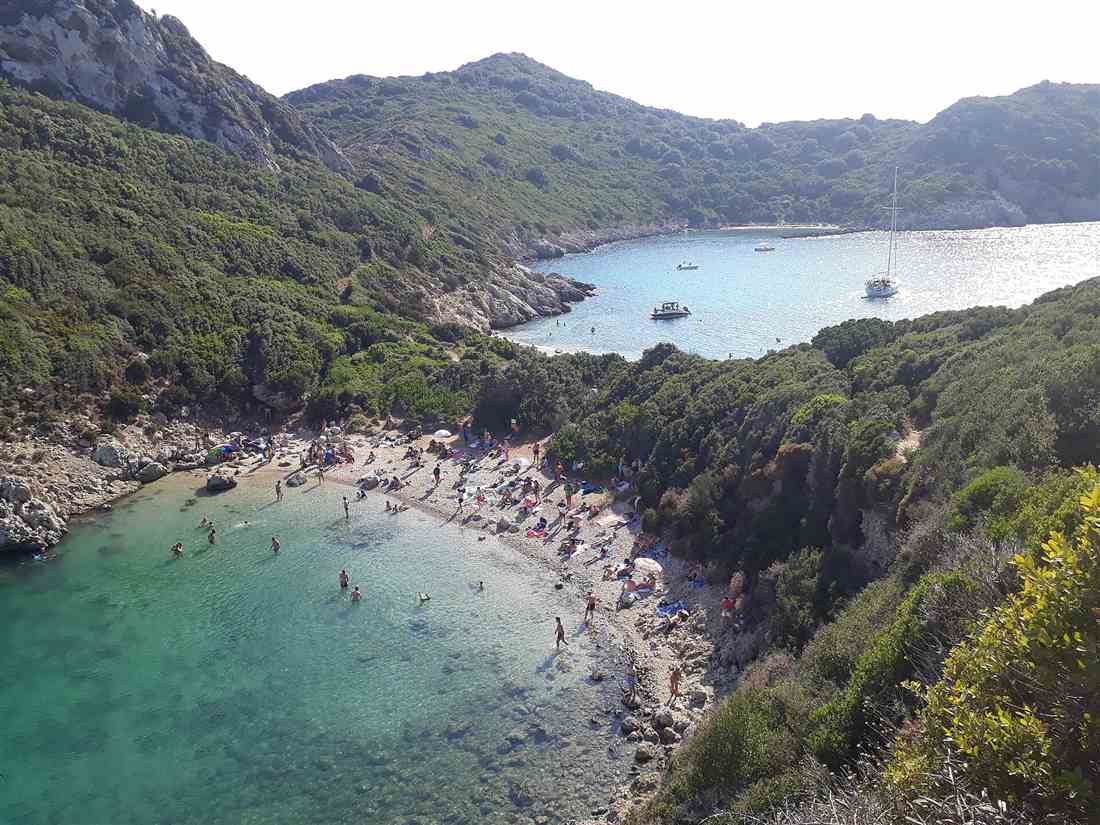
Corfu snorkeling runs as a guided speedboat trip out of Paleokastritsa to the blue caves and the beaches no road reaches, and as a free shore entry at the pebble coves of the north-east and the clear bays of the west coast. Plan the whole trip with Greece Tours.
This guide covers Corfu snorkeling in full: the boat trips and what they include, the blue caves, the best spots on the west, north-east and southern coasts, what you see underwater, the visibility and the season, the equipment and how to fit it, what it costs, safety for families, and how to book.
What Is Corfu Snorkeling and What Does a Guided Boat Trip Include?
It is surface swimming with a mask, snorkel and fins along the island’s rocky bays and sea caves, and a guided boat trip adds a skipper, a set route, fitted gear and stops at the clearest water on the coast.
The choice of Corfu snorkeling comes down to the boat, the route and the stops. Corfu snorkeling is booked ahead for a fixed, agreed price per person. The west coast of Corfu gives the calmest mornings, and a snorkeling boat leaves the marina before the wind builds, running past headlands to bays sheltered until early afternoon. The route mixes open-water swims with beach stops.
The blue caves under the west-coast cliffs are the set piece of Corfu snorkeling. A standard trip carries a mask, snorkel and fins for every guest, fitted on board before the first stop, plus a buoyancy noodle in open water. The skipper anchors clear of the swim zone, sets a visible marker buoy, and a second crew member swims with the group to the rocks and back.
The skipper on Corfu snorkeling holds the boat while the group swims. Trips run two to three hours, with two to four swim stops set by the conditions on the day. A short briefing covers hand signals and the swim boundary before the first jump. Water and a snack sit on board for the ride between bays.
The price of Corfu snorkeling covers the boat, the skipper and the equipment. Beginners and confident swimmers share the same boat: a weak swimmer holds the noodle in the shallow half of the bay while stronger swimmers head to the rocks where the fish gather. Nobody is pushed past a stop they want to skip, and the crew counts heads before leaving each site.
Do You Need Experience to Go Corfu Snorkeling?
No prior experience is needed: crews fit the mask and fins on the boat, hand out noodles for buoyancy, run a short briefing, and keep weak swimmers beside the guide for the whole swim.
A private Corfu snorkeling charter keeps the speedboat to one group. For a first time in the water, Corfu snorkeling starts with the mask fit and the briefing. A first-timer gets the same fitting routine as everyone else: the mask goes on dry, the strap sits above the ears, and the guide checks the seal against the face before anyone enters the water. Fins are matched to shoe size on the spot, and a spare pair sits on board for a swap mid-trip.
Every Corfu snorkeling trip starts with the safety briefing on board. The noodle is offered to every guest at the first stop, not only to nervous swimmers, and holding one costs nothing in terms of what a swimmer sees below the surface. A guest who wants to let go of it later in the trip is free to, and the guide never insists either way.
Corfu snorkeling passes seagrass meadows, rock shelves and white pebble bottom. The briefing before the first entry covers breathing through the snorkel at the surface, clearing water from the tube by exhaling sharply, and the hand signal for “I need help.” A guide demonstrates each step from the boat before the group goes in, so nobody learns it for the first time underwater.
Corfu snorkeling runs as a two-hour run or a longer half-day cruise. Weak swimmers stay within arm’s reach of the guide for the length of the swim, working a short loop close to the boat rather than the longer line the stronger swimmers take to the far rocks. Both groups return to the same ladder, and the guide re-counts heads at every stop.
What Corfu Snorkeling Boat Trips Run from Paleokastritsa?
Speedboat trips run out of Alipa and Ermones on the west coast, past the blue caves to Paradise Beach, Stelari, Yali and Limni, in two- and three-hour formats with a capped small-group size and full gear on board.
The morning departure for Corfu snorkeling fills first in high season. The choice of Corfu snorkeling comes down to the boat, the route and the stops. Boats based near Paleokastritsa launch from the small harbours at Alipa and Ermones, both a short drive from the main village, and run the coastline north toward the caves at a steady pace so the group can watch the cliffs the whole way. A morning departure meets the flattest sea of the day on this stretch.
Corfu snorkeling carries masks, fins and noodles for every guest. The blue caves sit along the west-coast cliffs a short run from the harbour, and the route swings through them before turning south to the open bays. Paradise Beach and Stelari follow, both reached only by boat or a steep goat path, which keeps the water free of the crowds that build on the road-accessible beaches by midday.
For stronger swimmers, Corfu snorkeling opens the deeper water off the headlands. Yali and Limni close out the longer format, two pebble coves set below the cliffline with deep, clean water close to shore. The three-hour trip adds these two stops to the caves and Paradise Beach; the two-hour version keeps to the caves and one beach stop, chosen by the skipper on the day.
The stops on Corfu snorkeling reach the caves and beaches no road serves. Groups are capped at a set number of guests per boat, small enough that the guide can watch every swimmer without binoculars. Full snorkel gear, noodles and rinse water are carried on board, along with a first-aid kit and a spare mask for every size on the manifest.
What Are the Corfu Blue Caves Like on a Snorkeling Trip?
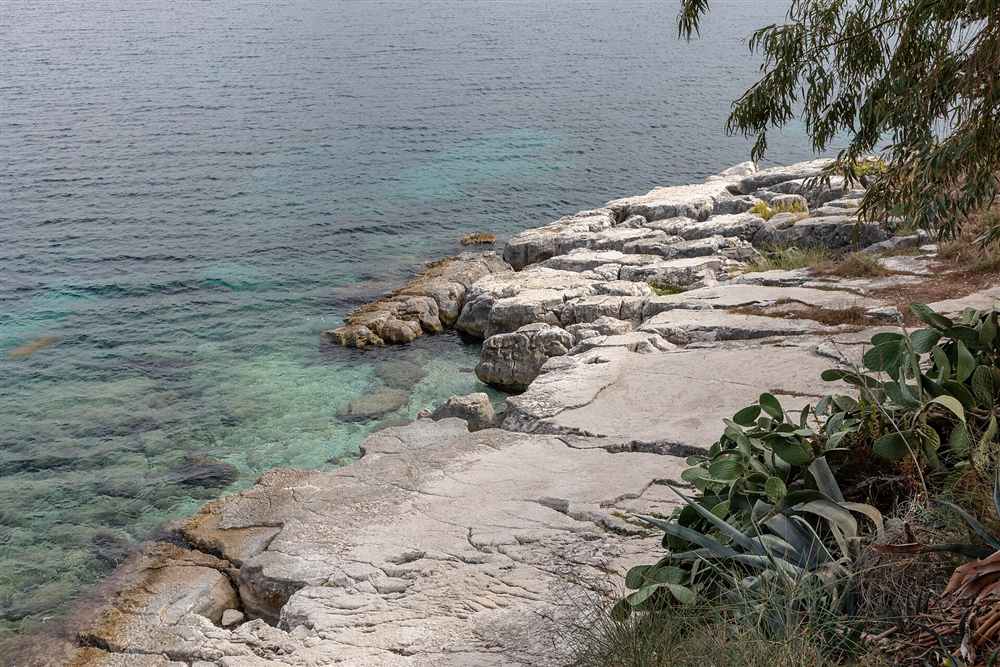
The Corfu blue caves are sea caves cut into the west-coast cliffs where sunlight bounces off the white limestone floor and turns the shallow water an intense blue, entered on calm mornings while the boat holds position outside and the group swims in together.
Families take Corfu snorkeling for the sheltered pebble coves and the buoyancy aids. A private Corfu snorkeling charter keeps the speedboat to one group. The caves formed where the sea wore soft limestone back into the cliff, leaving chambers with a low rock ceiling and a sand-and-pebble floor visible through three or four metres of water. Light enters from the open mouth and from narrow cracks overhead, and it bends off the pale floor to light the water from below rather than above.
The set price on Corfu snorkeling covers the boat, the skipper and the gear. Entry is shallow at the mouth of each cave, and a swimmer can stand in the largest chamber where the floor rises toward the back wall. The water inside stays a degree or two cooler than the open sea outside, shaded from direct sun for most of the day even when the coast beyond is bright.
The mask and the fins are fitted before Corfu snorkeling begins. A calm morning is the only time to go in: the swell that builds by early afternoon pushes surge through the cave mouth and makes the narrow entries risky. Guides check the sea state before committing to the caves and hold the trip at the outer bay instead on a rough day.
Booking Corfu snorkeling ahead secures the date and the place on the boat. The boat anchors or drifts a short distance from the cave mouth rather than entering itself, and the skipper keeps watch from outside while the group swims in and back as one unit. A count at the entrance and a second at the exit keeps track of every swimmer through the low light inside.
Where Are the Best Snorkeling Spots on Corfu’s West Coast?
The west coast holds the clearest water on the island for Corfu snorkeling: Paleokastritsa’s bays, Ampelaki, Agios Spyridon, Rovinia, the double bay at Porto Timoni and Agios Georgios Pagon all sit on open sea with little river run-off nearby.
Corfu snorkeling runs from Alipa and Ermones on the west coast. The morning departure for Corfu snorkeling fills first in high season. Paleokastritsa spreads across six linked bays under the monastery headland, each with a different mix of pebble and rock, and the water off the rocky points holds better visibility than the sandy centre of the main beach. Ampelaki, one bay to the north, sits in a near-circular cove that blocks most swell and stays flat on days the open coast does not.
Planning Corfu snorkeling ahead beats the scramble for a summer date. Agios Spyridon and Rovinia lie further north on quieter roads, both reached by a short walk down from the car park, and both keep visibility that beats the more built-up bays to the south of them. Rovinia’s clothing-optional status keeps the crowd smaller, which in turn keeps the water calmer through the middle of the day.
Corfu snorkeling includes the drinks on the trips that carry them. Porto Timoni is a double bay joined by a narrow strip of sand, reached by a footpath from Afionas, and the water on both sides of the strip stays clear enough to see the rocky bottom from the surface. Snorkeling around the rocks that split the two bays turns up the richest mix of fish on this stretch.
Corfu snorkeling ends with the run back to the harbour and the gear handed in. Agios Georgios Pagon, further north again, opens onto a long sandy bay backed by cliffs, better suited to swimming laps than close-in snorkeling, though the rocky points at either end hold fish close to shore. The west side of Corfu beaches as a group carries the best average clarity on the island.
Where Are the Best Snorkeling Spots on Corfu’s North and North-East?
The Kassiopi coves, Agni, Kalami and Kouloura, Kerasia, Avlaki and the white pebble shore at Nissaki make up the strongest north and north-east ground for Corfu snorkeling, sheltered by the channel that faces Albania across the strait.
The price of Corfu snorkeling covers the boat, the skipper and the equipment. Families take Corfu snorkeling for the sheltered pebble coves and the buoyancy aids. Kassiopi sits at the island’s north-east corner, ringed by small coves cut into the rock below the old fort, sheltered from the prevailing wind that hits the west coast harder. Each cove is reached by a short scramble down from the coast path, and most stay quiet outside high summer.
Corfu snorkeling is booked ahead for a fixed, agreed price per person. Agni, Kalami and Kouloura sit close together on the channel side, each a small pebble bay backed by tavernas that once drew writers to this stretch of coast. The water here is glass-flat on most mornings, since the Albanian coast opposite blocks the fetch that builds waves.
The blue caves under the west-coast cliffs are the set piece of Corfu snorkeling. Kerasia and Avlaki lie further along the same shore, quieter than the villages to their south, with Avlaki’s long pebble beach giving easy entry and a shallow shelf before the bottom drops toward the rocks at either end. Windsurfers favour Avlaki by afternoon, so a morning swim avoids the traffic.
The skipper on Corfu snorkeling holds the boat while the group swims. Nissaki’s white pebble shore sits below a steep road, split into small coves by rocky outcrops that break the water into short, clear pockets. Channel water along this coast holds its clarity through the day, sheltered by the narrow strait.
Where Are the Best Snorkeling Spots in South Corfu?
South Corfu offers Kavos and the Cape Asprokavos side, the long shore at Halikounas by the Korission lagoon, and Notos and Marathias further north, with more exposed swell than the sheltered coasts and clear water mainly on settled days.
Corfu snorkeling runs as a two-hour run or a longer half-day cruise. Corfu snorkeling runs from Alipa and Ermones on the west coast. Kavos sits at the island’s southern tip, better known for its nightlife than its coastline, but the coast toward Cape Asprokavos, a walk south of the resort strip, turns rockier and quieter, with small coves that hold clear water once the wind drops. The cape itself faces open sea, so a calm forecast matters more here than further north.
For a first time in the water, Corfu snorkeling starts with the mask fit and the briefing. Halikounas runs along the seaward edge of the Korission lagoon, a long sand-and-dune beach with the open Ionian on one side, offering flat, shallow entry rather than rock snorkeling, best suited to an easy swim close to shore rather than a search for fish among rocks.
Every Corfu snorkeling trip starts with the safety briefing on board. Notos and Marathias sit further north on the same west-facing stretch, both long sandy beaches that catch the same swell pattern as the rest of this coast, with the clearest water found at their rocky southern ends rather than the open sand in the middle.
Corfu snorkeling passes seagrass meadows, rock shelves and white pebble bottom. The south of the island takes the full run of the open Ionian, so swell builds here on days the sheltered north and east stay flat. A calm, settled day turns this coast from a plain swimming beach into water clear enough to see the sandy bottom three or four metres down.
What Marine Life Do You See While Snorkeling in Corfu?
Corfu snorkeling turns up beds of Posidonia seagrass, schools of salema and damselfish, wrasse and sea bream over the rocks, octopus and moray eels tucked into crevices, sea urchins and starfish on the bottom, with the rockier north-east ground the richest.
The stops on Corfu snorkeling reach the caves and beaches no road serves. The price of Corfu snorkeling covers the boat, the skipper and the equipment. Posidonia seagrass meadows spread across the sandy shallows between the rocky points, and a swim along the edge of a meadow is where fish concentrate, using the grass for cover and the open sand beyond it for hunting. The meadows also hold the water clear by trapping sediment that a bare sandy bottom stirs up on its own.
The choice of Corfu snorkeling comes down to the boat, the route and the stops. Salema swim in tight, silver schools close to the rocks, easy to spot from the surface by the yellow stripe along each fish, while damselfish hold territory over small patches of rock and dart out at anything that drifts too close. Wrasse in a range of colours pick over the same rocks for small prey.
Corfu snorkeling carries masks, fins and noodles for every guest. Sea bream move in loose groups over open ground between the rocks, and a patient swimmer holding still near a ledge draws them back within a few minutes. Octopus and moray eels stay hidden in crevices during the day, spotted by an eye or a curled arm rather than a full body in the open.
For stronger swimmers, Corfu snorkeling opens the deeper water off the headlands. Sea urchins cluster in cracks at the base of the rocks, black spines fanned out, and starfish sit on open ledges in the same shallow zone. The rockier ground on the north-east coast, with more crevice and less open sand than the west, holds the widest spread of species, including the occasional grouper working a deeper ledge.
How Clear Is the Water for Corfu Snorkeling?
Water clarity runs from good to excellent across the season, sharpest on calm mornings before the maestro wind from the north-west stirs the surface, and clearest in a pebble bay rather than a sandy one or a beach with run-off after rain.
Booking Corfu snorkeling ahead secures the date and the place on the boat. Corfu snorkeling runs as a two-hour run or a longer half-day cruise. Visibility sits at its best from the middle of summer into early autumn, when weeks pass without rain and the sea settles into a stable, warm surface layer. Spring water carries sediment stirred up by winter storms that has not yet settled onto the seabed.
A private Corfu snorkeling charter keeps the speedboat to one group. The maestro, a wind that builds from the north-west through the afternoon on the west coast, chops the surface and mixes sand into the shallows on exposed beaches, cutting visibility from four or five metres down to one or two by mid-afternoon. The same wind rarely reaches the sheltered channel on the north-east.
The set price on Corfu snorkeling covers the boat, the skipper and the gear. Morning calm is the reliable window: before the thermal wind builds, the surface sits flat and the light comes in low enough to pick out colour on the rocks below without the glare that midday brings. Boat trips schedule their first swim stop specifically to use this window.
The mask and the fins are fitted before Corfu snorkeling begins. A pebble bay keeps its clarity because pebbles do not cloud into suspension the way fine sand does when a swimmer kicks near the bottom. A sandy beach clouds faster underfoot, and any beach near a stream mouth turns cloudy for a day or two after heavy rain washes silt down from inland.
When Is the Best Season for Corfu Snorkeling?
May to October gives comfortable water, with the sea warming through spring, holding its warmest in late summer, and the shoulder months of May and October calling for a shorty wetsuit on Corfu, one of the greener and wetter Ionian islands.
Corfu snorkeling ends with the run back to the harbour and the gear handed in. The stops on Corfu snorkeling reach the caves and beaches no road serves. Water temperature climbs through spring from a cool base in April to a comfortable swimming temperature by June, and the warmest water sits in late August and September, after a full summer of sun. July and August give the most consistent conditions for a swim in just a rash vest.
The morning departure for Corfu snorkeling fills first in high season. May and June carry water that is swimmable without a wetsuit for most people but noticeably cooler than midsummer, and a shorty wetsuit removes the chill for a longer swim in these months. October runs the same way in reverse, with the sea still holding summer warmth even as air temperature drops.
Planning Corfu snorkeling ahead beats the scramble for a summer date. Corfu carries more rain and more green cover than the drier islands further south in the Ionian and Aegean, and winter rain feeds the streams that can cloud beaches near a river mouth for a day after a storm. The dry months from June through September avoid this entirely.
Corfu snorkeling includes the drinks on the trips that carry them. Late summer sea temperature is the warmest of the year, comfortable for a long swim without any wetsuit, though the trade-off is a busier coast and a fuller boat on the popular routes.
What Time of Day Is Best for Snorkeling in Corfu?
Morning is the best time, with flat water and low-angle light before the wind builds; midday brings the sun overhead for the truest colour underwater, while the west coast turns choppy by mid-afternoon as the boats head back in.
The skipper on Corfu snorkeling holds the boat while the group swims. Booking Corfu snorkeling ahead secures the date and the place on the boat. The first two hours after sunrise give the calmest sea of the day on almost every coast, before any thermal wind has had time to build over the warming land. A boat that leaves the harbour early reaches the first swim stop while the surface is still glass-flat and easy to see through from above.
Families take Corfu snorkeling for the sheltered pebble coves and the buoyancy aids. Midday sun sits close to overhead through the summer months, and that angle sends light straight down through the water column with the least amount of surface glare, bringing out colour on fish and rock that a low morning or evening sun misses. Photographers on board time their stops for this window.
Corfu snorkeling is booked ahead for a fixed, agreed price per person. Afternoon chop builds on the west coast as the maestro wind picks up, turning a flat morning bay into a choppier one by two or three in the afternoon, with visibility dropping as the surface breaks up. The sheltered north-east channel holds its calm later into the day than the open west side does.
The blue caves under the west-coast cliffs are the set piece of Corfu snorkeling. Boat departure times are set around this pattern: most Corfu snorkeling trips leave between eight and ten in the morning to catch the calm window and be back at the harbour before the afternoon wind and the crowds on the popular beaches both build.
What Equipment Do You Need for Corfu Snorkeling?
The kit list calls for a mask, snorkel and fins, a rash vest or shorty wetsuit for sun and warmth, reef shoes for pebble entries, a tow float on open water and a dive flag where boat traffic passes; operators supply the core gear on guided trips.
Corfu snorkeling passes seagrass meadows, rock shelves and white pebble bottom. Corfu snorkeling ends with the run back to the harbour and the gear handed in. A well-fitted mask is the single piece of gear that makes the biggest difference, and a low-volume mask with a soft silicone skirt seals against most face shapes without excess pressure. A snorkel with a splash guard and a purge valve at the base clears faster after a wave washes over the tube.
Corfu snorkeling runs from Alipa and Ermones on the west coast. Fins add range without adding fatigue, letting a swimmer cover the distance from boat to shore and back without tiring the arms, and open-heel fins worn over reef shoes give a secure fit for a full day of repeated entries and exits over rock and pebble.
For a first time in the water, Corfu snorkeling starts with the mask fit and the briefing. A rash vest or shorty wetsuit protects the back and shoulders from sun through hours in the water, doing double duty against the chill in the cooler shoulder-season sea. Reef shoes protect the feet on pebble and rock entries, which make up most of the shoreline on this coast.
Every Corfu snorkeling trip starts with the safety briefing on board. A tow float, a small inflatable buoy on a waist line, marks a swimmer’s position for boat traffic and gives something to rest against mid-swim. Anyone snorkeling from open water without a boat escort flies a dive flag, and guided trips carry the full kit on board so nothing needs packing from home; going past the surface for the deeper reefs and wrecks is covered separately under Corfu diving.
How Do You Fit a Mask and Clear a Snorkel?
A mask fits correctly when it seals against the face with no strap tension, checked with a suction test before the strap goes over the head; a snorkel clears by exhaling sharply through the tube, aided by a dry-top valve or a purge chamber at the base.
For stronger swimmers, Corfu snorkeling opens the deeper water off the headlands. The skipper on Corfu snorkeling holds the boat while the group swims. The suction test is simple: press the mask to the face without the strap, breathe in gently through the nose, and let go. A mask that holds itself in place on suction alone has a seal that will hold once the strap is on; one that falls away needs a different size or shape.
The price of Corfu snorkeling covers the boat, the skipper and the equipment. The strap sits at the widest point of the back of the head, not up near the crown, and hair pulled clear of the skirt line stops the seal breaking at the temple. A strap pulled too tight bends the skirt and lets water in rather than keeping it out.
The choice of Corfu snorkeling comes down to the boat, the route and the stops. Defogging keeps the lens clear for the whole swim: a drop of anti-fog solution or a rub with saliva across the inside of the lens, rinsed once and left with a thin film, stops the fog that plain seawater alone does not prevent.
Corfu snorkeling carries masks, fins and noodles for every guest. A dry-top snorkel closes itself when a wave rolls over the tube, so little water gets in to begin with, while a purge valve at the base lets a swimmer clear the tube with a short, sharp exhale rather than a long blast. Either design beats a plain open tube for a beginner learning to clear it underwater.
What Does a Corfu Snorkeling Trip Cost and What Is Included?
Trips are priced per person on shared boat cruises and per boat on private speedboat charters, agreed at the time of booking; the fee covers the boat, the skipper, snorkel gear on guided trips and, on select routes, drinks served on board.
The mask and the fins are fitted before Corfu snorkeling begins. Corfu snorkeling passes seagrass meadows, rock shelves and white pebble bottom. A shared-boat cruise sells seats individually, so the per-person rate covers a place on that day’s departure alongside other guests, split across the group rather than booked as a single unit. This format suits a couple or a solo traveller who wants to join a scheduled trip rather than book an entire boat.
Corfu snorkeling runs as a two-hour run or a longer half-day cruise. A private speedboat charter is booked and priced by the boat rather than by the head, so a family or a group of friends pays one agreed rate covering the whole vessel and route for the booked hours, regardless of the number of seats filled on board.
A private Corfu snorkeling charter keeps the speedboat to one group. Snorkel gear, fitted on board before the first stop, is included in the fee on guided trips rather than charged separately, along with the skipper’s time and fuel for the route. A first-aid kit, a marker buoy and rinse water for gear are part of the standard package rather than an add-on.
The set price on Corfu snorkeling covers the boat, the skipper and the gear. Drinks and light snacks ride along on certain routes as part of the package, confirmed at booking, and towels are a house item on most boats. The exact rate for any date is set and confirmed directly with the operator at booking, never advertised as a fixed figure.
Is Corfu Snorkeling Safe for Children and Families?
It suits families well: boats set a minimum age for the water, choose sheltered pebble bays over open coast, carry flotation aids sized for children, keep a tight guide-to-guest ratio and treat every swim stop as optional rather than compulsory.
For stronger swimmers, Corfu snorkeling opens the deeper water off the headlands. Operators set a minimum age for entering open water on a boat trip, and younger children are welcomed on board to watch from the boat or paddle in shallow water at a beach stop even where the swim itself is set for older kids. A crew member always stays with any child in the water.
The stops on Corfu snorkeling reach the caves and beaches no road serves. Sheltered pebble bays with a gentle slope into the water, rather than a steep drop-off or open coast, are the standard choice for a family route, giving a shallow shelf where a nervous child can stand and adjust before swimming out toward the guide.
The morning departure for Corfu snorkeling fills first in high season. Child-sized flotation aids and smaller masks and fins sit in the boat’s kit alongside the adult sizes, fitted the same way with a fit check before anyone enters the water. A vest-style float keeps a child’s head clear of the surface without restricting arm movement for swimming.
Planning Corfu snorkeling ahead beats the scramble for a summer date. The guide-to-guest ratio on a family boat stays tighter than the boat’s licensed maximum, and children are kept within arm’s reach of a guide at every stop rather than given an adult swimmer’s freedom to roam the bay. A swim stop that looks daunting to a child is skipped without argument.
What Are the Safety Rules for Corfu Snorkeling?
Safety rules cover never swimming alone, working with a buddy at all times, staying inside the marked swim zone away from boat traffic and the dive flag, avoiding the current at exposed headlands, protecting the back from sun, drinking water on a fixed schedule, and never touching urchins, weever fish or anything on the seabed.
The mask and the fins are fitted before Corfu snorkeling begins. Swimming alone is the single biggest risk in open water, since a cramp, a sting or simple fatigue is far harder to manage without a second swimmer nearby to signal for help. The buddy system pairs every swimmer with a partner who stays within sight for the whole swim.
Booking Corfu snorkeling ahead secures the date and the place on the boat. The swim zone marked by the boat’s buoy line is the boundary for a reason: boat traffic passes just outside it, and a swimmer who drifts past the marker is no longer visible to other vessels the way a dive flag makes a diver visible. Staying inside the line keeps every swimmer in the zone the skipper is actively watching.
Families take Corfu snorkeling for the sheltered pebble coves and the buoyancy aids. Currents build at headlands where the coastline narrows and funnels water past a point, stronger than in the open bay on either side. A swimmer caught in one swims across it toward shore rather than fighting straight against it, and guides route trips around these points on days the current runs hard.
Corfu snorkeling is booked ahead for a fixed, agreed price per person. Sun exposure on the back and legs is easy to miss face-down in the water for an hour, so a rash vest and reef-safe sunscreen matter as much as on a beach towel. Drinking water between swim stops prevents dehydration fatigue, and a firm rule against touching anything on the seabed keeps swimmers clear of urchin spines and the venomous spine on a weever fish buried in the sand.
How Do You Book Corfu Snorkeling and Where Does It Fit into a Trip?
Booking is done ahead of the date, since the morning departure fills first in high season; the process confirms swimming ability and the pickup point in advance, and a two- to three-hour trip leaves the rest of the day free for a beach, a meal or a second activity.
Corfu snorkeling includes the drinks on the trips that carry them. Booking ahead matters most for the early departure, the slot that catches the calmest water and the smallest crowd at each stop, and that slot is the first to sell out on any operator’s schedule once the summer season is underway. A booking made the day before, rather than the same morning, secures the preferred time.
Corfu snorkeling ends with the run back to the harbour and the gear handed in. Confirming swimming ability at booking lets the operator match a guest to the right boat and route rather than working it out on the dock, and confirming the pickup point, whether a harbour, a beach or a hotel pickup, avoids a missed departure on the morning of the trip.
Corfu snorkeling runs from Alipa and Ermones on the west coast. A two- to three-hour Corfu snorkeling trip fits into a single morning or afternoon, leaving the rest of the day open for lunch at a taverna, an afternoon on the sand or a visit to a village inland, rather than consuming the whole day the way a full-day cruise does.
For a first time in the water, Corfu snorkeling starts with the mask fit and the briefing. The activity sits well alongside a broader set of Corfu boat tours, and a trip built around one snorkeling stop plus a coastal cruise past the caves and a couple of swim beaches covers more ground than a single fixed route on its own, without adding much time to the day.
Frequently Asked Questions
Do you need experience for Corfu snorkeling?
No. The crew fit the mask and the fins on board, give a briefing before the first stop and carry noodles and buoyancy aids. Weak swimmers wear a flotation aid and stay beside the guide.
Where is the best Corfu snorkeling?
Paleokastritsa and its blue caves hold the clearest water on the island. Porto Timoni, Rovinia and Agios Spyridon add west-coast clarity, and the pebble coves at Kassiopi, Agni, Kalami and Nissaki cover the sheltered north-east.
When is the best season for Corfu snorkeling?
May to October holds comfortable water, with the warmest sea from late July into early October. The morning stays calmest, and the north-west maestro wind decides which coast works on the day.