
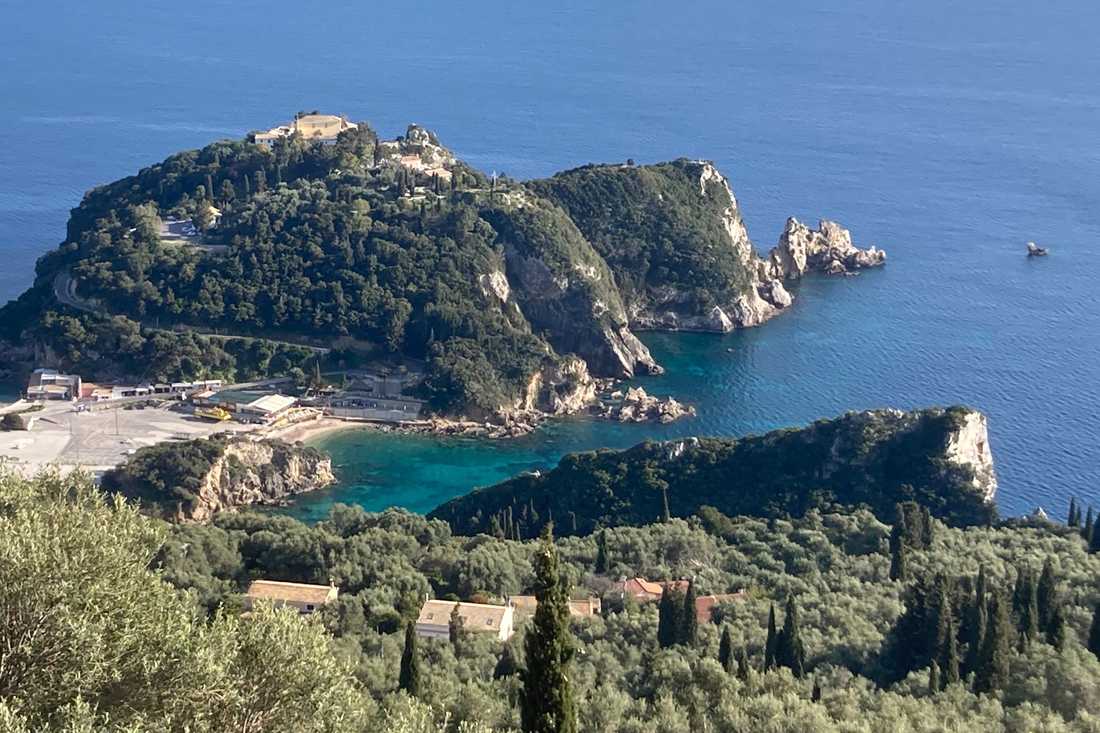
Paleokastritsa is Corfu’s most beautiful coastal area, a string of six turquoise coves beneath green cliffs on the dramatic west coast, crowned by a 13th-century clifftop monastery and ringed by sea caves. It is the island’s classic postcard. This guide covers the beaches, the monastery, the boat trips and how to visit. Plan the whole trip with Greece Tours.
The resort is the jewel of the island’s west coast, a highlight in the wider Corfu tours and travel guide. It lies about 25 kilometres from Corfu Town. The sections below cover the visit.
What is Paleokastritsa like?
Paleokastritsa is a series of six turquoise coves set beneath steep green cliffs on Corfu’s west coast, with crystal-clear water, sea caves and a clifftop monastery. Lush and dramatic, it is widely considered the island’s most scenic and photographed spot.
The resort is a landscape of green cliffs and blue water. Around 25 kilometres from Corfu Town, it spreads across a series of six small bays separated by wooded headlands, where steep, pine- and olive-clad cliffs fall to coves of exceptionally clear turquoise sea. A clifftop monastery, sea caves and boat-only beaches complete the picture, making it the image that graces Corfu postcards. Its beauty and range of things to do make it a must-see and a popular base, set within the wider Corfu beaches. The beaches are the first draw.
What are the beaches like?
Paleokastritsa has six distinct beaches plus boat-access-only coves. The main beach is sandy with sunbeds and watersports, while most others are pebble and rock, so beach shoes help. Hidden coves like Chomi, or Paradise Beach, are reachable only by boat or kayak.
The bay offers a beach for every mood. Its six main beaches range from the sandy, organised main beach with sunbeds, watersports and parking to smaller pebble-and-rock coves tucked beneath the cliffs, where beach shoes make a real difference. The clear, sheltered water is superb for swimming and snorkelling. Beyond the road-accessible beaches, hidden coves such as Chomi, often dubbed Paradise Beach, can be reached only from the water, by rented motorboat, kayak or boat trip, set out alongside the guide to Corfu boat tours. The monastery crowns the headland.
What is the monastery?
The monastery is the Theotokos Monastery of the Virgin Mary, perched on a rocky promontory above the bay. Founded in 1228, with current buildings mainly from the 18th century, it offers historic icons, peaceful gardens, a small museum and spectacular panoramic views.
The clifftop monastery is the area’s spiritual and scenic crown. The Theotokos Monastery, dedicated to the Virgin Mary, sits on a rocky headland overlooking the bays, founded in 1228 though its present buildings date mainly from the 18th century. Free to enter with modest dress, it holds historic Byzantine icons, a small museum of religious and folk objects, flower-filled courtyards and an old olive press, all wrapped in the finest views on this coast. The short walk or drive up rewards visitors richly, set out alongside the guide to Corfu villages like Lakones above. The sea caves are a highlight by boat.
What are the sea caves and boat trips?
Boat trips from the Paleokastritsa harbour explore the sea caves in 30 minutes to two hours, taking in Nausicaa’s Cave from the Odyssey legend and the Blue Eye Cave, where the water glows an intense blue.
The sea caves are the area’s hidden wonder. Small boats leave the harbour for trips of 30 minutes to two hours along the indented coast, threading caves and grottoes carved into the cliffs. Among them are Nausicaa’s Cave, named after the princess said to have found the shipwrecked Odysseus on these shores, and the celebrated Blue Eye Cave, where light through an underwater rock makes a patch of water glow an almost phosphorescent blue. The calmer morning sea gives the best visibility and access, set out alongside the guide to things to do in Corfu. A little planning makes the most of a visit.
How do you get there and when to visit?
Reach Paleokastritsa by Green Line bus from Corfu Town in about 45 minutes for around €2.50, or by car. Arrive before 9am in high season for beach space and parking, or after 4pm once day-trippers leave.
The resort is easy to reach and best enjoyed off-peak. Green Line buses run through the day from Corfu Town, taking about 45 minutes and costing around €2.50, terminating right at the beach, while driving gives more flexibility for the monastery and the hill village of Lakones above. In high summer, arriving before 9am secures a beach spot and parking, or visiting in the late afternoon after 4pm, once the day-trippers leave, brings a calmer swim and a sunset dinner at a clifftop taverna, set out alongside the guide to how to get to Corfu. The questions below cover the points travellers ask most.
Which coves and beaches sit around Paleokastritsa?
Paleokastritsa clusters six named coves: the sandy main beach and Agios Petros with facilities, plus Ampelaki, Agia Triada, Alipa and the rocky La Grotta swim spot. Boat-only coves like Rovinia and Chomi lie further along the cliffs.
The Paleokastritsa main beach anchors the bay, a sandy-to-shingle crescent with sunbeds, tavernas and the boat harbour at one end. Agios Petros, next along, keeps the same organised feel with a gentle entry that suits families. Ampelaki tucks into a quieter inlet backed by pines, while Agia Triada rewards a short walk with clearer, calmer water away from the crowds. Each cove carries its own character, so pairing two in one day gives a fuller sense of the coastline.
La Grotta sits below a cliffside bar, a deep-water rock platform where swimmers jump straight into glassy blue sea, prized by snorkellers rather than sunbathers. Alipa shelters the working boatyard and a slipway, calm and shallow for a lazy dip. The finest coves stay hidden: Rovinia, a broad pebble bay under wooded slopes, and Chomi, widely called Paradise Beach, both open only to a rented motorboat or kayak. Reaching them turns a beach day into a small adventure, set within the wider guide to Corfu beaches.
Is Paleokastritsa good for snorkelling and diving?
Paleokastritsa ranks among Corfu’s top snorkelling and diving spots, thanks to clear, sheltered water, rocky reefs, walls and sea caves teeming with marine life. Dive centres at the main beach run boat dives, try-dives and courses across the bays.
The rocky headlands that frame each cove drop into water of exceptional clarity, so a mask and fins turn the shallows into an aquarium. Snorkellers hug the edges of La Grotta, Ampelaki and Agia Triada, where reefs shelter bream, wrasse and the occasional octopus among the rocks. Visibility often reaches well beyond twenty metres on a calm morning, before wind ruffles the surface. Beach shoes and a mask are the only kit a casual swimmer packs to enjoy this underwater terrain.
Divers find Paleokastritsa richer still, with reef walls, swim-through caves and boulder gardens dropping past thirty metres offshore. Local dive centres based at the harbour run guided boat dives, beginner try-dives in the sheltered bay and certification courses through the season, detailed in the guide to Corfu diving. Kayaks and stand-up paddleboards rent from the main beach too, a slower way to reach the caves and hidden coves under your own power, complementing the wider Corfu boat tours.
What is Angelokastro fortress above Paleokastritsa?
Angelokastro is a ruined Byzantine castle on a peak above Paleokastritsa, near the villages of Krini and Lakones. Built in the 13th century, it guarded Corfu’s northwest coast and offers commanding sea views from its clifftop walls and rock-cut chapel.
The fortress crowns a sheer 300-metre crag that dominates the skyline north of the bay, one of the strongest defensive positions on the island. Angelokastro held out through repeated sieges in medieval times, sheltering villagers behind its curtain walls when raiders threatened the coast. The climb from the parking area passes a rock-cut chapel and cisterns before reaching the summit acropolis, where the ground falls away on every side to the open Ionian.
The reward at the top is a panorama that stretches along the whole northwest coastline, from the coves below to the mountains of the Albanian mainland on a clear day. Sturdy shoes and water make the short but steep ascent comfortable, and the site pairs naturally with a morning at the beach and an afternoon in the hill villages. The full history and route sit in the dedicated guide to Angelokastro, reached through the surrounding Corfu villages.
Where is the best view over Paleokastritsa?
The best view over Paleokastritsa is from Bella Vista near Lakones, a clifftop terrace looking down on all six coves at once. A winding road climbs from the bay to cafes and viewpoints framing the classic postcard panorama of the west coast.
The road up to Lakones twists through olive groves and past whitewashed houses, gaining height with every hairpin until the whole bay opens below. Bella Vista, the celebrated terrace on the ridge, hangs directly over the water, so the six coves, the wooded headlands and the monastery promontory line up in a single sweep. Cafes along the ridge pour coffee and cold drinks at tables built for the view, a rewarding stop between beach and castle.
The panorama shifts through the day, deep turquoise under the midday sun and warm gold as the light drops toward sunset, when the terraces fill for the evening show. Drivers reach Bella Vista in fifteen minutes from the main beach, while walkers tackle the climb on foot for a slower approach. The ridge road links onward to Angelokastro and Krini, tying the viewpoint into a natural half-day loop above Paleokastritsa.
Where do you park and stay in Paleokastritsa?
Paleokastritsa has paid car parks behind the main beach and roadside spaces that fill by mid-morning in summer, so arrive early. Hotels, studios and apartments cluster around the bays and up the approach road, with quieter stays in Lakones above.
Parking concentrates behind the main beach, in signed car parks and along the final stretch of road down to the harbour. High-season demand means the closest spaces disappear before mid-morning, so an early arrival or a late-afternoon visit sidesteps the squeeze. Drivers heading to the monastery find a small car park near the gate at the top of the promontory, a short climb above the beach road.
Accommodation ranges from beachfront hotels and family-run studios near the coves to apartments dotted up the wooded hillside with balconies over the water. Staying in Paleokastritsa itself puts the beaches, harbour and tavernas on the doorstep, while the hill village of Lakones trades sea access for cooler air and that famous view. Options across the whole island appear in the guide to where to stay in Corfu, and a hire car from the Corfu airport car rental desk unlocks the west-coast beaches beyond the bus route.
Where do you eat and when is best to visit Paleokastritsa?
Paleokastritsa’s tavernas cluster along the main beach and up on the Lakones ridge, serving fresh Ionian fish, grilled meats and Corfiot dishes. Late spring through early autumn brings the warmest sea and clearest boat trips, with June and September quieter than peak August.
The waterfront tavernas at the main beach and harbour trade on the view, plating catch-of-the-day fish, seafood pasta and Corfiot specialities like pastitsada beside the moored boats. Up on the ridge, the terraces near Bella Vista serve the same regional cooking with the whole bay laid out below, turning lunch into an event. A cliffside dinner as the sun drops behind the headlands ranks among the classic Paleokastritsa evenings, so a table booked toward sunset rewards the wait.
The season runs from late spring to early autumn, when the water warms and the boat trips run daily under settled skies. June and September deliver the sweet spot of hot seas, long days and thinner crowds than the August peak, when the coves and car parks fill fast. Morning visits catch the calmest water for snorkelling and cave trips, and the light softens the cliffs toward evening, framing the coastline that makes this corner of the island unforgettable.
What is the legend behind Paleokastritsa?
Paleokastritsa is tied to Homer’s Odyssey, identified by tradition as Scheria, land of the Phaeacians, where the shipwrecked Odysseus washed ashore and met Princess Nausicaa. A rock offshore is said to be his petrified ship, and a sea cave carries Nausicaa’s name.
The myth gives the coastline a storybook layer that guides love to tell on the boat trips. In the tale, Odysseus is thrown onto the rocks after a storm and found by Nausicaa, daughter of King Alcinous, who brings him to the Phaeacian court that later ferries him home to Ithaca. Local tradition plants this scene on the Paleokastritsa shore, and the pointed rock jutting from the water offshore is pointed out as the ship the sea-god turned to stone.
The legend also names Nausicaa’s Cave, one of the grottoes the harbour boats visit, weaving the Homeric story into the caves themselves. Whether or not the geography truly matches Homer, the association has drawn travellers to this stretch of Corfu since antiquity. The story adds meaning to a swim beneath the cliffs, and the boat crews who recount it turn a scenic ride into a walk through Greek myth along the west coast.
What can you do near Paleokastritsa in one trip?
Near Paleokastritsa you can climb to Angelokastro fortress, take in the Bella Vista panorama at Lakones, and drive south to Glyfada and Agios Gordios beaches. The clustered west-coast sights let a single base cover beaches, castle, viewpoint and village in a day or two.
The hill villages of Lakones and Krini crown the ridge directly above the bay, reached by the same winding road that climbs to Bella Vista and Angelokastro. A morning on the Paleokastritsa coves and an afternoon on the ridge combine easily, trading turquoise water for sweeping views and cool mountain air. The route threads through the traditional Corfu villages, where tavernas serve local dishes far from the beach bustle.
South along the west coast lie the broad sands of Glyfada beach and the laid-back bay of Agios Gordios, each a short drive from Paleokastritsa with a hire car. Pairing the dramatic coves of the north with these open beaches gives a fuller picture of Corfu’s western shore. The best window for the whole circuit is late spring to early autumn, set out in the guide to the best time to visit Corfu, when warm seas and long light reward every viewpoint and swim.
Which boat trip from Paleokastritsa shows the seabed and which one races to the beaches?
The underwater cruise lets passengers watch the seabed from a cabin, and the speedboat tour races to caves and beaches. Paleokastritsa offers both from the bay. The first lasts 45 minutes and keeps you dry; the second runs one hour in a small group.
The glass-bottom format is sold as Corfu: Paleokastritsa Underwater Cruise to View Marine Life. Passengers sit in an air-conditioned cabin with panoramic windows. They watch the local marine life while staying completely dry. The abstract describes a view of the bay above and below the sea.
The Paleokastritsa listing gives 45 minutes and carries the Skip the line label. Booking closes three hours before departure. The guide to Corfu glass bottom boat trips covers the cabin, the fish and the weather in detail.
The speedboat format is sold as Corfu: Paleokastritsa 1-Hour Paradise Beach Speedboat Tour. The abstract calls it a speedboat mini cruise to sea caves, Paradise (Chomi) beach and Stelari beach. It is a small-group trip with free cancellation, and booking closes 20 minutes before departure.
The two-hour speedboat run is titled Paleokastritsa: Paradise, Yali Beach & Blue Caves Boat Tour. The operator describes a speedboat for a small group of 10 people, leaving from Alipa Port. It makes two swim stops of 20 to 30 minutes, at Paradise Beach and Yali Beach. The operator sets these rules:
- Arrive at Alipa Port 20 minutes before departure and meet at the ramp on the little beach.
- Swimming in the sea is allowed, but staying on Paradise Beach is not.
- Swimming inside the caves is not safe.
- The captain has the right to change the itinerary when safety requires it.
- The boat has a small WC and an outdoor shower.
How do you choose among the Paleokastritsa boat trips and the longer cruises?
Choose by time and by what you want to see. Paleokastritsa trips run from 45 minutes underwater to three hours by wooden boat, and private cruises run longer. Swim stops, group minimums and free cancellation separate the formats.
The three-hour Paleokastritsa: 3 Blue Caves, Kasteli & Limni Beach Cruise uses a traditional wooden boat. It visits Nausika Cave, Blue Eye Cave and St. Nicolas Cave. Passengers swim at Limni Beach, then swim again from the boat at Kasteli. Booking closes 45 minutes before departure. The listing states that bad weather leads to a new date.
The evening option is Paleokastritsa: Corfu Caves & Paradise Beach Sunset Cruise. It lasts 1.5 hours on a traditional wooden boat from the main beach, Agios Spiridonas. On windier days the operator shortens it to one hour. Guests arrive 10 to 15 minutes early and receive local white wine or juice. The page lists no swimming.
Two longer cruises add more time on the water. Corfu: Palaiokastritsa Cruise, Blue Caves & Hidden Beaches is a semi-private cruise of 2.5 hours with a swim at Giali Beach. Corfu Private Cruise to Paleokastritsa Caves & Paradise Beaches is a private-group cruise of two to seven hours.
- Seabed view while dry: the 45-minute underwater cruise.
- Caves and two beaches in one hour: the speedboat mini cruise.
- Longer swim stops: the two-hour speedboat run, with 20 to 30 minutes at each stop.
- Evening on the water: the 1.5-hour sunset cruise.
- Longest time afloat: the wooden-boat cruise or the private cruise of up to seven hours.
Shared trips run only with a minimum group. The operator needs four booked people for the two-hour speedboat run and six for the sunset cruise. Below the minimum, it offers another date, time or a refund. Every listing above carries free cancellation, which keeps a Paleokastritsa plan flexible.
Frequently Asked Questions
What is Paleokastritsa known for?
Paleokastritsa is known as Corfu’s most beautiful bay, with six turquoise coves beneath green cliffs, a 13th-century clifftop monastery and sea caves. It is the island’s classic postcard, popular for swimming, boat trips and stunning views.
Can you visit the Paleokastritsa monastery?
You can visit the Theotokos Monastery free of charge, with modest dress, perched on the headland above the bay. Founded in 1228, it holds historic icons, gardens, a small museum and an old olive press, with spectacular panoramic views.
How do you get to Paleokastritsa from Corfu Town?
You get there by Green Line bus from Corfu Town in about 45 minutes for around €2.50, terminating at the beach, or by car for more flexibility. Arriving early or after 4pm in high season avoids the worst crowds and parking.
Which is the best beach in Paleokastritsa?
The Paleokastritsa main beach is the easiest choice, with sand, sunbeds and facilities. For clearer, quieter water, Agia Triada and Ampelaki reward a short walk, while La Grotta suits snorkellers and the boat-only coves of Rovinia and Chomi offer the most secluded swim.
Is Paleokastritsa good for snorkelling?
Paleokastritsa is one of Corfu’s best snorkelling spots, with clear, sheltered water and rocky reefs around La Grotta, Ampelaki and Agia Triada. Marine life gathers along the cliff edges, and dive centres at the main beach run boat dives and courses through the season.
Can you visit Angelokastro from Paleokastritsa?
You can reach Angelokastro fortress by car in about 20 minutes, climbing the ridge road past Lakones to Krini. The 13th-century Byzantine castle sits on a 300-metre crag with commanding views over the northwest coast, pairing well with a morning on the Paleokastritsa beaches.
How long is enough time in Paleokastritsa?
A full day suits Paleokastritsa, allowing time for the beaches, a boat trip to the sea caves and the clifftop monastery. Adding Angelokastro and the Bella Vista viewpoint above Lakones fills a relaxed day and a half without feeling rushed.