
The Corfu villages range from bohemian hilltop Pelekas with its Kaiser’s Throne sunset, to Lakones high above Paleokastritsa, the seaside harbour of Kassiopi, and the haunting ghost village of Old Perithia on Mount Pantokrator. Green, olive-clad and traditional, the island’s interior rewards a drive. This guide covers the best villages and what each offers. Plan the whole trip with Greece Tours.
The villages reveal the island’s quiet, authentic side, a highlight in the wider Corfu tours and travel guide. They spread from the hills to the coast. The sections below cover them in turn.
What is Pelekas like?
Pelekas is a bohemian hilltop village 13 kilometres from Corfu Town, surrounded by olive groves and known for its sunsets. Its highlight is Kaiser’s Throne, the viewpoint where Kaiser Wilhelm II watched the sun set, offering a 360-degree panorama of the island.
Pelekas is the island’s sunset village. Set on a hill amid lush olive groves about 13 kilometres west of Corfu Town, it has a creative, laid-back soul, with whitewashed lanes, tavernas and a relaxed atmosphere. Its famous viewpoint, Kaiser’s Throne, was the observatory where Kaiser Wilhelm II came to watch the sunset, and it still offers a sweeping 360-degree panorama over the whole island and the sea. Below lie sandy beaches such as Glyfada and Kontogialos, making it a fine base, set out alongside the guide to Corfu beaches. Lakones offers another great view.
What is Lakones like?
Lakones is a traditional village perched high above Paleokastritsa, famed for its panoramic views over the six bays below, which earned it the nickname “the Balcony of the Ionian”. Its clifftop cafés make a perfect coffee stop above the turquoise coast.
Lakones is the balcony above the island’s most beautiful bay. Clinging to the hillside high over Paleokastritsa, the narrow, traditional village looks down on the resort’s six turquoise coves and green headlands, a view so celebrated it gave the village its nickname, the Balcony of the Ionian. Its clifftop cafés, such as the well-known terraces along the road, are a classic place to pause over a coffee and take in the panorama, especially toward sunset. The village pairs naturally with a visit to the coast below, set out in the guide to Paleokastritsa. Kassiopi brings village life to the coast.
What is Kassiopi like?
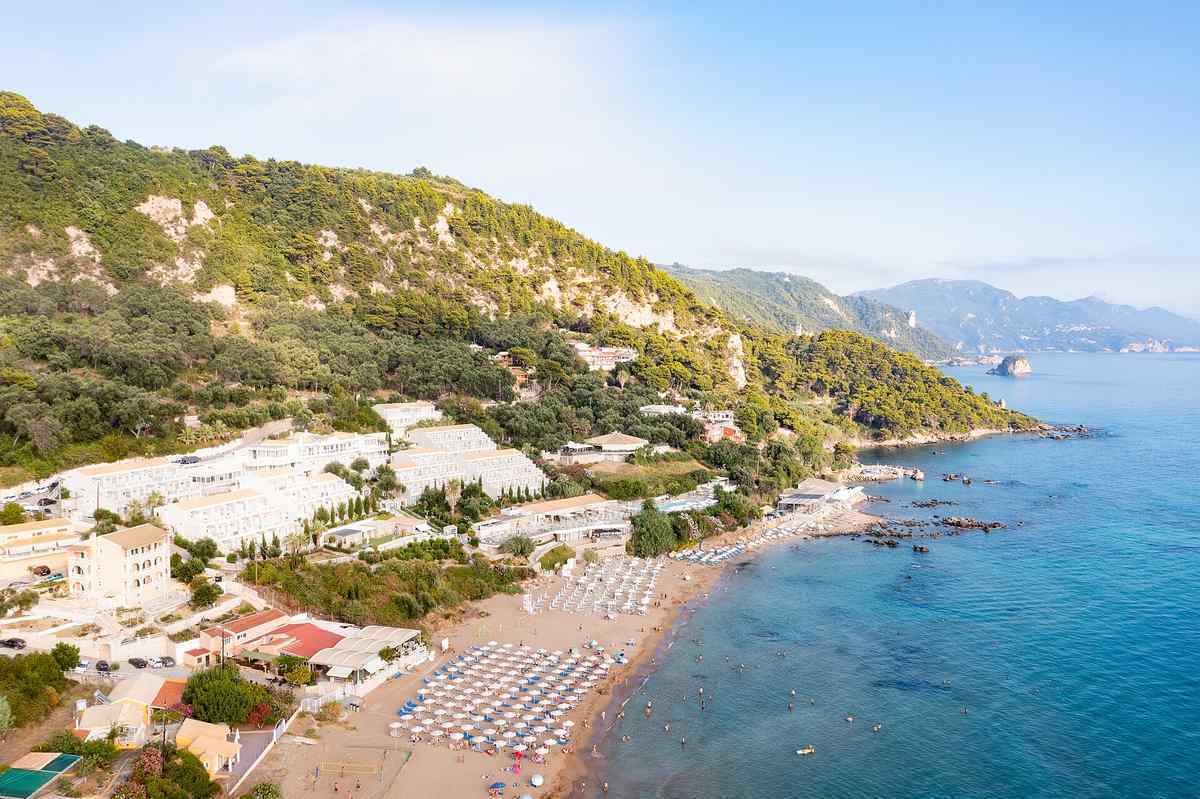
Kassiopi is a popular yet charming fishing village on the north-east coast, with a scenic harbour, the ruins of a Byzantine castle, and pebbly coves nearby. It keeps its traditional character while offering tavernas, bars and clear-water beaches like Bataria and Pipitos.
Kassiopi balances resort life with fishing-village charm. Set on the green north-east coast across a narrow channel from Albania, it gathers around a pretty harbour lined with tavernas and bars, watched over by the ruins of a Byzantine castle on the headland. Despite its popularity, it keeps an authentic, low-key feel, and small pebbly coves such as Bataria and Pipitos offer clear-water swimming a short walk from the centre. Its mix of harbour dining, history and beaches makes it a favourite base, set out in the guide to where to stay in Corfu. Old Perithia is the most haunting village of all.
What is Old Perithia?
Old Perithia is Corfu’s oldest village, a protected ghost village high on Mount Pantokrator, with Venetian-style stone houses, eight churches and tavernas restored among the ruins. Largely abandoned, it offers a hauntingly beautiful glimpse of the island’s past.
Old Perithia is a step back in time. Set high on the upper slopes of Mount Pantokrator, it is the island’s oldest permanently settled village, with records back to the 14th century, and a protected historic monument. Once a prosperous community, it was abandoned as people moved to the coast, leaving Venetian-style stone houses now half-reclaimed by nature and eight churches, including Agios Iakovos Persis. Family-run tavernas have been restored among the ruins, serving hearty traditional Corfiot food in a unique setting, set out alongside the guide to Corfu food and wine. A car is the key to the villages.
What is Afionas like?
Afionas is a traditional hilltop village on a narrow ridge in north-west Corfu, above the twin bays of Porto Timoni. Its stone houses, church square and clifftop path draw walkers to one of the island’s finest coastal viewpoints over Agios Georgios Pagon.
Afionas rewards those who climb to it. The village sits along a slender ridge that runs out to a headland, so its lanes and the little square by the church of Agioi Apostoloi look out over water on both sides. From the top a well-trodden footpath leads down toward Porto Timoni, the celebrated double bay where two crescents of beach meet back to back beneath the cape.
The walk out to the viewpoint is the main draw, taking in wildflowers, dry-stone terraces and wide sea horizons. Tavernas in the village serve Corfiot dishes with a panorama, making Afionas a natural pairing with a swim below, set out alongside the guide to Porto Timoni. Doukades shows the softer, greener face of the interior.
What is Doukades like?
Doukades is a quiet Venetian-era village in the green hills near Paleokastritsa, known for its shady central square, historic mansions and family tavernas. It offers an unhurried taste of old Corfu away from the coastal resorts, ringed by olive groves and cypress.
Doukades feels untouched by the busy coast nearby. Tucked into a fold of the hills a short drive inland from Paleokastritsa, the village keeps a cluster of tall Venetian-style houses and a leafy plateia where locals gather under plane trees. The narrow streets, worn stone and flower-filled balconies give it the feel of a place that has changed little.
Food is central to its appeal. The village is well known for its long-standing tavernas, where slow-cooked Corfiot specialities are served in the shade of the square, drawing visitors up from the beaches for a leisurely lunch. Its calm setting among olive groves makes Doukades an easy, authentic stop on a drive through the north-west, close to the coast at Paleokastritsa. A car unlocks all of these villages.
How do you visit the villages?
You visit the villages best by rental car, since the prettiest mountain villages are not served by bus, with Old Perithia reachable only by car. The Green Line buses reach the larger villages, and the spring and autumn shoulder months are ideal.
A car is the key to exploring the island’s villages. While the Green Line buses reach larger villages and Kassiopi, many of the loveliest mountain settlements, including Old Perithia and the road to Lakones, are best or only reached by car, which also allows linking several in a scenic day’s drive. The shoulder months of May, June and September offer warm weather, fewer crowds and easier parking for a village tour. Combining hill villages, viewpoints and a coastal harbour makes a rewarding day, set out alongside a Corfu itinerary. The questions below cover the points travellers ask most.
Frequently Asked Questions
What are the most beautiful villages in Corfu?
The most beautiful villages include bohemian hilltop Pelekas with its Kaiser’s Throne sunset, Lakones above Paleokastritsa, the harbour village of Kassiopi, and the haunting ghost village of Old Perithia on Mount Pantokrator. Each offers a different side of the island.
What is Old Perithia in Corfu?
Old Perithia is Corfu’s oldest village, a protected ghost village high on Mount Pantokrator with Venetian-style stone houses, eight churches and tavernas restored among the ruins. Largely abandoned, it gives a hauntingly beautiful glimpse of the island’s past.
How do you get to the Corfu villages?
You get to the villages best by rental car, since many mountain villages, including Old Perithia, are not served by bus. The Green Line buses reach larger villages and Kassiopi, and the shoulder months of May, June and September are ideal for touring.