
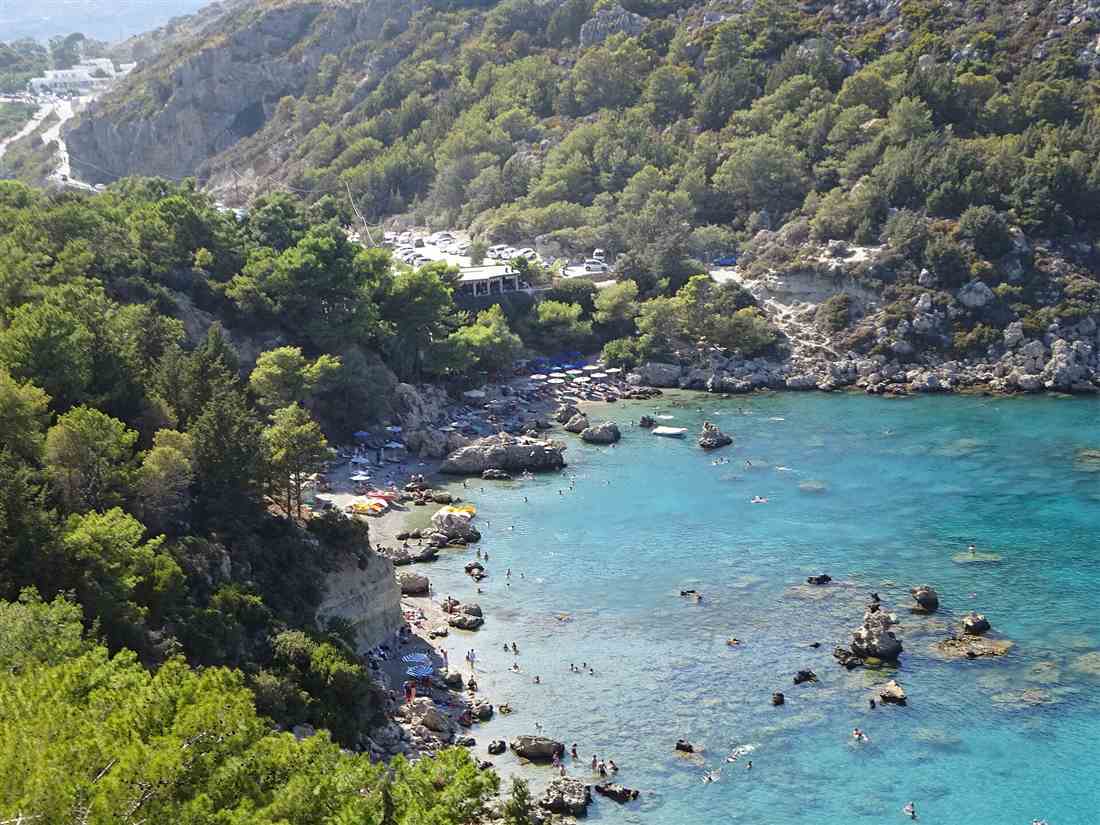
Rhodes snorkeling runs as a guided boat cruise out of Mandraki port and the east-coast resorts, and as a free shore entry at Anthony Quinn Bay, Ladiko and the rocky coves that line the sheltered east side of the island. Plan the whole trip with Greece Tours.
This guide covers Rhodes snorkeling in full: the cruises that run from Rhodes town, the Anthony Quinn Bay and sea caves trip, the best spots on the east, south and north coasts, what you see underwater, the caves, the season and the visibility, the equipment, what it costs, safety, and how to book.
What is Rhodes snorkeling and what does a guided trip include?
Rhodes snorkeling is guided sea swimming with a mask, snorkel and fins along the rocky coves, sea caves and seagrass meadows that ring the island of Rhodes, run from a boat or a shore point with an instructor pointing out fish, caves and swim-throughs at every stop.
Rhodes snorkeling is booked ahead for a fixed, agreed price per person. A private Rhodes snorkeling cruise keeps the boat to one group. A trip starts with a boat departure, a short run to the first cove, and a mask-and-fin fitting before anyone enters the water. The guide sets the pace, swims ahead to point out an octopus tucked in a crack or a school of salema crossing the sand, and keeps the group inside a marked patch of calm water.
Rhodes snorkeling is booked ahead for a fixed, agreed price per person. A private Rhodes snorkeling cruise keeps the boat to one group. Equipment is supplied on nearly every organized trip: a mask sized to the face, a snorkel with a purge valve, open-heel fins over a reef shoe, and a flotation noodle for anyone who wants one. A wetsuit top cuts glare and sun exposure on the back, and reef shoes protect feet on the pebble entries common along the east coast. A first-time visitor turns up in swimwear and leaves fully kitted.
Rhodes snorkeling is booked ahead for a fixed, agreed price per person. A private Rhodes snorkeling cruise keeps the boat to one group. Stops are chosen for calm, sheltered water rather than raw distance from the harbor: a bay behind a headland, a cave mouth out of the swell, a seagrass shelf where fish feed. A guide reads the wind and sets the order of stops for the day. This approach rewards patience over speed — the best sightings come from floating still.
Rhodes snorkeling is booked ahead for a fixed, agreed price per person. Group size stays small on the better-run trips: one boat crew watches ten to twenty swimmers, with a guide in the water and a second crew member on deck. A boat that packs a large group with no guide in the water is looser and less attentive than one running a small group with close supervision.
Do you need experience to go snorkeling in Rhodes?
No experience is needed to try snorkeling in Rhodes: every operator fits the mask and fins on the boat, hands a noodle or life jacket to anyone unsure in open water, and runs a briefing before the first swim stop, so a first-timer and a confident swimmer join the same group.
For a first time in the water, Rhodes snorkeling starts with the mask fit and the briefing. Families take Rhodes snorkeling for the sheltered bays and the life jackets. Mask fit is tested on deck before anyone gets wet: the guide presses the mask to the face without the strap, checks for a seal, sets the strap at the back of the head, and swaps sizes until there is no leak at the nose. Fin sizing follows the same process. A leaking mask or a slipping fin ruins a swim faster than any current.
For a first time in the water, Rhodes snorkeling starts with the mask fit and the briefing. Families take Rhodes snorkeling for the sheltered bays and the life jackets. Flotation is carried for exactly this reason: pool noodles, ring buoys and life jackets sit in a crate on every boat, free to take for the whole swim or just the first few minutes until confidence builds. A non-swimmer is not turned away — a life jacket and a tow from the guide covers the rest.
For a first time in the water, Rhodes snorkeling starts with the mask fit and the briefing. Families take Rhodes snorkeling for the sheltered bays and the life jackets. The briefing before entry covers hand signals, the boundary of the swim zone, clearing water from the mask, and where the boat ladder sits for the climb out. Guides run this at every stop, not just the first, because currents and entry points shift from bay to cave to open reef. Nothing about Rhodes snorkeling depends on remembering instructions from an hour earlier — the briefing repeats.
For a first time in the water, Rhodes snorkeling starts with the mask fit and the briefing. Confidence builds fast once a swimmer feels how buoyant a wetsuit top or life jacket makes the body. Floating face-down and breathing through a snorkel feels strange for the first minute and becomes automatic soon after; first-timers are swimming comfortably by the second stop of the day, in nearly every case.
What Rhodes snorkeling boat trips run from Mandraki and Rhodes town?
Traditional wooden caiques and larger gulet cruises leave from Mandraki port in Rhodes town for Rhodes snorkeling days that run a half-day or a full six hours, stopping at two or three coves, with a buffet lunch and open bar carried on the longer Rhodes boat trips.
The choice of Rhodes snorkeling comes down to the boat, the route and the stops. The price of Rhodes snorkeling covers the boat, the crew and the equipment. Mandraki sits at the edge of the old harbor, lined with the caiques that have carried day-trippers around the coastline for generations. Boarding starts early, before the midday heat, crews loading coolers and gear while the last guests find a seat. The caique is broad-beamed and stable, built for coastal work rather than speed.
The choice of Rhodes snorkeling comes down to the boat, the route and the stops. The price of Rhodes snorkeling covers the boat, the crew and the equipment. The half-day run covers the closer stretch of coast: two swim stops within an hour or two of Rhodes town, back at the dock by early afternoon. The six-hour version reaches further down the east coast, adds a third stop, and builds in more anchor time at each cove. Both formats are sold near Mandraki and online.
The choice of Rhodes snorkeling comes down to the boat, the route and the stops. The price of Rhodes snorkeling covers the boat, the crew and the equipment. Gulet cruises are the larger wooden motor-sail vessels. These boats carry the buffet lunch that sets the format apart: grilled fish or meat, salads, fresh bread and fruit, laid out after the second swim stop while the boat sits at anchor. An open bar runs alongside it on the full-day cruises, with beer, wine and soft drinks included in the ticket.
The choice of Rhodes snorkeling comes down to the boat, the route and the stops. Swim stops are timed to the anchor, not the clock: the crew drops anchor in a sheltered cove, hands out gear, and gives the group free time before calling everyone back for the next leg. A guide or crew member stays in the water at the busier stops, watching the swim zone from a paddleboard. This pattern is exactly what most first-time visitors picture when booking a day on the water.
What is the Anthony Quinn Bay and sea caves cruise near Rhodes?
This is a small-group boat trip down the east coast to Anthony Quinn Bay and the sea caves along the Ladiko headland, with a strict passenger cap and roughly twenty-five minutes of free swim time at each of its stops.
A private Rhodes snorkeling cruise keeps the boat to one group. The stops on Rhodes snorkeling reach the bays and caves no swimmer walks to. The run south from Rhodes town or Faliraki hugs the coastline, giving guests a close view of the headlands, cliffs and small coves along this stretch. Anthony Quinn Bay is a horseshoe of water backed by pine-covered cliffs. The water sits calm inside the horseshoe even when the open sea past the headland carries a chop, which is why the bay anchors so much of this coast’s snorkeling reputation.
A private Rhodes snorkeling cruise keeps the boat to one group. The stops on Rhodes snorkeling reach the bays and caves no swimmer walks to. Ladiko, the smaller cove next door, is separated from Anthony Quinn Bay by a short rocky headland riddled with sea caves and swim-through arches. Guides lead small groups through the lower caves at water level, timing entry to the swell so nobody is pushed against the rock on a surge. Light drops sharply once a swimmer passes the cave mouth, the water reading a deeper, cooler blue than the open bay outside.
A private Rhodes snorkeling cruise keeps the boat to one group. The stops on Rhodes snorkeling reach the bays and caves no swimmer walks to. The passenger cap on this route is deliberate: a smaller boat means a smaller group at any cave mouth, which matters when the entry is a single narrow gap in the rock. Operators keep numbers under what a large gulet carries. A guide swims the group through in twos or threes rather than letting everyone crowd the entrance at once.
A private Rhodes snorkeling cruise keeps the boat to one group. Twenty-five minutes at each stop is enough to swim the perimeter of Anthony Quinn Bay, cross to the cave mouths, and float over the seagrass beds carpeting the bay floor. The short window fits both stops into a half-day. Guides call time with a whistle, and stragglers are collected by tender rather than left to swim back against the current.
What snorkeling trips in Rhodes combine paddleboarding?
A stand-up paddleboard and snorkel tour launches on a calm morning, paddles out along the coast to a cave or reef, straps the mask and fins to the board for the crossing, then anchors the board offshore while the group snorkels the same spot from the water.
The morning departure for Rhodes snorkeling fills first in high season. Rhodes snorkeling ends with the run back to Mandraki and the gear handed in. These tours launch early, before the wind picks up, from a beach or small jetty rather than the main harbor. A calm morning surface is what makes stand-up paddling workable for a mixed group, since a choppy sea turns a stable board into a wobbling one within minutes.
The morning departure for Rhodes snorkeling fills first in high season. Rhodes snorkeling ends with the run back to Mandraki and the gear handed in. Gear rides on the board: mask, snorkel and fins go into a mesh pouch lashed to the deck, alongside a small dry bag for phones or keys. Fins stay off the feet during the paddle, since standing and steering needs bare feet or a thin water shoe with a flat sole. Once the group reaches the target cove, everyone slides off the board and the fins go on for the swim.
The morning departure for Rhodes snorkeling fills first in high season. Rhodes snorkeling ends with the run back to Mandraki and the gear handed in. The paddle out is a slow cruise rather than a workout, timed to keep the group together and let anyone unfamiliar with a board find balance before the water deepens or a current picks up near a headland. Guides lead from the front, calling the line around rocks and shallow reef a swimmer clears easily on foot.
The morning departure for Rhodes snorkeling fills first in high season. Once anchored, the boards double as a rest point mid-swim: a tired swimmer climbs back on, floats, and drops back in when ready, rather than swimming the full distance to a boat. This suits a mixed group of strong swimmers and beginners on the same outing. The caves reached this way tend to sit at shallower entry points unsuitable for a larger boat, giving this paddle-based route access to water a caique cannot reach.
Where are the best Rhodes snorkeling spots on the east coast?
The east coast holds the island’s strongest Rhodes snorkeling water: Anthony Quinn Bay and Ladiko for caves, Kallithea Springs for architecture and clear coves, Traganou near Afandou for a cave swim, Agathi and Charaki for open reef, and Lindos bay with St Paul’s Bay and Glystra for calm, sheltered swimming.
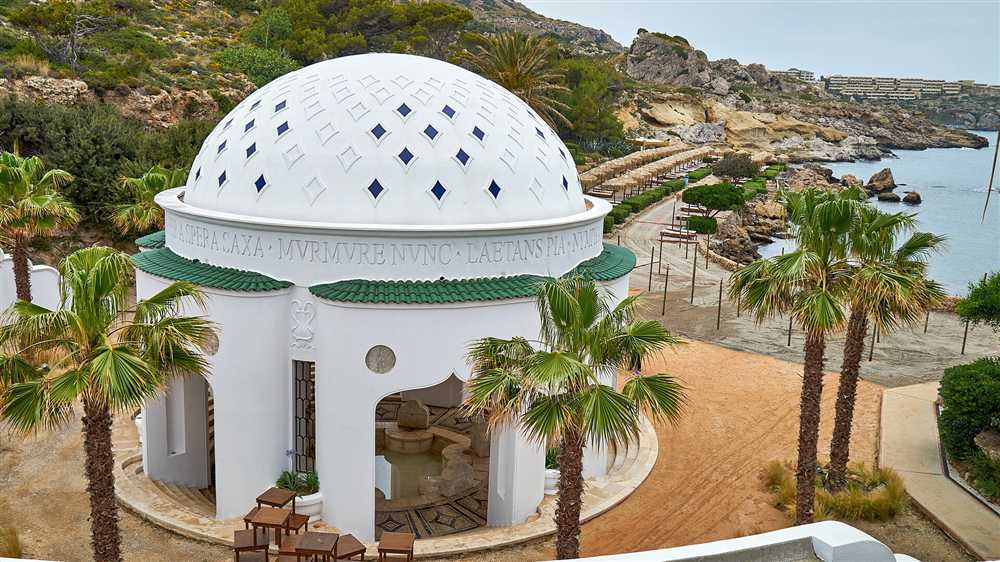
Families take Rhodes snorkeling for the sheltered bays and the life jackets. Rhodes snorkeling passes seagrass meadows, rock shelves and sandy patches. Kallithea Springs sits a short drive south of Rhodes town, built around a restored spa complex with domes and colonnades framing a small rocky cove below. The water runs clear over a mix of sand and rock, sheltered by the shape of the bay, and the ruins above the shoreline give the site a backdrop no other stop on this coast matches. Nearby Rhodes beaches extend this stretch of coast further south toward Faliraki.
Families take Rhodes snorkeling for the sheltered bays and the life jackets. Rhodes snorkeling passes seagrass meadows, rock shelves and sandy patches. Traganou cave sits near Afandou, a short swim from a pebble beach reached down a dirt track off the coast road. The cave mouth opens low and wide, letting light flood the first chamber before the passage narrows and darkens further back. Local swimmers treat it as a quiet alternative to Anthony Quinn, with far fewer boats moored offshore.
Families take Rhodes snorkeling for the sheltered bays and the life jackets. Rhodes snorkeling passes seagrass meadows, rock shelves and sandy patches. Agathi and Charaki sit further south, past Lindos, where the reef opens onto exposed rock shelves rather than sheltered coves. Agathi’s sand slopes gently to a rockier bottom thick with weed and small fish; Charaki’s harbor wall breaks the swell, keeping the water beside it flat calm when the open coast is choppy.
Families take Rhodes snorkeling for the sheltered bays and the life jackets. Lindos offers two distinct bays: the main harbor beach, busy and shallow, and St Paul’s Bay just south, a near-enclosed lagoon reached by a narrow gap in the rock, calm enough for a strong swimmer to cross in minutes. Glystra, further south, is a small crescent beach with clean sand and a reef edge close to shore, less crowded than Lindos. Together these spots cover most of what a first trip planning Rhodes snorkeling on the east coast needs.
Where are the best snorkeling spots in southern Rhodes?
The south coast centers on Prasonisi, where the Aegean and the Mediterranean meet at a narrow sand spit, with Gennadi, Plimmyri and Kiotari offering flatter reef shelves further north and more exposure to swell than the sheltered east-coast bays.
Rhodes snorkeling runs from Mandraki port and the east-coast resorts. The mask and the fins are fitted before Rhodes snorkeling begins. Prasonisi sits at the island’s southern tip, a thin strip of sand connecting Rhodes to a small islet that becomes a true island when winter storms cut the sandbar. One side of the spit faces calmer water; the other catches the open swell and wind that made this spot famous among windsurfers. The sheltered side holds clear, shallow water over sand and scattered rock, with far less current than the exposed face.
Rhodes snorkeling runs from Mandraki port and the east-coast resorts. The mask and the fins are fitted before Rhodes snorkeling begins. Gennadi lies north of Prasonisi, a long pebble-and-sand beach backed by a small village rather than resort development. The seabed is flatter than the east coast’s rocky points, sand patches and low reef shelves holding fish without a cave’s drama. Wind exposure runs higher than at Lindos or Kallithea.
Rhodes snorkeling runs from Mandraki port and the east-coast resorts. The mask and the fins are fitted before Rhodes snorkeling begins. Plimmyri and Kiotari sit between Gennadi and Lindos, both long open beaches with gently shelving sand giving way to reef further out. Plimmyri stays quieter, with less shoreline development. Kiotari has grown into a resort strip, and its reef shelf sits close enough to shore for a wading swimmer to reach fish-holding structure.
Rhodes snorkeling runs from Mandraki port and the east-coast resorts. Exposure to swell defines this whole stretch and changes which days work for a snorkel here. A south wind or a building meltemi pushes chop onto these open beaches, turning water clear at dawn into a churned, sand-clouded mess by early afternoon. Anyone planning a swim along the south coast checks the wind forecast before the drive, since the sheltered coves further north stay swimmable on days the south coast does not.
What are the best snorkeling spots on the west and north coast of Rhodes?
The west coast runs cooler and rougher than the east: Kalithies and the Kallithea headland hold pockets of shelter, Ixia and Ialysos face steady wind that suits windsurfing over snorkeling, and the northern tip where the two seas meet stays productive only in the calm of early morning.
The price of Rhodes snorkeling covers the boat, the crew and the equipment. The clear shallow rock at Anthony Quinn Bay is a set piece of Rhodes snorkeling. Kalithies sits inland from the coast road, and the headland sharing its name with Kallithea Springs forms a natural buffer against the prevailing wind that hammers the west side through the warm months. Coves tucked behind this headland hold calmer water than the open beaches further along.
The price of Rhodes snorkeling covers the boat, the crew and the equipment. The clear shallow rock at Anthony Quinn Bay is a set piece of Rhodes snorkeling. Ixia and Ialysos, the strip running north from Rhodes town toward the airport, face directly into the wind that built this coastline’s reputation among windsurfers and kitesurfers. Sand and shallow reef line the shore, but the near-constant midday chop turns the water cloudy for a mask-and-fin swim. A dawn session before the wind fills in is the reliable window here, and even that window narrows through the height of summer.
The price of Rhodes snorkeling covers the boat, the crew and the equipment. The clear shallow rock at Anthony Quinn Bay is a set piece of Rhodes snorkeling. The northern tip of the island, past the aquarium and the old town’s sea walls, is where the two seas the coastline sits between meet directly. Currents run stronger here than anywhere else around the island, driven by the pressure difference between the calmer water east and the rougher water west. Snorkeling this stretch calls for a guide who knows the exact timing of tide and wind, since flat calm at seven can turn unswimmable by ten.
The price of Rhodes snorkeling covers the boat, the crew and the equipment. Cooler water is the other defining trait of the west side. Deeper water sits closer to shore here than on the shallow shelves of the east coast, and wind-driven mixing keeps the surface layer from warming the way the sheltered east-coast bays do through summer. A wetsuit top unnecessary at Anthony Quinn Bay earns its place fast on a west-coast swim, and operators route their boats east and south rather than fighting this coastline’s wind.
What do you see when Rhodes snorkeling?
Rhodes snorkeling shows Posidonia seagrass meadows, schools of salema and damselfish, wrasse and sea bream picking over the rock, octopus and moray eels tucked into cracks, sea urchins and starfish on the bottom, and an occasional barracuda or parrotfish drifting through open water.
Rhodes snorkeling runs as a half-day cruise or a full six-hour day. Rhodes snorkeling carries a buffet and an open bar on the cruises that supply them. Posidonia seagrass is the backbone of the coastal ecosystem here, dense green meadows rooted in sand between the rocky points, swaying with the surge in shallow bays like Anthony Quinn and Kallithea. This is not drifting weed a swimmer brushes past; it is a living structure that shelters juvenile fish, holds sand against erosion, and marks out the clearest water on the coast.
Rhodes snorkeling runs as a half-day cruise or a full six-hour day. Rhodes snorkeling carries a buffet and an open bar on the cruises that supply them. Salema move in loose silver schools through the shallows, unbothered by swimmers and easy to approach within an arm’s length. Damselfish hold tighter territory, darting out to chase off anything straying too close to a nest. Wrasse come in a spread of colors, picking at the rock face for small invertebrates, while sea bream cruise in slow loops over the sand.
Rhodes snorkeling runs as a half-day cruise or a full six-hour day. Rhodes snorkeling carries a buffet and an open bar on the cruises that supply them. Octopus and moray eels share the same real estate: cracks and overhangs in the rock, spotted by a guide before a guest notices anything at all in most cases. An octopus changes color and texture within seconds of being seen, blending into the rock so completely that swimmers pass within a meter without registering it. Morays sit with just the head showing from a crevice, breathing rather than threatening.
Rhodes snorkeling runs as a half-day cruise or a full six-hour day. Sea urchins cluster in black patches on shaded rock, easy to avoid once a swimmer knows to look before putting a hand or foot down. Starfish sit in the open on sand and low reef, slow enough to watch closely. A barracuda passing through open water is a rarer sight, a single fish holding still in the current rather than the packed schools further south in the Mediterranean. Parrotfish, native to warmer water and now established this far north as the sea warms, add a flash of color against the muted rock and sand.
What are the sea caves and swim-throughs like?
The sea caves along the east coast are shallow, low-ceilinged caverns entered on calm days only, with dim blue light filtering back from the mouth, water rarely deeper than a few meters, and a strict rule of one swimmer at a time through the narrowest gaps, torch in hand.
The stops on Rhodes snorkeling reach the bays and caves no swimmer walks to. Planning Rhodes snorkeling ahead beats the scramble for a summer date. Most caves reachable on a guided trip sit at sea level rather than requiring a dive down to an entrance, carved by wave action into the softer rock along headlands like Ladiko. A calm sea is the precondition for entering any of them; the same swell that looks minor in open water amplifies inside a confined cave mouth, pushing a swimmer against rock on each surge. Guides check the sea state first and call off a cave stop on a rough day.
The stops on Rhodes snorkeling reach the bays and caves no swimmer walks to. Planning Rhodes snorkeling ahead beats the scramble for a summer date. Light behaves differently past the entrance. The first few meters stay bright, lit by sun reflecting off the sand or rock floor, but the color shifts fast toward deep blue and then near-black as the passage bends or narrows. Eyes adjust within a minute, and a ledge or a second chamber invisible on entry becomes visible as they settle into the dim light.
The stops on Rhodes snorkeling reach the bays and caves no swimmer walks to. Planning Rhodes snorkeling ahead beats the scramble for a summer date. Depth inside these caves stays shallow by design; the ones on guided trips are chosen because a swimmer can stand or tread water comfortably rather than manage buoyancy in the dark. A few meters of water sit below most cave floors, with rock close enough on either side that fins need a controlled, narrow kick rather than the wide sweep used in open water. This is one reason cave stops stay open to first-time swimmers.
The stops on Rhodes snorkeling reach the bays and caves no swimmer walks to. The one-at-a-time rule applies at any true swim-through, a passage narrow enough that two swimmers cannot pass side by side. A guide goes first with a waterproof torch, signals back that the passage is clear, and calls each swimmer through individually, waiting at the far side to confirm everyone has made it. A narrow swim-through with a swimmer stuck or panicking blocks the only way out for everyone behind, which is why every well-run cave stop enforces the rule without exception.
How clear is the water for snorkeling in Rhodes?
Visibility for snorkeling in Rhodes runs from ten to over twenty meters in a sheltered bay on a calm morning, dropping sharply once the meltemi wind builds through the afternoon, with a sandy bay clouding faster under wave action than a rocky point with little loose sediment.
Booking Rhodes snorkeling ahead secures the date and the place on the boat. For a first time in the water, Rhodes snorkeling starts with the mask fit and the briefing. The clearest water of the day sits in the hour or two after sunrise, before boat traffic, wind and swimmers stir up sediment along the shoreline. A morning departure reaches a cove while the surface is still glassy and the light comes in low and flat, which is when the seagrass meadows and reef structure show their true color rather than the washed-out blue of a choppy midday sea.
Booking Rhodes snorkeling ahead secures the date and the place on the boat. For a first time in the water, Rhodes snorkeling starts with the mask fit and the briefing. The meltemi, the seasonal north wind that builds through the warmer months, is the single biggest factor working against clarity on any given day. It picks up mid-morning, stacking chop against the coast it hits directly and stirring the shallows into a milky haze. The east coast, sheltered by the island’s own bulk, holds its clarity longer into the day than the exposed west side.
Booking Rhodes snorkeling ahead secures the date and the place on the boat. Bottom type matters as much as wind. A sandy bay like Agathi clouds fast once wave action or fin kicks disturb the loose bottom, turning a clear morning swim gritty by midday. A rocky point or reef shelf with little loose sediment stays visually stable even with light chop on the surface, since there is nothing fine on the bottom to stir. Guides steer groups toward rock and reef stops rather than sandy shallows once the wind starts to build.
Booking Rhodes snorkeling ahead secures the date and the place on the boat. Seasonal rainfall plays a smaller but real role: a heavy spring storm washes sediment down the island’s dry riverbeds and into the sea near a river mouth, clouding the water locally for days afterward. By the height of summer, with no rain for months, this effect disappears entirely and the sea runs at its clearest baseline, one more reason the peak season for Rhodes snorkeling lines up with the driest stretch of the calendar.
When is the best season for Rhodes snorkeling?
The season for comfortable Rhodes snorkeling opens in mid-spring and runs into autumn, with the sea reaching its warmest in late summer and staying swimmable in a shorty wetsuit into October, while the meltemi wind through the middle months favors the sheltered east coast over the exposed west.
Rhodes snorkeling ends with the run back to Mandraki and the gear handed in. A private Rhodes snorkeling cruise keeps the boat to one group. Water temperature climbs slowly through spring, still cool enough in April for a wetsuit top to matter, and crosses into genuinely comfortable territory by early summer. It keeps rising through the height of summer, when the surface layer holds heat from long days and short nights, and peaks in the final weeks of summer before a slow decline. This lag between air and sea temperature explains why the warmest swimming does not match the hottest weeks on land.
Rhodes snorkeling ends with the run back to Mandraki and the gear handed in. A private Rhodes snorkeling cruise keeps the boat to one group. September and the first half of October carry the warmth built up over summer — the most comfortable stretch of the year for a long swim, since the sea has had months to warm and the wind has begun to ease. Crowds thin through this stretch as school terms resume across Europe.
Rhodes snorkeling ends with the run back to Mandraki and the gear handed in. A shorty wetsuit — short arms and legs, covering the torso — bridges the shoulder months at either end of the season, worn through spring before the water has fully warmed and again in the back half of autumn as it cools. It extends a comfortable swim by weeks on either side of the core summer window, gear operators skip in the warmest months.
Rhodes snorkeling ends with the run back to Mandraki and the gear handed in. The meltemi shapes which coast is workable through the middle of the season rather than whether snorkeling happens at all. It runs strongest through the peak summer weeks, hitting the west coast directly and leaving the east coast in its lee, sheltered by the island’s own landmass. A trip booked for a windy week routes toward Lindos, Kallithea and the Anthony Quinn stretch, while the west coast beaches sit abandoned by anyone chasing clear, calm water until the wind eases toward evening.
What time of day is best for snorkeling in Rhodes?
Morning is the best window for snorkeling in Rhodes, with flat, calm water and low, even light right after sunrise; midday brings the strongest color into the reef under direct overhead sun, while the west coast turns choppy by afternoon as the wind builds through the day.
The crew on Rhodes snorkeling hand out masks, fins and noodles at each stop. Families take Rhodes snorkeling for the sheltered bays and the life jackets. The first two to three hours after sunrise deliver the calmest surface of the day almost everywhere on the island, before thermal winds develop and boat traffic picks up. A guide launching at this hour reaches a cove with glassy water and no other boats moored offshore — fish that scatter from engine noise and disturbed sediment later in the day are still settled in the early light.
The crew on Rhodes snorkeling hand out masks, fins and noodles at each stop. Families take Rhodes snorkeling for the sheltered bays and the life jackets. Midday sun, directly overhead rather than at a low angle, penetrates the water column with less refraction and brings out color a morning or evening light misses. Coral-colored sponges and the silver flash of a passing school read more vividly under this high sun, which is why photographers swim near noon rather than dawn.
The crew on Rhodes snorkeling hand out masks, fins and noodles at each stop. Afternoon on the west coast is a different story. The wind that builds through the morning reaches its strongest push by early-to-mid afternoon, turning a flat Ixia or Ialysos shoreline into a churned stretch unsuitable for anything but the windsurfers it was built for. The east coast holds up better into the afternoon, sheltered by the island’s landmass, though a building meltemi still reaches around the headlands late in the day.
The crew on Rhodes snorkeling hand out masks, fins and noodles at each stop. Boat departure times reflect this: most half-day and six-hour trips leave Mandraki or Faliraki mid-morning, back at the dock before the worst of the afternoon wind. A trip departing late trades calm conditions for a rougher ride home.
What equipment do you need for snorkeling in Rhodes?
Snorkeling in Rhodes calls for a mask, a snorkel, a pair of fins, a rash vest or shorty wetsuit for sun and warmth, reef shoes for the pebble entries common along this coast, a float for open water, and a dive flag where local boat traffic runs close to shore.
Rhodes snorkeling passes seagrass meadows, rock shelves and sandy patches. The price of Rhodes snorkeling covers the boat, the crew and the equipment. A mask needs a silicone skirt that seals against the face without a strap pulled tight enough to leave marks — a proper fit relies on suction, not tension. A low-volume mask clears faster if water gets in. A snorkel with a purge valve drains with a sharp exhale rather than a blow up the tube.
Rhodes snorkeling passes seagrass meadows, rock shelves and sandy patches. The price of Rhodes snorkeling covers the boat, the crew and the equipment. Fins for snorkeling are open-heel designs worn over a reef shoe or bare foot, shorter and more flexible than the long blade fins used in freediving or spearfishing. This length suits the shallow, rock-strewn water most Rhodes snorkeling stops involve, where a long fin catches on rock on a tight turn. A rash vest cuts sun exposure across the shoulders and back during a long surface swim, the area most prone to burning.
Rhodes snorkeling passes seagrass meadows, rock shelves and sandy patches. Reef shoes matter more here than on a sand-only coastline, since much of the east coast’s best snorkeling starts from a pebble or rock entry rather than a sloped sandy beach. A thin rubber sole guards against sharp rock and urchin spines at the water’s edge. A float — a small inflatable buoy on a line or a pool noodle — marks a swimmer’s position to boat traffic and gives a resting point on a longer crossing.
Rhodes snorkeling passes seagrass meadows, rock shelves and sandy patches. A dive flag becomes necessary in open water away from a marked, guided swim zone, since local boat traffic has no other way to know a snorkeler is in the water ahead. Guided trips handle this by keeping the group inside a zone the boat marks and watches, but an independent swimmer heading into open water beyond the shallows carries one. Operators supply the core gear on nearly every trip, so most visitors bring nothing beyond swimwear and a towel.
How do you fit a mask and clear a snorkel?
A mask fits correctly when it seals against the face by suction alone, tested by pressing it on without the strap and inhaling gently through the nose; a snorkel clears either through a purge valve at the base or by a sharp exhale that blows trapped water out the top.
For stronger swimmers, Rhodes snorkeling opens the deeper water off the headlands. The stops on Rhodes snorkeling reach the bays and caves no swimmer walks to. The suction test comes before the strap ever gets buckled. Press the mask lightly against the face, breathe in through the nose, and let go — a properly sealed mask stays in place on suction alone for five to ten seconds before falling. If it drops immediately, the skirt is not making full contact with the skin, a sign of an uneven fit around the cheekbones or a stray hair crossing the seal.
For stronger swimmers, Rhodes snorkeling opens the deeper water off the headlands. The stops on Rhodes snorkeling reach the bays and caves no swimmer walks to. Strap position sits at the widest part of the back of the head, not up near the crown, where it slips and loses tension. A strap pulled too tight does not improve the seal — it distorts the skirt and creates the leak it is meant to prevent — so the correct tension is snug rather than crushing. Hair pulled back and tucked under the skirt, particularly at the temples, is the most common cause of a slow, persistent leak.
For stronger swimmers, Rhodes snorkeling opens the deeper water off the headlands. Defogging happens before entry, not after a mask has already clouded up. A drop of baby shampoo or a defog spray rubbed across the inside of the lens and rinsed with a little seawater leaves an invisible film that stops condensation beading on the glass. A brand-new mask carries a manufacturing residue that fogs heavily until cleaned once with toothpaste before its first use.
For stronger swimmers, Rhodes snorkeling opens the deeper water off the headlands. Clearing water from the snorkel depends on the type in use. A dry-top snorkel has a valve at the top that closes if the tube dips underwater, keeping most water out in the first place, while a purge valve at the mouthpiece end lets water drain out with a short, sharp exhale rather than up the whole tube. A basic snorkel without either feature clears the old way: a strong burst of breath out through the mouth, angling the head up so gravity pushes the water clear of the top.
What does a Rhodes snorkeling trip cost and what is included?
Pricing for Rhodes snorkeling is set per person at the time of booking and varies by boat size, trip length and what is carried on board; a guided trip bundles the boat, the guide, the mask-and-fin gear, and on the gulet cruises a buffet lunch or open bar, with a hotel transfer sometimes included.
The mask and the fins are fitted before Rhodes snorkeling begins. Rhodes snorkeling ends with the run back to Mandraki and the gear handed in. The boat and its crew make up the core of what any ticket pays for: fuel to reach the coves, a captain to handle the vessel, and on the better-run trips a dedicated guide in the water rather than a crew member watching from the deck. A small caique running a short half-day route out of Mandraki charges less than a full-day gulet cruise covering more distance.
The mask and the fins are fitted before Rhodes snorkeling begins. Rhodes snorkeling ends with the run back to Mandraki and the gear handed in. Equipment is bundled into the ticket on nearly every organized trip: mask, snorkel, fins and a flotation aid, fitted on board before the first stop. This removes the need to pack personal gear, and the price agreed at booking covers the full kit. A handful of budget operators charge extra for gear, so confirming what is bundled before paying is worth the two minutes it takes.
The mask and the fins are fitted before Rhodes snorkeling begins. The buffet lunch and open bar carried on gulet cruises separate a full-day trip from a bare snorkeling run: grilled meat or fish, salads, bread and fruit served at anchor after the middle swim stop, with beer, wine and soft drinks poured through the afternoon rather than sold by the glass. A shorter half-day caique trip carries little more than water and fresh fruit, since there is neither the time nor the galley space for a full meal service.
The mask and the fins are fitted before Rhodes snorkeling begins. Hotel transfer is the variable most worth checking before booking, since certain operators collect and return guests directly from a resort while others expect guests to reach Mandraki or another departure point on their own. A trip advertised as all-inclusive states this plainly in its listing; anything unclear about pickup is worth a direct question before payment. A cheap ticket on a bare-bones boat and a pricier one with a full buffet and open bar are not the same product.
Is snorkeling in Rhodes safe for children and families?
Snorkeling in Rhodes suits families well: boat operators set a minimum age around six to eight for the open-water trips, the shallow bays at Kallithea and Agathi give children a gentler introduction, flotation aids are sized for smaller bodies, and guides keep young swimmers within arm’s reach throughout.
Rhodes snorkeling includes the hotel transfer where the operator offers it. Rhodes snorkeling passes seagrass meadows, rock shelves and sandy patches. The minimum age set by boat operators exists because the trips involve open-water swimming away from a beach. A child under the cutoff is welcome on the boat and in the shallow water near the swim platform under a parent’s direct supervision, but is not sent out to the deeper swim zone with the rest of the group. Families with a younger child do better booking a beach-based or explicitly family-friendly trip.
Rhodes snorkeling includes the hotel transfer where the operator offers it. Rhodes snorkeling passes seagrass meadows, rock shelves and sandy patches. Kallithea Springs and Agathi both offer a gentler entry point than the deeper coves further south: a sloped, sandy or lightly rocky bottom, water shallow enough to stand in for a wide stretch, and a sheltered bay shape that keeps waves and current to a minimum. A child snorkeling here for the first time can put a face in the water, look at fish over a shallow patch of sand, and stand up the moment anything feels uncomfortable.
Rhodes snorkeling includes the hotel transfer where the operator offers it. Flotation aids sized for children are standard equipment on any family-oriented trip: smaller life jackets that fit a slighter frame properly rather than a scaled-down adult vest riding up around the ears, along with smaller masks and fins matched to a child’s face and feet. A poorly fitted adult mask on a child leaks constantly and turns a first snorkel into a frustrating experience, so checking that child-sized gear is available is worth confirming before booking.
Rhodes snorkeling includes the hotel transfer where the operator offers it. Guide-to-guest ratio tightens further when children are in the water, with an experienced guide staying within arm’s reach of a young swimmer rather than supervising a confident adult group from a distance. This close supervision is the real safety mechanism at work, and it is why a guided family trip outperforms an unsupervised swim from a beach.
What are the safety rules for snorkeling in Rhodes?
Never snorkel alone: stay with a buddy, remain inside the marked swim zone away from boat traffic, watch for the current that builds around headlands and at Prasonisi, protect the exposed back of the neck and shoulders from sun, and drink water through a long day on the boat.
The clear shallow rock at Anthony Quinn Bay is a set piece of Rhodes snorkeling. The mask and the fins are fitted before Rhodes snorkeling begins. The buddy system is the single most repeated rule in any snorkeling briefing, and for good reason: a swimmer in trouble alone has no one to raise the alarm, while a buddy notices a problem within seconds and can help directly or signal the boat. Pairs are assigned or self-selected at the start of a guided trip so that no one is out of sight of another swimmer for the whole session.
The clear shallow rock at Anthony Quinn Bay is a set piece of Rhodes snorkeling. The mask and the fins are fitted before Rhodes snorkeling begins. Staying inside the marked swim zone matters most where boat traffic shares the same water, since a propeller gives almost no warning before it reaches a swimmer on the surface. The zone is marked with buoys or the boat itself, and the rule holds even in flat, inviting water beyond the line — the line exists because of what a swimmer cannot see coming.
The clear shallow rock at Anthony Quinn Bay is a set piece of Rhodes snorkeling. Currents build specifically around headlands, where water funnels around a point of rock, and at Prasonisi, where two seas meet and pull in different directions across the narrow spit. A swimmer caught in one of these currents fights it at their own risk of exhaustion; the correct response is to swim across the current rather than against it, angling toward shore, and a guide briefs this response before any stop with known current.
The clear shallow rock at Anthony Quinn Bay is a set piece of Rhodes snorkeling. Sun exposure across the back, shoulders and neck catches nearly every first-time snorkeler, since these areas face the sun continuously during a face-down swim. A rash vest or reef-safe sunscreen reapplied through the day prevents the kind of burn that ends a beach holiday early. Hydration matters just as much on a boat trip running six hours under open sun, and carrying water keeps a long day on the water comfortable rather than exhausting.
What marine life do you keep clear of while snorkeling in Rhodes?
Snorkeling in Rhodes means keeping a clear distance from black sea urchins on shaded rock, weever fish buried in sand, jellyfish that appear in certain weeks of the season, and fire worms on the reef, following one simple rule — touch nothing — and wearing reef-safe sun cream.
Every Rhodes snorkeling cruise starts with the safety briefing on board. The clear shallow rock at Anthony Quinn Bay is a set piece of Rhodes snorkeling. Sea urchins cluster on shaded, north-facing rock and in cracks below the waterline, their long black spines capable of breaking off under the skin on contact and causing a sharp, lingering sting. The defense is entirely about where hands and feet go: never touching a rock face without looking first, and never standing on the bottom near a rocky point where urchins gather in the shade.
Every Rhodes snorkeling cruise starts with the safety briefing on board. The clear shallow rock at Anthony Quinn Bay is a set piece of Rhodes snorkeling. Weever fish bury themselves in sand with only their eyes and venomous dorsal spines exposed, nearly invisible against a sandy bottom in shallow water. A step directly onto one delivers a sting far sharper than its small size suggests, most commonly at the ankle in the shallowest meters near a beach entry. Reef shoes with a solid sole cut this risk by keeping a layer of rubber between the foot and anything buried in the sand.
Every Rhodes snorkeling cruise starts with the safety briefing on board. Jellyfish appear in patches rather than constantly, arriving in certain stretches of the season when currents carry them close to shore and then disappearing again for weeks. A guide checks the water before a group enters and calls off a swim stop if a bloom is visible near the boat. Fire worms, small bristled creatures found on rock and coral rubble, deliver a stinging contact if touched, another reason the hands-off rule matters as much for what looks harmless as for what looks obviously dangerous.
Every Rhodes snorkeling cruise starts with the safety briefing on board. The rule covering all of this is simple and absolute: touch nothing in the water, not rock, not coral, not anything that looks like a plant or an inert shell, since the animals that sting are the ones easiest to mistake for scenery. Reef-safe sun cream, free of the chemical filters shown to harm coral and marine life, protects both the swimmer’s skin and the reef, and operators running Rhodes snorkeling trips now stock or recommend it.
How does Rhodes snorkeling compare with a Discover Scuba dive?
Rhodes snorkeling stays on the surface with a mask, snorkel and fins and needs no training, while a Discover Scuba dive takes a first-timer three to twelve meters underwater on an air tank with an instructor attached at all times, costs more, and opens up reef and wreck detail invisible from above.
Rhodes snorkeling carries a buffet and an open bar on the cruises that supply them. The morning departure for Rhodes snorkeling fills first in high season. Depth is the clearest line between the two. A snorkeler stays at the surface, diving down for brief looks at anything below but always returning to breathe through the tube, which limits time close to the reef floor to whatever a single held breath allows. A Discover Scuba dive puts a beginner meters down for the better part of an hour, breathing continuously from a tank, turning a brief glance at the bottom into sustained, close observation.
Rhodes snorkeling carries a buffet and an open bar on the cruises that supply them. The morning departure for Rhodes snorkeling fills first in high season. Equipment scales up accordingly: a snorkeler wears a mask, snorkel and fins, nothing heavier. A scuba diver adds a buoyancy vest, a regulator, a weight belt and an air tank, all fitted and checked by an instructor before entering the water, and none of it usable without a briefing on buoyancy control and breathing underwater.
Rhodes snorkeling carries a buffet and an open bar on the cruises that supply them. Training and supervision differ sharply too. Snorkeling needs no certification at all — a guide’s briefing on the boat is the full extent of instruction required. A Discover Scuba dive is run under a certifying agency’s standards, with a qualified instructor in physical contact or within a hand’s reach of the beginner diver for the entire underwater portion, following a fixed pattern of skills practiced in shallow water before the dive begins.
Rhodes snorkeling carries a buffet and an open bar on the cruises that supply them. Cost sits noticeably higher for the scuba option, reflecting the instructor’s certification, the tank fill, and the smaller ratio of divers to instructor safety standards require. Age limits also diverge: snorkeling suits nearly any age with the right flotation aid, while a Discover Scuba dive carries a minimum age set by the certifying agency. Snorkeling gives breadth, a wide view of bays and coastline covered in one session, while Rhodes scuba diving gives depth, a close and sustained look at a single patch of reef.
How does a boat snorkeling trip compare with snorkelling from the beach?
A boat trip reaches bays and sea caves no shore swimmer can get to, comes with a guide and full equipment supplied, and runs in a small group for a set price, while snorkeling straight from a beach costs nothing beyond gear already owned but limits a swimmer to whatever water is within an easy swim of the sand.
The set price on Rhodes snorkeling covers the boat, the crew and the drinks. Planning Rhodes snorkeling ahead beats the scramble for a summer date. Access is the biggest practical difference. Anthony Quinn Bay’s caves, the Traganou passage near Afandou, and the deeper coves along headlands south of Lindos sit well beyond the range of a swimmer entering from the nearest public beach, reachable only by boat or a long, exposed open-water swim few visitors attempt. A boat drops anchor directly at these spots, turning a destination that otherwise needs serious open-water swimming ability into a short, easy entry from the stern platform.
The set price on Rhodes snorkeling covers the boat, the crew and the drinks. Planning Rhodes snorkeling ahead beats the scramble for a summer date. A guide changes what a swimmer actually sees and how safely the trip runs. Left alone from a beach, most visitors swim over whatever is immediately in front of them and miss the octopus tucked in a crack twenty meters to the side or the cave mouth hidden behind a headland. A guide points toward exactly this kind of feature and reads conditions —.
The set price on Rhodes snorkeling covers the boat, the crew and the drinks. Equipment supplied on a boat trip removes the need to travel with a mask, snorkel and fins at all, useful for anyone who does not own gear. Beach snorkeling requires bringing personal equipment or renting it locally at whatever shop sits near the sand, and quality varies far more at a casual beachfront rental stand than on a boat operator that fits and checks gear as part of the trip’s standard routine.
The set price on Rhodes snorkeling covers the boat, the crew and the drinks. Cost is where beach snorkeling wins outright: swimming from a public beach with gear already owned costs nothing beyond getting to the sand, while a guided boat trip charges per person for the boat, crew, guide and a meal. The trade-off is straightforward — a beach entry suits a casual, low-cost swim over whatever reef sits close to shore, while a boat trip reaches the caves, headlands and open-water coves that sit out of reach from the sand.
How do you book Rhodes snorkeling and where does it fit in a trip?
Book Rhodes snorkeling ahead of the date, since morning departures fill first through the high season; confirm swimming ability and the pickup point when booking, and plan a half-day trip so the rest of the day is free for the Rhodes old town and the island’s beaches.
Planning Rhodes snorkeling ahead beats the scramble for a summer date. For a first time in the water, Rhodes snorkeling starts with the mask fit and the briefing. Booking ahead matters most for the earliest departure of the day, the slot every operator sells out first because it carries the calmest water and the coolest temperature before the sun climbs high. A visitor trying to book a morning trip for the next day in the height of summer finds the earliest slots already taken, left with a later, hotter departure. Reserving a spot before arrival secures the better time slot.
Planning Rhodes snorkeling ahead beats the scramble for a summer date. For a first time in the water, Rhodes snorkeling starts with the mask fit and the briefing. Confirming swimming ability at the point of booking lets an operator match the right trip to the right guest rather than discovering a mismatch on the boat itself. A non-swimmer booked onto a deep-water cave trip designed for confident swimmers ends up sitting out most of the water time, while the same guest booked onto a shallow-bay, family-friendly trip gets a session built around their comfort level. This single question at booking prevents most of the disappointment that comes from a mismatched trip.
Planning Rhodes snorkeling ahead beats the scramble for a summer date. The pickup point is the other detail worth nailing down before payment, since certain trips depart directly from Mandraki in Rhodes town while others collect guests from resort areas along the coast at a fixed time. A guest staying in Lindos booking a Mandraki departure without transfer faces a taxi ride before the boat leaves. Operators list this clearly, but it is worth a direct question if the listing is unclear.
Planning Rhodes snorkeling ahead beats the scramble for a summer date. A half-day format leaves the back half of the day open, which suits a trip itinerary built around more than one activity. Guests back at the dock by early afternoon have time to walk the cobbled streets and medieval walls of the old town, still cool enough for a comfortable walk, or head to one of the island’s beaches for a second swim on sand rather than reef. This pairing — a morning of guided Rhodes snorkeling followed by an afternoon on foot or on the sand — is how visitors structure a full day around the coast without needing two separate trips.
Frequently Asked Questions
Do you need experience for Rhodes snorkeling?
No. The crew fits the mask and the fins on board, gives a briefing before the first stop and carries noodles and life jackets. Weak swimmers wear a buoyancy aid and stay inside the marked area.
Where is the best Rhodes snorkeling?
Anthony Quinn Bay and the Ladiko headland hold the clearest shallow rock on the island. Kallithea, Traganou cave near Afandou, St Paul’s Bay at Lindos and Glystra add sheltered water with seagrass and fish.
When is the best season for Rhodes snorkeling?
May to October holds comfortable water, with the warmest sea from late July into October. The east coast sits in the lee of the meltemi, so it stays workable on the days the west side turns rough.