
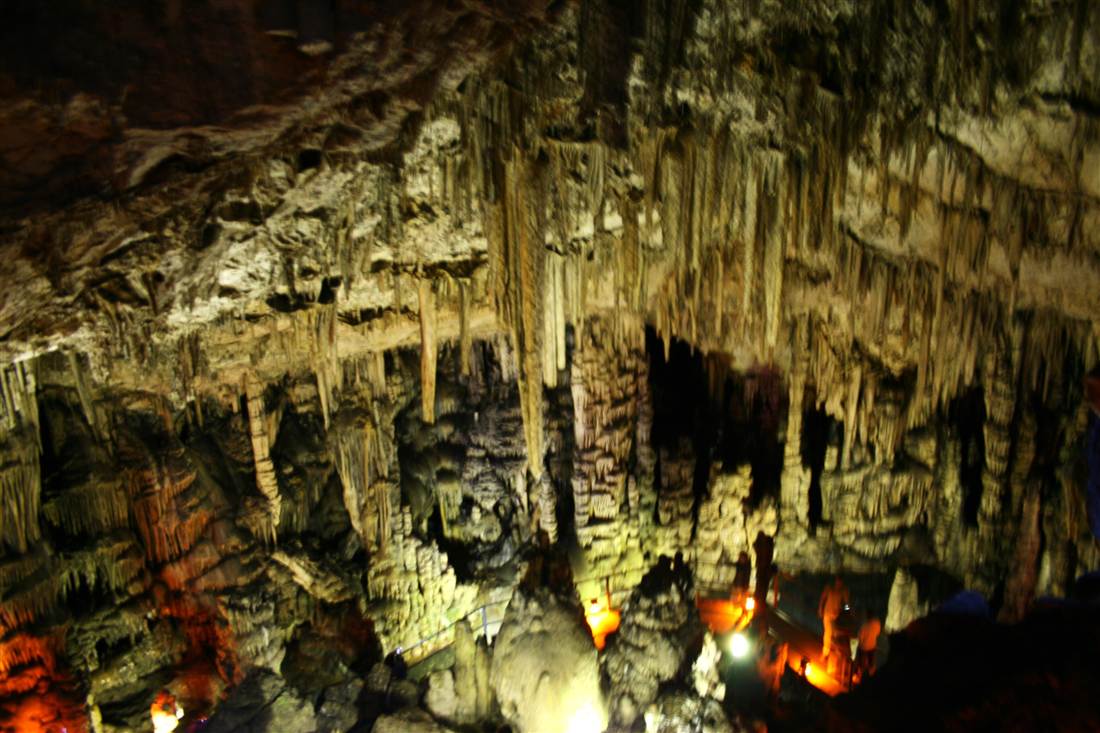
A Crete cave tour is a guided day trip to the show caves of Crete, such as the Cave of Zeus above the Lasithi plateau, the Sfendoni cave at Zoniana and the Melidoni cave, by coach, jeep, quad or private car, with Knossos or an olive mill on the same day. Tours across the rest of the country are listed on Greece Tours.
The sections below cover the caves on the routes, the tour formats, the Cave of Zeus, Knossos combinations, quad and buggy safaris, Sfendoni, Melidoni, Agia Sofia and Elafonisi, the Matala caves, sea caves by boat, what to wear and booking, with links into the Crete pages. The tours shown are checked on GetYourGuide and Viator.
What is a Crete cave tour?
A Crete cave tour is a guided day or half-day trip to one or more of the island’s show caves, with transport and set stops included. The Dikteon cave above Psychro and the Sfendoni cave at Zoniana sit on the main routes.
Cave days run from the north coast resorts and from Heraklion, Chania, Rethymno, Malia and Elounda. A coach, a jeep, a quad or a buggy carries the group to a cave mouth, a guide explains the route, and the driver waits. Durations run from four hours to eleven hours. The ticket for the cave itself is bought at the gate.
Crete holds more than 3,000 caves, and seven of them take regular visitors: the Dikteon cave at Psychro, the Idaean cave on Psiloritis, the Sfendoni cave at Zoniana, the Melidoni cave, the Agia Sofia cave at Topolia, the Milatos cave and the Matala caves. A Crete cave tour chooses one, two or three of them, and the hours between are spent on mountain roads.
The start point decides the route. A Crete cave tour from Chania turns south to the Topolia gorge and the Agia Sofia cave. One from Heraklion climbs to the Lasithi plateau above the village of Psychro. One from Agios Nikolaos follows the coast of Mirabello Bay. One from Rethymno heads inland along the Amari road towards Melidoni.
Group sizes range from six guests in a four-wheel-drive van to eighty on a coach. Departure times fall between 07:30 and 10:00, and return times sit between 15:00 and 20:00. Pick-up is included on nearly every listed departure, either at your hotel or at a meeting point a short walk away.
Which caves does a Crete cave tour visit?
A Crete cave tour reaches the Dikteon cave at Psychro on the Lasithi plateau, the Idaean cave on Psiloritis, the Sfendoni cave at Zoniana, the Melidoni cave, the Agia Sofia cave at Topolia, the Milatos cave and the Matala caves.
Each cave sits in a different part of the island, so one day covers one or two of them. The Dikteon and the Idaean caves fill the eastern and central mountains. The Sfendoni cave and the Melidoni cave belong to the Rethymno region. The Agia Sofia cave guards the western gorge road to Elafonisi. The Milatos cave lies close to the sea in the east.
Travel times matter as much as the caves. Psychro sits about an hour from Hersonissos by coach. Zoniana stands 43 kilometres from Heraklion. Melidoni village is 2 kilometres from its cave. Topolia lies 47 kilometres southwest of Chania, and Matala village sits 75 kilometres southwest of Heraklion. A Crete cave tour builds the day around those drives.
- The Dikteon cave at Psychro: a 15-minute walk up from the ticket booth, then 200 steps down and 200 steps back up inside.
- The Idaean cave on the Nida plateau: 1,538 metres up on a paved road, 24 kilometres from Anogia, with three rooms and a carved altar 70 metres from the entrance.
- The Sfendoni cave at Zoniana: 650 metres up, 1 kilometre northeast of the village, with 3,500 square metres of chambers.
- The Melidoni cave: 220 metres up on the southern slope of Mount Kouloukonas, 2 kilometres from Melidoni village.
- The Agia Sofia cave: 285 metres up above the Topolia gorge, with a cupola 20 metres high and 70 metres across.
- The Milatos cave: 155 metres up, 3 kilometres northeast of Milatos, with eight entrances along a 40-metre rock face.
- The Matala caves: cut into the cliff above Matala bay, 75 kilometres southwest of Heraklion.
The Idaean cave near the Nida plateau and the Dikteon cave share the same story of the infant Zeus, and a long day in the centre of the island can touch both. A Crete cave tour that sells itself on the Cave of Zeus points at Psychro, because that site holds the walkways and the lighting that suit a coach group.
Which Crete cave tour formats can you book?
A Crete cave tour comes in six bookable shapes: a Lasithi plateau and Cave of Zeus coach day, a Knossos combination, a quad or buggy safari, an Elafonisi and Agia Sofia day, a Matala day, and a private tour.
The Lasithi coach day runs 7 hours from Hersonissos and Malia, with a live guide in English, French and German. A longer version from Heraklion runs 10 to 11 hours and adds the Vidiani monastery, the Lasinthos Eco Park and the village of Krasi. The Knossos combination runs 8 to 10 hours in a private vehicle and pairs the palace with the cave in one loop.
Off-road formats are shorter and louder. A quad safari lasts 4 hours, from 10:00 to 14:00, and a buggy safari lasts 5 hours from a 09:30 start. Both use a cave stop of 15 to 30 minutes rather than a full cave walk. A private Crete cave tour in a Mercedes Viano or an SUV from Elounda takes 7 to 8 hours and sets its own pace.
- Lasithi plateau and Cave of Zeus coach tour: 7 hours, up to a full coach, guide and hotel pick-up included.
- Knossos plus Cave of Zeus private day: 8 to 10 hours, VIP vehicle, honey and raki tasting included.
- Small-group four-wheel-drive day: 8 hours, up to 15 travellers, lunch with wine and water included.
- Quad safari with a cave stop: 4 hours, morning or sunset departure, licence required to drive.
- Buggy safari with Milatos cave: 5 hours, maximum of 12 travellers, lunch and a beach swim included.
- West Crete beach day with the Agia Sofia cave: 10 hours from Chania, with 4 hours on Elafonisi beach.
Elafonisi and Matala days trade the mountain for the coast. The Matala departure runs 8 to 9 hours from Heraklion and carries up to 80 travellers, with a guided walk at Gortys and 4 hours of free time in the village. A private Crete cave tour suits families who want to skip the coach and set their own stops.

What does a Crete cave tour to the Cave of Zeus on the Lasithi plateau include?
A Crete cave tour to the Cave of Zeus includes the coach drive up to the Lasithi plateau, the walk into the Dikteon cave, and stops at a monastery, the plateau windmills and an olive oil mill.
The 7-hour version of this Crete cave tour starts at the Panagia Kera monastery, a nunnery with 14th-century frescoes, and then crosses the plateau past the white-sailed windmills that once pumped water for the fields. The group stops at Psychro village for a family-run ceramic workshop, and then climbs to the cave itself. A viewpoint at Seli looks back over the whole plain.
The walk from the ticket booth to the cave mouth takes about 15 minutes. Inside, the marked route drops 200 steps and climbs the same 200 back. Opening hours end in the mid-afternoon, near 15:30, and the site shuts on days of high wind. When that happens, operators move the group to the village of Krasi instead.
The longer 10 to 11 hour departure from Heraklion adds the Vidiani monastery, the Lasinthos Eco Park and 25 minutes in Krasi. It ends with 1 hour 40 minutes at a family olive mill and farm, where the group watches the press and tastes the oil and soap made from the crop. Lunch at the mill is optional and paid on the spot.
The 7-hour version carries a live guide in English, French and German, and pick-up happens at your hotel. Read the full story of the Dikteon cave at Psychro and the villages of the Lasithi plateau before you pick a departure on a Crete cave tour, because the walk, the windmills and the monastery stops differ between operators.

How does a Crete cave tour combine Knossos with the Cave of Zeus?
A Crete cave tour combines Knossos with the Cave of Zeus by driving from the palace to the plateau in one loop, as a private vehicle day of 8 to 10 hours, with both entrance tickets paid at the gates.
The loop leaves Heraklion early and turns first to the mountain villages. Mochos comes first, a hill village with narrow lanes. Then Krasi, where a plane tree said to be 2,400 years old shades the square and a spring feeds the taps. The line of windmills at the entrance to the Lasithi plateau follows, with a 10-minute photo stop.
The cave slot lasts about an hour. The group walks up the paved path and down into the chambers, and the guide explains the Minoan offerings found there. Then the vehicle drops to Knossos, where the slot lasts an hour and a half among the palace courts, the storerooms and the reconstructed frescoes.
A private vehicle keeps water, a small fridge and a first-aid kit on board, and the fare includes honey and raki tasting. The Knossos palace ticket and the cave ticket are not part of the fare, and a licensed guide inside the sites costs extra. An optional hour at the Heraklion Archaeological Museum fits at the end.
A longer private Crete cave tour from Elounda follows the same idea through the Minoan mountain route, with holy monasteries and working olive presses on the way. The shape suits visitors who want the archaeology, the cave and the mountain landscape in a single day, without a coach timetable, in one booking of 7 to 8 hours.


What does a quad or buggy safari Crete cave tour include?
A quad or buggy safari Crete cave tour includes a guided off-road drive, safety gear and instruction, a cave stop, an olive mill visit and a swim, and it runs 4 to 5 hours with hotel transfers.
The quad day starts at 10:00 and lasts 4 hours. Riders follow the coast at Hersonissos and Anissaras, turn inland to Skotino cave for a 15-minute stop among its stalactites, and pause at a viewpoint that looks across to Dia island. A traditional mill and rakokazano follows, with a tasting of olive oil and light snacks.
The buggy day starts at 09:30 and lasts 5 hours. It leaves from Malia, rolls past the ruins of the Minoa palace, and works through gorges and the villages of Sissi and Milatos. The cave stop at Milatos cave takes in the small chapel and the memorial inside the first hall. Lunch in Latsida comes next, and then the olive factory.
- Guided instruction, helmets, hairnets, fuel, insurance and a safety briefing.
- A cave visit of 15 to 30 minutes, with a torch useful for the darker corners.
- An olive oil mill and distillery with a tasting of oil, raki and light snacks.
- A beach or river-mouth swim of up to an hour at the end of the ride.
- Free pick-up and drop-off from Hersonissos, Gouves, Analipsi and nearby resorts.
- A valid car licence and photo ID for every driver, and a maximum group of 12 to 16 riders.
Children ride as passengers but do not drive on a Crete cave tour by buggy, and the operator sets a height and weight limit for the carrier. Compare the two formats on the Crete ATV quad tour page and the Crete jeep safari page, since a day on four wheels spends less time underground than a coach day.

Which Crete cave tour visits the Sfendoni cave near Zoniana?
A Crete cave tour that visits the Sfendoni cave near Zoniana runs as a jeep safari from Malia or Hersonissos in central Crete, lasts about 8 hours, and includes the guided walk through the lit chambers.
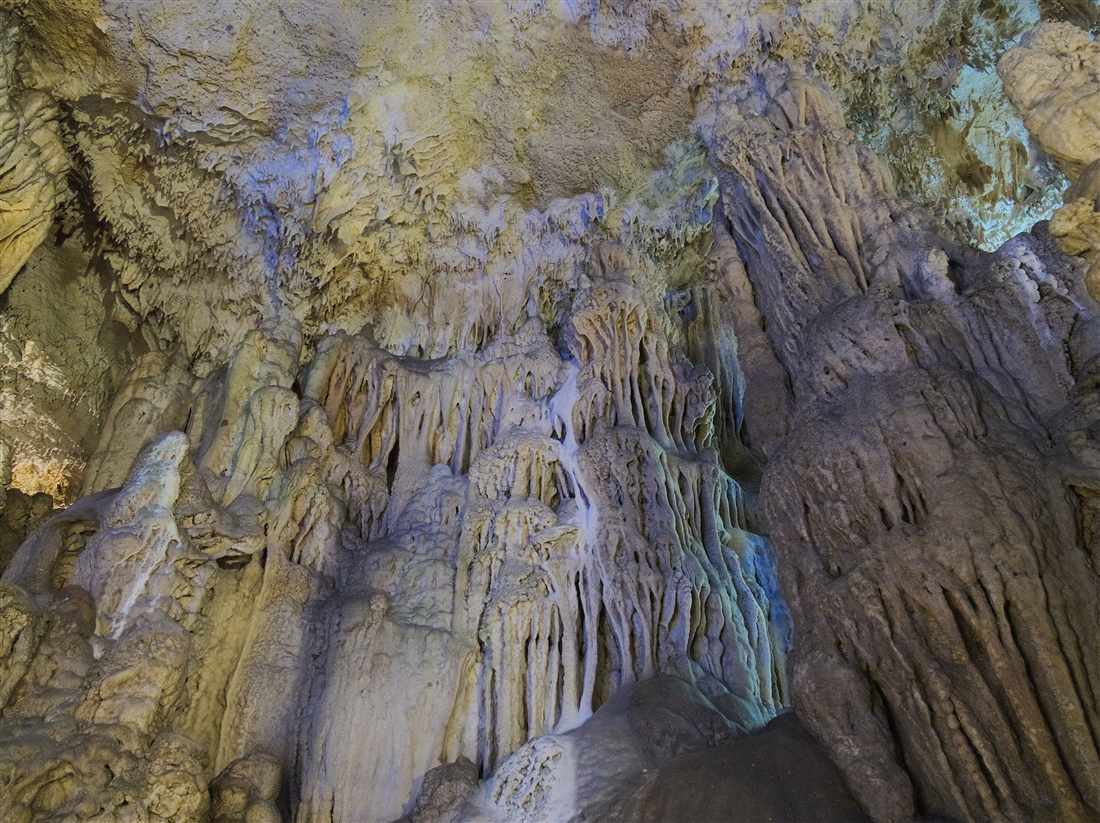
The cave sits 1 kilometre northeast of Zoniana and 43 kilometres from Heraklion, at 650 metres up on the flank of the Psiloritis range. It is the largest accessible cave on Crete, with 3,500 square metres of chambers and a 270-metre steel walkway that lets visitors see about two-thirds of the interior without leaving the path.
Entry happens only with a guide, and the tour takes about half an hour. The temperature holds at 16 to 17 degrees all year. The route passes the first hall with its fanciful name, the “Palace” room with its waterfall shapes, and the “Parthenon” room with its columns at the far end. Guides tell the village legends as the group walks.
- Opening hours: daily from 15 April to 31 October, 10:00 to 17:00.
- Winter visits: Sundays only, 10:00 to 14:30.
- Setting: inside the Psiloritis Natural Park, under the auspices of UNESCO.
- Visitors each year: between 70,000 and 80,000.
- Access: the walkway with hand ropes suits visitors with reduced mobility.
The cave was once used by villagers to mature cheese, and the constant cool air kept it fresh. Coaches cannot reach the mouth, so drivers park below and the group walks the last part. A Crete cave tour that pairs Zoniana with Anogia or the Nida plateau fills a full day in the centre of the island.

What does a Crete cave tour to the Melidoni cave show?
A Crete cave tour to the Melidoni cave shows a lit limestone hall over 60 metres long and over 20 metres high, with named chambers, dripstone columns, a small ossuary and a walk of about 20 minutes.
The cave sits 2 kilometres from Melidoni village, on the southern slope of Mount Kouloukonas, inside the Mylopotamos area. The coach parks on the road and the group walks 200 to 300 metres across a shallow doline about 25 metres wide, formed when part of the roof fell in, and passes under a low natural arch into the first hall. A Crete cave tour from Rethymno reaches it in about half an hour.
That hall, the Room of Heroes, holds the monument and the ossuary of the villagers who died here when the entrance was set on fire during the Cretan struggle against Ottoman rule. Stairs lead down to the floor, and a circular path runs around the chamber. Lighting lifts the columns, the flowstone sheets and the still pools that mirror the roof.
- The Room of Heroes, the entrance hall with the monument and the ossuary.
- Stavrodromi, the crossroads where the route splits.
- The Pashley Room on the right branch, dense with hanging and rising stone.
- The Chamber of Curtains on the left branch.
- The Raulin Room, where excavation work reached layers of the Minoan period.
The cave opens at 09:00 and closes at 19:00, and the whole visit fits into about 20 minutes. Parts of the route close at times for conservation, so ask at the desk which halls are open that day. Visitors who want the full history of the site and its story can read the Melidoni cave page, while a Crete cave tour gives you the drive, the guide and the ticket in one booking.
Which Crete cave tour reaches the Agia Sofia cave and Elafonisi?
A Crete cave tour that reaches the Agia Sofia cave and Elafonisi runs 10 hours from Chania, gives 30 minutes to the cave, four hours on the beach and 45 minutes in the village of Elos.
The coach on this Crete cave tour leaves the Chania area at 08:00 and follows the road south through the Topolia gorge. The cave mouth sits above the roadside just past the tunnel, at 285 metres, and a stepped path climbs from the layby to the entrance. Inside, the central hall forms a cupola 20 metres high and 70 metres across, with stalagmites that reach five and six metres.
A small chapel of Agia Sofia stands inside the cave, and a rock marked with a horseshoe shape carries the legend of Saint George’s horse. Shells from the Neolithic period were found in the floor. Groups spend about 30 minutes here before the drive continues to the coast and the pink sand of Elafonissi, the south-western tip of Crete.
The beach slot lasts four hours, long enough to swim and walk the lagoon. On the way home the coach stops 45 minutes in Elos, a village of stone houses where the fields and the family kitchens still set the rhythm. Breakfast, lunch and drinks stay out of the fare. The vehicle carries a guide, and pick-up happens at or near your hotel.
What are the Matala caves on a Crete cave tour?
The Matala caves on a Crete cave tour are rock-cut chambers in the cliff above Matala bay, seen on an 8 to 9 hour day from Heraklion that gives four hours of free time in the village.
The caves were cut in the Neolithic period, and the bay served as the port of Phaistos in Minoan times. Later it became the port of Gortys, and the chambers were used as tombs and as living space. One of them carries the name Brutospeliana, after a legend that the Roman general Brutus sheltered there.
During the hippie years the caves filled with travellers who lived in them for a season, and songs written about that time keep the story alive. The chambers are fenced now and entry is by ticket, so visitors look from the path above the sand rather than sleeping in them. A Crete cave tour that stops in Matala points them out from that path, and a festival each June remembers the period.
- 08:30 pick-up in the Heraklion area, or 07:30 from Hersonissos and Malia.
- A guided stop at the Gortys archaeological park, once the Roman capital of Crete.
- Four hours of free time in Matala for the beach, the caves and the village lanes.
- 45 minutes at the Odigitria monastery, which asks for modest dress.
- Return to the north coast after roughly 8 to 9 hours.
The day carries up to 80 travellers in an air-conditioned coach with a guide and a driver, and the Matala entrance ticket is bought on the spot. Beach shoes, a hat and water help, and the vehicle is not adapted for wheelchairs. Take the link for the Matala village guide if you want to plan the free hours before the coach arrives.

Which sea caves can a Crete cave tour reach by boat?
A Crete cave tour can reach the Cave of Barbarossa in Mirabello Bay and the Pelekita cave near Kato Zakros by boat, since neither one has a road to its mouth. Both lie off the east coast of Crete.
Boats leave the harbour of Agios Nikolaos on the east coast and cross Mirabello Bay past the cliffs that hold the Cave of Barbarossa, a sea cave tied in local telling to the corsair who sailed these waters. The same cruises carry on to Spinalonga island, and the return leg adds a swim stop in calm water. Departures run in the middle of the day and last half a day.
The Pelekita cave sits 5 kilometres northeast of Kato Zakros in the far east. A boat from the beach at Kato Zakros reaches it in about a quarter of an hour, while walkers on the E4 trail need about an hour over the headland. The mouth is one of the widest on the island, and the cave is listed among the largest on Crete.
Sea caves on a Crete cave tour behave differently from show caves. Swell, wind and season decide whether a boat enters or only passes, and a skipper who cannot land stays further out. Book a boat day as a coast and swimming trip rather than as a scheduled cave visit, and treat the cave mouth as the reward when the water allows.

What do you wear and bring on a Crete cave tour, and is it accessible?
On a Crete cave tour you wear closed shoes with grip and a light jacket, and you bring water, a hat and a torch, because cave paths are damp, stepped and cool even in high summer.
Inside Sfendoni the air holds at 16 to 17 degrees all year, so a thin layer helps after the heat of the road. The climb to the Dikteon cave is steep and slick in places, and trainers or walking shoes beat sandals. The Melidoni path crosses an open doline, and the Milatos route asks visitors to bend at two or three points and rewards a torch for the darker corners.
- Closed, non-slip shoes, since cave floors stay damp.
- A light jacket or fleece for the constant cool air.
- A torch or a charged phone light for unlit corners.
- Water, a hat, sunglasses and sunscreen for the outdoor stops.
- Photo ID for the driver on a quad or buggy day, and for ticket desks.
- Modest dress for the chapels and monasteries on the route.
Access on a Crete cave tour varies by site and by vehicle. The Sfendoni walkway with its hand ropes takes visitors with reduced mobility through two-thirds of the cave. The small-group four-wheel-drive day to Lasithi lists an accessible vehicle, while the Matala coach day does not. Coastal caves reached by boat depend on the swell, and steps lead up to the Agia Sofia cave from the road.
How do you book and cancel a Crete cave tour?
You book a Crete cave tour online in minutes by picking a date, a language and a pick-up point; the ticket sits on your phone, and you cancel with no charge up to 24 hours before the departure.
Confirmation arrives at once, and the exact pick-up time reaches you by message up to 12 hours before the start. Pick-up points range from your hotel door to a meeting spot about five minutes away on foot. A set of departures also lets you reserve a place now and pay later, which suits travellers who are still building an itinerary.
Check the cave calendar as well as the tour calendar before you book a Crete cave tour. The Dikteon cave closes on Tuesdays and shuts on days of high wind, and operators then move the group to another stop or offer a full refund. The Melidoni cave opens from 09:00 to 19:00, and Sfendoni opens daily from 15 April to 31 October and on winter Sundays only.
- Book small-group departures early, since places run to 12 or 15 travellers.
- Enter every traveller’s age, which sets the child rate and the child seat.
- Note any diet or mobility need when you book, not on the day.
- Carry the booking reference on your phone for the driver.
- Check the cancellation window, which runs 24 hours on the listed departures.
Private days set their own hour and route, and families with small children tend to pick them. A Crete cave tour bought through a listing page needs only a name, a hotel and a language, and the cave ticket is then paid at the gate on arrival.
Frequently Asked Questions
How long does a Crete cave tour last?
Durations spread from 4 hours to 11 hours. A quad safari runs 4 hours, a buggy safari 5 hours, the Lasithi coach day 7 hours, the small-group four-wheel-drive day 8 hours, the Matala day 8 to 9 hours, the Elafonisi day 10 hours and the Heraklion to Lasithi coach route 10 to 11 hours. Driving time takes a large share of every one of them.
Do I pay extra for the cave entrance?
Yes, on nearly every departure. Tickets for the Dikteon cave, the Melidoni cave and the Matala caves are bought at the gate, and the Sfendoni cave ticket includes the compulsory guided walk. The Knossos combination adds a palace ticket as well. Tour fares cover the vehicle, the driver and the guide.
Which caves suit families with young children?
The Sfendoni cave works well, because a steel walkway with hand ropes replaces steep steps and the guided tour lasts about half an hour. The Matala day adds four hours of beach time after a short walk past the caves. Buggy and quad rides carry children as passengers, with a parent driving and a licence in hand.
Can I reach the Cave of Zeus without joining a tour?
Yes. The road from the Lasithi plateau village of Psychro ends at a car park below the cave, and the walk up takes about 15 minutes. Two hundred steps lead down and the same number lead back. Hours end in the mid-afternoon near 15:30, and the site closes on Tuesdays and on days of high wind.
When is the quietest time for a Crete cave tour?
Late spring and October bring lighter crowds and cooler roads on a Crete cave tour, and coaches fill fast in July and August. Cave temperatures hold steady through the year, from 16 to 17 degrees at Sfendoni, so the interior feels fresh in any month. Book small-group departures two or three weeks ahead in the high season.