
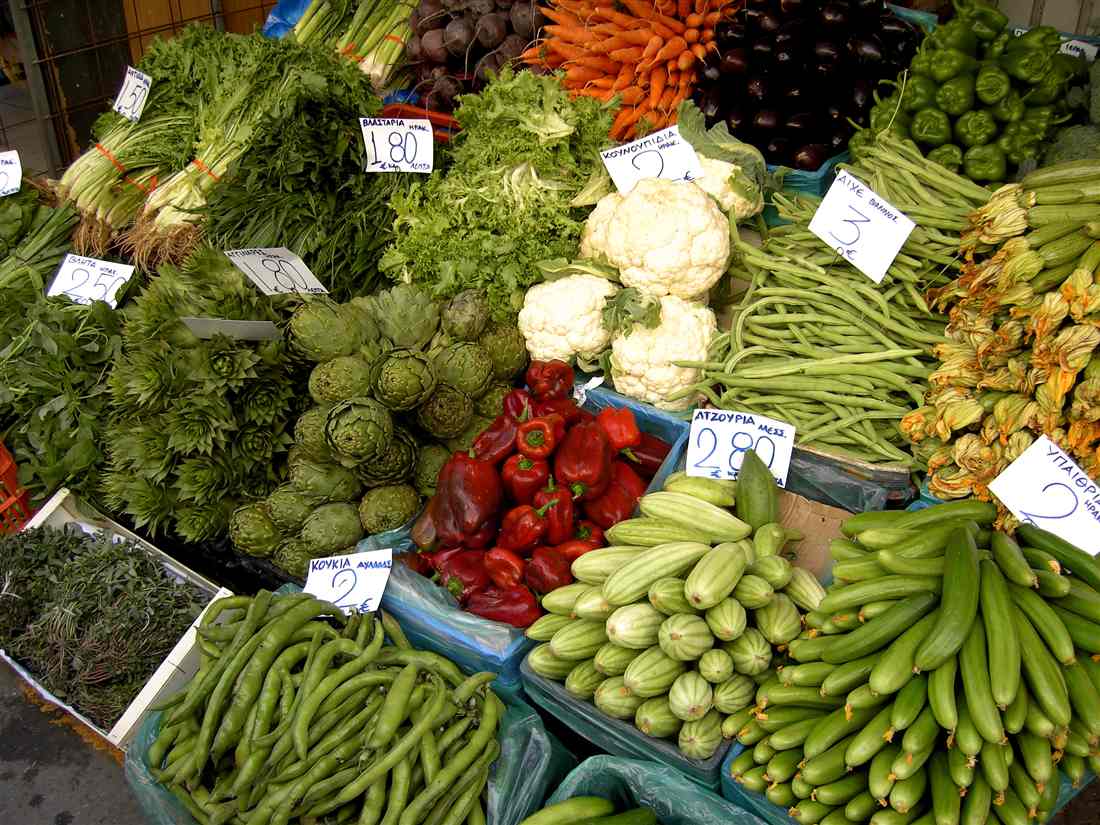
A Heraklion market tour is a guided walk through the central market of Heraklion on 1866 Street, with its stalls of Cretan herbs, cheeses, honey, olive oil and raki, sold alone or with Knossos, the city sights or the CretAquarium. Tours across the rest of the country are listed on Greece Tours.
The sections below cover the formats, the market street, the stalls, the Knossos combinations, the CretAquarium tour, the landmarks on the way, what to buy, opening hours and booking, with links into the Heraklion pages. The tours shown are checked on GetYourGuide and Viator.
What is a Heraklion market tour?
A Heraklion market tour is a guided walk through the city’s central shopping street, Odos 1866, with stops at food shops, stalls and old cafés while a guide explains Cretan produce. A Heraklion market tour takes about one hour inside a longer city day.
The street sits in the middle of Heraklion, between the Meidani quarter and Kornarou Square, and it stays a working shopping street rather than a staged attraction. Shopkeepers serve local families in the morning and visitors later in the day. On a Heraklion market tour the guide takes the group past the butcher, the cheese counter and the herb shelves, then explains what each product is, where in Crete it comes from and how it is eaten at home.
This page is about the street and its food. Knossos, the museums and the harbour belong to the wider city routes, and a separate Heraklion food tour covers seated tastings. When the market itself is the main subject, with time to buy thyme honey or mountain herbs, a Heraklion market tour is the format built for that.
- The central street, Odos 1866, on foot
- A guide who explains produce, seasons and growers
- Time to buy herbs, cheese, honey and raki
- A stop at a kafeneion for coffee or raki
- A walk that joins the market to the squares nearby
Which Heraklion market tour formats can you book?
Four formats carry the market: a city tour with the market and the CretAquarium, a Knossos and Heraklion city tour with the market, a Knossos and market guided tour, and an e-bike food tour. A Heraklion market tour lasts three hours to a full day.
Bus days begin with hotel pickups along the north coast, from Malia and Hersonissos to Ammoudara and Agia Pelagia, and use air-conditioned coaches with a multilingual guide. The city tour with the market and the CretAquarium, one form of Heraklion market tour, runs about six to seven hours and holds three stops: the aquarium at Gournes, the market street, and a guided walk through the centre.
A Knossos and Heraklion city tour with the market lasts six to eight and a half hours, depending on the pickup area. A licensed guide walks the group through the palace, then the coach moves to the centre for a guided walk and about two and a half hours of free time. On the Knossos and market guided tour, eight hours long, the market comes first, at the open-air market in Pateles, and the palace closes the day.
The e-bike food tour is the lightest option: a private ride of three to four hours on electric bikes, helmet included, from a meeting point in the centre. Riders stop for bougatsa at a pastry shop that has served it for a century, for Greek coffee near Georgiadis Park, and for a Cretan meal beside the Historical Museum of Crete.
Where is the Heraklion market, and what is 1866 Street?
The Heraklion market is Odos 1866, a pedestrian shopping street in the centre that runs from the Meidani quarter to Kornarou Square. A Heraklion market tour covers this street on foot, and the name remembers a Cretan uprising against Ottoman rule.
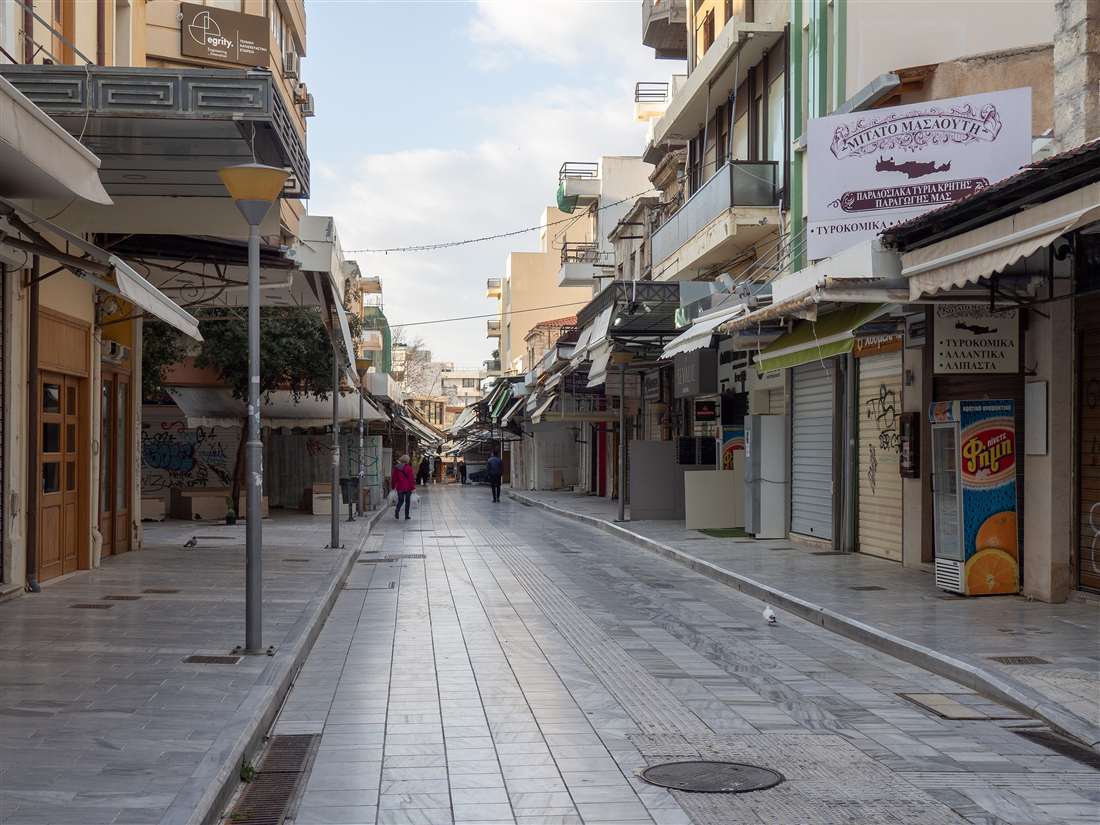
1866 Street is the spine of the old commercial centre, and a Heraklion market tour stays on it from end to end. Side streets cross it to left and right, and they hold more shops, a bank and an indoor car park. Near the top, on Karterou Street, fishmongers lay out the morning catch. At the far end stand the Bembo Fountain, which brought running water to the city under Venetian rule, and the sebil of Haci Ibrahim Agha, an Ottoman charity fountain that shelters a café today.
People have traded on this ground for centuries, and older buildings survive between and inside the shops. The coffee roaster Koudoumas keeps a Venetian archway at its entrance and grinds more than thirty blends each morning. A sixteenth-century church, Agios Onoufrios, sits enclosed by later buildings, and its dome shows from the pavement opposite. A Heraklion market tour guide points out the old signs above the doors, including the butcher Dimitriou, which has traded here for about a century.

What does a Heraklion market tour show at the stalls?
At the stalls a Heraklion market tour shows fresh produce from Messara and nearby villages, mountain herbs, dittany, cheese, cured meat, honey, olive oil, sweets and raki. The guide names each product and explains its season and its village of origin.
Fruit and vegetable shops change with the season on a Heraklion market tour. In summer the crates hold watermelons from Knossos with their long shape, cucumbers from Kalesia, courgettes with the flowers still on, avocados from Chania, lemons, garlic and onions. Herbs hang in bunches or sit in jars: thyme, sage, oregano and dittany, the Cretan herb that locals call erontas and brew as a tea. Cafés along the street pour raki, the pomace spirit that Cretans also call tsikoudia.
Cheese counters carry graviera, a sheep’s milk cheese that ripens for months, anthotyro, myzithra and xigalo with staka from Sitia. One shop sells graviera with holes in it, ripened in caves near the village of Geraki. Another keeps the range from a creamery in the mountain village of Vorizia. Alongside the cheese sit smoked apaki, salted olives and salt flower from southern Crete.
- Fruit and vegetables from Messara, Kalesia and Knossos
- Dittany, thyme, sage and oregano by the bunch
- Graviera, anthotyro, myzithra and xigalo
- Smoked apaki, salted olives and salt flower
- Thyme honey, xerotigana and kalitsounia
- Raki by the glass, or by the bottle to take home
Which Heraklion market tour combines Knossos and the city?
Two products combine the palace and the market: a Knossos and Heraklion city tour with the market, and a Knossos and market guided tour. A Heraklion market tour of this type visits the palace and the market street in about eight hours.
Knossos sits about five kilometres south of the centre, ten to fifteen minutes by road from the market street. The palace was the heart of Minoan Crete, excavated by Arthur Evans, and its rooms and courtyards carry the story of King Minos and the labyrinth. Guides hold a licence for the site, and a group needs one to make sense of the ruins. Entry is not part of the tour fee and is paid at the gate.
After the palace the coach returns to the city for a guided walk along the main streets and free time of roughly two and a half hours. Guests choose between the market, a café and the Heraklion Archaeological Museum, which holds the Minoan finds from Knossos Palace and the sites around it. A Heraklion market tour that ends in the centre leaves the evening free.
What does the Heraklion market tour with the CretAquarium include?
The Heraklion market tour with the CretAquarium adds the aquarium at Gournes to a city day, so the group sees the market street, the centre and the Mediterranean tanks in one trip. Coach travel brings the day to about seven hours.
The CretAquarium stands at Gournes, fifteen kilometres east of Heraklion, on the site of a former air station, and the Hellenic Centre for Marine Research runs it. Sixty-one tanks hold 1.8 million litres of water, and the largest tank holds 600,000 litres. About 2,500 animals from roughly 250 Mediterranean species live there, among them sand tiger sharks, loggerhead sea turtles, octopus, slipper lobsters, moon jellyfish and clownfish.
The itinerary gives the aquarium between one and two hours, then the coach turns back to the city for the market and a guided walk, with a photo stop at Liberty Square and views of the Koules fortress and the Venetian walls. Guides on the day speak English, German and French. A Heraklion market tour with this stop suits families, because the tanks hold attention at the end of a long morning. Aquarium entry stays outside the tour fee.
- Return coach travel with air conditioning
- A professional guide who speaks English, German and French
- Hotel pickup and drop-off on the north coast
- Liability insurance held by the operator
- Free time in the market street and the centre
- Aquarium ticket paid separately

Which Heraklion landmarks does a market tour pass?
A Heraklion market tour passes Lions Square, the church of Agios Titos and the Venetian Loggia, and city routes add the harbour and the walls. A Heraklion market tour guide links each stop to the market street, so the walk stays on one thread.
Lions Square, officially Eleftheriou Venizelou Square, takes its nickname from the Morosini fountain in the middle, where four lions hold up the basin. The fountain dates from the Venetian period, and the square is the meeting point of the centre. Pastry shops serve bougatsa with cream or cheese from early morning, and the café tables fill at midday. A Heraklion market tour that starts here reaches 1866 Street on foot in five minutes.
Agios Titos stands on 25 August Street, two minutes away. The first church on the site followed the Byzantine recovery of Crete, and the building later served as a mosque. The skull of Saint Titus, the first bishop of Crete, returned from Venice in the last century and rests in a silver reliquary. The Loggia, a Palladian building from the seventeenth century, houses the city hall today and won a European award for its restoration. Nearby squares and lanes are covered on the Heraklion walking tour page.

What can you buy on a Heraklion market tour?
On a Heraklion market tour you can buy mountain herbs, dittany, thyme honey, olive oil, graviera and other cheeses, smoked apaki, olives, sweets and raki. A Heraklion market tour guide points out which shops pack goods for flights and which sell by weight.
Herbs travel well, and a bag of dittany or thyme takes little room in a suitcase. Honey comes in glass jars, olive oil in tins or bottles, and cheese counters vacuum-pack graviera and myzithra on request. Sweet shops sell xerotigana, kalitsounia and lychnarakia made by hand, and coffee roasters grind Greek coffee to order. Raki is sold in bottles, and a kafeneion will pour a glass for anyone who wants to sit down first.
Two points of planning help. Shops close for lunch and reopen in the late afternoon, so a morning visit suits anyone with an evening flight. And if you want to cook with what you buy, a Cretan cooking class in the city shows how the ingredients are used. Pages on Cretan olive oil and on Cretan cheese tasting explain the labels and the ageing.
- Mountain herbs and dittany by the bunch
- Thyme honey in glass jars
- Olive oil in tins or bottles
- Graviera, myzithra and anthotyro
- Smoked apaki and salted olives
- Raki, xerotigana and kalitsounia
When is the Heraklion market open, and which hours suit a tour?
Market shops on 1866 Street open from Monday to Saturday in the morning and again in the late afternoon, and they stay closed on Sunday. A Heraklion market tour reaches the street between ten and two, when the food shops are busiest.
The weekly open-air market is a different thing and runs at Pateles, a short drive from the centre, on Thursday and on Saturday. Saturday is the larger of the two days, with stalls until the middle of the afternoon. Growers start early, so the first two hours bring the fullest crates. Nothing opens on Sunday, because Greek law limits street markets to Monday through Saturday.
Coach days collect guests from hotels along the north coast from about eight in the morning, and the market stop inside the itinerary lasts around one hour. Late spring to early autumn brings strong heat at midday, and the market street offers little shade, so a hat and water matter. A Heraklion market tour booked for the morning leaves the afternoon free for the museum or the harbour.
How do you book and cancel a Heraklion market tour?
You book a Heraklion market tour on a booking platform or with the operator, pick a date, a language and a pickup point, then pay online. Free cancellation up to twenty-four hours before the start applies to the leading listings.
Hotel pickup needs your accommodation details at the time of booking. Operators send the exact pickup point and time by email within a day of the reservation, and coaches collect from towns such as Malia, Stalis, Hersonissos, Anissaras, Gouves, Gournes, Karteros, Heraklion, Ammoudara and Agia Pelagia. Arrive five minutes early, because coaches work to a timetable. A Heraklion market tour from a coast hotel adds pickups at both ends of the day.
Before you pay, check four things: the language of the live guide, the pickup area that covers your hotel, which entry fees stay outside the tour fee, and the group size. Aquarium and palace tickets sit outside the fee, and a coach day can carry up to fifty travellers, while the e-bike tour caps at fifteen. Cruise passengers compare timings with the ship’s schedule through a Heraklion shore excursion before booking a coach day.
- Booking date, language and pickup point
- Hotel name and address for the coach
- Entry fees for the aquarium and the palace
- Cancellation window and refund terms
- Return time against a ship or a flight
Frequently Asked Questions
Is the market street open on Sunday?
No. Shops on 1866 Street open from Monday to Saturday, with a break in the middle of the day, and they stay shut on Sunday. The weekly open-air market at Pateles also stops on Sunday, because Greek law allows street markets only from Monday to Saturday. Plan a Heraklion market tour for a weekday or a Saturday instead.
How much walking does a Heraklion market tour involve?
The market street is flat and paved, and a guided walk along its length covers under a kilometre. City routes add a walk through the centre of about the same distance, while Knossos involves more steps and uneven ground. A Heraklion market tour suits anyone who can stay on their feet for an hour, and coaches park close to the street.
Can food from the market be taken home?
Yes. Herbs, honey, olive oil and raki travel well in a suitcase, and cheese counters vacuum-pack graviera, myzithra and anthotyro for the journey. Dittany and dried thyme keep for months in a sealed jar. Ask the shop to wrap glass in paper before a flight, and check the airline rules on liquids in hand luggage.
Which format suits a short stay in Heraklion?
A half-day city tour with the market and the CretAquarium fits a short stay, because it leaves from hotels on the north coast and returns by late afternoon. The e-bike food tour works for a city-centre hotel and three spare hours. A Heraklion market tour of either kind can be paired with the archaeological museum on the same day.